

Could your current shipping strategy withstand the scrutiny of a June 2026 customs audit? With the indefinite suspension of the de minimis exemption and the implementation of a 15% global tariff under Section 122, the margin for error in North American logistics has vanished. We understand that for many Canadian businesses, the fear of cargo being "stuck at the border" isn't just a minor inconvenience; it's a threat to your bottom line and client trust. This guide d'expédition transfrontalière pour PME provides the strategic framework you need to navigate these complexities with quiet confidence.
By visiting www.dubointl.com, you can access the specialized coordination required to maintain predictable transit times despite shifting regulations. You'll master the nine essential data elements of CUSMA certification, learn why commercial carriers now offer a distinct tariff advantage over postal services, and discover how to protect your margins from unexpected penalties. We'll explore the meticulous documentation and strategic foresight necessary to turn a volatile border into a seamless gateway for your growth.
Key Takeaways
- Understand how to navigate the 2026 regulatory landscape, including the critical nuances of CUSMA certification and the essential documents required for seamless border passage.
- Utilize this guide d'expédition transfrontalière pour PME to transform the Canada-US corridor into a stable, predictable engine for your business growth.
- Learn to evaluate the strategic trade-offs between LTL, FTL, and specialized transportation to optimize your logistics budget while maintaining high service standards.
- Identify the essential risk management frameworks and insurance protocols that safeguard your bottom line against the inherent complexities of North American trade.
- Connect with the seasoned logistics architects at www.dubointl.com to secure the end-to-end coordination and specialized consulting your cargo requires.
The Strategic Importance of Cross-Border Shipping for Canadian SMEs
The border is more than a physical line. It's a strategic junction where your business's reputation meets the reality of international trade. For a Canadian SME, effective cross-border freight forwarding acts as a stabilizing force. It transforms a vulnerable supply chain into a resilient asset. The Canada-United States trade relations remain the bedrock of our national economy, making this corridor the most vital route for your company's growth. This guide d'expédition transfrontalière pour PME is designed to help you navigate this path with precision and foresight.
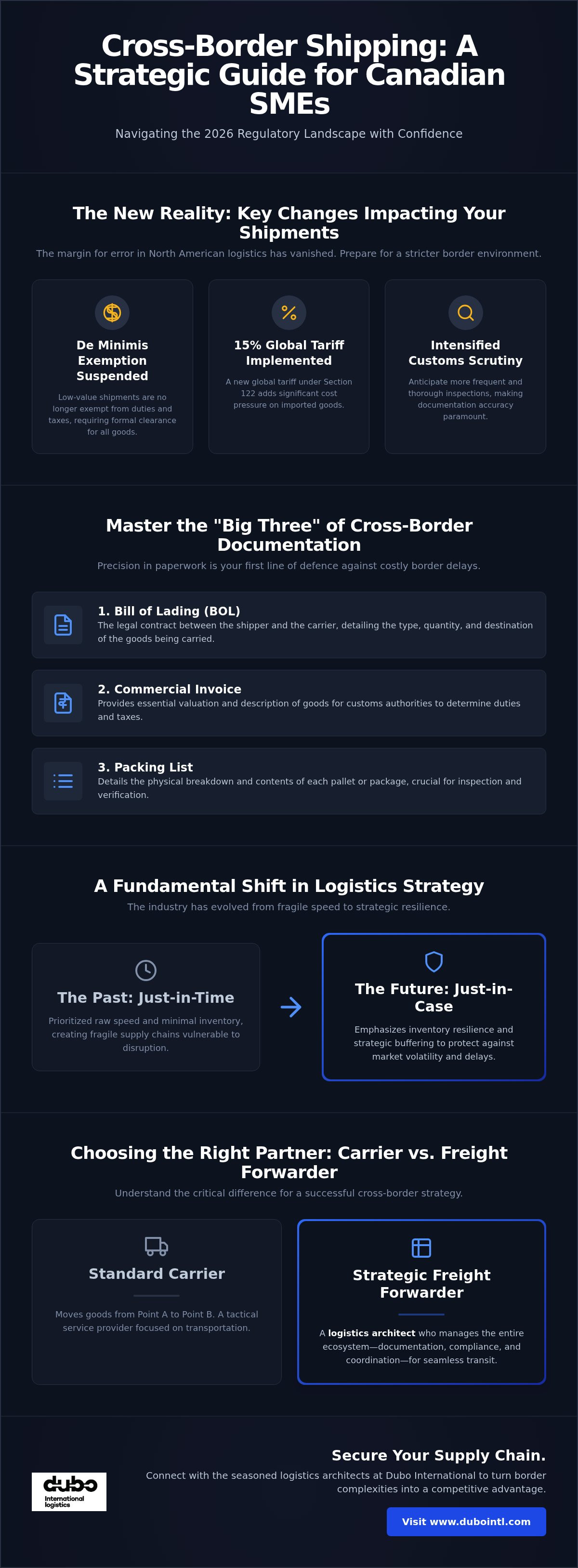
By 2026, the logistics landscape has evolved. The industry has moved away from the fragile "just-in-time" models that once dominated global trade. We've entered the era of "just-in-case" logistics. This shift prioritizes inventory resilience and strategic buffering over raw speed. To succeed in this environment, you need a logistics architect. This is a partner who understands the grand scale of North American movement while remaining focused on the minute details of your specific needs. They design frameworks that protect your cargo from the friction of modern trade.
Why SMEs Must Prioritize Logistics Resilience
Market volatility can disrupt even the most established trade routes without warning. When a shipment is delayed at the border, it isn't just the cargo that's at risk. It's your relationship with your American clients. Reliability is a premium currency in global commerce. Professional freight management protects your brand by ensuring that your promises are kept, regardless of external pressures. Achieving this peace of mind allows you to operate with a quiet confidence that your competitors may lack.
The Role of Professional Freight Forwarders
There's a fundamental difference between a simple carrier and a strategic freight forwarder. A carrier moves goods from one point to another. A forwarder manages the entire ecosystem surrounding that movement. Working with CIFFA certified freight forwarders ensures that your logistics strategy is anchored by professional standards and ethical practices. By outsourcing complex coordination to the seasoned experts at www.dubointl.com, you regain the ability to focus on your core products. You leave the intricacies of specialized transportation and regulatory integration to those who treat logistics as a craft.
Essential Documentation and Regulatory Compliance for North American Trade
Precision is the primary requirement for a successful border crossing. In the complex world of North American trade, your documentation acts as the voice of your cargo before it even reaches the inspector. To maintain a smooth flow, SMEs must master the "Big Three" of cross-border paperwork. The Bill of Lading serves as your contract of carriage, while the Commercial Invoice provides the essential valuation and description of goods. Completing the trio is the Packing List, which details the physical breakdown of every pallet. This guide d'expédition transfrontalière pour PME emphasizes that even a minor discrepancy between these documents can trigger a full inspection, leading to costly delays and storage fees.
Accuracy begins with the Harmonized Tariff Schedule (HTS) codes. These ten-digit numbers determine the duty rates and regulatory requirements for your products. Since the indefinite suspension of the de minimis exemption in June 2026, all shipments entering the United States are subject to intense scrutiny regardless of value. Every item requires a precise HTS classification to ensure you aren't overpaying duties or under-reporting them. For a deeper understanding of these nuances, you might consult U.S. export documentation requirements to see how authorities view the entry process from the other side of the line.
Navigating CUSMA and Trade Agreements
The Canada-United States-Mexico Agreement (CUSMA) remains a powerful tool for Canadian SMEs to realize significant tax advantages. However, claiming duty-free status isn't an automatic right. You must provide a certification of origin containing nine specific data elements, including the importer's details and specific origin criteria. There's no longer a prescribed government form; the certification can live directly on your commercial invoice or a separate document. Understanding these "rules of origin" ensures your goods qualify for preferential treatment, protecting your margins from the 15% global tariffs currently in place for non-compliant shipments.
The Consequences of Non-Compliance
The risks of an audit by the CBSA or CBP are real for businesses of all sizes. Incorrect CUSMA claims or vague cargo descriptions can lead to back duties, penalties, and even seizures. Utilizing professional cross-border freight forwarding acts as a compliance shield, positioning a seasoned expert between your business and the complexities of customs law. If you're unsure about your current documentation workflow, the consultants at www.dubointl.com can help you architect a more resilient process that ensures your growth isn't stalled by administrative errors.
Selecting Optimal Transport Modes for Specialized and Standard Freight
Choosing the right mode of transport is a strategic decision that impacts both your balance sheet and your delivery promise. It's not merely about finding the lowest price; it's about matching the vehicle and the route to the specific value and urgency of your cargo. This guide d'expédition transfrontalière pour PME helps you evaluate these trade-offs with the precision of a logistics architect. For many Canadian businesses, Less-than-Truckload (LTL) shipping offers a cost-effective entry point, allowing you to share trailer space and costs with other shippers. However, when your volume increases or your deadlines tighten, Full Truckload (FTL) becomes the superior choice, offering dedicated routes and significantly reduced handling.
Long-haul efficiency often requires a more integrated approach. Intermodal solutions, which combine the cost-effectiveness of rail with the flexibility of road transport, can provide a sustainable and predictable alternative for non-urgent shipments travelling across the continent. Regardless of the mode, organizing your freight based on sensitivity and urgency is essential. You must weigh the speed of transit against the budgetary constraints of your project. To better understand the regulatory framework governing these movements, you can consult the official Canadian import guide, which details the requirements for goods entering the country.
Handling Specialized and Oversized Cargo
Specialized cargo requires a level of coordination that standard freight simply doesn't demand. In the North American market, this category includes everything from heavy industrial machinery to sensitive medical equipment that requires climate control. These shipments often involve oversized dimensions or fragile components that won't fit into a standard dry van. Managing these moves requires bespoke solutions, including specialized trailers, rigging services, and meticulous permit coordination. Relying on "off-the-shelf" shipping methods for such high-value assets often leads to avoidable damage or border delays.
Optimizing for Cost and Seamlessness
Strategic logistics consulting allows SMEs to look beyond the immediate shipment and identify long-term efficiencies. By analyzing your shipping patterns, you can determine when to prioritize speed and when to leverage slower, more economical routes. Implementing end-to-end freight management ensures that every stage of the journey is synchronized, from the initial pickup point within Canada to the final delivery in the United States. The experts at Dubo International Logistics (www.dubointl.com) specialize in creating these seamless transitions, ensuring your cargo moves without friction through even the most complex corridors.
Mitigating Risks in Cross-Border Logistics
"Is it worth the cost to hire a pro?" This is the most common question we hear from SMEs. The answer lies not in the immediate expense, but in the high cost of failure. A single shipment seized or a 15% tariff penalty due to a documentation error can erase months of profit. This guide d'expédition transfrontalière pour PME views risk management as a foundational investment rather than an optional add-on. Comprehensive cargo insurance and proactive risk mitigation protect your bottom line from the inherent unpredictability of international movement.
Modern supply chains require more than just movement; they demand visibility. Technology now allows for real-time tracking and data integration, providing the transparency needed to manage your clients' expectations effectively. When evaluating the reliability of a freight partner, consider these three pillars:
- Regulatory Expertise: Do they possess a deep understanding of current CUSMA requirements and HTS classifications?
- Technological Transparency: Can they provide real-time visibility into the status and location of your cargo?
- Specialized Experience: Have they successfully managed shipments similar to yours in terms of scale, sensitivity, and destination?
A reliable partner acts as a steward of your interests. They ensure that every pallet is accounted for and every regulation is met with precision.
Strategic Risk Assessment
Identifying vulnerabilities in your current supply chain is the first step toward long-term stability. You must look beyond the standard route and consider how your business would react to border closures, labour strikes, or extreme weather events. Contingency planning is the hallmark of a mature logistics strategy. Logistics resilience is the ability to maintain flow despite external disruptions. By anticipating these challenges, you move from a reactive stance to one of strategic foresight.
The Value of Logistics Consulting
Professional supply chain optimization consulting identifies hidden costs that often go unnoticed by in-house teams. These might include inefficient routing, improper HTS classification, or underutilized cargo space. A professional partner realizes efficiencies by viewing your logistics as a cohesive system rather than a series of isolated shipments. This partnership approach ensures that your long-term planning is anchored by expertise and a deep understanding of global trade dynamics. If you're ready to secure your supply chain against the complexities of the North American corridor, contact the seasoned experts at www.dubointl.com to begin your strategic risk assessment.
Strategic Partnership: How Dubo International Logistics Streamlines Your Growth
Navigating the North American corridor requires more than a simple carrier; it demands a partner who acts as a protective steward of your business interests. Dubo International Logistics positions itself as the premier logistics architect for Canadian SMEs. We don't just move cargo; we design the frameworks that allow your business to expand across borders with quiet confidence. This guide d'expédition transfrontalière pour PME has outlined the technical hurdles of the Canada-US border, but the final piece of the puzzle is professional execution. By visiting www.dubointl.com, you gain access to a team that prioritizes regulatory excellence and end-to-end coordination.
A bespoke approach to freight management is essential for businesses that outgrow standard shipping models. We understand that your supply chain is a unique ecosystem with its own set of pressures and opportunities. Our commitment to dependability means we take the time to understand the minute details of your operation, ensuring our logistics consulting and freight forwarding services align perfectly with your growth targets. This strategic alignment transforms your logistics from a cost centre into a stabilizing force that supports long-term national and international growth.
Precision and Integration in Every Shipment
Our team utilizes a meticulous process of cargo coordination that leaves nothing to chance. We realize that the smoothness of a shipment depends on the integration of strategic consulting and physical transportation. Every pallet we manage is backed by a methodology designed to minimize friction at the border. By handling the complex administrative and physical requirements of your cargo, we lower your operational stress. You can trust that your interests are being guarded by seasoned experts who value longevity and consistency over short-term shortcuts. This level of professional care ensures your reputation with American clients remains untarnished.
Your Gateway to North American Markets
Specialized transportation projects often involve cargo that others find difficult or "non-standard." Whether you're moving sensitive industrial equipment or oversized components, our team possesses the strategic foresight to manage these movements seamlessly. We invite you to experience a professional register of service that prioritizes your peace of mind and the safety of your assets. Our role is to act as a sophisticated bridge between your local operations and the complex international systems that define modern trade. Don't let regulatory complexity stall your momentum. Contact Dubo International Logistics to optimize your cross-border strategy and secure your place in the competitive North American market.
Securing Your Future in the North American Corridor
Cross-border trade is a journey of precision where the details determine your success. This guide d'expédition transfrontalière pour PME has highlighted that success isn't found in shortcuts but in the meticulous integration of regulatory compliance and strategic transport modes. You've seen how mastering CUSMA documentation and selecting the right vehicle can protect your margins from unexpected tariffs. By prioritizing logistics resilience, you ensure that your business remains a reliable partner for your clients in the United States.
As a proud member of the Canadian International Freight Forwarders Association (CIFFA), Dubo International Logistics provides the seasoned authority your supply chain deserves. We specialize in specialized transportation and project cargo, offering the strategic consulting required to optimize every route. Our role is to act as your dedicated logistics architect, ensuring that your growth is never stalled by border complexity. We invite you to partner with Dubo International Logistics for seamless cross-border success. Your expansion into North American markets is a significant milestone, and we're here to ensure it's a smooth and predictable one.
Frequently Asked Questions
What is the most common reason for cross-border shipping delays for SMEs?
Discrepancies in documentation remain the primary cause of border friction. When the Commercial Invoice doesn't match the Packing List or Bill of Lading, customs agents are likely to flag the shipment for physical inspection. These administrative errors often lead to storage fees and missed delivery windows, which is why this guide d'expédition transfrontalière pour PME emphasizes meticulous record-keeping during the preparation stage.
How does CUSMA (USMCA) affect my shipping costs in 2026?
Proper CUSMA compliance is now the only way to avoid the 15% global tariff imposed under Section 122 as of early 2026. While eligible goods remain duty-free, the indefinite suspension of the de minimis rule means every shipment requires formal entry and precise certification. Failing to provide the nine essential data elements on your origin statement can lead to significant back duties and penalties that inflate your total landed cost.
Can a freight forwarder help with customs brokerage if they don't provide it in-house?
Yes, a strategic freight forwarder acts as a coordinator between your business and a licensed customs broker. While Dubo International Logistics doesn't sell customs brokerage directly, we manage the integration of these services to ensure your documentation flows seamlessly. This coordination prevents the communication gaps that often occur when an SME tries to manage multiple vendors independently, providing a more cohesive experience.
What is the difference between LTL and FTL for cross-border freight?
The primary difference lies in trailer utilization and transit speed. Less-than-Truckload (LTL) allows you to share space and costs with other shippers, which is ideal for smaller volumes that don't require a whole trailer. Full Truckload (FTL) provides a dedicated trailer for your cargo, resulting in faster transit times and reduced handling since the truck moves directly from your facility to the final destination.
Is cargo insurance necessary for every cross-border shipment?
We strongly recommend cargo insurance because carrier liability is often limited to a specific dollar amount per pound. This standard coverage rarely reflects the full value of specialized equipment or high-value project cargo. Purchasing comprehensive insurance protects your SME's bottom line against theft, damage, or loss during the complex transit through North American corridors, ensuring a single incident doesn't cause a major financial setback.
How do I determine the correct HTS code for my products?
You can determine the correct code by consulting the Canada Border Services Agency (CBSA) Customs Tariff or the U.S. International Trade Commission's HTS database. It's essential to classify your goods based on their material composition and intended use. If you're unsure about the classification of complex items, the consulting team at www.dubointl.com can provide guidance to ensure your classifications meet current regulatory standards.
What are the benefits of hiring a CIFFA certified freight forwarder?
Hiring a CIFFA certified partner ensures your logistics strategy is managed by a professional who adheres to strict ethical codes and industry standards. This certification serves as a mark of reliability and expertise in the Canadian market. It provides SMEs with the peace of mind that their shipments are being handled by a qualified expert who is committed to the highest levels of professional integrity.
How can I reduce my overall logistics costs when shipping to the USA?
Reducing costs requires a shift from reactive shipping to strategic supply chain optimization. Consolidating multiple LTL shipments into a single FTL move or choosing commercial carriers over postal services for CUSMA-compliant goods can yield significant savings. This guide d'expédition transfrontalière pour PME suggests that regular logistics consulting is the most effective way to identify and eliminate hidden inefficiencies in your distribution network.

