
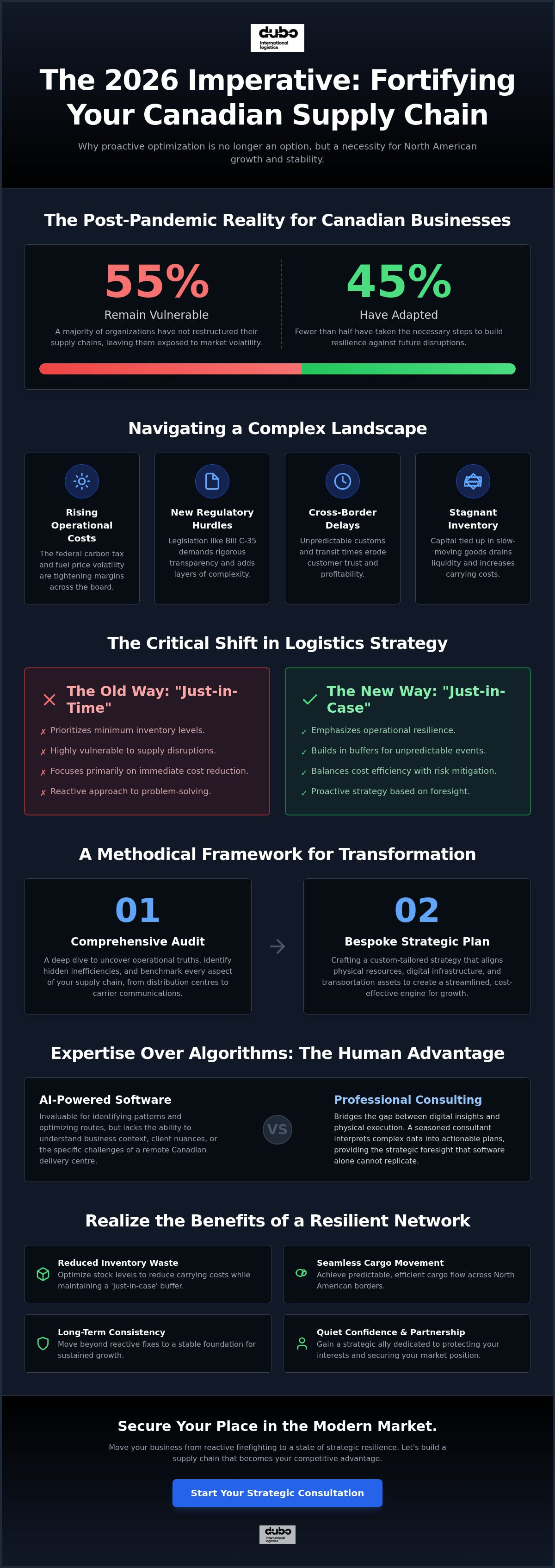
Only 45% of Canadian organizations have restructured their procurement and supply chains since the pandemic, leaving a majority of businesses vulnerable to the volatility of 2026. You likely feel the weight of unpredictable cross-border delays and the rising operational costs that tighten your margins. Between new regulatory hurdles like Bill C-35 and the increasing pressure of the federal carbon tax, the need for a stabilizing force is clear. Professional supply chain optimization consulting provides that anchor, moving your business away from reactive firefighting and toward a state of quiet confidence and partnership.
This article details how strategic foresight transforms fragmented logistics into a streamlined, cost-effective engine for North American growth. We'll examine a framework designed to help you realize reduced inventory waste and achieve seamless cargo movement across borders. By integrating specialized transportation services with methodical logistics consulting, you can build a resilient network that survives global disruptions. Discover how a commitment to precision and dependable methodology can protect your interests and secure your place in the modern market. It's time to move beyond temporary fixes and establish a foundation for long-term consistency.
Key Takeaways
- Understand the necessary transition from "just-in-time" models to "just-in-case" resilience to safeguard your operations against unpredictable global disruptions.
- Learn how to organize your distribution centres for maximum geographic efficiency while reducing the carrying costs of stagnant inventory.
- Identify the specific red flags, such as rising costs and missed customer agreements, that signal your business is ready for professional supply chain optimization consulting.
- Discover a methodical two-step framework that begins with a comprehensive audit to uncover operational truths before crafting a bespoke strategy.
- Realize the long-term benefits of bridging the gap between strategic foresight and the physical execution of specialized transportation services.
Defining Supply Chain Optimization Consulting for the 2026 Landscape
Strategic supply chain optimization is far more than a simple exercise in cost reduction. It represents the precise alignment of your physical resources, digital infrastructure, and transportation assets to maximize value across every mile. In the current Canadian market, where the federal carbon tax adds roughly seven cents per litre to gasoline and Bill C-35 demands rigorous transparency, the old models of efficiency are no longer sufficient. Supply chain optimization consulting provides the steady authority needed to navigate these complexities, ensuring your network remains a source of strength rather than a liability.
We've seen a fundamental shift from the "just-in-time" inventory models of the past toward "just-in-case" resilience. This transition isn't a one-time project; it's a continuous process of refinement that requires constant vigilance. A consultant acts as an objective steward of your logistics interests, identifying where your capital is tied up in stagnant inventory or where fragmented carrier communication is eroding your bottom line. They bring a level of strategic foresight that allows you to anticipate disruptions before they impact your customers.
The Evolution of Logistics Strategy in Canada
By June 2026, standard freight movement has become a baseline requirement, not a competitive advantage. Success now requires a sophisticated North American perspective that accounts for new interprovincial trucking agreements and shifting global trade routes. Realizing true value means moving beyond simple expense management to active risk mitigation. It's about building a network that can absorb shocks, whether they stem from geopolitical shifts or domestic regulatory changes. This integrated approach ensures that your cargo moves seamlessly across borders without the friction of unpredictable delays.
Consulting vs. Software: Why Human Expertise Still Rules
While AI-powered demand forecasting and route optimization tools are invaluable, algorithms lack the ability to understand the unique context of your specific business. They can identify patterns, but they can't realize the nuances of a sensitive client relationship or the specific challenges of a remote Canadian delivery centre. Supply chain optimization consulting is necessary to interpret complex data into actionable plans. A seasoned consultant bridges the gap between digital insights and physical execution, providing the industry foresight that software alone cannot replicate. You need a partner who understands the grand scale of movement while focusing on the minute details of your individual needs.
The Core Pillars of a Resilient Supply Chain Strategy
A resilient strategy isn't built on luck; it's constructed on a foundation of structural stability. To move beyond the vulnerabilities exposed in recent years, businesses must anchor their operations in a few core pillars that prioritize longevity. Through professional supply chain optimization consulting, you can identify the key features of effective supply chain optimization that apply specifically to your unique cargo requirements. This process ensures that every decision, from hub placement to carrier selection, serves a broader strategic purpose.
The first pillar involves a rigorous look at inventory optimization. Stagnant goods represent more than just physical clutter; they are a drain on your liquidity. By reducing the carrying cost of slow-moving items, you free up capital that can be better used to navigate the 2026 market. This lean approach must be balanced with the "just-in-case" resilience we discussed earlier, ensuring you have the right buffer without the waste. When these inventory strategies are integrated with specialized transportation services, your business gains the ability to handle non-standard or sensitive cargo with the same precision as your high-volume lanes.
Network and Distribution Centre Architecture
Geographic efficiency is the heartbeat of a successful Canadian operation. Placing your distribution centres strategically is essential to minimize transit times across our vast distances. You must carefully analyze the trade-offs between a centralized model and a decentralized warehousing approach. With the new Memorandum of Understanding on interprovincial trucking signed in June 2026, standardizing regulations across the country, the architecture of your network has a direct impact on your ability to scale. A well-planned network allows you to expand into new territories without sacrificing the reliability your customers expect.
Cross-Border Compliance as an Optimization Lever
Regulatory expertise is a primary driver of speed, not just a box to be checked. In an environment where Bill C-35 requires detailed supply chain reporting and the May 31, 2026, deadline has already passed for many, compliance has become a sophisticated hurdle. Meticulous documentation and carrier coordination are the only ways to ensure seamless cross-border freight forwarding Canada USA. By treating these requirements as a strategic lever, you turn potential bottlenecks into a competitive advantage. If your current cross-border movements feel fragmented, partnering with logistics consulting experts can help you transition to a more proactive, integrated framework that survives global disruptions.
Identifying Inefficiencies: When to Seek Professional Strategic Guidance
Recognizing the signs of a fractured network is the first step toward reclaiming operational control. Many Canadian businesses find themselves caught in a cycle of reactive shipping, where the daily grind of "firefighting" replaces any semblance of proactive planning. When your logistics costs begin to outpace your revenue growth, it's a clear signal that the existing framework is no longer sustainable. Engaging in supply chain optimization consulting allows you to pause the chaos and identify exactly where your resources are being drained. It's time to stop guessing and start measuring.
Persistent failure to meet Service Level Agreements (SLAs) is perhaps the most damaging symptom of an inefficient network. It's not just about one late truck; it's about the erosion of trust with your customers. With the Bank of Canada's policy interest rate sitting at 2.25% as of June 2026, the cost of carrying excess inventory or financing delayed shipments has become significantly more expensive. If you lack end-to-end visibility into your cargo movement, you're essentially flying blind in a high-stakes environment where every delay compounds your financial risk.
The Hidden Costs of Fragmented Logistics
Siloed communication between departments often leads to wasted resources and duplicated efforts. When procurement doesn't align with transport, the resulting friction creates hidden expenses that rarely show up on a single line item. Poor data quality further compounds this issue, slowing down your decision-making speed at a time when agility is paramount. Organizations like the Supply Chain Innovation Center emphasize that innovation in this field is directly tied to how well a business can integrate its internal data with external logistics reality. Calculating the real price of missed delivery windows involves more than just late fees; it includes the lost lifetime value of a frustrated client.
Bridging the Gap Between Planning and Reality
In-house teams often struggle to see the "big picture" because they are too close to the daily operational hurdles. An external audit provides the objective perspective needed to uncover overlooked bottlenecks that have become part of the "way we do things." This strategic intervention is the bridge between theoretical planning and physical execution. By transitioning from reactive shipping to end-to-end freight management, you move from a state of constant stress to one of quiet confidence. A professional consultant ensures that your strategy isn't just a report on a shelf but a living framework that guides every shipment.
The Strategic Framework: How Consulting Transforms Operations
Transformation of a complex network requires more than just a list of recommendations; it demands a methodical roadmap that bridges the gap between high-level theory and physical cargo movement. A structured framework ensures that every adjustment serves the broader goal of North American resilience. Through professional supply chain optimization consulting, your business can move beyond fragmented logistics and toward a state of quiet, steady efficiency. This process is not a disruptive overhaul but a series of calculated refinements designed to protect your interests and lower operational stress.
The journey toward a streamlined engine for growth follows four distinct, logical stages:
- Step 1: The Comprehensive Audit — We begin by uncovering the truth of your current operations, looking past surface-level symptoms to find the root causes of delay and waste.
- Step 2: Strategy Development — This stage involves crafting a bespoke solution for your unique cargo needs, ensuring that your network design aligns with your specific growth targets.
- Step 3: Implementation — Moving from the whiteboard to the warehouse floor requires a hands-on guide who understands the minute details of physical execution.
- Step 4: Continuous Refinement — Success is maintained through the diligent monitoring of KPIs, allowing for proactive adjustments as market dynamics shift throughout 2026.
The Logistics Architect’s Approach to Auditing
A seasoned expert starts by analyzing historical data to identify seasonal trends and anomalies that might be draining your capital. This isn't just about numbers; it involves interviewing key stakeholders to understand the daily operational pain points that data alone might miss. By benchmarking your current performance against North American industry standards, we establish a clear baseline for excellence. This objective assessment provides the foundation of trust needed to build a more dependable future. If you're ready to uncover the hidden potential in your network, our logistics consulting team is prepared to lead the way.
Implementation: Turning Strategy into Movement
The most sophisticated strategy is worthless if it cannot be executed on the ground. Change management plays a critical role here, as your team must be aligned with the new methodology to ensure long-term consistency. Many businesses find that the most effective way to realize these improvements is to outsource freight management in Canada to dedicated experts who can manage the transition. This approach ensures your new strategy integrates seamlessly with existing vendor relationships while maintaining the "boots on the ground" accountability necessary for specialized transportation. We prioritize a smooth handover that minimizes disruption while maximizing the impact of your new strategic framework.
Beyond the Report: Integrating Strategy with Specialized Execution
True optimization doesn't end when the final report is delivered. It begins when that strategy meets the physical reality of a cross-border highway or a busy shipping terminal. Many firms offer supply chain optimization consulting as an isolated service, providing a theoretical blueprint but leaving the actual movement of goods to a separate group of carriers. This separation often leads to a loss of accountability and a dilution of the original strategic intent. When your consultant is also the one managing your freight, you gain a partner who is deeply invested in the success of every individual shipment.
A "logistics architect" who understands both the grand scale of global movement and the minute details of a specific bill of lading offers a superior level of protection for your interests. This hands-on approach ensures that the efficiencies identified during the audit stage are actually realized on the ground. By acting as a stabilizing force, a single partner can lower your operational stress and provide the quiet confidence that comes from knowing your cargo is in expert hands. You move away from managing multiple fragmented vendors and toward a unified, dependable system.
The Value of Specialized Freight Expertise
Handling non-standard or sensitive cargo requires a level of "boots on the ground" experience that cannot be gained from data analysis alone. It's about knowing the specific requirements of a specialized trailer or the nuances of a particular border crossing in real-time. Leveraging freight forwarding in North America as a strategic tool allows you to turn these logistical challenges into a seamless part of your operation. We ensure that your most complex projects are managed with precision and care, bridging the gap between high-level strategy and physical delivery. This commitment to execution is what transforms a good plan into a resilient network.
Your Partner in North American Growth
Building a supply chain that acts as a competitive advantage requires more than just temporary fixes; it demands a commitment to long-term operational excellence. Dubo International Logistics projects the persona of a seasoned guide, acting as a sophisticated bridge between your local business and complex international systems. We prioritize longevity and consistency over the high-energy hype of experimental newcomers. Our focus remains on your unique needs, ensuring that your network is both high-level and meticulously executed. If you're ready to secure your business against global disruptions and streamline your path to growth, consult with Dubo International to optimize your supply chain today.
Securing Your Competitive Edge in the North American Market
The transition from a reactive network to a streamlined engine for growth requires both strategic foresight and physical precision. By focusing on the core pillars of network design and inventory optimization, your business can move beyond the volatility of 2026 and turn logistics into a source of stability. A methodical audit and a commitment to continuous refinement allow you to stop "firefighting" and start building a state of quiet operational confidence.
True supply chain optimization consulting is most effective when it's anchored in real-world execution. As a proud member of the Canadian International Freight Forwarders Association (CIFFA), Dubo International Logistics brings seasoned authority to every project, particularly when moving specialized and non-standard cargo across complex borders. Having a partner who understands the grand scale of movement ensures your long-term consistency and protects your bottom line. It's time to bridge the gap between high-level theory and the warehouse floor with a steward who prioritizes your peace of mind.
Partner with a Logistics Architect to streamline your supply chain and realize the benefits of a truly resilient network. Your organization's potential is tied to the strength of its logistics foundation, and we're here to help you build it with excellence.
Frequently Asked Questions
What exactly does a supply chain optimization consultant do?
A supply chain optimization consultant acts as a logistics architect who analyzes your end-to-end movement of goods to maximize value. Through professional supply chain optimization consulting, they review your network design, carrier communication, and inventory levels to identify where capital is being wasted. By providing strategic foresight, they help you transition from reactive shipping to a proactive framework. Their role is to ensure that your resources, technology, and transport are perfectly aligned.
How much can my business save by optimizing its logistics network?
Savings are achieved by identifying and eliminating waste in your transportation lanes and inventory management. While specific financial outcomes depend on your current operational baseline, the goal is to lower your overall cost-to-serve while improving reliability. By optimizing your network, you reduce the carrying cost of stagnant goods and minimize expensive transit delays. This process ensures that your logistics spend is an investment in growth rather than a drain on your bottom line.
Is supply chain consulting only for large multinational corporations?
Strategic consulting is valuable for any business that relies on the movement of goods, regardless of its size. Small and medium-sized Canadian businesses often face the most significant risks from global disruptions and rising fuel costs. Optimization provides these organizations with the resilience needed to compete with larger entities. A bespoke strategy ensures that your logistics network is scaled appropriately for your current needs while providing a foundation for future expansion.
How long does a typical supply chain optimization project take to show results?
You can expect to see initial operational improvements within the first few months of implementing a new strategy. While the comprehensive transformation of a network takes time, quick wins in carrier coordination and inventory management often provide immediate relief. The full benefits of a resilient framework realize as processes are standardized and data quality improves. Long-term success is then maintained through a commitment to continuous refinement and monitoring of key performance indicators.
What is the difference between logistics consulting and freight forwarding?
Logistics consulting involves the strategic design and planning of your network, whereas freight forwarding is the physical execution of moving cargo. A partner who integrates both services offers a higher level of accountability because they bridge the gap between theory and reality. This ensures that the strategic insights gained during the consulting phase are actually applied to your daily shipments. It provides a seamless, end-to-end solution that reduces the stress of managing multiple vendors.
Can optimization help with cross-border shipping compliance between Canada and the USA?
Yes, professional supply chain optimization consulting integrates regulatory expertise directly into your logistics framework to ensure seamless movement. By aligning your documentation and carrier coordination with current Canadian and U.S. requirements, you turn compliance into a strategic speed lever. This approach minimizes the risk of unpredictable cross-border delays. It ensures that your cargo moves with precision while adhering to complex laws like the new Bill C-35 reporting standards.
How do I know if my current supply chain is actually inefficient?
Your network is likely inefficient if your logistics expenses are rising faster than your revenue or if you frequently miss customer delivery windows. Other red flags include a lack of end-to-end visibility and a daily reliance on "firefighting" to solve recurring problems. If you find it difficult to track the real price of missed windows or stagnant inventory, your system needs attention. An objective external audit is the most reliable way to uncover these hidden bottlenecks.
What role does technology play in supply chain optimization consulting?
Technology provides the essential data and visibility needed to make informed strategic decisions. Tools for route optimization and demand forecasting allow consultants to identify patterns and anomalies within your historical data. However, human expertise is required to interpret these digital insights and apply them to the unique context of your business. This balance ensures that you aren't just following an algorithm but are executing a plan that accounts for real-world complexities.

