
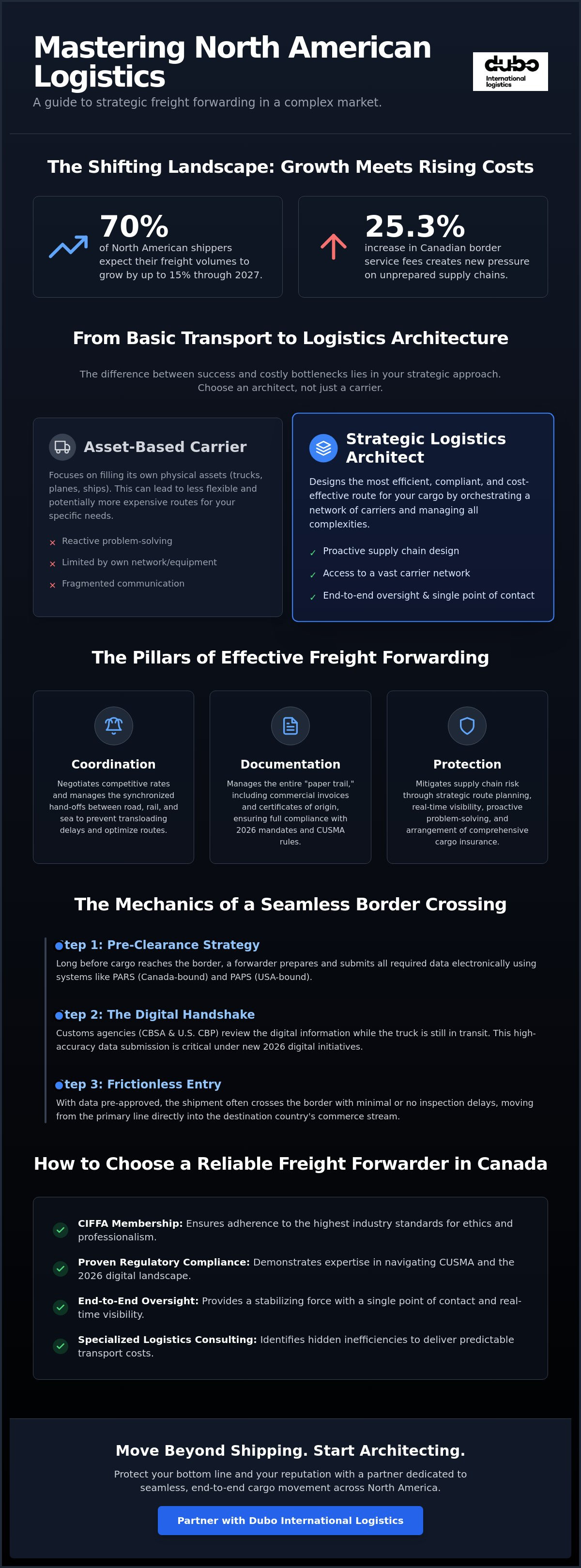
Seventy percent of North American shippers expect their volumes to grow by up to 15% through 2027, yet many remain unprepared for the sharp 25.3% increase in Canadian border service fees that took effect this April. You likely feel the weight of these shifting variables every time a shipment nears the border. It's a common frustration to face unexpected delays or discover hidden fees that weren't in the initial quote. When you manage freight forwarding North America, the difference between a successful delivery and a costly bottleneck often comes down to the quality of your strategic planning.
We've designed this guide to help you master the complexities of modern logistics with a focus on regulatory compliance and seamless movement. By understanding the latest 2026 mandates and choosing a partner with deep industry literacy, you can significantly reduce supply chain risk. This article previews the essential steps to achieve predictable logistics costs and ensure your cargo moves across borders without hesitation. We'll explore how to transition from reactive shipping to a model of "logistics architecture" that protects your bottom line and your reputation.
Key Takeaways
- Understand the distinction between basic transport and strategic logistics architecture to better protect your business interests across the continent.
- Master the mechanics of freight forwarding North America to eliminate border delays and manage the recent 2026 regulatory changes with confidence.
- Use specialized logistics consulting to identify hidden supply chain inefficiencies and realize more predictable transport costs.
- Evaluate potential partners through a professional lens by prioritizing CIFFA membership and a proven commitment to regulatory compliance.
- Learn how a dedicated partner provides the stabilizing force needed to ensure seamless, end-to-end movement for even the most complex cargo.
What is Freight Forwarding in the North American Context?
In the complex environment of international trade, a professional partner acts as the architect of your supply chain journey. While an asset-based carrier owns the physical trucks, planes, or ships, a strategic logistics partner focuses on the orchestration of the entire movement. It's helpful to understand What is a freight forwarder? to see how these specialists act as the essential bridge between your warehouse and your customer. For businesses managing freight forwarding North America, this distinction is critical. A carrier's primary goal is to fill their own equipment, but a forwarder's goal is to design the most efficient, cost-effective route for your specific cargo.
The vast geography of our continent demands a multi-modal coordination approach. Moving goods from a manufacturing facility in one part of North America to a distribution centre in another, distant region involves more than just a single driver. It requires a synchronized dance between rail, road, and sometimes sea. Without a dedicated architect to oversee these hand-offs, transloading delays can quickly erode your profit margins. A forwarder manages the "paper trail" of international trade, ensuring that every manifest and declaration is precise. This administrative precision is what prevents your shipment from being sidelined at a busy border crossing.
The Core Functions of a North American Forwarder
Successful cargo movement relies on three pillars: coordination, documentation, and protection. Your forwarder negotiates with a vast network of carriers to secure competitive rates, ensuring you don't pay a premium during capacity crunches. They handle the management of commercial invoices and certificates of origin to ensure cross-border compliance. Finally, they mitigate risk through strategic route planning and the arrangement of cargo insurance. This integrated approach creates a sense of security, knowing that your interests are being protected at every stage of the journey.
Navigating the 2026 Regulatory Landscape
The regulatory environment in 2026 is defined by digital transformation and stricter enforcement. The CUSMA (USMCA) trade requirements have become more complex, particularly regarding regional value content for industrial goods. Digital customs initiatives now allow for faster processing, but they also require higher data accuracy from the outset. Professional forwarders stay ahead of these policy changes by participating in industry groups and monitoring government updates. They act as a stabilizing force, translating new laws into actionable logistics strategies so your supply chain remains uninterrupted by shifting political tides.
The Mechanics of Moving Cargo Across the Border
Precision is the hallmark of professional logistics. Successful movement begins with a meticulous pick-up and ends only when the final delivery is confirmed at the destination. For businesses engaged in freight forwarding North America, the primary goal is to eliminate friction during the hand-off between different carriers. Transloading delays often occur when communication breaks down at transfer points, but a coordinated approach ensures that equipment is ready the moment cargo arrives. Modern technology now provides the real-time visibility required to track these milestones, allowing shippers to anticipate the specific needs of complex distribution networks.
Managing the "last mile" is often the most challenging aspect of the journey. It requires a deep understanding of local infrastructure and the ability to pivot when congestion or weather disruptions occur. By maintaining a steady authority over the entire process, a forwarder acts as a protective steward of your cargo. This end-to-end oversight transforms a fragmented series of events into a single, cohesive movement. It's about creating a sense of security through constant integration and strategic foresight.
Seamless Cargo Delivery: From Canada to the USA
Crossing the border requires more than just a truck and a driver. It demands a pre-clearance strategy that anticipates the requirements of both the CBSA and U.S. Customs and Border Protection. Systems like the Pre-Arrival Review System (PARS) and the Pre-Arrival Processing System (PAPS) allow for the electronic submission of data before the vehicle reaches the primary inspection line. This digital handshake ensures that cargo is often cleared for entry while it's still kilometres away from the border. Aligning these technical requirements with U.S. Freight Forwarder Best Practices provides a necessary framework for security and compliance. For those seeking a smoother transition, partnering with experts for specialized transportation services can bridge the gap between simple hauling and strategic coordination.
Documentation: The Foundation of Reliable Freight
The digital foundation of a shipment is built on three essential documents: the Bill of Lading, the Commercial Invoice, and the Certificate of Origin. These must be perfectly synchronized to avoid scrutiny. A single discrepancy in a Harmonized System (HS) code can lead to costly storage fees or extensive audits. In 2026, the shift toward digital document management has reduced manual entry errors, yet the human element of oversight remains vital. Experienced forwarders review every line item to ensure that the declaration matches the physical cargo. This meticulous verification process is what prevents the hidden fees and delays that often plague unmanaged supply chains.
Logistics Consulting: Optimizing Your Supply Chain Strategy
Strategic consulting is the first step toward reducing your total logistics spend. While many providers focus solely on the physical movement of goods, a true partner begins by analyzing the structural integrity of your supply chain. Identifying hidden inefficiencies, such as redundant lane assignments or poor equipment utilization, allows you to reclaim lost capital. This analytical approach bridges the gap between your production schedule and the final delivery point, ensuring that your transport model supports your business goals rather than hindering them. It's about moving from a reactive state to one of controlled, strategic movement.
The scale of movement across the continent is staggering. According to North American Transborder Freight Data, billions of dollars in goods flow between Canada and its neighbours every month. Managing your portion of this volume requires more than just booking a truck; it requires a bespoke strategy that accounts for seasonal fluctuations and regulatory shifts. For those navigating freight forwarding North America, consulting provides the strategic foresight needed to move beyond simple shipping and toward a model of long-term stability. This high-level oversight, often facilitated by specialized consulting firms like Customs and Trade Logistics, ensures that every decision is anchored by data and professional process.
Handling Specialized Transportation Projects
Not all cargo fits within a standard dry van. Specialized transportation projects involve cargo that is oversized, high-value, or exceptionally sensitive. These one-off movements require meticulous project-based planning that starts weeks before the first mile. Whether you're moving industrial machinery or delicate technology, the equipment and expertise must be perfectly matched to the unique needs of the cargo. A seasoned expert acts as a dedicated guide through the permits and specialized routing required for these complex movements, ensuring that even the most difficult cargo arrives without incident.
Cost Reduction Through Strategic Foresight
Realizing better freight spend management starts with a deep dive into your lane data. By analyzing your shipping patterns, you can identify opportunities for consolidation that might otherwise go unnoticed. For Less-than-Truckload (LTL) shippers, strategic consolidation into full truckloads can significantly lower the cost per unit and reduce the risk of damage during handling. This methodical approach offers a much higher ROI than "spot market" hunting, which often leaves businesses vulnerable to price spikes and unreliable capacity. A well-planned strategy ensures that your costs remain predictable even when the broader market is volatile.
How to Choose a Reliable Freight Forwarder in Canada
Selecting a logistics partner is a decision that impacts your entire operational stability. It's more than a simple vendor selection; it's the appointment of a protective steward for your commercial interests. When you evaluate providers for freight forwarding North America, you must look beyond the digital interface to find a partner with deep industry literacy. A reliable forwarder acts as a sophisticated bridge between your local operations and the complex international systems that govern trade. This requires a balance of formal credentials and the practical problem-solving skills that only come with years of experience in specific North American trade lanes.
The "human element" remains the most critical factor in successful logistics. Technology provides visibility, but people solve problems. When a shipment faces an unexpected inspection or a carrier experiences a mechanical failure, you need a partner who communicates with clarity and speed. Assessing a provider's communication style during the initial consultation often reveals how they'll handle a crisis. You want a seasoned expert who offers calm authority rather than high-energy hype. This personality is essential for maintaining a steady pace in a fast-moving industry.
The CIFFA Advantage: Why Certification Matters
In Canada, membership in the Canadian International Freight Forwarders Association (CIFFA) serves as a vital trust signal. This organization establishes standardized professional conduct and ethical requirements that all members must follow. CIFFA also sets high educational benchmarks, ensuring that your forwarder possesses the technical knowledge to manage complex customs and transport regulations across the continent. When you prioritize these standards for your freight forwarding North America needs, you ensure your logistics strategy is anchored by a methodology that prioritizes excellence and strategic foresight. It provides the peace of mind that your business is being handled by a true professional who values longevity and consistency.
Questions to Ask During the RFP Process
A thorough Request for Proposal (RFP) process is your best tool for identifying a dedicated, hands-on guide. Move beyond pricing to ask specific questions about their methodology and support systems. For a partnership built on transparency and dependability, consider starting a conversation with the experts at Dubo International Logistics to see how a professional approach can stabilize your supply chain. Ensure your candidates can answer the following:
- How do you handle unexpected border delays or carrier issues? Look for a detailed description of their contingency planning and communication protocols rather than vague promises.
- What is your process for verifying carrier safety ratings? A professional forwarder must have a methodical system for vetting every carrier in their network to mitigate your liability.
- Can you provide a transparent breakdown of all service fees? Avoid providers who use ambiguous language; demand a clear explanation of all potential costs to ensure predictable logistics spend.
Dubo International Logistics: Your North American Logistics Architects
Dubo International Logistics provides the calm authority required to stabilize your supply chain in a complex global environment. Our team operates as a dedicated partner, offering a commitment to reliable, end-to-end cargo management that prioritizes your peace of mind. For businesses seeking excellence in freight forwarding North America, we combine sophisticated industry expertise with a hands-on approach to client service. We don't just move goods; we position your business for long-term growth by identifying and implementing optimized supply chain strategies that reflect the serious nature of global trade.
Our persona is that of a logistics architect. This means we understand the grand scale of global movement while remaining focused on the minute details of your individual needs. We act as a sophisticated bridge between your local operations and the international systems that govern trade. By choosing a partner that values longevity and consistency, you ensure that your business is protected by a steward who views your interests as their own. It's about creating a narrative of support that feels cohesive, well-planned, and entirely dependable from pick-up to final delivery.
Tailored Solutions for Diverse Cargo Needs
Every shipment carries its own set of requirements and risks. Whether you require standard freight movement or highly specialized transportation services for oversized equipment, we act as a stabilizing force between your production line and your customer. We realize efficiency for our partners across the continent by designing bespoke solutions that account for the unique challenges of each lane. Our role is to ensure that even the most complex movements feel seamless and well-planned, allowing you to focus on your core business while we manage the intricacies of the journey. This integrated approach is what allows us to maintain a steady pace in a fast-moving industry.
While we manage the movement of your cargo, other aspects of your physical presence, such as custom packaging and targeted distribution, also require expert handling; to learn more about these integrated services, check out Micro Printing.
Partner with a CIFFA Member for Peace of Mind
Trust is the foundation of every successful logistics partnership. As a proud member of the Canadian International Freight Forwarders Association (CIFFA), we leverage a professional network that provides you with a distinct competitive advantage. Your cargo is always in the hands of seasoned logistics architects who value professional conduct and ethical requirements. If you're ready to optimize your movement across the border and beyond, Contact Dubo International Logistics today to discover how our methodology can secure your interests. We're here to provide the sophisticated bridge your business needs to thrive in the North American market, ensuring your supply chain remains a source of strength rather than a point of stress.
Securing Your Supply Chain for 2026 and Beyond
The landscape of trade is becoming increasingly technical, yet your operations needn't suffer from the friction of shifting regulations. Mastering freight forwarding North America requires a transition from simple transport to a model of integrated logistics architecture. By prioritizing strategic consulting and choosing a partner with CIFFA certification, you gain the foresight needed to avoid hidden costs and border bottlenecks. These steps ensure that your cargo remains a moving asset rather than a liability stuck in transit.
Achieving this level of precision requires a seasoned guide who understands the minute details of your industry. Partner with the logistics architects at Dubo International Logistics to benefit from comprehensive North American coverage and specialized expertise in project cargo transportation. As a dedicated member of the Canadian International Freight Forwarders Association, we provide the stabilizing force and professional oversight your business deserves. Let's work together to build a more resilient and predictable future for your supply chain.
Frequently Asked Questions
What exactly does a freight forwarder do for a North American business?
A freight forwarder acts as a strategic intermediary that organizes the end to end movement of goods between shippers and carriers. They manage the complex coordination required for freight forwarding North America, including rate negotiation, route planning, and documentation management. By serving as a single point of contact, they simplify the logistics process and ensure that cargo moves efficiently through multi-modal networks across the continent.
Is freight forwarding the same as a trucking company?
No, freight forwarders and trucking companies serve distinct roles in the supply chain. While a trucking company is an asset based carrier that physically moves goods, a forwarder is a logistics architect that designs the entire journey. They utilize a broad network of carriers, including rail and air, to find the most efficient route for your specific needs, rather than being limited to their own fleet.
How much does it cost to hire a freight forwarder in Canada?
The cost of hiring a professional partner varies based on several factors, including the volume of cargo, the distance travelled, and the required mode of transport. Fees are typically structured around the specific services provided, such as coordination and documentation management. To ensure predictable logistics spend, you should request a transparent breakdown of all service fees during the initial consultation rather than relying on generic industry averages.
Can a freight forwarder help with USMCA (CUSMA) documentation?
Yes, a professional forwarder manages the essential "paper trail" required for CUSMA compliance. They ensure that Certificates of Origin and commercial invoices are precisely prepared to meet the latest 2026 regulatory standards. This administrative precision is vital for maintaining seamless movement across the Canada, US, and Mexico borders while helping you avoid the penalties associated with incorrect data submission.
What is the difference between standard and specialized transportation?
Standard transportation typically involves moving palletized goods in conventional dry vans or containers. In contrast, specialized transportation services address cargo that is oversized, exceptionally sensitive, or of high value. This requires project based planning, specialized equipment like flatbeds or climate controlled units, and a deeper level of technical expertise to manage the unique routing and permit requirements involved in these complex movements.
Why should I use a CIFFA-certified freight forwarder?
Choosing a CIFFA certified partner ensures that your logistics provider adheres to standardized professional conduct and rigorous ethical requirements. This certification serves as a trust signal in Canada, indicating that the forwarder has met high educational benchmarks in international trade. It provides peace of mind that your cargo is being managed by a vetted expert who prioritizes excellence and strategic foresight in every transaction.
How does logistics consulting help reduce my overall shipping costs?
Logistics consulting identifies hidden inefficiencies in your current transport model by analyzing lane data and equipment utilization. By moving away from reactive "spot market" booking toward a strategic plan, you can realize significant savings through consolidation and better freight spend management. This proactive approach bridges the gap between your production and delivery, ensuring that your supply chain supports your long term financial goals.
What happens if my cargo is delayed at the border?
If a delay occurs, your forwarder acts as a dedicated guide to resolve the issue with border authorities. They immediately investigate the cause, which often involves correcting documentation errors or providing additional data required by the CBSA or U.S. Customs. A reliable partner provides clear, calm communication throughout the process, ensuring that you stay informed while they work to minimize any impact on your delivery schedule.

