

What if the pallet count you've used to decide between LTL and FTL for years is actually costing you thousands in hidden border delays and new 2026 customs fees? As of June 2026, the strategic choice between LTL vs FTL shipping to USA from Canada has evolved from a simple logistics task into a critical component of your financial health. You likely feel the weight of unpredictable transit times and the risk of damage during multiple transloads, which can jeopardize your reputation with American partners. It's a complex landscape where a lack of precision can lead to significant cost overruns and fragmented supply chains.
We understand that you need a dependable partner to act as a stabilizing force in this volatile market. This article promises to help you master the nuances of cross-border freight so you can optimize your costs and delivery timelines with quiet confidence. We'll provide a clear framework for choosing the right shipping mode and detail the methodology required for seamless movement between Canada and the United States.
Key Takeaways
- Define the operational trade-offs between shared-space efficiency and exclusive trailer use to select the most appropriate freight model for your current volume.
- Master the specific pallet-count thresholds and weight variables that dictate the financial logic of LTL vs FTL shipping to USA from Canada in 2026.
- Understand the mechanics of border friction to minimize customs delays caused by complex manifests and the increased handling associated with multiple transloads.
- Recognize when specialized transportation services are essential for sensitive or non-standard freight to ensure a secure, seamless delivery across the border.
- Utilize professional logistics consulting to realize a more resilient supply chain that prioritizes strategic foresight and long-term cost reduction over simple transactional shipping.
Understanding LTL and FTL: The Fundamentals of Cross-Border Freight
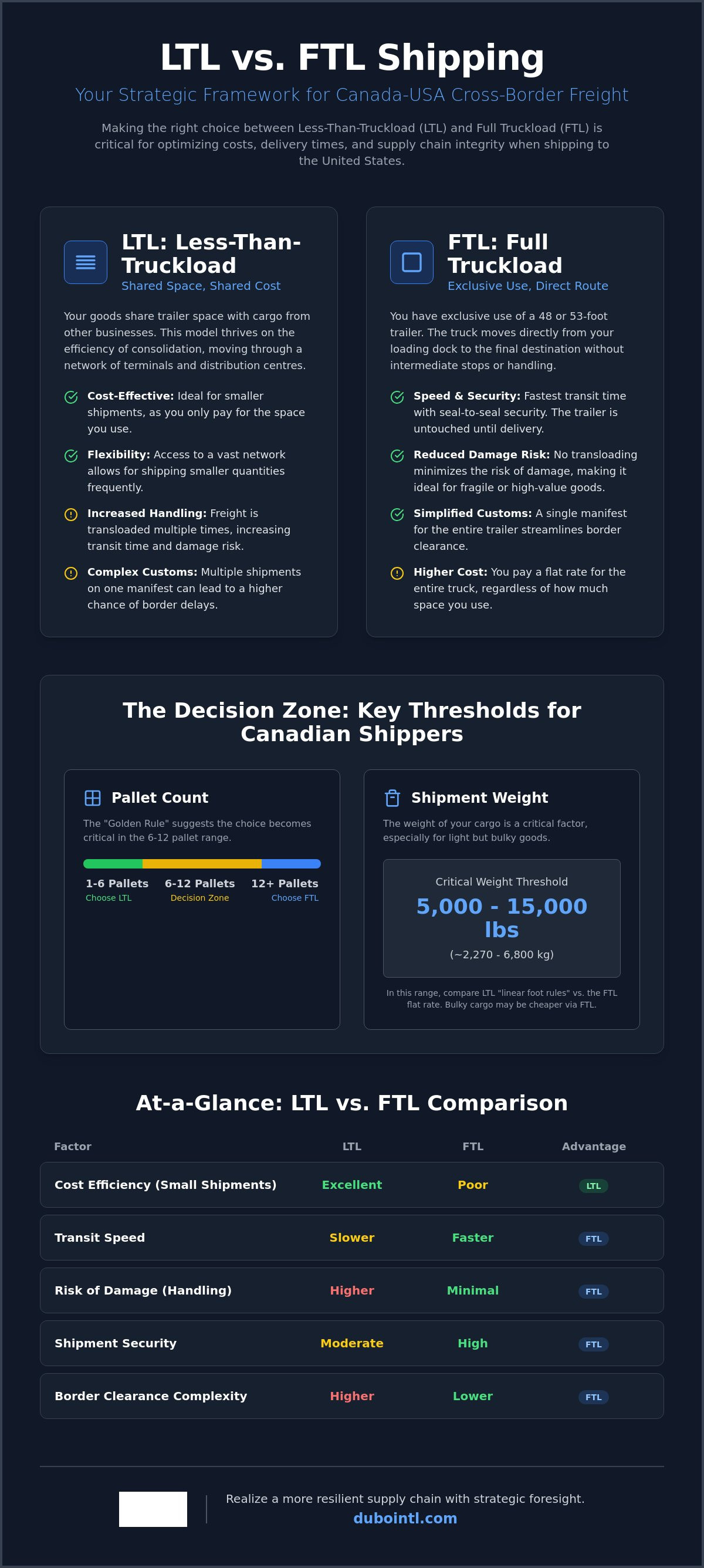
Success in cross-border trade begins with a clear understanding of your equipment and routing options. At its most basic level, Less-than-truckload (LTL) shipping refers to a logistics model where your goods share trailer space with cargo from other businesses. This contrasts with Full Truckload (FTL), which grants you exclusive use of a 48-foot or 53-foot trailer. Choosing between LTL vs FTL shipping to USA from Canada isn't just about pallet counts. It's about selecting a methodology that aligns with your specific risk tolerance and budget. While LTL operates on a hub-and-spoke network, FTL moves point-to-point, creating a fundamental difference in how your freight travels across the 49th parallel.
The Mechanics of LTL Shipping in North America
The LTL model thrives on the efficiency of consolidation. Your freight is collected and moved to a local terminal where it's combined with other shipments bound for the same general region in the United States. This process frequently involves transloading. At various distribution centres, professional handlers move goods between trailers to optimize routes. Pricing follows a shared cost model. It's heavily influenced by freight class, a system that categorizes goods based on their transportability. In the Canadian market, this classification considers density, stowability, and ease of handling. High-density items that occupy minimal space but weigh more often secure better rates than light, bulky items that are difficult to stack or organize. It's a sophisticated balancing act that allows smaller businesses to access global markets without paying for empty trailer space.
The FTL Advantage: Speed and Exclusivity
FTL offers a level of control and precision that LTL cannot match. Because the truck is dedicated solely to your cargo, the driver moves directly from your loading dock to the final destination. This point-to-point path eliminates the transit delays often found at busy regional terminals. One of the most significant benefits is the seal-to-seal security. Once the trailer is closed at your facility, it remains untouched until it reaches the receiver. This makes FTL a necessity for high-value electronics, sensitive pharmaceutical products, or fragile equipment that won't survive multiple touches. Whether you're utilizing a standard 48-foot trailer or a high-capacity 53-foot unit, you gain a predictable delivery window. It's a premium service designed for those who prioritize security and absolute consistency in their supply chain.
Evaluating the Choice: When to Opt for LTL vs. Full Truckload
Choosing the right mode for LTL vs FTL shipping to USA from Canada requires more than a cursory glance at a rate sheet. It involves a deep analysis of your cargo's physical characteristics and the specific demands of your supply chain. The industry's "Golden Rule" suggests that the grey zone exists between 6 and 12 pallets. While LTL is usually the default for smaller volumes, the moment your shipment occupies more than half a trailer, the cost-per-pallet for FTL often becomes more competitive. Beyond pallet counts, you must consider the Total Landed Cost. This figure includes the freight rate plus the potential costs of damage, border delays, and administrative overhead. For businesses looking to refine these variables, engaging in logistics consulting can reveal hidden efficiencies in your current shipping lanes.
Volume and Weight Thresholds for Canadian Shippers
Weight is a critical, yet often overlooked, factor. The threshold between 5,000 and 15,000 lbs is where the choice between LTL and FTL becomes most impactful. LTL carriers often apply "linear foot rules," which penalize shipments that take up significant floor space but lack the density to be stacked. If your cargo is light but bulky, you might find that the aggregate LTL rate exceeds the cost of a dedicated truck. Precision matters here. Accurate measurements ensure you avoid unexpected surcharges. Additionally, understanding Canada's import requirements and documentation is vital. LTL shipments involve multiple manifests on a single trailer, which can increase the probability of a customs inspection compared to a single-manifest FTL load.
Urgency and Delivery Windows to the USA
Time is frequently the deciding factor for high-stakes shipments. LTL transit times are inherently less predictable because they rely on terminal schedules and consolidation cycles. Every transfer between trucks introduces a "hidden" time cost. Conversely, FTL provides a direct route that is essential for just-in-time (JIT) manufacturing environments. It allows you to offer your American customers firm delivery windows, which builds trust and strengthens long-term partnerships. When your reputation depends on a specific arrival time, the exclusivity of a full truckload provides a level of certainty that shared-space models simply cannot replicate. This stability is a protective steward of your professional interests.
Navigating the Canada-USA Border: Logistics Compliance and Transit Times
Crossing the border in 2026 requires precision. Data management is critical. The decision regarding LTL vs FTL shipping to USA from Canada significantly influences how much "border friction" your cargo encounters. In an LTL scenario, a single trailer often carries goods from dozens of different shippers, each requiring its own manifest and entry documentation. If one shipment on that trailer contains an error, the entire truck can be delayed at the border, affecting every other customer on board. FTL shipments avoid this collective risk by utilizing a single manifest. This streamlines the clearance process. It provides a more predictable path through customs for your time-sensitive freight.
Documentation and Regulatory Excellence
Expertise matters here. Professional freight forwarding ensures that every Bill of Lading (BOL) and commercial invoice is prepared with absolute accuracy. Since August 29, 2025, the suspension of the Section 321 de minimis exemption has mandated that all commercial shipments undergo formal customs entry. This change removed the streamlined path for low-value goods. Every item counts. CIFFA-certified professionals understand how to navigate these complexities, ensuring that your goods qualify for USMCA origin treatment where applicable to avoid temporary surcharges like the Section 122 import surcharge. This level of strategic oversight prevents costly delays and protects your bottom line from avoidable administrative penalties.
Transit Time Expectations: Canada to USA
Timelines depend on consolidation. LTL shipments typically require additional days to account for terminal transfers and the "cross-docking" process at the border. In this model, freight is often reorganized for final delivery within the US market. When comparing LTL vs FTL shipping to USA from Canada, you must account for these logistical pauses. While shared-space models are cost-effective, they lack the speed of expedited FTL options. A dedicated truck moves directly from your Canadian facility to the US destination. This often shaves 48 to 72 hours off the total transit time. Reliability is paramount. Realizing a seamless delivery date depends on a freight partner who manages these timelines with precision. By integrating sophisticated tracking and proactive communication, a professional forwarder ensures that your supply chain remains a stabilizing force.
Beyond Pallet Counts: Strategic Factors in Specialized and Sensitive Cargo
Standard metrics of volume and weight often fail to capture the full scope of complex logistics. When your cargo involves non-standard dimensions or extreme sensitivity, the debate regarding LTL vs FTL shipping to USA from Canada shifts from cost-per-pallet to risk-per-mile. Specialized transportation services become the necessary bridge for these unique requirements. It's not just about moving goods. It's about protecting the integrity of your most critical assets through strategic foresight. For many Canadian businesses, the "cheapest" option quickly becomes the most expensive if the shipping mode doesn't align with the cargo's physical needs.
Managing Non-Standard and Oversized Freight
Security and Risk Mitigation for High-Value Goods
High-value goods demand a higher standard of care than general merchandise. The LTL hub-and-spoke model introduces multiple transloading points where the risk of damage or misplacement increases. Every touch is a potential failure point. FTL remains the gold standard for security because it offers a direct, untouched path from origin to destination. It provides peace of mind. When you choose specialized transportation services, you ensure your delicate or expensive items are handled with absolute precision. This exclusive use of equipment mitigates the "vibration and handling" risks inherent in shared-space models. By leveraging professional logistics consulting, you can build a more resilient supply chain that identifies these vulnerabilities before they manifest as financial losses. This commitment to dependability ensures your high-value cargo arrives exactly as intended, regardless of the distance travelled.
Optimizing Your Supply Chain with Professional Freight Management
The decision regarding LTL vs FTL shipping to USA from Canada represents more than a choice between shared space and exclusive trailers. It's a strategic pivot that defines the resilience and financial health of your North American trade lanes. As a logistics architect, Dubo International Logistics moves beyond the transactional nature of freight. We focus on the intricate details that allow your business to thrive in a complex global environment. By positioning ourselves as a protective steward of your interests, we ensure that every shipment reflects a commitment to excellence and strategic foresight. This partnership approach lowers your stress by providing a stabilizing force amidst market volatility and regulatory shifts.
The Role of a Strategic Logistics Partner
Modern trade requires integrated supply chain solutions rather than simple transportation. Logistics consulting provides the framework necessary to scale your US operations with efficiency and precision. While some may view professional fees as an added expense, they're actually a vital investment in the long-term health of your supply chain. Expert guidance helps you identify the most economical lanes and equipment types, preventing the "hidden" costs of border friction and transit delays that often plague unmanaged shipments. This proactive methodology allows you to focus on your core business growth while we handle the minute details of carrier coordination. We act as a sophisticated bridge, ensuring that your local business can navigate the complexities of international systems without the burden of administrative overhead.
Seamless Execution: From Saint-Philippe to Any US Destination
Execution is where strategy meets reality. From our base in Saint-Philippe to any destination across the United States, the Dubo commitment is characterized by quiet confidence and meticulous attention to detail. We remove the heavy burden of carrier management from your team by overseeing the complete lifecycle of your freight. This includes the rigorous coordination of specialized equipment and the exacting preparation of all cross-border documentation required in the 2026 regulatory landscape. You gain peace of mind knowing that a seasoned expert is guiding your goods through every terminal and customs checkpoint. This level of end-to-end support is what transforms a standard shipment into a seamless movement of cargo, anchored by a narrative of dependability and professional excellence.
Optimize your cross-border logistics with Dubo International Logistics and experience the stability of a dedicated logistics partnership that prioritizes your success.
Master Your Cross-Border Strategy for 2026
Success in North American trade depends on moving beyond simple pallet counts to embrace a total landed cost methodology. You've explored how weight thresholds and border friction dictate the efficiency of LTL vs FTL shipping to USA from Canada, particularly in a year marked by significant regulatory shifts. As a CIFFA Certified Member and a strategic logistics architect, we provide the steady authority needed to navigate these complexities with precision. Our expertise in specialized transportation ensures that even the most sensitive project cargo reaches its destination without the risks of excessive handling or terminal delays.
We invite you to lower your operational stress by partnering with a steward who prioritizes the longevity of your supply chain. Through bespoke logistics consulting, we help you build a resilient framework that balances speed with fiscal responsibility. This partnership ensures that your business remains a stabilizing force in a complex global environment.
Request a Strategic Logistics Consultation with Dubo International Logistics to refine your cross-border movement and secure your business's future in the global market. Your path to seamless international growth starts with a partner you can trust.
Frequently Asked Questions
Is LTL always cheaper than FTL for shipping from Canada to the USA?
LTL is not universally cheaper for every shipment. While it provides excellent value for smaller volumes, the strategic choice between LTL vs FTL shipping to USA from Canada often tips toward FTL once you exceed 10 pallets or 10,000 lbs. You should always evaluate the total landed cost to ensure that shared-space savings aren't offset by terminal delays, transload fees, or increased handling risks during transit.
How many pallets typically make an FTL shipment more cost-effective?
The transition point where FTL becomes more cost-effective usually occurs between 6 and 12 pallets. If your cargo is particularly heavy or occupies more than 12 linear feet of trailer space, carriers often apply over-length surcharges that make a full truckload more economical. Precision in measuring your freight's footprint is essential for making an informed financial decision that protects your bottom line.
What are the most common documentation errors in cross-border shipping?
Documentation errors often involve incorrect Harmonized System (HS) codes or incomplete commercial invoices. Vague descriptions of goods can trigger inspections that stall your supply chain and result in unexpected storage fees. Ensuring your paperwork precisely matches current regulatory requirements is the most effective way to minimize border friction and avoid administrative penalties that can compromise your delivery timelines.
How does freight class affect my LTL shipping rates to the United States?
Freight class is a numerical classification that determines your shipping rate based on the transportability of your goods. It evaluates four primary factors: density, stowability, ease of handling, and liability. Dense, durable items that are easy to organize in a trailer generally qualify for lower classes, resulting in more competitive pricing compared to light, fragile, or bulky items that require extra care.
Can I ship specialized or oversized cargo using LTL services?
Specialized or oversized cargo typically requires dedicated FTL equipment rather than standard LTL services. Items that exceed standard pallet dimensions or require flatbeds cannot be consolidated into a traditional hub-and-spoke network. These shipments require bespoke solutions and meticulous planning to move safely across provincial and state lines, ensuring that every permit and escort requirement is addressed with strategic foresight.
What is the typical transit time for an FTL shipment from Canada to the USA?
Most FTL shipments reach their US destination within 2 to 4 days, depending on the distance from the Canadian origin. This direct, point-to-point path is significantly faster than the hub-and-spoke model used in LTL vs FTL shipping to USA from Canada. Dedicated trucks bypass regional terminals, ensuring your goods remain in motion rather than sitting at a cross-dock awaiting consolidation.
Why should I use a freight forwarder instead of booking directly with a carrier?
A freight forwarder acts as a sophisticated bridge between your business and complex international systems. We provide logistics consulting that direct carriers cannot offer, managing everything from documentation to carrier coordination across multiple lanes. This end-to-end support ensures your supply chain remains a stabilizing force, allowing you to focus on growth while we handle the minute details of your cross-border movements.
How do I realize the best value when shipping fragile goods across the border?
Realizing the best value for fragile cargo requires prioritizing security over the lowest initial freight rate. FTL or specialized transportation services offer a seal-to-seal benefit that eliminates the risks associated with multiple transloads. By reducing the number of times your goods are handled, you protect your investment and maintain the integrity of your professional reputation with American partners who expect pristine deliveries.

