

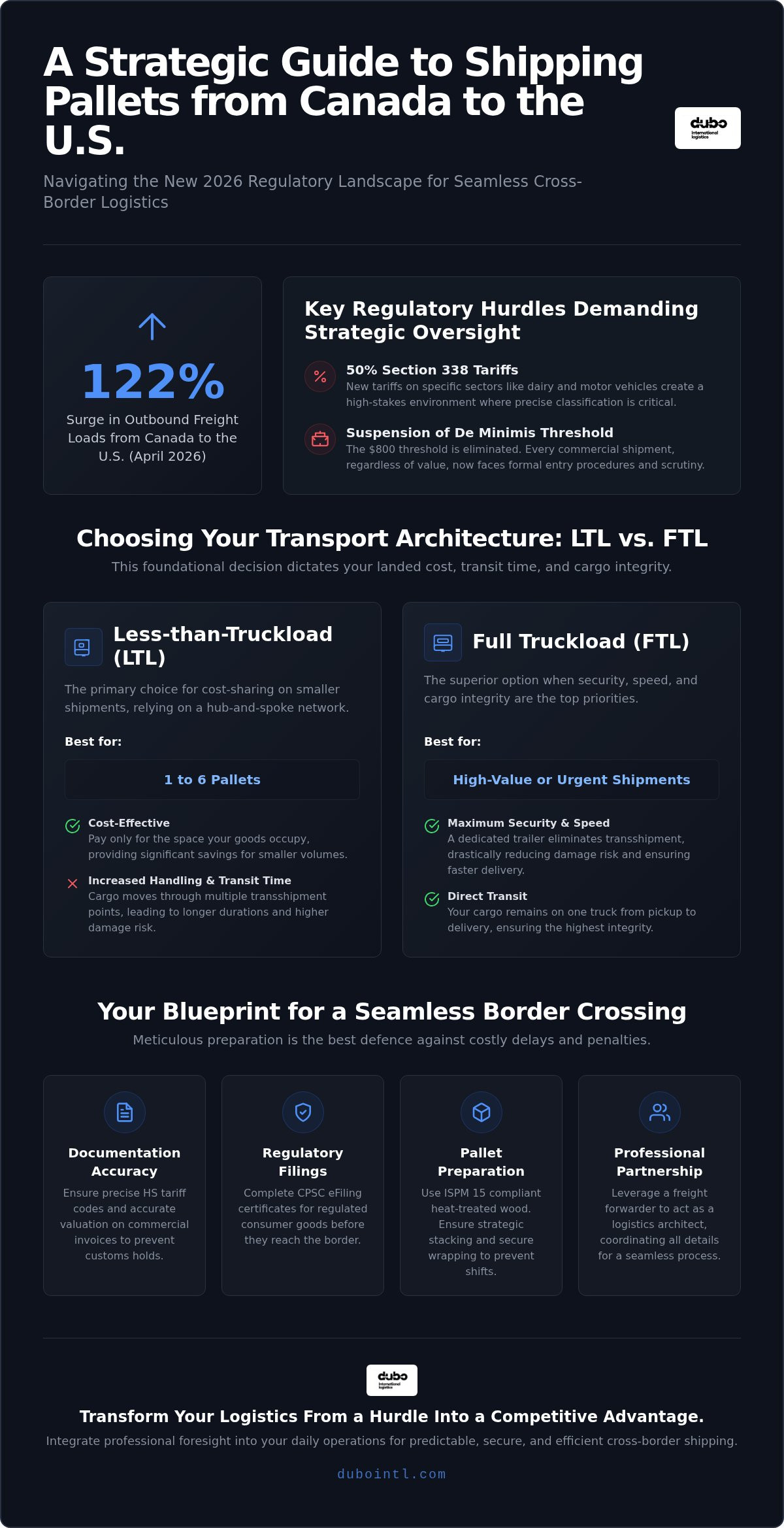
Outbound freight loads from Canada to the United States surged by 122% in April 2026, yet many exporters are watching their margins disappear under the weight of new 50% Section 338 tariffs and the total suspension of de minimis thresholds. You understand that the border is no longer a simple crossing point but a complex regulatory hurdle that demands absolute precision. Identifying the best way to ship pallets to the US from Canada has evolved into a strategic necessity for businesses aiming to remain competitive in a volatile trade environment.
We recognize the stress caused by unpredictable wait times and the frustration of rising fuel surcharges that threaten your bottom line. This guide offers a comprehensive roadmap to achieving a seamless, "set-and-forget" shipping process by integrating expert cargo coordination with strategic foresight. You'll discover how to navigate CPSC eFiling requirements, optimize LTL vs FTL decisions, and implement the documentation standards required to avoid customs penalties. By the end of this article, you will have the tools to lower landed costs for your US customers and ensure your palletized goods move with the quiet confidence of a well-orchestrated supply chain.
Key Takeaways
- Understand how the 2026 regulatory landscape, including Section 338 tariffs and de minimis suspension, necessitates a shift from transactional shipping to strategic cross-border oversight.
- Evaluate the structural differences between LTL and FTL transport to determine which architecture best protects your cargo's integrity and your business's bottom line.
- Discover why meticulous documentation and precise tariff classification represent the best way to ship pallets to the US from Canada without incurring costly border delays.
- Adopt rigorous preparation standards, such as ISPM 15 heat-treated wood compliance and strategic stacking, to safeguard your goods against the physical rigours of international transit.
- Leverage professional freight forwarding to transform your logistics from a source of stress into a competitive advantage through expert cargo coordination.
Navigating the Border: Why Shipping Pallets to the US Requires Strategic Oversight
Palletized freight serves as the fundamental unit of North American commerce. It allows Canadian Small and Medium Enterprises (SMEs) to move significant volumes of product with standardized efficiency, turning local production into international supply. For many businesses, the corridor to the United States represents their primary growth engine. However, as outbound freight loads surged by 122% in April 2026 compared to the previous year, the physical movement of goods has become secondary to the movement of data and compliance. Many shippers realize too late that the best way to ship pallets to the US from Canada involves far more than merely securing a spot on a trailer. Standard methods often crumble under the pressure of modern border enforcement, where a single missing HS code leads to indefinite delays and mounting storage fees.
The Complexity of Cross-Border Logistics
The interface between the Canada Border Services Agency (CBSA) and US Customs and Border Protection (CBP) has tightened significantly. In 2026, the suspension of the $800 de minimis threshold means every commercial shipment faces formal entry, regardless of value. Additionally, the implementation of 50% Section 338 tariffs on specific sectors like dairy and motor vehicles has turned the border into a high-stakes environment. Pallet hold-ups often stem from inaccurate valuation or failure to file the new CPSC eFiling certificates for regulated consumer goods. These regulatory shifts demand a level of precision that basic carriers rarely provide without external coordination.
Establishing a Stabilizing Supply-Chain Force
Moving from reactive shipping to proactive logistics planning is the only way to safeguard your margins. A professional freight forwarder acts as a logistics architect, designing a route that accounts for both physical transit and regulatory hurdles. This oversight reduces the "stress of the unknown" by ensuring every detail is verified before the truck leaves your dock. At Dubo International Logistics, we position ourselves as a stabilizing force for Canadian exporters. We focus on the minute details of global movement so you can focus on your customers. This partnership ensures that your cargo remains secure and your landed costs stay predictable, even when international trade policies shift overnight. The best way to ship pallets to the US from Canada is to integrate this professional foresight into your daily operations, transforming a complex hurdle into a seamless extension of your business.
LTL vs. FTL: Choosing the Right Transport Architecture for Your Pallets
Selecting the correct trailer configuration is a foundational decision in logistics architecture. It isn't merely a matter of volume; it's a strategic choice that dictates your landed cost and the integrity of your cargo. Determining the best way to ship pallets to the US from Canada starts with understanding how Less-than-Truckload (LTL) and Full Truckload (FTL) models interact with your specific supply chain needs. This choice influences everything from fuel surcharge calculations to the physical security of your goods during transit.
When to Realize the Benefits of LTL
LTL is the primary choice for shipments ranging from one to six pallets. This model relies on a cost-sharing structure where you only pay for the linear feet your goods occupy. It provides immense flexibility for Canadian businesses with fluctuating inventory demands. The trade-off, however, lies in transit times. Because LTL shipments move through various hub-and-spoke transshipment points, they often face longer durations and more frequent handling than direct loads. For non-urgent freight, the cost savings of LTL are significant, provided your packaging can withstand the rigours of multiple transfers.
The Case for Full Truckload (FTL) Efficiency
FTL becomes the superior option when security and speed outweigh volume considerations. By securing a dedicated trailer, you eliminate transshipment points, which drastically reduces the risk of damage during the cross-border journey. This is particularly vital for specialized or high-value freight that requires a "sealed-at-source" approach. The economic breakeven point for FTL typically begins around 10 to 12 pallets, or when total weight exceeds 10,000 lbs. Beyond these thresholds, the per-unit cost of FTL often drops below LTL rates, especially when factoring in the efficiency of a direct route to your US customer.
Our team at Dubo International Logistics provides the strategic consulting necessary to optimize your pallet configurations and maximize trailer space. We don't just facilitate transport; we analyze your cargo to ensure you aren't paying for empty air or unnecessary handling. Regardless of the transport architecture you choose, you must still provide Essential Documentation for Seamless Border Crossings to satisfy US Customs requirements. Proactive planning ensures that whether you use LTL or FTL, your pallets arrive on time and without the burden of unexpected border penalties.
The Compliance Framework: Essential Documentation for Seamless Border Crossings
Paperwork serves as the invisible infrastructure of global trade. Without precise documentation, even the most efficiently packed pallet remains stationary at the port of entry. The Commercial Invoice acts as the foundation of your customs value, providing the necessary data for tax and duty assessment. Simultaneously, the Bill of Lading (BOL) functions as the legal contract of carriage and the title of goods. In 2026, the best way to ship pallets to the US from Canada involves mastering the digital transition. Shippers must now navigate mandatory electronic filing systems and real-time manifest reporting to meet heightened security standards.
To benefit from preferential trade treatment, you must provide a valid Certificate of Origin. Following the Official USMCA Implementation Instructions ensures that your goods qualify for duty exemptions under the Canada-United States-Mexico Agreement. However, documentation is not a "set-and-forget" task. You must account for the 2026 suspension of de minimis thresholds, which requires a formal customs entry for every commercial shipment, regardless of its value. This shift makes administrative precision a non-negotiable component of your export strategy.
Precision in Paperwork
Accuracy in Harmonized Tariff Schedule (HTS) codes is paramount to your financial health. Using an incorrect code can lead to overpaying duties or triggering a formal audit by US Customs and Border Protection. Descriptions must be exhaustive and specific. Vague terms like "miscellaneous parts" or "general merchandise" are red flags for customs inspectors and often lead to physical examinations and costly storage fees. Each pallet's contents should be itemized with clarity to ensure a smooth transition through the border.
Leveraging Professional Documentation Services
Administrative errors remain the most frequent cause of cross-border friction. Utilizing professional freight documentation services allows businesses to integrate their customs strategy with their physical transport schedule. At Dubo International Logistics, we act as a sophisticated bridge between your local operations and complex international systems. This unified approach provides a "zero-error" strategy, offering the peace of mind that comes from knowing every digital manifest and physical invoice is perfectly aligned. Strategic logistics consulting ensures that your documentation supports your supply chain speed rather than hindering it, allowing you to maintain a competitive edge in the US market.
Preparation and Protection: Best Practices for Palletized Freight Security
Physical preparation represents the final line of defense for your cargo. While meticulous documentation ensures a legal crossing, your packaging strategy ensures the product arrives in sellable condition. The best way to ship pallets to the US from Canada begins with selecting ISPM 15 heat-treated wood pallets. This international standard is strictly enforced at the border to prevent the spread of timber pests. Failure to use compliant pallets can result in your entire shipment being turned back or even destroyed at your expense, creating significant financial and reputational damage.
Stability depends heavily on your stacking methodology. While column stacking maximizes compression strength for heavy items, the "brick" or interlocking method provides superior lateral stability for lighter goods. Once stacked, you must secure the load using high-gauge stretch wrap. Aim for at least three layers at the base and top to prevent "pallet creep" during the long-haul transit. Heavy-duty polyester banding adds an essential layer of security, particularly for high-density loads that might shift during sudden stops or sharp turns on the highway.
Handling Specialized and Sensitive Cargo
Standard packing tips often fall short when you're dealing with non-standard dimensions or fragile components. If your equipment extends beyond the edges of a standard 48x40 pallet, it requires custom crating or oversized platforms to prevent impact damage during transshipment. For high-value electronics or medical devices, vibration dampening and climate control become essential requirements. Understanding the nuances of specialized freight North America allows you to tailor your protection strategy to the specific vulnerabilities of your cargo, rather than relying on a generic approach that leaves your investment at risk.
Risk Mitigation and Insurance
You shouldn't rely solely on standard carrier liability. Most carriers limit their financial responsibility based on the weight of the shipment, which rarely covers the full value of high-tech or luxury goods. An "all-risk" insurance model provides the comprehensive coverage needed for total peace of mind. If a shipment arrives damaged, you must document the condition immediately on the Bill of Lading and take high-resolution photographs before the driver leaves. This proactive documentation is vital for a successful claim and reflects the methodical approach required for international trade.
Ensuring your goods are protected requires both physical precision and strategic foresight. If you need a partner to oversee your most complex shipments and ensure they are handled with expert care, contact Dubo International Logistics to discuss a bespoke transportation solution for your cross-border freight.
Partnering for Success: How Professional Freight Forwarding Streamlines Your Supply Chain
A carrier simply provides the trailer. A strategic logistics partner provides the foresight to ensure that trailer actually reaches its destination without delay. While automation and digital marketplaces offer superficial convenience, they often lack the "logistics architect" approach required to handle the minute details of cross-border trade. Professional cross-border freight forwarding creates a genuine competitive advantage by transforming your supply chain from a cost centre into a reliable engine for growth.
Accessing vetted carrier networks and specialized equipment ensures your cargo is matched with the right transport architecture. This is particularly crucial for specialized or non-standard freight that requires more than a generic LTL solution. The long-term value of CIFFA-certified expertise lies in the peace of mind it provides; you aren't just hiring a truck, you're engaging a protective steward of your business interests. Integrating this level of professional coordination is the best way to ship pallets to the US from Canada while maintaining predictable landed costs in an era of fluctuating tariffs.
The Dubo International Advantage
We believe in meticulously executed transport solutions that prioritize trust and dependability. At Dubo International Logistics, we act as a sophisticated bridge between Canadian exporters and US markets. Our bespoke logistics consulting doesn't just move pallets; it reduces operational friction and uncovers efficiencies that automated systems often overlook. We understand the grand scale of global movement, but we remain focused on the specific needs of your individual business. This commitment to excellence ensures that your supply chain remains a stabilizing force, even as international trade regulations evolve.
Moving Forward with Confidence
Choosing a mature, established partner is essential in a volatile trade environment. We invite you to begin a consultation for your next US-bound shipment to experience the difference that professional cargo coordination makes. You don't have to navigate the complexities of CBP requirements or the impact of Section 338 tariffs alone. Visit www.duboexpedited.com to realize your shipping potential and secure a seamless future for your international freight. Our team is ready to help you move forward with the quiet confidence that comes from expert oversight.
Securing Your Competitive Edge in Cross-Border Trade
Navigating the complex corridor between Canada and the United States requires more than a simple carrier; it demands a strategic architecture built on precision and foresight. You've seen how meticulous documentation and the correct choice between LTL and FTL configurations can preserve your margins and protect your goods from transit damage. As regulatory requirements like the USMCA guidelines and Section 338 tariffs continue to evolve, the best way to ship pallets to the US from Canada is to integrate professional coordination into your supply chain from the very beginning.
Success in international markets depends on consistency and the peace of mind that comes from expert oversight. As a CIFFA certified member and specialist in specialized transportation, Dubo International Logistics provides the end-to-end cargo coordination necessary to stabilize your operations in a volatile environment. We invite you to Request a professional logistics consultation at Dubo International to realize the full potential of your export strategy. Your business deserves a partner that treats your cargo with the same dedication you bring to your customers. Let's build a more resilient future for your freight together.
Frequently Asked Questions
What is the most cost-effective way to ship 2-3 pallets to the US?
Less-than-Truckload (LTL) shipping is the most economical choice for smaller pallet counts. It allows you to share trailer space and costs with other exporters, paying only for the linear feet your cargo occupies. For many SMEs, this cost-sharing model is the best way to ship pallets to the US from Canada when volume doesn't justify a dedicated trailer. This approach effectively balances budget constraints with reliable transit schedules.
Do I need a customs broker to ship pallets from Canada to the USA?
Yes, you generally require a customs broker to facilitate the formal entry of commercial goods into the United States. While freight forwarders manage the physical movement and coordination, a broker handles the legal transmission of data to US Customs and Border Protection. Because the $800 de minimis threshold was suspended in 2025, every commercial pallet now requires a formal entry filing to clear the border legally and avoid penalties.
What are the standard pallet dimensions for shipping to the US?
The standard North American pallet size is 48 inches by 40 inches. Utilizing these dimensions ensures your freight remains compatible with standard racking systems and trailer widths across the continent. Adhering to these specifications allows for more accurate freight quoting and minimizes the risk of "overhang" damage. If your goods require larger platforms, you should consult with a logistics expert to arrange specialized transportation tailored to your cargo's footprint.
How long does it typically take for a pallet to clear customs?
Electronic pre-clearance through the Automated Commercial Environment (ACE) often allows pallets to clear within minutes of reaching the primary inspection booth. However, if a shipment is selected for a secondary examination, delays can range from several hours to multiple days. Ensuring your documentation is meticulous and filed well in advance of the truck's arrival is the most effective way to minimize these unpredictable wait times and maintain your delivery schedule.
What happens if my palletized freight is damaged during transit?
You must document any visible damage immediately on the Bill of Lading before the driver departs the delivery site. Take high-resolution photographs of the shrink wrap, banding, and the goods themselves to support your claim. Since standard carrier liability is often limited by weight rather than value, maintaining a comprehensive "all-risk" insurance policy is a critical step in protecting your financial investment during the long-haul journey across the border.
Are there specific wood requirements for pallets crossing the border?
All wood packaging material must be ISPM 15 compliant and feature the official heat-treatment stamp. This regulation prevents the cross-border movement of invasive pests and is strictly enforced by both CBSA and CBP inspectors. If your pallets lack the proper certification, your shipment may be refused entry or quarantined at your expense. Using plastic pallets or certified heat-treated wood is essential for a seamless and compliant border crossing.
Can I ship oversized or non-standard pallets to the US?
Yes, you can ship oversized pallets by utilizing specialized transportation services tailored for non-standard dimensions. These shipments require strategic planning to account for trailer height, width restrictions, and the specific handling needs of the cargo. Working with a logistics consultant ensures that your oversized freight is secured correctly and routed through ports capable of handling larger units without causing significant supply chain bottlenecks or safety concerns.

