

Success in the transborder corridor is built on meticulous regulatory foresight rather than the mere movement of physical assets. Reliable cross-border freight forwarding Canada USA requires a sophisticated understanding of how to balance speed with strict adherence to evolving trade laws. You likely realize that a single documentation error or an unexpected border hold-up can disrupt an entire supply chain, leading to the inconsistent communication and hidden costs that often compromise your bottom line.
It's our goal to help you transform these challenges into a competitive advantage by positioning your business as a model of efficiency. This article provides a strategic framework to master transborder complexities, ensuring your operations achieve full regulatory compliance and predictable delivery timelines. We will examine the critical shifts in the 2026 logistics landscape, such as the 25.3% inflation adjustment to certain CBSA service fees, and outline a methodology to reduce your administrative burden while optimizing your total shipping costs.
Key Takeaways
- Understand the 2026 economic landscape to better coordinate the multi-layered regulatory and physical requirements of transborder movement.
- Learn how to integrate meticulous carrier coordination with real-time visibility to maintain supply chain stability and predictability.
- Master the nuances of cross-border freight forwarding Canada USA to ensure full compliance with evolving CBSA and CBP documentation standards.
- Identify the specific permit requirements and strategic frameworks needed to safely transport oversized, sensitive, or high-value specialized cargo.
- Recognize the value of professional logistics consulting and CIFFA-aligned partnerships in reducing administrative burdens and eliminating hidden costs.
The Strategic Landscape of Canada-USA Cross-Border Freight
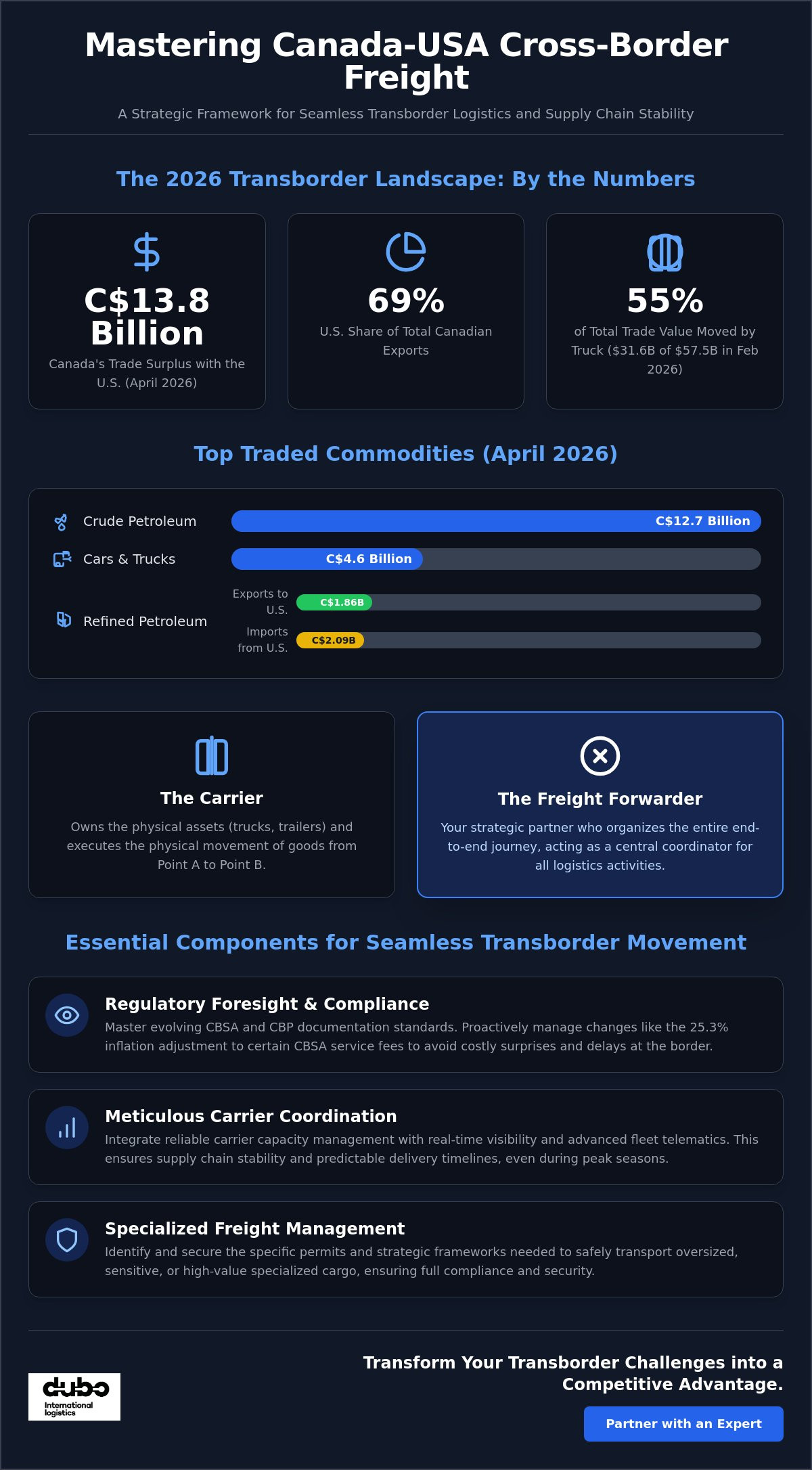
Effective cross-border freight forwarding Canada USA is far more than a simple transaction involving a truck and a trailer. It's a multi-layered coordination of complex regulatory frameworks and physical movement across one of the world's most active trade borders. As of April 2026, Canada maintained a trade surplus of C$13.8 billion with the United States. This massive volume of crude petroleum and automotive parts demands a strategy that prioritizes precision, especially as the U.S. share of Canadian exports has shifted to 69%. Relying on a "set it and forget it" approach often results in costly supply chain bottlenecks. Instead, sophisticated shippers utilize logistics consulting as a prerequisite for success, ensuring every shipment is anchored by strategic foresight.
The current economic environment requires a stabilizing force. While U.S. transborder freight with Canada saw a 9.0% decrease in February 2026 compared to the previous year, the complexity of moving goods hasn't diminished. Businesses can't afford to be passive. A dedicated focus on logistics consulting allows you to anticipate shifts in trade shares and regulatory updates before they impact your delivery timelines. This proactive stance transforms your supply chain from a cost centre into a reliable engine for growth.
As businesses scale and look toward international expansion, having the right corporate infrastructure becomes as vital as the logistics themselves. Platforms like Encor Group facilitate this transition by providing global corporate services through regional hubs in more than 10 markets.
Understanding the North American Logistics Corridor
The flow of goods depends on a network of primary highway and intermodal gateways that connect Canadian manufacturing centres to major American markets. These corridors facilitate the movement of essential commodities that define the bilateral relationship. In April 2026, the following goods dominated the flow:
- Crude Petroleum: C$12.7 billion in Canadian exports.
- Cars and Delivery Trucks: Over C$4.6 billion in combined trade value.
- Refined Petroleum: A balanced exchange with C$1.86 billion exported and C$2.09 billion imported from the U.S.
The velocity of this cargo is maintained through advanced fleet telematics, which provide the data needed to realize real-time adjustments. These systems ensure that assets move efficiently through congested border points, though the physical path is only half the journey. Integration between road and rail remains a cornerstone of this corridor's resilience.
The Vital Role of the Freight Forwarder
It's essential to distinguish between a carrier, who owns the physical assets, and a freight forwarder who organizes the entire end-to-end journey. A forwarder acts as your central point of contact, integrating disparate services into a cohesive movement. They serve as a sophisticated bridge, possessing the industry-literate knowledge required to handle both CBSA and CBP regulations. This expertise ensures that your specialized transportation services remain compliant, protecting your interests as a steward of your global trade commitments. By choosing a partner who understands the minute details of individual client needs, you secure a seamless path through complex international systems.
Essential Components of Seamless Transborder Cargo Movement
Achieving a frictionless flow across the border requires the precise integration of physical assets and administrative rigor. In February 2026, truck freight accounted for $31.6 billion of the $57.5 billion in total U.S.-Canada trade, highlighting the continued dominance of road transport. However, moving this volume isn't just about finding a driver. It's about the seamless synchronization of carrier coordination and documentation management. When these elements are siloed, shipments face unexpected hold-ups. By treating cross-border freight forwarding Canada USA as a unified process, businesses can eliminate the points of failure that typically occur at the hand-off between carriers and customs agents.
Customized solutions are essential because a one-size-fits-all approach rarely satisfies the demands of both SMEs and large enterprises. While a small business might prioritize cost-effective consolidation, a large manufacturer often requires dedicated lanes and specialized equipment to maintain production schedules. Reliability is the common thread. Engaging in professional logistics consulting ensures that your specific business scale is matched with a framework designed for your unique volume and frequency.
Carrier Coordination and Capacity Management
Securing reliable trailer capacity during peak shipping seasons is a perennial challenge for North American businesses. You must have a strategy to navigate the seasonal tightening of the market, particularly when competing for dry van, reefer, or flatbed equipment. Managing the nuances of cross-border freight forwarding Canada USA requires a partner who can pivot between these equipment types without sacrificing transit speed. For example, temperature-sensitive goods moving through the U.S.-Canada transportation and logistics network require reefers with validated tracking to ensure food safety compliance. Balancing cost and speed is a delicate act. While air freight showed significant growth in early 2026 for high-value goods, road transport remains the most pragmatic choice for the majority of industrial cargo.
End-to-End Visibility and Communication
Proactive communication serves as the primary safeguard against border delays. It's not enough to know where a truck is; you need to know the status of the paperwork before the wheels reach the port of entry. Modern technology provides this peace of mind by offering real-time visibility into the movement of high-value cargo. Standardizing your reporting ensures that all stakeholders, from the warehouse floor to the executive suite, are aligned on the shipment's progress. This transparency reduces the administrative burden and allows you to address potential issues before they escalate into costly inspections or fees, such as the $7.35 commercial truck arrival fee.
Managing Specialized and Non-Standard Freight Across North American Borders
Moving oversized, sensitive, or high-value project freight requires a level of precision that standard logistics providers simply cannot match. Specialized cargo isn't just a larger version of a standard pallet; it's a complex engineering challenge that demands a bespoke strategy. You'll find that a standard quote often fails to account for the intricate permit requirements necessary to move non-standard loads across provincial and state lines. Whether you're transporting industrial turbines or delicate medical technology, successful cross-border freight forwarding Canada USA relies on an architect's eye for detail and a strategist's foresight.
Risk mitigation is the cornerstone of this process. Long-haul transit exposes sensitive equipment to environmental stressors and physical vibrations that can compromise integrity. We prioritize a methodology that emphasizes protective stewardship over mere movement. Organizations like the Freight Management Association of Canada emphasize that the shipper's voice is critical in ensuring these specialized needs are met with regulatory precision. By integrating specialized transportation services early in the planning phase of cross-border freight forwarding Canada USA, you avoid the bottlenecks that arise when permits are treated as an afterthought.
Project Cargo: Coordinating Complex Logistics
Project cargo involves a series of interconnected shipments that must arrive in a synchronized sequence to prevent site delays. It's not enough for the parts to arrive; they must arrive in the correct order. This requires extensive site surveys and route planning before the first truck even departs. Coordinating multiple vendors under a single strategic logistics umbrella ensures that everyone is aligned with the project's timeline. This integration is vital for large-scale infrastructure or manufacturing projects where a single missing component can halt operations for weeks.
Handling Sensitive and High-Value Shipments
Delicate machinery and high-value international freight require a "white-glove" approach that starts with specialized packaging. We utilize secure handling protocols designed to isolate sensitive equipment from the rigours of the road. Insurance considerations also play a pivotal role. You need a partner who understands the nuances of high-value coverage to ensure your assets are protected throughout their journey. This level of care provides the peace of mind that your most critical investments will arrive in pristine condition, ready for immediate deployment.
Ensuring Regulatory Compliance and Documentation Precision
Precision in documentation is the invisible foundation of successful transborder trade. While the physical movement of goods is visible, the administrative accuracy behind the scenes determines whether those goods actually reach their destination. Incomplete or incorrect paperwork is the leading cause of CBSA and CBP inspections, which often lead to significant delays and unexpected storage fees. To master cross-border freight forwarding Canada USA, you must treat every document as a critical component of your risk management strategy. This includes a deep understanding of Incoterms, which clearly define where the responsibility for costs and risks transfers between the buyer and the seller. Maintaining a meticulous audit trail for every international shipment is not just a best practice; it's a necessity for ensuring long-term compliance and protecting your business during future regulatory reviews.
Success requires that freight forwarders work in tandem with customs brokers to ensure a seamless exit and entry. While the forwarder manages the logistics, the broker ensures the legal right of entry. Any misalignment between these two parties can result in your cargo being stalled at the border. By integrating these processes, you create a stabilizing force in your supply chain that prioritizes peace of mind and operational excellence. To secure your supply chain against regulatory hurdles, you can rely on our expert logistics consulting to verify every detail of your transborder strategy.
The Essential Cross-Border Document Checklist
The Bill of Lading serves as the primary contract of carriage. Every detail, from the exact weight to the commodity description, must be precise. Discrepancies between this document and your Commercial Invoice are immediate red flags for border agents. Additionally, Certificates of Origin are vital for claiming preferential tariff treatment under CUSMA. You must also ensure that pre-arrival manifest filings, such as ACE for US-bound cargo and ACI for Canadian entries, are submitted within the required timeframes. These digital filings directly impact border wait times. Failing to realize the importance of these manifests often leads to trucks being turned back at the port of entry.
Navigating Customs and Border Protection (CBP) Protocols
Understanding the distinction between Canadian export requirements and US import protocols is essential for seamless transit. For example, the Merchandise Processing Fee (MPF) in the United States remains at an ad valorem rate of 0.3464% as of October 2025, with a minimum fee of $33.58. A seasoned forwarder acts as a sophisticated bridge, resolving administrative discrepancies at the port of entry before they escalate. This proactive document review mitigates the risk of fines and seizures. It also accounts for the 25.3% inflation adjustment applied to certain CBSA service fees as of April 1, 2026. Strategic foresight allows you to navigate these costs without disrupting your delivery timelines or your budget.
Why Professional Coordination is the Key to Supply Chain Stability
Professional coordination acts as the central nervous system of any successful international operation. While previous sections detailed the technicalities of ACE filings and permit requirements, the true differentiator is how these elements are integrated into a single, cohesive movement. A professional partner doesn't just react to border hold-ups; they build a framework that prevents them. This level of strategic foresight is what defines excellence in cross-border freight forwarding Canada USA. It allows you to focus on your core business while your logistics partner serves as a protective steward of your interests, ensuring every shipment is anchored by a description of professional process.
Transparency remains the cornerstone of trust in this relationship. We believe that specialized transportation project fees should be structured with absolute clarity to eliminate the hidden costs that often compromise a shipper's budget. At Dubo International Logistics, our methodology prioritizes precision and integration, ensuring that every cost is accounted for before the first mile is driven. This commitment to honesty transforms a complex global environment into a predictable and manageable landscape for your team. It's about providing a sense of security that suggests your partner is a stabilizing force in an otherwise volatile market.
The CIFFA Advantage: Professionalism and Ethics
Working with a member of the Canadian International Freight Forwarders Association (CIFFA) provides a layer of protection that goes beyond standard carrier agreements. CIFFA membership signifies a deep commitment to industry best practices and the use of standardized trading conditions that protect the shipper's interests. These standards ensure that your operations are handled with a high professional register and ethical rigour. Professional accreditation acts as a safeguard, ensuring that your partner is not just a service provider but a dedicated guide who understands the grand scale of global movement. This level of oversight is essential for navigating the serious nature of international commerce with quiet confidence.
Optimizing Your Supply Chain for 2026
The transition from tactical shipping to strategic supply chain management is the most effective way to realize long-term cost reductions. While tactical shipping focuses on the immediate movement of goods, strategic management utilizes logistics consulting to identify efficiencies across your entire network. In the 2026 trade environment, where Canadian exports to the U.S. remain a cornerstone of the economy, this foresight is a prerequisite for excellence. You don't have to manage these complexities alone. By aligning with a seasoned expert, you can turn cross-border freight forwarding Canada USA from a daily stressor into a distinct competitive advantage that supports your longevity in the North American market.
Partner with Dubo International Logistics for reliable transborder solutions and experience the peace of mind that comes from professional, end-to-end support.
Securing Your Competitive Advantage in the North American Corridor
Navigating the transborder landscape requires a logistics architect who understands the minute details of international trade. You've seen how meticulous documentation and proactive carrier coordination prevent the bottlenecks that disrupt supply chain stability. By mastering the nuances of cross-border freight forwarding Canada USA, your business can move past reactive shipping and embrace a strategic framework built for longevity. This approach ensures you remain compliant with evolving regulatory standards while maintaining the velocity required to compete in the current trade climate.
Dubo International Logistics acts as a stabilizing force in this complex global environment, offering a comprehensive North American logistics reach that prioritizes your peace of mind. As a proud member of the Canadian International Freight Forwarders Association (CIFFA), we're committed to industry best practices and the protective stewardship of your interests. Whether you're moving standard industrial goods or require our deep expertise in specialized and project cargo transportation, we provide the precision your operations deserve. Request a strategic logistics consultation from Dubo International Logistics to realize a seamless, integrated approach to your transborder movement. We look forward to building a dependable partnership that supports your long-term success.
Frequently Asked Questions
What is the difference between a freight forwarder and a customs broker?
A freight forwarder manages the end-to-end physical movement of your goods, while a customs broker focuses specifically on the legal entry and tax obligations required by border authorities. While we coordinate the carrier, equipment, and route, the broker ensures your cargo meets all regulatory standards for release. These two roles work in tandem to ensure your supply chain remains stable and compliant.
How long does it typically take for freight to clear the Canada-USA border?
Most commercial shipments clear the border in a matter of minutes or hours if all digital manifests and pre-arrival filings are processed correctly. However, physical inspections or documentation discrepancies can extend this timeline to several days. Utilizing cross-border freight forwarding Canada USA strategies that prioritize pre-arrival manifest filings is the most effective way to ensure predictable transit times.
Do I need a freight forwarder for a one-time specialized shipment?
Engaging a professional for a one-time specialized shipment is a prudent decision that mitigates the high risks associated with non-standard cargo. Specialized moves often require unique permits and specific equipment that are difficult for occasional shippers to source independently. Our logistics consulting ensures that even a single project is anchored by the same strategic foresight as a long-term contract.
What are the most common reasons for cross-border shipping delays?
Inaccurate documentation and late manifest filings remain the primary causes of transborder shipping delays. Even a minor discrepancy between a Bill of Lading and a Commercial Invoice can trigger a secondary inspection by border agents. Other factors include unexpected congestion at major ports of entry and missing certificates of origin, which are essential for realizing preferential tariff treatments under current trade agreements.
How are cross-border freight forwarding fees calculated?
Fees for transborder movement are typically calculated based on a combination of cargo weight, dimensional volume, transit distance, and the specific equipment required. Specialized transportation services may also include costs for permits, pilot cars, or secure handling protocols. We focus on providing a transparent fee structure that accounts for all regulatory requirements without the hidden costs that often compromise a shipper's budget.
Can a freight forwarder help with oversized or non-standard cargo?
Yes, a professional forwarder provides the specialized transportation services necessary to move oversized or non-standard cargo safely across provincial and state lines. This involves more than just sourcing a flatbed; it includes route planning, site surveys, and the procurement of over-dimensional permits. We act as a logistics architect to ensure that complex machinery or project cargo reaches its destination without structural or regulatory setbacks.
What documentation is required for shipping commercial goods to the USA?
Shipping commercial goods to the United States requires a precise set of documents, including a Bill of Lading, a detailed Commercial Invoice, and a Certificate of Origin. You must also ensure that an Automated Commercial Environment (ACE) manifest is filed electronically before the truck arrives at the border. Accurate cross-border freight forwarding Canada USA relies on these documents being perfectly aligned to avoid costly administrative hold-ups.
How does CIFFA membership benefit me as a shipper?
CIFFA membership provides shippers with the assurance that their cargo is being handled by a partner committed to the highest ethical and professional standards. Members adhere to standardized trading conditions that offer clear definitions of liability and responsibility, protecting your interests in a complex global environment. This accreditation signifies a level of excellence and industry-literate expertise that is essential for maintaining a reliable supply chain.

