

A shipment can qualify as project cargo for reasons beyond size alone. It may be oversized, heavy, high-value, complex, or subject to a delivery schedule that requires planning beyond routine transport. Project cargo logistics in Canada can involve specialized equipment, route planning, permits, escorts, and coordination through to the delivery site.
The route and shipping location can be just as important as the cargo itself. A port, rail connection, or inland corridor affects how freight moves onward, while site access and unloading requirements shape the final leg.
This guide explains what counts as project cargo and how breakbulk and out-of-gauge freight differ. It also covers permits and escorts, equipment selection, inland transport, and delivery across Canadian shipping locations, helping you understand what each stage requires.
Key Takeaways
- Identify whether cargo is heavy, oversized, breakbulk or out-of-gauge to understand the planning it may require.
- Map the route early: permit and escort needs depend on the load and the provinces or territories it travels through.
- Plan inland delivery around site access, unloading arrangements and the sequence of equipment arriving.
- Match the trailer and handling equipment to the cargo’s dimensions, weight and lifting requirements.
- Assess Canadian shipping locations by how well they connect to the final destination and inland route.
What is considered project cargo?
Project cargo includes freight whose size, weight, value, complexity, or delivery timeline requires planning beyond routine transport. In Canada, project-cargo specialists coordinate movements involving heavy or oversized loads, specialized equipment, permits, escorts, and delivery-site requirements.
Canadian companies specializing in project cargo and heavy lift include freight forwarders and project-logistics coordinators who arrange the transport plan, suitable capacity, and required handling. For a load such as a production press, assess whether the plan accounts for its dimensions, weight, loading method, route, and final delivery site.
Cargo Types and Load Definitions
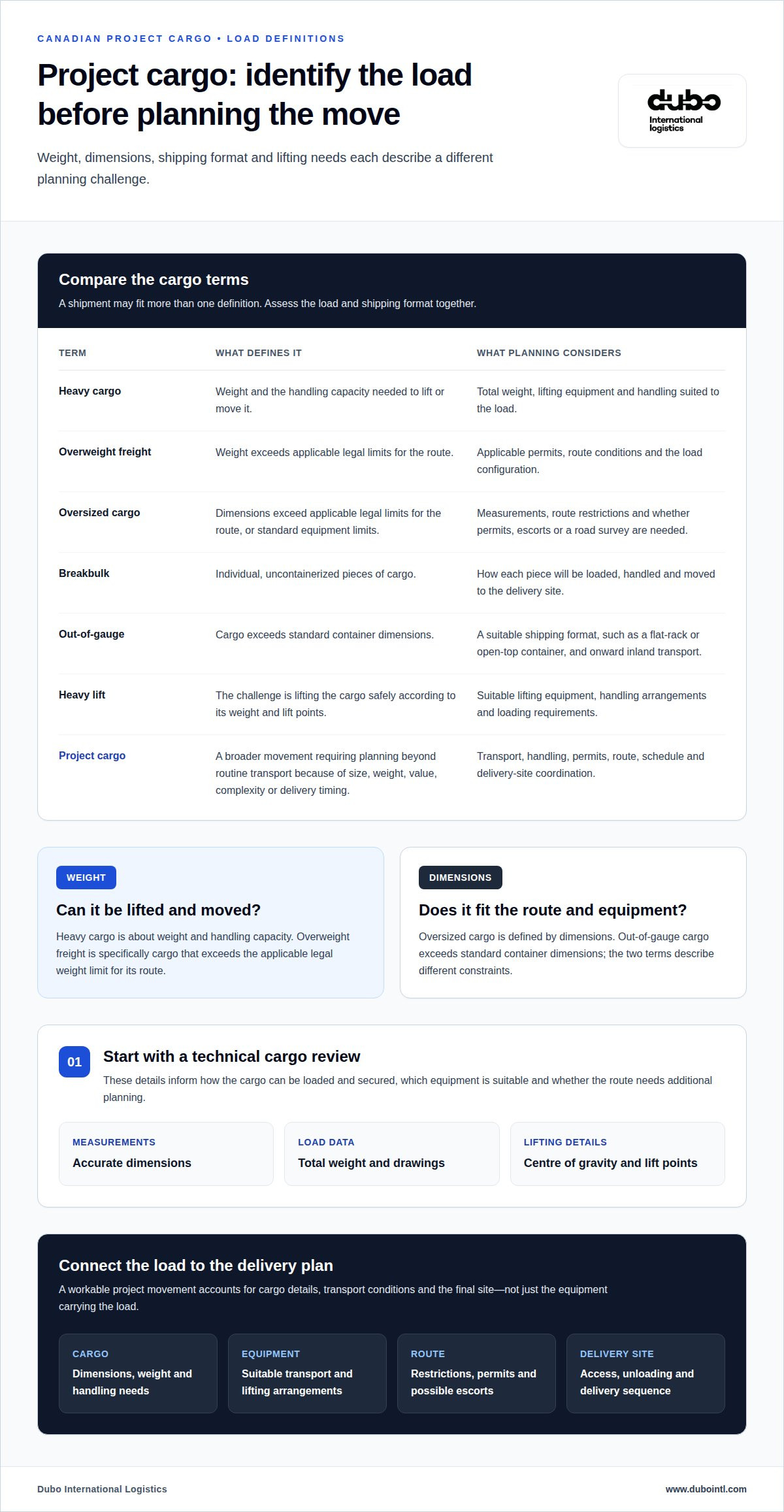
Heavy cargo is defined by its weight and the handling capacity needed to lift or move it. Oversized cargo exceeds applicable legal dimension limits for its route; overweight freight exceeds applicable legal weight limits. These conditions can occur separately or together, so a wide, light machine and a compact, heavy component require different transport plans.
Breakbulk is cargo shipped as individual, uncontainerized pieces. Out-of-gauge cargo exceeds standard container dimensions and may need options such as a flat-rack or open-top container. A construction beam shipped separately is breakbulk; a machine extending beyond a container’s dimensions is out of gauge. Assess measurements, weight, and shipping format together.
Heavy Lift, Oversize and Project Cargo
Heavy lift refers to the lifting challenge: cargo needs lifting equipment and handling suited to its weight and lift points. Oversize refers to dimensions that exceed standard equipment or legal road limits. Project cargo describes the broader movement, often combining transport, handling, timing, and delivery coordination. A large generator, for example, may be both heavy lift and oversize freight within a project shipment.
Start the technical review with accurate dimensions, total weight, drawings, centre of gravity, and lift points. These details help determine how the cargo can be loaded and secured, which specialized equipment is suitable, and whether the route needs additional planning. For international freight, the plan must also connect the shipping method with inland transport and the delivery timeline.
Oversized-Load Accommodations and Specialist Providers
Accommodations for oversized loads depend on the cargo and route. Freight that exceeds legal dimension or weight limits moves under permit with planned routing; an escort vehicle or road survey may also be required. Requirements vary by province, state, and load. For example, a wide machine crossing provincial boundaries needs a route plan that accounts for each jurisdiction.
Specialist providers coordinate the elements that make a move workable: equipment selection, permits, escorts, loading and unloading arrangements, and site access. They also align the timeline with cargo readiness and the delivery sequence. When assessing a proposed plan, look for clear treatment of measurements, handling requirements, route constraints, and the final site. These details distinguish a coordinated project movement from a simple truck booking.
What about permits and escorts, how does that work?
Oversized or overweight freight that exceeds legal limits moves under permit with planned routing. Common challenges include provincial requirements, route restrictions, escort coordination, and changes that affect loading or arrival at the destination.
For project cargo logistics in Canada, a route plan must account for the actual load, every jurisdiction crossed, and the delivery site. A route suitable for one shipment may not work for another with different dimensions.
Route Planning and Surveys
Route planning assesses whether the road network can accommodate the shipment from origin to destination. A survey can identify obstacles such as tight turns, limited clearances, or access constraints near the delivery site. For example, a large component may fit on the highway but face a turning restriction on the final approach.
Start with accurate cargo dimensions and the proposed loading configuration. The planner can then review the full route, including local roads, rather than assessing only the longest highway segment.
Permit Coordination and Escorts
Overdimensional permits authorize a planned movement when freight exceeds applicable legal dimension or weight limits. Requirements vary by province, state, and load, so a cross-border journey may involve different permit and routing conditions on each side. Escort vehicles may also be required for some oversized moves.
Coordination connects permit conditions with the transport plan. The movement schedule, route, cargo dimensions, and escort arrangements need to align before dispatch. A change to the load or route can affect the permit plan.
Route and Permit Risks
A permit does not make every road suitable. Route restrictions, site access limits, or a mismatch between the permitted configuration and actual loading can disrupt a planned move. A shipment approaching a border also needs a route plan that accounts for the change in jurisdiction.
A risk review should connect each restriction with a practical response. If a road survey identifies a narrow turn near the destination, adjust the route before dispatch. If loading changes the cargo dimensions, update the plan to reflect the new configuration. Clear coordination helps keep permits, escorts, and delivery timing aligned.
For a complex Canadian move, logistics consulting can bring route surveys, permit coordination, and escort planning into one transport plan. Resolve route and load requirements before dispatch, not after freight reaches a restriction.
Inland transport and site delivery
A project shipment may combine road, rail, sea, or air transport before reaching a Canadian site. Careful planning connects each transfer with the cargo’s handling needs and the receiving site’s access.
Multimodal Transport Options
Multimodal transportation combines different modes in a single movement. A large industrial component might travel by ship to a Canadian port, then continue by truck or rail to its destination. The right sequence depends on cargo dimensions, route access, available equipment, and delivery timing.
Each transfer needs a clear handoff plan. The team coordinates how freight moves between a vessel, railcar, and truck, including the equipment needed for loading and unloading. A container may suit cargo that fits its dimensions; an out-of-gauge component may need a different arrangement. Account for every transfer point in the routing plan, not just the first and final legs.
Mode selection also depends on the receiving site. Rail may bring freight closer to an industrial corridor, while a truck completes delivery to a facility without rail access. When a shipment changes modes, planners align arrival timing and handling arrangements so the next carrier can receive the cargo as planned.
Breakbulk Transport
Breakbulk freight travels as individual, uncontainerized pieces rather than inside a standard container. Examples include steel beams, large machinery, and construction components shipped separately. The movement plan must account for each piece’s dimensions, lifting points, and loading method.
At a port or transfer point, cranes may be needed to move pieces between a vessel and inland transportation. Crane availability, lifting capacity, and access to the cargo influence how the transfer is organized. For a group of components, a coordinated sequence can help ensure the right pieces reach the site in the order needed for installation.
Documentation and handling instructions should identify each piece clearly. Marked components make it easier to match cargo with delivery sequences and receiving plans. A component that arrives before its installation stage may complicate site operations, so the shipment schedule should reflect the project sequence.
Site Delivery and Unloading Coordination
The final leg brings inland routing together with practical site conditions. A delivery plan should address appointment times, site access limits, unloading arrangements, and equipment needs. For example, a truck carrying a large press may reach the right facility but still need a suitable unloading area and planned access for cranes.
Before dispatch, the movement team aligns the cargo’s arrival with the site’s ability to receive it. This means coordinating the delivery sequence, unloading resources, and instructions for the receiving team. If several components form one installation, each arrival should match the planned work sequence.
Route restrictions can affect the final approach. A truck’s path through an industrial site may differ from its highway route because of turns, gates, or limited access. Including these details in the transport plan connects inland movement with the actual delivery point, rather than treating arrival at the site entrance as the end of the shipment.
Specialized trailer and equipment selection
The trailer and handling method must match the cargo, route, and delivery operation. A production press, transformer, and fragile machine each have different transport requirements.
Review the cargo before choosing equipment
Equipment selection starts with the shipment’s technical details. Drawings, dimensions, weight, centre of gravity, lift points, and handling requirements help determine how machinery can be loaded and secured. A machine’s footprint affects deck space, while its weight and lift points shape the loading method. Missing or inaccurate details can lead to a poor match between cargo and equipment.
Consider the full movement, not just the road leg. A component arriving by ship or rail still needs a suitable transfer plan and inland trailer. For example, a generator may need one arrangement for port handling and another for road delivery. Each change of mode should preserve a practical loading and unloading sequence.
Match the trailer to the load
Flatbed and step-deck trailers can carry project cargo when their configurations suit the freight and route. A lowbed trailer has a low deck, which can help transport tall or heavy cargo while maintaining legal clearance. Selection depends on cargo dimensions, weight, operating conditions, route restrictions, and available qualified capacity.
Overweight or oversized machinery needs more than a suitable trailer category. The plan must consider how the load sits on the equipment, how it will be secured, and whether the route can accommodate the loaded combination. A large stamping press and a long industrial beam may each exceed standard equipment dimensions but require different trailer configurations and loading methods.
Coordinate lifting and handling equipment
Energy equipment such as transformers, turbines, and oilfield equipment may require specialized handling. Drawings and lift points inform the choice of lifting equipment and how the cargo transfers between transport modes. A crane may support loading or unloading, but site access and the planned lift must also suit the cargo’s handling requirements.
For heavy assembly tools or production equipment, coordinate trailer selection with loading arrangements, route requirements, and site delivery. When a standard flatbed or step-deck does not suit the shipment, heavy-haul partners may be used where specialized equipment is needed. Make that decision after reviewing the cargo.
A sound equipment plan links cargo data to every movement stage. Confirming dimensions, weight, centre of gravity, lift points, and handling instructions gives the transport team a clear basis for matching the trailer and equipment to the shipment.
Project cargo shipping locations in Canada
A suitable Canadian shipping location connects the cargo’s origin with its inland route and final site. For project freight, assess terminal handling arrangements, onward connections, and access requirements alongside the shipment’s dimensions and weight.
Map the origin, destination, and transfer points before choosing an entry location. A port or rail terminal may be suitable, but the shipment also needs a practical route from that facility to the delivery site. For example, a machine arriving by vessel needs a planned transfer to inland transport and a route that accommodates its loaded dimensions. Base location decisions on the entire journey.
Across Canada, project cargo providers and terminals serve different shipment needs. Their suitability depends on the cargo, available handling arrangements, and connections to the destination. Assess the actual movement requirements rather than assuming a particular location has the capacity for a specific shipment.
For a destination far inland, compare possible entry points by their onward connections. The route may depend on whether the cargo can travel by rail, truck, or a combination. A large component requiring specialized handling may need suitable transfer arrangements. A shipment with a fixed delivery sequence may benefit from a plan that limits unnecessary transfers.
Customs and shipment documentation also matter for international freight. The origin, destination, cargo description, and transport mode inform the documents needed to coordinate the border crossing and onward movement. Keep shipment details consistent across transport records. Differences between the documents and the cargo can complicate a handoff at a terminal or border.
Insurance for project cargo should reflect the shipment’s declared value, route, transport modes, and handling points. Consider the full journey, including transfers between vessel, rail, and truck, rather than only the longest leg. Fragility and specialized loading or unloading needs also matter when deciding on coverage.
Before selecting a location, map these decision points:
- Origin and destination: define the complete movement, including the final site approach.
- Terminal handoffs: match handling arrangements to cargo dimensions, weight, and requirements.
- Inland connection: assess the available transport modes for the onward shipment.
- Border and documentation: align cargo details across international transport records.
This location-first approach connects the choice of Canadian terminal with the project’s delivery requirements.
Dubo International Logistics
Dubo International Logistics coordinates project cargo movements through freight forwarding, logistics consulting, and specialised transportation services. Turn to the team when a shipment needs coordination across transport modes, specialised equipment, or complex Canadian corridors.
Planning connects cargo details with routing, equipment requirements, and delivery-site needs, giving each stage a clear place in the overall movement. Whether you’re moving oversized machinery, delicate equipment, or components with specific handling needs, the plan is shaped around the shipment rather than a standard transport template.
For project cargo across Canada or between Canada and the United States, our specialists can coordinate the logistics needed to move freight toward its destination. Contact Dubo International Logistics to discuss your shipment requirements.
Prepare the next shipment decision
Before committing to a movement plan, bring the cargo description, drawings, dimensions, weight, origin, destination, handling needs, and target delivery window into one working brief. This gives the logistics team a shared starting point for assessing options and identifying decisions that need coordination across the shipment. For staged projects, specify which components must arrive first and what site readiness each arrival depends on.
Planning project cargo logistics in Canada is easier when operational priorities guide decisions from the outset. Dubo International Logistics supports this work through freight forwarding, logistics consulting, and specialized transportation services, coordinating each movement around the shipment and its delivery requirements.
A useful next step is to identify who will make decisions about cargo readiness, site access, and delivery sequence. Clear ownership can help keep project planning aligned as requirements develop. When you’re ready to discuss your shipment, contact Dubo International Logistics. A clear starting brief can help your planning conversation focus on the decisions that matter and move your project toward a coordinated delivery.
Frequently Asked Questions
Freight That Doesn't Fit the Box?
Freight that exceeds a container’s dimensions or a standard trailer’s capacity may need project-cargo planning. A long industrial beam, for example, may travel as an individual piece rather than inside a container. Cargo may also need special planning because of its weight, fragility, or handling requirements. Accurate measurements and a clear cargo description help identify suitable equipment and transport arrangements.
When should planning begin?
Project cargo teams typically begin planning three to six months ahead. A simple oversize move might need only a few weeks. The timeline depends on the cargo, route, permits, escorts, equipment, and site arrangements. A phased shipment also needs time to coordinate component readiness and delivery sequence. Starting early gives planners room to align these moving parts before the requested site date.
Which trailers can be used?
Flatbed, step-deck, and lowbed trailers can carry project freight, depending on the load and route. A lowbed’s lower deck can help accommodate tall cargo while maintaining legal clearance. Trailer selection also considers cargo weight, dimensions, securement points, and loading and unloading arrangements. A detailed cargo drawing can help planners assess whether the trailer configuration suits the shipment.
What is project cargo logistics in Canada?
Project cargo logistics in Canada coordinates freight movements that need more planning than routine shipments. This can involve specialized equipment, multiple transport modes, route coordination, and delivery sequencing. For example, moving several components for one industrial installation means aligning transport plans with the order the site needs them. The logistics plan connects shipment requirements with every movement stage.
Which Canadian ports and transport corridors handle project cargo?
The suitable port or corridor depends on the shipment’s origin, destination, cargo dimensions, and onward transport options. A port is only one part of the route: planners also consider terminal handling, rail or truck connections, and access to the final site. For a shipment with several components, assess how well possible routes support transfers and the required delivery sequence.
What are the size and weight limits for oversized loads on Canadian roads?
There is no single size or weight limit for every Canadian road movement. Requirements depend on the load and the jurisdictions along its route. Planners assess the loaded vehicle’s dimensions and weight against route conditions, then determine whether permits and planned routing are needed. A load crossing provincial boundaries may face different requirements along the way.
What permits and escorts are required for oversized cargo in each Canadian province?
Permit and escort requirements vary by province, state, and load. Oversized or overweight cargo that exceeds legal limits moves under permit with planned routing; some movements may also require escorts or a road survey. For a shipment crossing provincial boundaries, coordinate requirements across each jurisdiction. Changes to the cargo configuration or route can affect those arrangements.
What information helps plan project cargo shipping to or within Canada?
Share the cargo description, dimensions, weight, origin, destination, loading method, delivery-site details, and timing. These details help planners assess suitable transport modes, equipment, route requirements, and transfer arrangements. For machinery, technical drawings and handling instructions can clarify how it should be moved. For phased shipments, include the order in which components are needed so the delivery sequence supports site operations.
