

Traditional logistics partner onboarding typically takes 2-6 weeks. A clear plan for how to onboard a new logistics partner sets workflow expectations, confirms system integrations, assigns communication responsibilities and stages the transition before shipments move through the new arrangement. The calendar matters, but readiness depends on resolving operational details in sequence.
A logistics partner does more than move freight. They coordinate the services and processes that connect shipments with your wider supply chain. A clear timeline matters, especially when your team must maintain service while adopting new procedures. The schedule depends on the complexity of your workflows, the systems involved and your cargo requirements.
This guide explains how to set expectations, plan integrations and assess the local expertise needed to support shipments across Canada. You’ll also see practical onboarding timeline examples, from straightforward transitions to projects that require more coordination, so you can plan each stage with greater confidence.
Key Takeaways
- Set service expectations around your actual workflows, cargo requirements and communication needs before the transition begins.
- Map system connections and information flows early so integration work doesn’t become an onboarding bottleneck.
- Traditional logistics partner onboarding typically takes 2-6 weeks; workflow complexity and integration needs shape the schedule.
- Assess local market knowledge and agree on how teams will share updates, manage exceptions and review performance.
- Use practical timeline examples to sequence responsibilities and prepare your team for a controlled changeover.
Aligning service expectations with workflow clarity and responsiveness
Start onboarding by defining what the logistics arrangement needs to support. An online retailer, for example, may need frequent parcel dispatches and order-status updates. A manufacturer shipping oversized machinery may need specialized transportation, coordinated pickup windows and specific handling instructions. Each situation calls for distinct workflows, service expectations and measures of success.
Map each shipment’s journey from order release to delivery confirmation. Record who sends the booking, which details accompany it, who handles exceptions and how delivery completion is reported. Include the shipment type, origin, destination, handling needs and delivery window. This gives both teams a shared operating picture and makes shipment visibility practical, rather than dependent on scattered manual updates.
Match the proposed service to your business model and cargo. For temperature-sensitive products, define how handling instructions and shipment updates pass between relevant teams. For delicate equipment, document handling requirements before dispatch. Connect each requirement to a clear process and responsible role. This helps close gaps between business expectations and the workflow supporting them.
Location and capacity also shape a workable arrangement. For shipments between Canadian destinations, confirm that the transportation plan covers the routes and origins involved. If shipments cross into the United States, include cross-border hand-offs in the workflow. For specialized cargo, assess whether the planned transportation approach suits the equipment and route. This clarifies how the service fits and where coordination needs attention.
Plan for changes in volume or geography. If a manufacturer expects to expand deliveries into another region, map the new origin, destination, handling requirements and communication path before adding that route. Review capacity against the shipment profile, not just current dispatches. This creates a defined way to adapt as the business expands, without assuming every route or cargo type requires the same approach.
Set customer service expectations in operational terms. Identify the contact route for routine updates, who handles service exceptions and what information each update should include. For example, a delayed pickup notice should identify the affected shipment and the next operational step. Regular team meetings can surface recurring issues and upcoming initiatives, while agreed service levels make performance discussions more specific.
Canadian requirements depend on the activity and cargo. According to the Department of Justice Canada, a person must register in the dangerous-goods database before importing, offering for transport, handling or transporting dangerous goods at a site they own or operate. Identify the relevant activity and cargo when assigning responsibilities and planning compliance procedures.
Automating onboarding and integrations
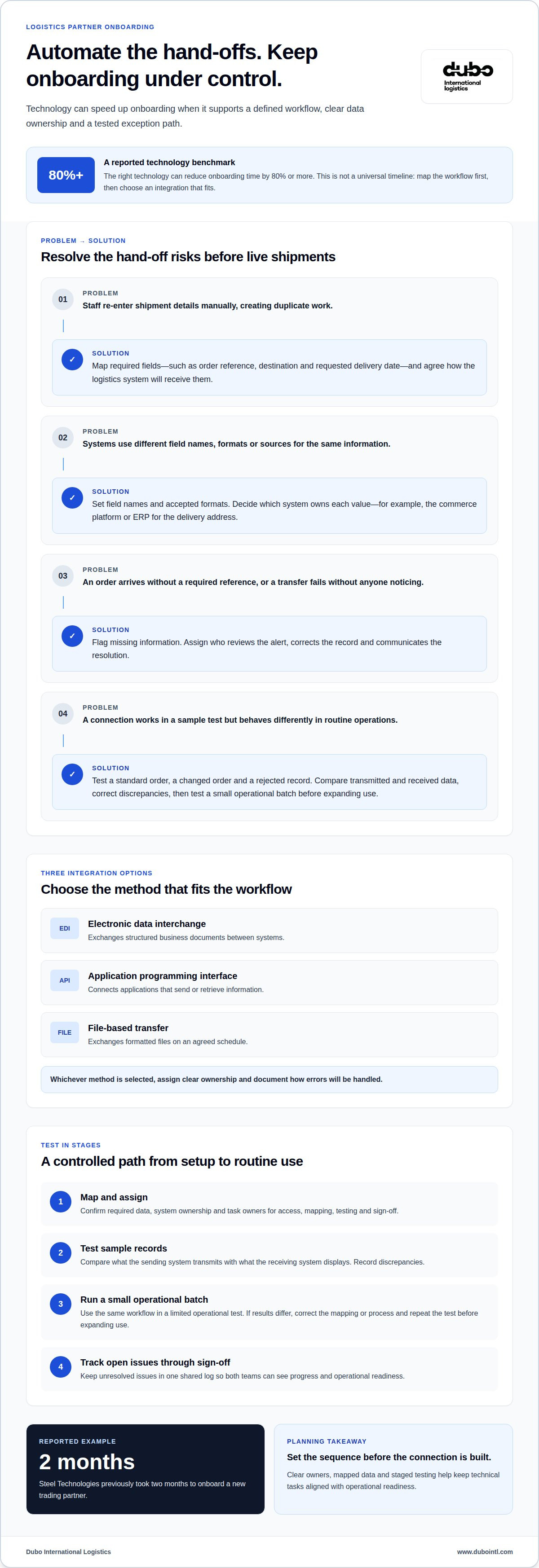
Technology can shorten partner onboarding, but only when it supports a defined process. One reported benchmark says the right technology can reduce onboarding time by 80% or more. That figure is not a universal timeline. First map which shipment, order and status details must pass between systems, then choose an integration method that fits those workflows.
Three common integration options are electronic data interchange (EDI), application programming interfaces (APIs) and file-based transfers. EDI exchanges structured business documents between systems. APIs connect applications that send or retrieve information. File-based integration can suit workflows where teams exchange formatted files on an agreed schedule. Each method needs clear ownership and an error-handling process.
Consider a Canadian distributor whose commerce platform sends orders to an operations system. Staff currently re-enter shipment details manually, creating duplicate work. First, map required fields, such as order reference, destination and requested delivery date, then agree how the logistics system will receive them. The result is a defined hand-off between teams, rather than repeated data entry.
Integration also depends on consistent information. Before testing, define field names, accepted formats and which system owns each value. For example, decide whether the commerce platform or ERP provides the delivery address. Then test a standard order, a changed order and a rejected record. These scenarios can reveal mismatches before they affect live supply chain activity.
Automation needs an exception path. If an order arrives without a required reference, the receiving system should flag the missing field for assigned staff. Document who reviews the alert, corrects the record and communicates the resolution. This keeps a failed transfer visible instead of allowing incomplete shipment information to pass silently between business and logistics operations.
Test in stages before putting the connection into routine use. Start with sample records, compare what the sending system transmits with what the receiving system displays, and record discrepancies. Next, test a small operational batch using the same workflow. If results differ, correct the mapping or process, then repeat the test before expanding use.
A named example shows why integration planning deserves time: Steel Technologies previously took two months to onboard a new trading partner. For a new implementation, assign owners for system access, data mapping, testing and sign-off. Track unresolved issues in one shared log. This gives both teams a practical view of progress and keeps technical tasks aligned with operational readiness.
Connecting third-party logistics, warehousing, and freight delivery
A third-party logistics arrangement connects shipment planning with the people responsible for each transportation hand-off. During onboarding, map how freight moves from pickup through planned transfers to final delivery. Identify who books each movement, shares shipment instructions, coordinates appointments and confirms completion. A clear chain of responsibility helps prevent missed hand-offs between logistics teams and carriers.
For a business serving customers across Canada, define the routes and delivery regions the freight plan must support. Match each shipment’s origin, destination, handling requirements and delivery window to the appropriate transportation arrangement. If demand shifts between regions, review how the change affects pickup coordination, routing and delivery commitments before updating dispatch plans.
For example, a distributor begins serving a new group of business customers, creating a delivery pattern with appointment-based receiving. Document each destination’s appointment process, the required shipment details and who is responsible for coordinating arrival. The result is a defined hand-off between dispatch and the receiving contact, rather than an arrival planned without regard to site procedures.
Choose the freight method around the shipment profile. LTL freight shipping may suit cargo that shares trailer capacity with other shipments, while a dedicated movement may fit freight requiring a specific handling plan. For B2B distribution, agree how delivery appointments, pallet flow and dock coordination connect to dispatch. These details shape the operating plan and clarify what information must accompany the freight.
Set an exception process for disruptions in transit. If a connection is missed or a delivery appointment changes, define who communicates the revised plan and how affected parties receive it. For instance, the transportation coordinator can notify the receiving contact and update the shipment record. This gives the team a consistent response instead of leaving each carrier or department to interpret the change independently.
For freight moving through complex corridors, document each transportation hand-off and its owner. Specify which shipment references travel with the freight, who confirms each transfer and how delivery status is reported to the business. This is especially useful when separate carriers handle different legs. A shared route plan shows where responsibility changes and who should act if a movement falls behind schedule.
Review the connected process using delivery completion, on-time dispatch and issue-resolution records. If delays recur at a particular transfer point, examine its appointment steps, communication path and assigned responsibilities. Agree on a corrective action and review subsequent movements for improvement. This keeps the freight plan focused on practical coordination from origin to destination, rather than treating transportation legs as isolated tasks.
Local market knowledge and provider accountability
Local expertise affects how a transportation plan works in practice. A partner familiar with the relevant Canadian markets can account for regional delivery expectations, seasonal changes and established industry relationships. During onboarding, map each origin and destination, then discuss local operating conditions that could affect hand-offs. This connects route planning with actual capabilities and customer commitments.
Industry knowledge matters too. Delicate equipment requires a different operating conversation from recurring replenishment freight. Describe the cargo, handling needs and business objectives, then assess whether the provider’s experience aligns with those requirements. For a complex corridor, discuss transitions between transportation modes or teams. The result is a plan shaped around the shipment, not a generic description of service.
Consider a Canadian manufacturer expanding deliveries into a new region, where local delivery expectations are unfamiliar. Review the route, operational hand-offs and seasonal considerations with a partner who understands that market. The result is a clearer transition plan, with responsibilities and communication points established before shipments begin.
Accountability starts with shared visibility. Agree on the information each party will provide about internal and external logistics activities, and how teams will use it. Schedule regular reviews of performance, incidents and operational changes. If delivery exceptions cluster around one route, both teams can review the hand-off and identify a practical improvement. Record the action owner and follow-up in meeting notes.
Assess capabilities using relevant evidence. Ask for examples of similar industry or supply chain requirements, and consider references that address those needs. Review the provider’s operating history, professional associations and contracted suppliers as part of the assessment. These steps help show whether the relationship is supported by suitable experience and aligned operating practices, rather than broad claims alone.
Joint initiatives can extend beyond resolving individual shipment issues. If both teams identify recurring delays at a hand-off, for example, they can examine the process together and agree on a change. Share operational information and business objectives so proposed improvements support both organizations. Early involvement also helps teams define shared efficiency initiatives and decide how to review progress.
Keep marketing and lead generation within a clear boundary. A logistics partner can provide operational input that supports customer-facing promises, such as which destinations a transportation plan serves and how delivery updates are communicated. If a sales team plans to promote service in a new region, align those claims with the actual logistics arrangements. This supports credible messaging, while campaign strategy and lead generation remain with the business.
Logistics partner onboarding timelines
Traditional logistics partner onboarding typically takes 2-6 weeks. Treat that range as a planning guide, not a fixed schedule: system connections, shipment complexity, documentation and team readiness affect the work. A clear plan for how to onboard a new logistics partner starts with completed milestones, not simply a target date.
A practical sequence moves through scope definition, process design, system setup, testing and controlled launch. Assign an owner to each milestone and record what must be ready before work proceeds. For example, establish shipment instructions and communication routes before testing orders. Flag unresolved integrations or processes instead of treating a calendar date as proof of readiness.
A straightforward transition may involve familiar freight and a limited set of workflows. Confirm shipment data, contacts, operating steps and exception handling, then test representative orders. This supports a go-live decision based on successful hand-offs. A more complex transition, such as specialized cargo or multiple shipment paths, needs additional coordination and testing before volume expands.
When deciding how to onboard a new logistics partner, compare proposals against the same shipment profile, service scope and operating requirements. Review contract terms for responsibilities, performance commitments, liability provisions, claims procedures and renewal or termination conditions. Confirm how the agreement addresses shipment exceptions and changes to instructions. Comparing equivalent service assumptions makes operational differences between proposals easier to assess.
For insurance and claims, review insurance documents, stated coverage limits, exclusions and how coverage applies to your cargo and routes. Read the contract’s liability terms, claim-notification steps, required records and submission process. These documents clarify how a loss or damage claim would be handled. Insurance coverage and contractual liability are related, but they are not interchangeable.
Before shifting shipments at scale, test the partner with a controlled set of representative movements. Include routine freight and a relevant exception, such as changed delivery instructions or a shipment detail requiring correction. Compare booking information, status updates, delivery records and issue handling against agreed expectations. Record gaps, assign corrective actions and repeat the affected test before increasing volume.
A growing business can use these milestones to plan efficiently while adding a platform or expanding shipment types. If delays occur, identify whether the cause is missing information, a system mismatch, unclear responsibility or incomplete testing. Resolve the cause before compressing later stages. Moving faster without fixing the underlying issue can carry errors into live operations.
For structured planning around shipment requirements and launch readiness, discuss logistics consulting as part of your onboarding approach.
Dubo International Logistics
Dubo International Logistics helps businesses align shipment requirements, workflows and partner coordination during a logistics transition. Its logistics consulting supports onboarding plans, while freight forwarding and specialized transportation services support cargo movement and specific handling needs. These services are a practical fit when your team is coordinating multiple shipment requirements, integrating new processes or moving complex cargo across North America.
Bring your shipment profile, operating priorities and transition challenges to the discussion. Together, these details can inform a plan that connects day-to-day workflows with the transportation you need. For support onboarding a logistics partner, contact Dubo International Logistics.
Build a partnership that can adapt
Onboarding should prepare your organization for change, not just a hand-off. As products, suppliers or customer expectations evolve, review whether the logistics relationship still supports your operating priorities. Set a clear trigger for that review, such as a supply chain change or planned market expansion. This keeps future decisions connected to business direction rather than relying on processes that no longer fit.
Knowing how to onboard a new logistics partner also means deciding how the relationship will develop after launch. Identify who can raise a new requirement, how teams will assess its operational impact and how they will record agreed changes. This simple governance practice gives new initiatives a defined path without disrupting established work.
If you’re planning a transition or adapting an existing arrangement, Dubo International Logistics can discuss the logistics considerations behind your next step. Contact Dubo International Logistics to discuss your requirements and consider a practical path forward.
Frequently Asked Questions
What causes delays in carrier and supplier onboarding?
Incomplete shipment details, unresolved contract terms and unclear responsibilities commonly slow onboarding. Delays can also arise when system records use different product codes or destination formats. For example, a supplier may submit an order without the reference required by the carrier’s booking process. Assign an owner to each unresolved item and track decisions in a shared record. This makes blockers visible and helps teams address them before launch.
What information and documents should you collect when onboarding a logistics partner?
Collect company and operating contacts, shipment profiles, origin and destination details, handling instructions, expected service requirements and escalation contacts. Include relevant insurance documents, contract terms, claims procedures and operating instructions. For cross-border movements, organize the shipment information and trade documents required for the specific goods and route. A controlled document set gives each team a consistent reference, while version dates help prevent outdated instructions from guiding a live shipment.
What are the steps to onboard a new logistics provider from selection to go-live?
Move from selection to launch through defined approval gates: document requirements, agree on scope and responsibilities, complete the contract, prepare system and operating processes, test representative shipments, then authorize go-live. For example, a manufacturer can test a routine machinery shipment and a changed delivery instruction before transferring regular volume. Record who approves each gate and what evidence they review. This makes onboarding a controlled transition, not just a launch date.
How do you assess a logistics partner’s capacity, coverage, and service levels?
Compare the provider’s operating capabilities with your shipment profile, routes, handling requirements and anticipated changes in demand. Ask for a route-by-route view of coverage and how capacity is planned during seasonal peaks or growth. Assess service levels using documented performance information and examples relevant to your cargo. For instance, a business shipping delicate equipment should evaluate handling experience and exception communication, not just general transport capacity.
How should you integrate a logistics partner’s systems, EDI, API, and shipment tracking?
Map which system creates each shipment record and which system owns updates such as delivery status. Define access permissions, data formats, reference fields and notification recipients before connecting EDI, an API or file transfers. Test a shipment update, a changed delivery instruction and a failed data message. Then reconcile the partner’s tracking events with your internal records, so teams can identify missing or inconsistent statuses without relying on separate manual searches.
What KPIs and service-level agreements should you set with a new logistics partner?
Choose measures that reflect the service your operation depends on, such as pickup and delivery performance, order-processing accuracy, shipment visibility and issue-resolution time. In service level agreements (SLAs), define how each measure is calculated, which events count, who reports results and how teams address a missed commitment. For example, clarify whether delivery performance is measured against the agreed delivery window or another recorded milestone. Review results together and assign follow-up actions.
What are common logistics partner onboarding risks and how can you mitigate them?
Common risks include incorrect shipment data, unclear ownership, untested system connections and transferring too much volume before processes settle. Reduce exposure by limiting the launch scope, assigning owners to exceptions and documenting change approvals. For example, if delivery instructions change after booking, specify who updates the record and informs the receiving team. A defined fallback process helps maintain continuity while teams resolve a disruption.
How long does logistics partner onboarding typically take, and what affects the timeline?
Traditional logistics partner onboarding typically takes 2-6 weeks. The schedule depends on the work involved, including contract approvals, workflow decisions, system integration, shipment requirements and testing. A transition with familiar processes can move through fewer preparation tasks than one involving specialized cargo or several data connections. Plan around completed milestones, not just a target date, and allow unresolved issues to be corrected before regular shipments transfer.
