
If your logistics strategy feels like a collection of disconnected hand-offs rather than a single, fluid motion, how much is the lack of visibility actually costing your bottom line? Many Canadian business leaders realize that fragmented carrier networks often result in hidden expenses and a persistent lack of accountability when shipments stall. By adopting a strategic approach to end-to-end freight management, you can transition from reactive shipping to a unified system that secures your supply chain across North America.
It's difficult to maintain composure when diesel prices sit at C$2.19 per litre and fuel surcharges for some routes exceed 70 percent, yet you're still stuck fixing cross-border documentation errors. You deserve a stabilizing partner to act as a protective steward of your interests. This guide examines the methodology behind achieving predictable pricing, ensuring seamless cross-border movement, and accessing expert guidance for your most complex specialized cargo needs. We'll show you how to move beyond the friction of traditional shipping and into a future of strategic foresight and operational excellence.
Key Takeaways
- Learn to transition from fragmented shipping models to a unified logistics architecture that secures your entire North American supply chain.
- Understand how logistics consulting identifies operational inefficiencies and hidden costs before they impact your project's bottom line.
- Evaluate providers based on strategic expertise rather than software interfaces to ensure the safe movement of specialized or high-value cargo.
- Discover how end-to-end freight management provides the meticulous execution required for seamless cross-border transit between Canada and the United States.
- Realize the value of a professional logistics steward who prioritizes dependability and precision to provide peace of mind for complex global movements.
What is End-to-End Freight Management in the Canadian Market?
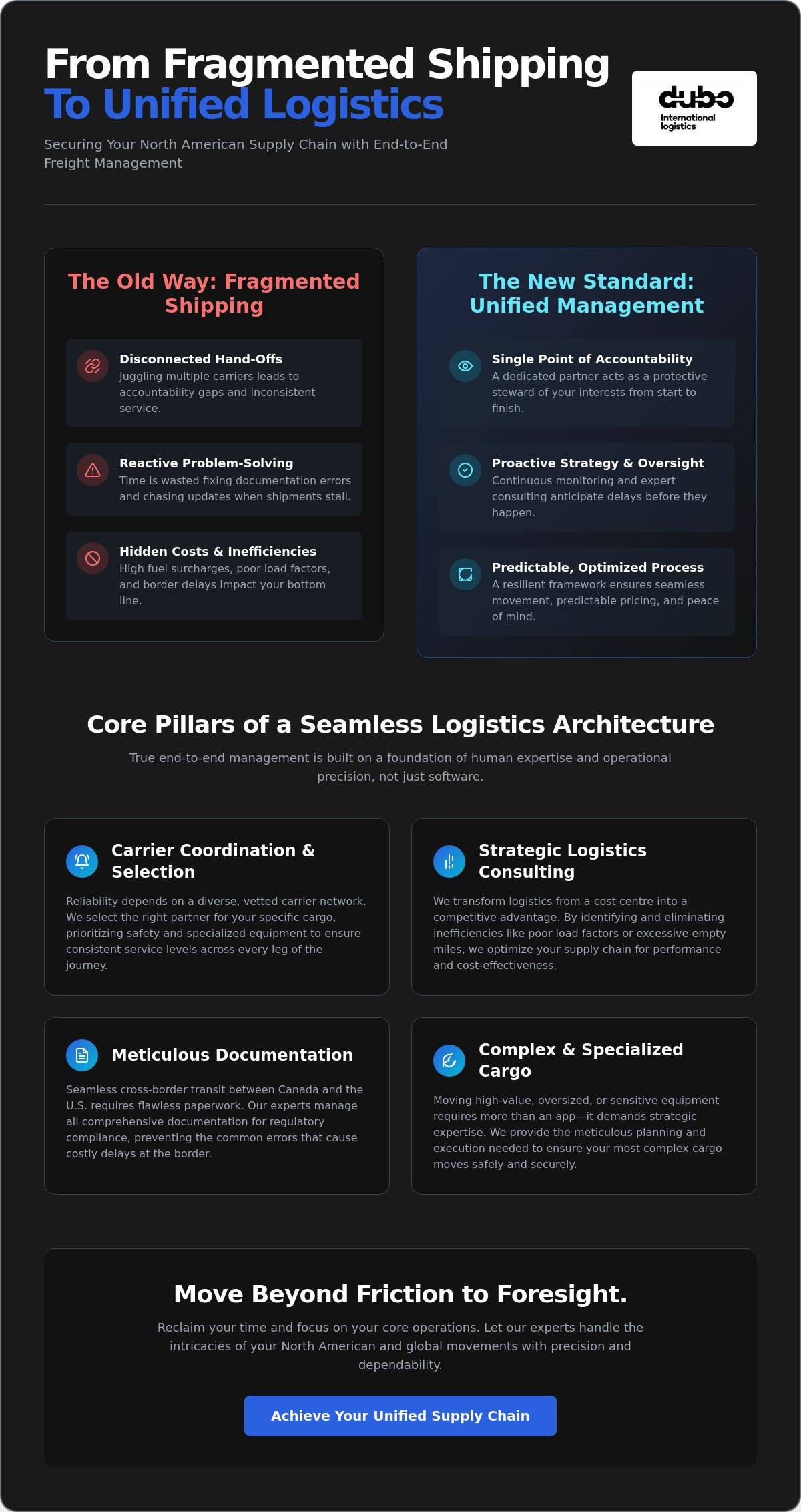
End-to-end freight management represents a fundamental shift in how Canadian enterprises approach their supply chains. It is a holistic strategy that oversees every phase of movement from the point of origin to the final destination. Instead of treating logistics as a series of isolated events, this model integrates carrier coordination, meticulous documentation, and high-level consulting into a single, cohesive process. It provides a stabilizing force for businesses that can no longer afford the risks associated with fragmented shipping methods.
For many organizations, shipping has traditionally been a transactional task. You find a carrier, you book a load, and you react to problems as they arise. Strategic logistics architecture replaces this uncertainty with a bespoke framework designed to withstand the complexities of North American trade corridors. This is particularly vital in Canada, where the federal government continues to propose reforms to streamline the National Trade Corridors. Moving beyond simple transport to a managed system ensures that your business remains resilient against shifting regulations and economic pressures. Ultimately, the transition to end-to-end freight management allows companies to reclaim their time and focus on their core operations while experts handle the intricacies of global movement.
The Difference Between Shipping and Management
Shipping is the physical act of moving cargo from point A to point B. Management is the professional science of optimizing that entire lifecycle. When a business adopts a managed approach, it significantly reduces the labour burden on internal teams who would otherwise spend hours chasing updates or correcting paperwork. By establishing a central point of accountability, you eliminate the friction that often occurs between fragmented carriers. This oversight ensures that every shipment remains on schedule, as a dedicated partner acts as a protective steward of your interests, anticipating delays before they impact your customer's experience.
Key Components of the End-to-End Model
A robust model relies on several Core pillars of logistics that work in tandem to protect your bottom line. This begins with strategic route planning and multi-modal coordination, ensuring that whether your freight moves by rail, road, or sea, the transitions are seamless. It extends to comprehensive documentation management, which is essential for regulatory compliance and avoiding the errors that frequently cause border delays. High-quality end-to-end freight management requires continuous oversight from the factory floor to the customer's door. This level of precision provides a sense of security that transactional shipping simply cannot match, turning a complex global environment into a predictable, manageable process for your business.
The Core Pillars of a Seamless Logistics Architecture
A high-functioning logistics strategy isn't built on software alone. It requires a structural foundation that balances human expertise with operational precision. True end-to-end freight management acts as a strategic control tower, overseeing every variable from port congestion to the final mile. This architectural approach aligns with the initiatives led by Canada's National Supply Chain Office, which focuses on enhancing the reliability and efficiency of our domestic transportation networks. By viewing the supply chain as a single, integrated system, businesses can move away from the stress of fragmented shipping and toward a model of quiet confidence.
Carrier Coordination and Selection
Reliability in North American movement depends on a diverse, vetted carrier network. You don't just need a truck; you need the right partner for your specific cargo requirements. Whether you're moving sensitive electronics or oversized industrial equipment, the selection criteria must prioritize safety records and specialized equipment. Centralized coordination ensures that service levels remain consistent across all legs of the journey. This eliminates the accountability gap that often occurs when shippers juggle multiple, disconnected providers. When every carrier is synchronized under one management strategy, the result is a smoother, more predictable flow of goods.
Strategic Logistics Consulting
Many businesses view logistics as a cost centre, but strategic logistics consulting transforms it into a competitive advantage. By identifying inefficiencies like poor load factors or excessive empty miles, consultants help realize long-term savings that far outweigh their initial fees. This process involves meticulous route optimization and a deep understanding of current market pressures, such as the rising costs of diesel, which reached C$2.19 per litre in early 2026. Logistics consulting serves as a vital tool for achieving supply chain maturity in 2026. It allows you to build a resilient framework that adapts to economic shifts rather than being victimized by them.
Real-time visibility is about more than just tracking a dot on a map. It's about proactive problem solving. When a widespread winter storm or a regulatory shift impacts the Canada-USA border, a managed strategy allows for immediate pivoting. Instead of reacting to a delay after it happens, you're anticipating disruptions and rerouting assets to maintain your delivery promises. This level of strategic foresight provides the peace of mind that modern Canadian businesses require to thrive in a complex global environment.
Evaluating Providers: Technology vs. Strategic Expertise
Dashboards are seductive. They promise total control through sleek data visualization and automated updates. However, a dashboard is only as effective as the strategy behind the data it presents. True end-to-end freight management requires a delicate balance between automated tracking and high-level project management. While Freight management technology provides essential data points, it cannot account for the human variables that frequently disrupt global trade. Choosing a provider based solely on their software interface often leads to a lack of accountability when real-world challenges arise.
When Software Isn't Enough
Technology thrives on standardization. It excels at moving uniform pallets along predictable routes. But what happens when your cargo is oversized, sensitive, or high-value? These non-standard challenges demand the touch of a logistics architect rather than a mere freight aggregator. An architect understands the minute details of your specific needs and can realize a manual contingency plan when digital systems fail or border regulations shift unexpectedly. You need a partner who doesn't just monitor a screen but possesses the industry literacy to intervene personally when a shipment requires a bespoke solution.
The Value of Professional Accreditation
In the Canadian market, professional accreditation serves as a benchmark for reliability and peace of mind. Membership in the Canadian International Freight Forwarders Association (CIFFA) is a non-negotiable standard that ensures your partner adheres to strict ethical and operational guidelines. Navigating freight forwarding North America requires more than just a software license; it necessitates a deep familiarity with international standards and the nuances of the North American regulatory environment. This expertise is what transforms a simple service into a dedicated partnership.
Relying on a steady, authoritative partner allows your business to remain resilient regardless of technological or geopolitical volatility. A seasoned expert acts as a stabilizing force, providing the quiet confidence that comes from years of hands-on experience in the field. By prioritizing strategic expertise over flashy interfaces, you ensure that your end-to-end freight management strategy is built on a foundation of dependability and professional precision rather than digital hype.
Managing Complexity: Specialized Cargo and Cross-Border Coordination
Complexity is the true test of a logistics strategy. While standard freight moves with relative ease, specialized cargo requires a level of precision that transactional providers often lack. Whether you are transporting oversized industrial machinery or sensitive medical equipment, the stakes involve more than just a delivery date. High-value assets require a bespoke logistics plan that accounts for physical protection, regulatory hurdles, and optimal route selection. Through end-to-end freight management, businesses can ensure that even the most non-standard shipments move with the same predictability as a standard pallet.
Specialized Transportation Solutions
Coordinating the movement of project cargo across the vast Canadian landscape is a meticulous undertaking. It begins long before the wheels turn, involving detailed site surveys and equipment assessments to mitigate the risk of damage. Specialized expertise is essential for reducing insurance claims and ensuring that high-value goods remain secure throughout their journey. By integrating specialized transportation services into your broader strategy, you gain access to a network of partners equipped to handle unconventional weight and dimensions. This architectural approach ensures that every variable is managed with the quiet confidence of a seasoned expert.
Cross-Border Seamlessness
Navigating the Canada-USA border remains one of the most complex aspects of North American trade. With the upcoming USMCA review in 2026 and ongoing shifts in tariff policies, maintaining a clear paperwork trail is non-negotiable. A provider with deep roots in the North American market understands how to manage documentation to ensure rapid customs clearance. Regulatory compliance in cross-border freight management is the bedrock upon which supply chain reliability is built. This foresight prevents the costly delays that occur when documentation errors stall a shipment at the point of entry.
Bespoke logistics involves more than just moving goods; it requires managing the financial and regulatory pressures that come with international trade. For instance, with Canadian diesel prices reaching C$2.19 per litre in mid-March 2026, and fuel surcharges at major carriers like Bison Transport ranging between 70.8% and 74.0% in June 2026, cost control is paramount. A managed approach to end-to-end freight management allows you to navigate these economic pressures while maintaining the integrity of your specialized cargo. You deserve a partner who acts as a protective steward of your interests, ensuring that every cross-border movement is executed with professional precision.
The Dubo Advantage: Precision in End-to-End Management
Dubo International Logistics stands as a stabilizing force in an increasingly volatile global market. By positioning ourselves as a professional steward of your interests, we provide the quiet confidence required to manage complex supply chains. Our approach to end-to-end freight management is defined by a commitment to dependability and meticulous execution, ensuring that every detail of your cargo movement is handled with precision. We act as a sophisticated bridge between your local operations and the intricate systems of international trade, allowing you to focus on growth while we secure your assets.
As an independent, CIFFA-certified logistics architect, we adhere to the highest standards of the Canadian freight forwarding industry. This accreditation is a mark of excellence that separates seasoned experts from mere aggregators. It ensures that your logistics partner possesses the industry literacy and ethical grounding necessary to protect your interests across every North American trade corridor. By choosing a partner with deep roots in the Canadian market, you gain a level of strategic foresight that technology-only platforms simply cannot replicate.
Our Methodical Approach to Logistics
Every partnership begins with a foundation of trust. We move seamlessly from initial logistics consulting to the flawless execution of your transport plan. Our communication rhythm is direct and organized, designed to lower your stress by providing clear, professional updates. This methodical flow is why businesses across Canada realize the value of our steady authority. We don't just solve immediate problems; we build long-term consistency into your movement patterns, ensuring that your freight arrives as planned, every time.
Securing Your Supply Chain for 2026
The year 2026 brings unique challenges, from regulatory shifts to fluctuating fuel costs. Preparing for these disruptions requires strategic foresight and a partner who can pivot quickly. Our bespoke solutions are designed to adapt to your evolving needs, ensuring that your supply chain remains resilient regardless of external pressures. Whether you are dealing with specialized cargo or standard freight, our team provides the stability needed to thrive in a complex global environment. Take the next step toward a seamless supply chain by requesting a professional logistics audit from Dubo International Logistics to identify opportunities for greater efficiency and security in your end-to-end freight management strategy.
Securing Your Supply Chain for a Resilient Future
Transitioning to a unified logistics architecture is no longer a luxury for Canadian businesses; it's a necessity for maintaining a competitive edge. By prioritizing strategic foresight over mere tracking software, you navigate the complexities of North American trade with precision. A robust end-to-end freight management strategy ensures that even the most specialized cargo reaches its destination without the friction of documentation errors or carrier fragmentation.
As an independent CIFFA member, Dubo International Logistics serves as a dedicated steward of your interests, offering expert specialized transportation handling and bespoke consulting. We provide the stabilizing force your business needs to thrive in a global environment that is often unpredictable. You deserve the peace of mind that comes from a partnership built on dependability and meticulously executed processes. Our team acts as the sophisticated bridge between your local operations and the intricate requirements of international movement.
Take the first step toward a more predictable and efficient supply chain by reaching out to our team today. Request a Strategic Logistics Consultation with Dubo International to realize the full potential of your logistics strategy. We look forward to building a resilient future together.
Frequently Asked Questions
What is included in end-to-end freight management?
It encompasses the entire lifecycle of a shipment from initial planning and route optimization to final delivery at the destination. This model integrates carrier selection, documentation management, and continuous oversight into a single managed flow. By consolidating these variables, end-to-end freight management provides a cohesive strategy that replaces the friction of fragmented shipping methods with professional precision.
How does end-to-end management reduce overall logistics costs?
It identifies and eliminates hidden inefficiencies such as empty miles, suboptimal load factors, and redundant administrative tasks. By preventing documentation errors that lead to costly border penalties and storage fees, this approach lowers the total cost of ownership for your supply chain. It turns unpredictable shipping expenses into a manageable budget through strategic foresight and meticulous planning.
Is end-to-end freight management suitable for small businesses in Canada?
Yes, it is particularly beneficial for small to medium enterprises that lack an internal logistics department. It allows these firms to leverage the same specialized expertise and diverse carrier networks as large corporations without the overhead of a full-time staff. This partnership ensures that smaller businesses can scale their operations across North America with quiet confidence and operational stability.
What is the role of a freight forwarder in cross-border shipping?
A freight forwarder acts as a sophisticated bridge between your business and complex international transportation systems. They manage the intricate paperwork trail required for customs clearance and ensure every shipment complies with current North American trade regulations. This stewardship is essential for preventing delays at the border and ensuring the smooth movement of goods between Canada and the United States.
How do specialized transportation services differ from standard freight?
Specialized services address cargo that cannot be moved via standard trailers due to its unique dimensions, extreme weight, or high sensitivity. This involves utilizing non-standard equipment and developing bespoke project plans tailored to the specific requirements of the cargo. Unlike standard freight, these services require a higher level of architectural planning to ensure the physical protection of your most valuable assets.
Why is CIFFA certification important when choosing a freight manager?
CIFFA certification serves as a benchmark for professional excellence and ethical conduct within the Canadian logistics industry. Choosing a certified manager ensures that your partner possesses the industry literacy and operational standards required to protect your interests. It provides peace of mind that your supply chain is being managed by a seasoned expert who adheres to recognized global best practices.
Can end-to-end management help with oversized or sensitive cargo?
It is the most reliable way to handle complex cargo because it provides a single point of accountability throughout the journey. End-to-end freight management ensures that specialized handling protocols are maintained from the factory floor to the final site. This continuous oversight significantly reduces the risk of cargo damage and ensures that oversized loads navigate logistical hurdles without unexpected disruptions.
What should I look for in a logistics consulting partner?
Look for a partner who acts as a "logistics architect" rather than a mere software provider. They should offer bespoke solutions that reflect a deep understanding of the North American regulatory environment and current market pressures. A dedicated consulting partner prioritizes long-term dependability and strategic integration over high-energy hype, acting as a stabilizing force for your evolving business needs.

