

A shipment’s journey is only as reliable as the coordination behind it. In Canada, freight forwarder responsibilities include arranging carriers and routes, coordinating shipment documents, tracking cargo, and responding when plans change. The forwarder connects the moving parts from origin to destination.
It’s understandable to think freight forwarding is simply booking space on a truck, ship, or aircraft. In practice, it typically involves four stages: booking, transport, customs clearance, and delivery. That structure matters when a delay, route change, or cargo-specific requirement affects several parties.
This article explains what freight forwarders do, including how they select transport options, coordinate with carriers, monitor shipments, and manage disruptions. You’ll see how these responsibilities support domestic and cross-border deliveries, and how coordinated freight forwarding can help keep complex shipments on course.
Key Takeaways
- A freight forwarder coordinates the parties and stages involved in moving cargo from origin to destination.
- Transport choices depend on the shipment’s requirements, route, timing, and cargo characteristics.
- Shipment tracking helps keep the parties informed and supports a timely response when disruptions occur.
- Carrier negotiations involve more than rates; service requirements and equipment suitability also shape the arrangement.
- For complex or specialized shipments, freight forwarding and logistics consulting can bring the movement into a coordinated plan.
What is a freight forwarder?
A freight forwarder organizes cargo movement by coordinating shippers, transport providers, and shipment information. In Canada, this work connects booking, transport, customs clearance, and delivery in a planned shipment.
Coordinating shipments on a shipper’s behalf
A freight forwarder coordinates international shipments for the shipper, arranging the steps needed to move cargo between origin and destination. This gives businesses a central point for managing transport details that would otherwise be spread across separate parties.
For example, a Canadian exporter sending machinery overseas may need a local pickup, an international transport provider, and onward delivery at the destination. The forwarder coordinates the sequence and keeps shipment details aligned as responsibility passes between providers. Tracking updates show which stage the cargo has reached and help determine the next coordination step. These freight forwarder responsibilities give the shipper visibility across a movement involving several organizations.
Organizing shipments and selecting modes
Organizing a shipment means planning its route and selecting transport modes and carriers suited to the cargo. This matters because a route that works for standard freight may not suit a fragile, bulky, or time-sensitive shipment.
A forwarder weighs the shipment’s characteristics against route, timing, and safety constraints. Bulky machinery, for example, may need a different road arrangement than smaller freight, while an urgent shipment may call for another mode. The forwarder coordinates the plan with the providers involved, including transitions between transport legs. This helps businesses align cargo needs with the practical demands of international transport.
Distinguishing related shipping roles
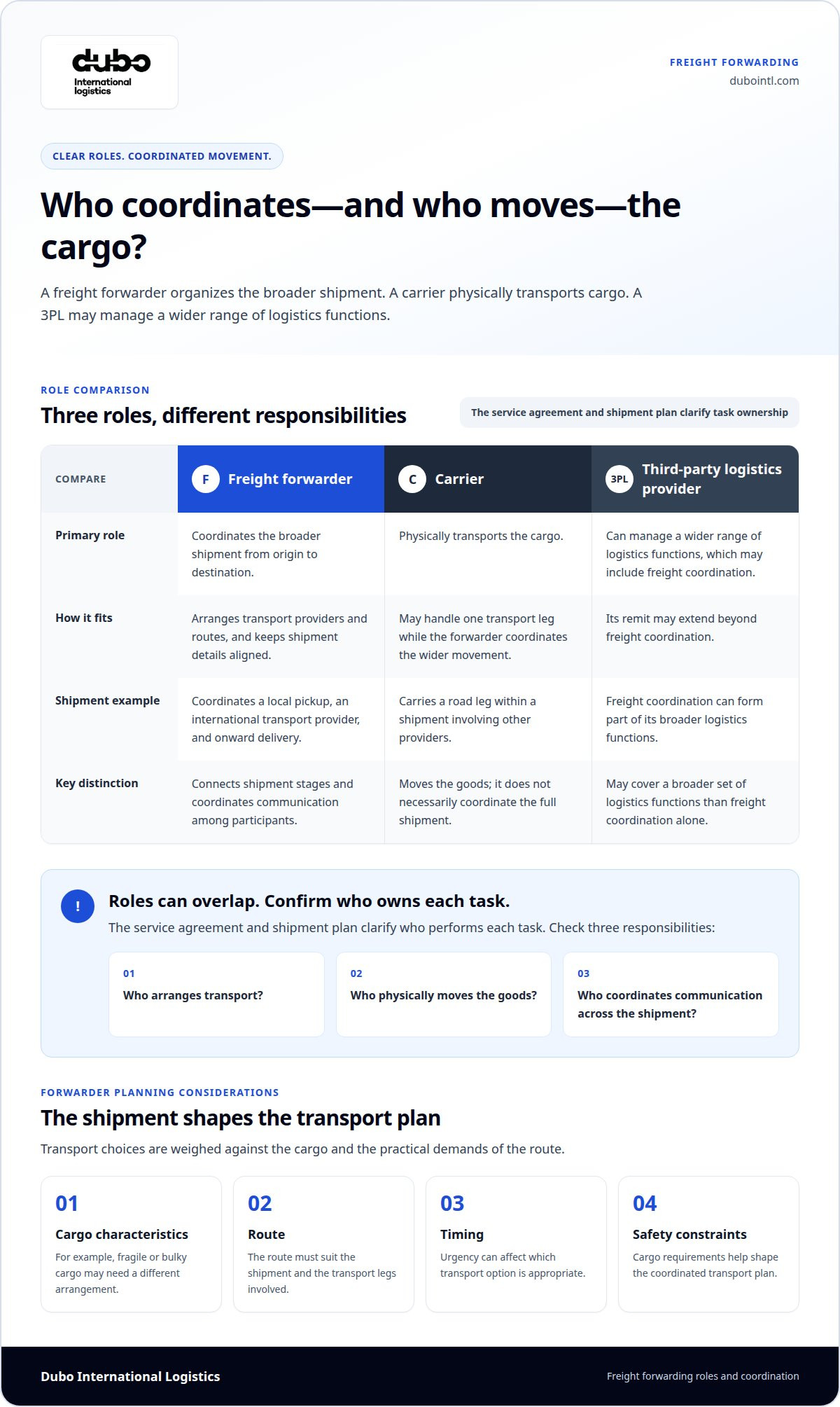
A freight forwarder coordinates the broader shipment, while a carrier physically transports cargo. A third-party logistics provider, or 3PL, can manage a wider range of logistics functions, which may include freight coordination.
These roles can overlap, so the service agreement and shipment plan clarify who performs each task. A carrier, for instance, may handle one road leg while the forwarder coordinates it with other providers. This distinction matters when an importer or exporter needs to know who arranges transport, who moves the goods, and who coordinates communication across the shipment.
Handling Canadian customs and duties
For Canadian imports, a freight forwarder can organize shipment documents and coordinate their movement alongside the cargo. This helps the importer prepare for clearance and keeps transport planning connected to the required shipment information.
Depending on the shipment, documents may include a commercial invoice, certificate of origin, permit, or licence. The forwarder helps manage these records but does not determine the importer’s duties or taxes. Those obligations belong to the import process and the responsible importer. Coordinating shipment details and documents helps businesses understand what information must accompany cargo as it moves toward its Canadian destination.
Depending on the arrangement, a forwarder may also manage transport contracts and administrative tasks. Other possible services include packaging, coordinating loading and unloading, and arranging how goods are collected. Forwarders can also coordinate communication among participants in international trade.
Export haulage, transport, and final delivery
From pickup to delivery, a forwarder coordinates transport providers, cargo handoffs, and shipment documents. A route may combine road, rail, air, or maritime transport.
Coordinating inland transport and delivery
Inland transport coordination connects the pickup point with a port, airport, rail terminal, or final destination. The forwarder arranges local carriers and aligns collection and delivery with the main transport leg.
For an export leaving a Canadian production site, this may mean arranging road transport to a port and coordinating the handoff to the next carrier. At the destination, another inland carrier may complete delivery. The forwarder manages these linked movements and communicates changes among participants, helping keep the shipment organized from origin to receipt.
From pickup to delivery, the forwarder’s main responsibilities are arranging carriers, coordinating transport stages, managing shipment information, and monitoring progress. Cargo insurance depends on the arrangement: a forwarder may manage it when the shipper has contracted that insurance. Responsibility for loss or damage depends on the applicable contract and the forwarder’s role in the carriage.
Consolidating cargo for multimodal transport
Cargo consolidation groups compatible shipments for transport, while multimodal transport uses more than one mode for a single journey. These approaches can help organize goods when a shipment needs several carriers or connections.
For example, goods may travel by road from a Canadian shipper to a rail terminal, continue by rail, and then transfer to a truck for final delivery. A forwarder coordinates the sequence and information needed at each handoff. Consolidation can also combine shipments headed along a shared route, so cargo planning must account for timing, destinations, and handling requirements.
Transport contracts and documentation
Transport contracts set out the agreed carriage arrangements between the parties, while documents communicate shipment and handling details. The forwarder coordinates with carriers and organizes the information needed for each transport leg.
For an export, shipment documents can include a commercial invoice, certificate of origin, or applicable permit or licence. Required documents depend on the shipment and destination. Clear records help carriers match cargo to the transport plan and help participants manage transfers. Contracts also matter when assessing responsibility for damage, loss, or delay, because obligations can vary by service and carriage arrangement.
Responsibilities across transport modes
Freight forwarders organize air, ocean, rail, and road shipments by coordinating the carriers and connections each mode requires. Their role is to manage the overall movement, not to operate every aircraft, vessel, train, or truck themselves.
Air transport may suit urgent or high-value cargo, while ocean, rail, and road options serve different routes and shipment needs. A forwarder coordinates the relevant carrier, transport documents, and handoffs for the selected mode. The shipper’s cargo, route, timing, and safety requirements shape the plan. Matching them to suitable transport helps avoid a route that fails at a key transfer.
For shipments that need coordinated transport planning, freight forwarding support can help align the journey’s moving parts.
Shipment tracking and disruption management
Tracking gives shippers and logistics partners a shared view of a shipment’s progress. Forwarders use updates to identify exceptions, coordinate responses, and keep the next transport step aligned.
Tracking cargo and monitoring shipments
Shipment tracking means monitoring cargo through planned transport stages and checking whether milestones remain on course. Updates at pickup, transfer, or arrival can help identify a delay before it affects the next connection.
For example, a shipment moving by road to an airport and then by air has distinct handoffs. The forwarder can gather status information from carriers, follow the movement, and share relevant updates with the shipper. Online channels, reports, or integrations may provide shipment information. Tracking does not remove uncertainty, but it gives participants information to coordinate their next actions.
A useful update connects the shipment’s current status with its next planned step. If cargo has not reached a transfer point, the forwarder can contact the carrier and assess the effect on onward transport. This coordination matters when clearance, delivery appointments, or other time-sensitive arrangements depend on the shipment’s arrival.
Managing incidents and exceptions
Incident management means responding when cargo movement departs from the transport plan. A missed connection, delayed carrier, or report of damage can affect later stages and require coordination among several parties.
The forwarder identifies the exception, contacts the relevant supplier, and shares available information with the shipper. If a road leg is delayed, for instance, the forwarder can determine whether the next transport connection is affected and coordinate updates with the parties involved. If cargo is damaged, the forwarder may manage the incident and make a claim with the supplier involved in the logistics chain.
Shipment contracts help define the arrangements for each transport service. They also provide important context when assessing an incident: the forwarder’s role and the relevant contract affect how responsibility is addressed. Clear records of status updates, handoffs, and communications help establish what happened and which parties were involved.
Port and airport administration also affects timing. Forwarders coordinate terminal requirements and related arrangements so cargo can proceed through clearance or onward transport. If an arrival update changes the expected handoff, for example, the forwarder can communicate with relevant parties about the next required step. Managing these details alongside tracking helps prevent an administrative hold from being overlooked.
Regulations and clearance requirements can affect a shipment after an exception. A forwarder’s logistics expertise supports coordination of the broader movement, while the specific response depends on the disruption and the parties involved. The aim is to keep communication and transport planning aligned as conditions change, rather than treating tracking as a status report alone.
Carrier contract and rate negotiation
Canadian businesses should assess whether a forwarder can match carrier capabilities to shipment requirements, compliance needs, and communication practices. Clear coordination matters because carrier selection and contract terms affect each transport leg.
Selecting carriers and negotiating rates
Carrier selection matches a shipment’s route and handling needs with a suitable transport provider. Forwarders can negotiate preferential rates with carriers and logistics service providers, but the arrangement must also fit the shipment’s operational requirements.
A shipment requiring road and rail transport, for example, needs carriers that can support the planned transfers. The forwarder considers route, timing, cargo characteristics, and service expectations when coordinating options. This helps businesses assess the full arrangement rather than treating the quoted rate as the only decision point.
Managing carrier contracts
Carrier contract management means coordinating the terms that govern a transport provider’s service. Those terms can clarify responsibilities, service expectations, and the arrangements that apply to a shipment.
Service level agreements (SLAs) are contractual commitments defining service performance, delivery windows, or equipment availability. A forwarder aligns these commitments with the shipment plan so the shipper and carrier share an understanding of the agreed service. For a shipment with a required delivery window, documented terms help the parties coordinate schedules and address changes consistently.
Liaising with carriers
Liaising with carriers means keeping communication and shipment details aligned among the forwarder, shipper, and transport providers. This matters when a route has multiple handoffs or operations change after booking.
If a road carrier updates a pickup time, for example, the forwarder communicates the change to the next carrier and relevant shipment participants. This coordination helps keep the transport sequence aligned and clarifies whether schedules need adjustment. During import or export movements, communication may also need to account for customs documentation and clearance milestones.
Carrier selection also involves understanding each provider’s role in the overall movement. A carrier performs a transport service; the forwarder coordinates that service with other providers and shipment functions. When consolidation is part of the plan, the forwarder coordinates cargo movement and carrier arrangements around the consolidated shipment instead of treating each piece as an unrelated operation.
Businesses can assess a forwarder’s approach by considering how it connects carrier selection, contracts, compliance, and communication. A shipment crossing from road to rail, for instance, may require consistent transport terms, handoff timing, and shipment information across providers. A well-defined coordination process gives the shipper a clearer view of who handles each transport function and how updates move through the chain.
Rate negotiation is one part of a broader carrier arrangement. The selected service must fit the route and cargo, while contract terms and communication practices support execution. Coordinating these elements helps businesses plan shipments more clearly across carriers and transport stages.
Benefits of international freight forwarding
International freight forwarding brings separate transport and shipment functions together in a coordinated plan. For Canadian businesses, this can make complex trade routes easier to manage.
A key benefit is having one coordinating point across a shipment’s network of participants. An export from a Canadian manufacturer may involve a local carrier, an international transport provider, and a delivery partner at the destination. The forwarder helps keep instructions and shipment details aligned across these relationships, rather than leaving the shipper to coordinate every handoff independently.
A forwarder’s expertise can also help match a transport plan to the cargo and route. A time-sensitive shipment, fragile equipment, and oversized machinery each have different planning needs. The appropriate mode and carrier depend on the shipment’s characteristics, destination, timing, and handling requirements. This assessment can help avoid a mismatch, such as a route that does not account for a cargo-specific constraint.
International trade also involves documents and clearance processes linked to transport schedules. Coordinating shipment information among the shipper, carriers, and clearance participants connects operational planning with the movement of goods. If an export’s destination requirements affect paperwork or the handoff sequence, for example, the forwarder can coordinate relevant information with the parties involved. This does not replace each party’s own responsibilities; it helps keep the overall movement organized.
Another benefit is clearer communication when different providers handle different stages. If a shipment moves from a Canadian pickup to an international carrier and then onward to its destination, the forwarder can coordinate the sequence and relay relevant updates. This shared coordination helps businesses understand which stage is underway and what transition follows, supporting informed supply-chain decisions.
Freight forwarding can also give businesses flexibility as shipment needs change. A company entering a new international market may need to assess a different destination, transport mode, or carrier network than it uses on established routes. A forwarder can organize these considerations around the shipment rather than applying the same transport plan to every export or import. This is particularly useful when cargo requirements or route complexity call for careful planning.
The benefit is not simply moving goods. It is connecting transport choices, documentation, carrier coordination, and destination requirements into a workable sequence. For Canadian businesses managing international trade, this coordination can clarify responsibilities and support continuity throughout a shipment’s journey.
For help planning a shipment across international transport stages, discuss freight forwarding requirements.
A freight forwarder may manage documents to help meet legal and customs requirements for imports and exports. This connects paperwork with the transport plan instead of treating documents as separate from the movement of goods. Businesses can coordinate relevant information with the parties involved and consider document preparation alongside route planning, handoffs, and shipment timing. This supports organization while leaving each participant responsible for its own role.
Dubo International Logistics: Freight forwarding
Dubo International Logistics coordinates freight forwarding for businesses managing complex cargo movements nationwide across Canada. Its logistics consulting can help shape a shipment plan around the route, cargo requirements, carrier coordination, and handoffs involved.
For shipments involving oversized machinery, delicate equipment, or temperature-sensitive products, Dubo provides specialized transportation services. This support is relevant when transport planning needs to account for cargo-specific handling or complex project logistics.
If your shipment requires coordinated freight forwarding, logistics consulting, or specialized transportation, contact Dubo International Logistics to discuss your requirements.
Plan your next shipment with confidence
Your next shipment is an opportunity to build coordination into the plan from the outset. Before arranging movement, consider what the cargo needs, where each handoff occurs, and how shipment updates should reach the people managing delivery. Understanding freight forwarder responsibilities can help your team define expectations and identify where specialist coordination would support your operations.
Dubo International Logistics offers freight forwarding, logistics consulting, and specialized transportation services. If your shipment involves complex routing or cargo-specific requirements, a conversation can help clarify the planning support that fits your needs.
Contact Dubo International Logistics to discuss your shipment and take the next step with a considered plan.
Frequently Asked Questions
What shipping documents does a freight forwarder prepare or manage in Canada?
A freight forwarder coordinates shipment information and manages relevant documents when arranging cargo movement. Keep shipment details consistent across paperwork and transport instructions, including the shipper, consignee, cargo description, and destination. If a detail changes after booking, communicate the update promptly so the parties can work from the same information and avoid unnecessary confusion during the shipment.
What risks and common mistakes should importers and exporters know about when using a freight forwarder?
Incomplete or outdated cargo details can undermine the transport plan. If an exporter changes a shipment’s dimensions after arrangements are made, for example, the selected carrier or route may no longer suit the cargo. Importers and exporters should also establish how updates will be shared and who coordinates each transport stage. Clear information and defined responsibilities help reduce preventable disruptions.
