

Cargo and trailer theft incidents in Canada rose from about 570 in 2024 to nearly 970 in 2025. A practical answer to how to prevent cargo theft in Canada is to combine active tracking, secure trailer locks, careful cargo selection and prompt information sharing. No single measure covers every risk; layered controls help protect loads while they’re parked, moving or being transferred.
For Canadian shippers and carriers, cargo theft risks go beyond the value of a stolen load. Theft can disrupt deliveries, complicate operations and undermine customer confidence, especially on busy North American routes. Effective prevention starts with practical measures that fit the way shipments move, rather than relying on a single device or procedure.
This guide explains how GPS tracking, door locks and seals, safer parking, cargo-risk awareness and coordinated reporting can reduce exposure in Canada and the United States. It also considers theft trends across both countries, helping you plan security for the full journey, not just pickup or delivery.
Key Takeaways
- Pair vehicle and trailer tracking with clear alert and dispatch procedures so unexpected movement or delays can be acted on quickly.
- Use suitable locks and seals, check them after stops, and limit unattended time for loaded trailers.
- Assess cargo resale appeal when planning security, since routine loads can also attract theft.
- Share precise shipment and incident details promptly with dispatch and authorities to support a coordinated response.
- For complex or specialized shipments, freight forwarding and logistics consulting can help align transport plans with cargo-specific risks.
1. Real-time tracking and integrated data visibility
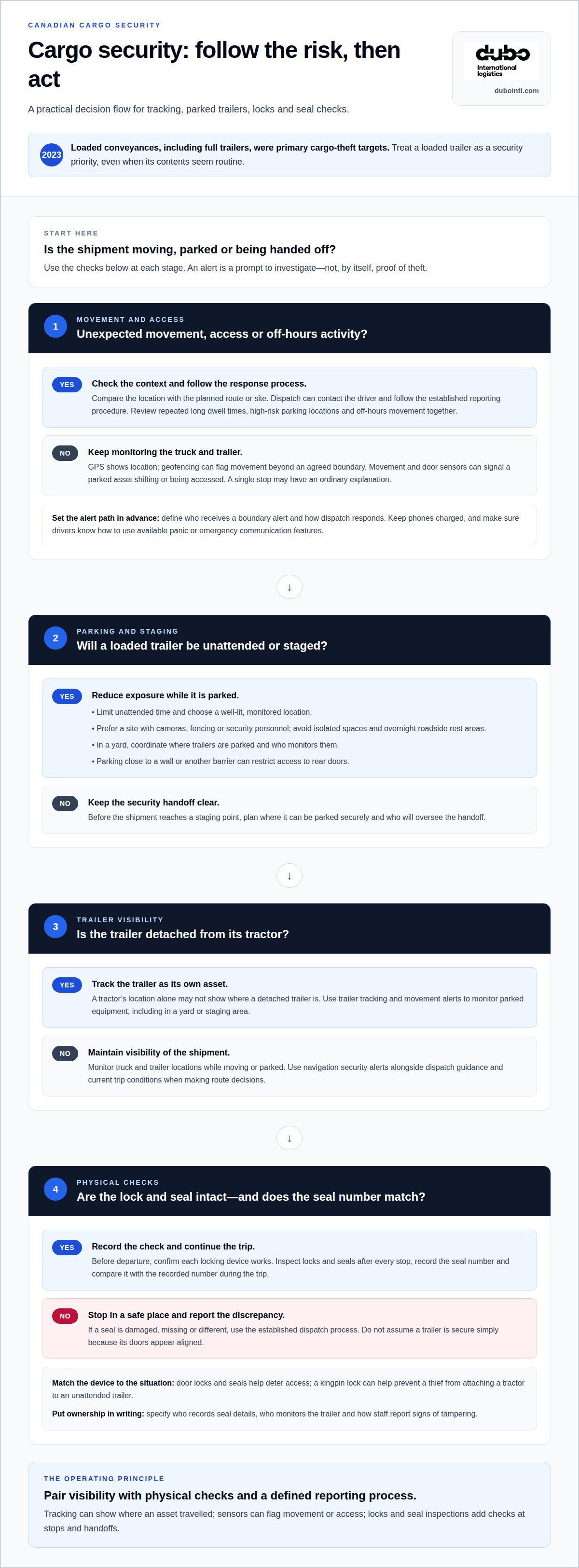
GPS tracking, geofencing, movement sensors and door sensors can help identify cargo-theft risks in Canada. GPS shows a truck or trailer’s location. Geofencing flags unexpected movement beyond a virtual boundary, while movement and door sensors can signal that a parked asset has moved or been accessed. Together, these tools give dispatch a clearer picture of a shipment’s status.
Tracking is most useful when dispatch can act on the information. Set a clear process for reviewing truck and trailer locations, including while they’re stationary, and responding to unexpected stops or movement. For example, if a trailer leaves an agreed boundary outside its planned movement, dispatch can contact the driver and follow the established reporting procedure. This turns an alert into a defined operational step.
Telematics and tracking data can help operations distinguish a planned delay from an unusual pattern. Review repeated long dwell times, high-risk parking locations and off-hours movement together, rather than treating every alert as proof of theft. A single stop may have an ordinary explanation, while a recurring pattern can prompt a closer review of route planning and parking choices. This is one practical part of how to prevent cargo theft in Canada.
Trailer tracking matters because a tractor’s location alone may not show where a detached trailer is. Fleets can monitor trucks and trailers while they’re moving or parked. Pairing that visibility with movement sensors helps flag a trailer that shifts unexpectedly in a yard or staging area, so dispatch can investigate before visibility is lost for longer.
Geofencing adds a practical layer to route and site monitoring. Create virtual boundaries around planned locations, then define who receives an alert if an asset crosses one unexpectedly. Some GPS navigation systems can also provide real-time security alerts to help drivers avoid cargo-theft hot spots. Use those alerts alongside dispatch guidance and current trip conditions when making route decisions.
Surveillance cameras can support tracking measures in a different way. Video surveillance inside the cabin may deter theft or vandalism and provide evidence for an investigation. It doesn’t replace location tracking: GPS can show where a vehicle travelled, while footage may help explain activity inside the cab.
Communication completes the process. Drivers should know how to use available panic or emergency communication features, and dispatch should have a defined process for alerting them if a trailer or load is reported stolen. Keep phones charged and report suspicious activity promptly. For companies planning how to prevent cargo theft in Canada, these steps connect tracking, telematics and cargo sensors to a coordinated response, rather than leaving alerts unaddressed.
2. Using cargo-container and trailer-door locks
At truck stops, shipping yards and other staging points, reduce exposure by limiting unattended time, choosing monitored parking and securing each loaded trailer. Use high-quality door locks and seals, then inspect them after every stop. These measures add physical barriers where cargo may be parked or staged during a journey.
Loaded conveyances, including full trailers, were primary cargo-theft targets in 2023. Treat a loaded trailer as a security priority even when its contents seem routine. Before departure, confirm that each locking device works properly, including padlocks and any kingpin lock used for a dropped or staged trailer. A lock can deter access, while a kingpin lock can help prevent a thief from attaching a tractor to an unattended trailer.
Avoid leaving loaded trailers unattended whenever possible. If a pause is necessary, choose a well-lit, monitored location with cameras, fencing or security personnel. In a shipping yard, coordinate where trailers are parked and who monitors them. At a truck stop, avoid isolated spaces and overnight roadside rest areas. Use a secured yard or monitored stop when possible. Parking a trailer close to a wall or another barrier can also restrict access to its rear doors.
Locks work best when each stop includes a deliberate inspection. Check the lock and seal before leaving, record the seal number, and compare it with the recorded number during the trip. If a seal is damaged, missing or different, stop in a safe place and report the discrepancy through the established dispatch process. Don’t assume a closed trailer is secure simply because its doors appear aligned.
Technology can help close the visibility gap between a tractor and its trailer. A tractor’s position alone may not show where a detached trailer has been left. Use trailer tracking and movement alerts to monitor parked equipment, then pair those signals with physical checks of doors, locks and seals. For example, an unexpected trailer movement from a yard should prompt dispatch to confirm the asset’s location and security status.
Before a shipment reaches its staging point, plan where it can be parked securely and who will oversee the handoff. A written procedure should state who records seal details, who monitors the trailer and how staff report signs of tampering. Clear plans help teams coordinate cargo movements with security considerations in view.
High-quality locks and seals on cargo containers and trailer doors can help deter theft. Cargo theft can occur when trucks or trailers are parked, staged or left without active monitoring, so prioritize checks during those periods. Unattended trailers in yards and unsecured loads can be easy targets. Door sensors add another way to identify unauthorized access to cargo.
3. High-demand and easily resold goods
Cargo thieves may target goods with ready resale markets, but no shipment is automatically low-risk. In Canada, food and beverages were the most sought-after stolen goods, followed by household products and metals. Electronics and copper were also among the goods targeted. A familiar commodity can therefore create supply-chain exposure even when a shipment seems routine.
Plan security around the cargo’s resale appeal, route and handling points. Record what is moving, where each handoff occurs and who is responsible for shipment updates. For example, a load of electronics scheduled for a distribution centre may need closer attention during a long stop or unexpected route change. These steps help teams identify where theft could disrupt the supply chain.
Location matters too. Warehouses, parking lots and distribution centres have been identified as cargo-theft hotspots. Theft activity has shown a gradual westward shift as organized groups adapt to enforcement pressure in high-surveillance areas. Review risks along the shipment’s actual route rather than assuming security needs are the same at every facility or transfer point.
Use the cargo profile to set practical controls before dispatch. Match the load’s resale appeal to suitable parking, trailer security and monitoring procedures. Share only necessary shipment details with people involved in the move. At a facility, keep handoff records clear and investigate discrepancies between the planned load and received goods. For example, a shipment with several product types needs item-level documentation to make missing cases easier to detect.
Vetting carriers, drivers and freight brokers can also help address theft by deception. Conduct driver background checks, train personnel on cargo-security procedures, and audit physical security, GPS tracking, cameras and controls for loaded trailers. Organized groups may impersonate legitimate carriers using stolen credentials, so verify pickup arrangements through established channels and investigate unexpected changes before releasing cargo.
A carrier review should examine identity, credentials, security procedures and the ability to follow shipment instructions. Apply the review consistently to routine and high-demand loads, since thieves may target ordinary goods as well as electronics or metals. Training should explain how to report suspicious activity and handle unusual pickup requests. Regular audits can reveal gaps between written procedures and actual practices.
These measures help teams adapt security to changing threats without relying on commodity labels alone. A shipment’s contents, route, facility and handoffs all shape its risk. Reviewing them together gives operations staff a clearer basis for deciding where to strengthen protection and which events need prompt attention.
4. Law-enforcement intelligence and information sharing
Timely, precise reporting can help police connect cargo theft with related criminal activity. Drivers should alert dispatch and the police service responsible for the incident location as soon as they identify theft or suspicious activity. Share the truck and trailer descriptions, cargo details, last known location, route, seal information and relevant tracking records. These details give investigators a clearer starting point.
For theft in any Canadian province, contact the police service with jurisdiction where the incident occurred and notify dispatch promptly. Provide the shipment’s origin and destination, carrier details, time last seen, and any known changes to pickup or delivery instructions. The incident location determines which local service to contact, so include the precise location in the initial report.
When a driver discovers a missing trailer, personal safety comes first. The driver should avoid confronting anyone, move to a safe place and report the incident to dispatch and police. Dispatch can coordinate shipment details and preserve relevant records, including messages, tracking events, pickup instructions and the trailer’s last confirmed location. Keeping these records together can help establish a clear sequence of events.
Consistent information sharing strengthens relationships between carriers, industry partners and law enforcement. Establish a reporting process before a theft occurs, including who contacts police, who informs shipment partners and who maintains an incident record. For example, if a driver sees an unfamiliar person attempting to change pickup instructions, the driver can alert dispatch, which can pass the details to the appropriate authorities.
Canada Border Services Agency (CBSA) channels can matter when stolen vehicles may be at a marine port or intermodal facility. CBSA acts as a 24/7 central contact point for police requests to locate vehicles in those locations. According to CBSA, it responded to 3,877 law-enforcement information requests in 2025. Carriers should give police accurate vehicle identifiers and location details so authorities can direct appropriate requests.
Coordinated enforcement can support broader investigations. In April 2024, Project VECTOR resulted in the recovery of 598 stolen vehicles through a joint operation involving CBSA and police. The example illustrates how timely intelligence can connect incident reports with wider enforcement activity. Carriers can support that work by sharing consistent identifiers and preserving records related to the shipment.
Build awareness through regular driver briefings and clear escalation steps. Drivers should know whom to contact at dispatch, which shipment details to report, and how to preserve relevant messages or records. After an incident, carriers can review the timeline with law enforcement and industry partners, then update procedures to address gaps. Sharing useful patterns can help identify repeated tactics while limiting disclosure to information relevant to the case.
In any province, promptly notify dispatch and the police service with jurisdiction where the incident occurred. Provide the precise location, vehicle and cargo details, route, last known location, seal information and relevant tracking records. The incident location determines the appropriate police contact.
5. Cargo theft trends in Canada and the United States
Cross-border trends matter because transportation networks connect Canadian and U.S. routes, carriers and freight facilities. Cargo theft incidents across both countries reached 3,625 reported cases in 2024, an increase of 27% that year. The shared takeaway is practical: assess risk across the full journey, including handoffs and stops beyond the shipment’s origin region.
Canadian figures point to a growing challenge. Cargo and trailer theft incidents increased from about 570 in 2024 to nearly 970 in 2025. That change calls for regular reviews of routes, parking plans and shipment controls, rather than relying on one security measure. Reported figures also understate activity when incidents are handled internally or through insurance.
Ontario had a pronounced concentration, accounting for 85% of reported Canadian cargo thefts in 2024. Yet a regional pattern shouldn’t narrow attention to one province. Theft activity has shown a gradual westward shift as organized groups adapt to enforcement pressure. Carriers moving across Canada should review emerging risks along their actual routes and at transfer points.
Cargo-theft methods can cross borders. Canadian incidents can involve loaded trailers, fictitious pickups, hostage loads and identity theft. A fraudulent pickup can exploit gaps in carrier or shipment verification, while diversion may occur after a legitimate load begins moving. Connect pickup instructions, dispatch communications and GPS tracking records so unusual changes receive timely attention.
Shipment profiles add another layer. Food and beverages, household goods, metals and electronics have all been targeted in Canada. Thieves may pursue easily resold goods, but routine cargo can also be vulnerable. Operations teams can consider commodity type, route, facility and planned dwell time together when deciding where to apply stronger monitoring.
The right combination of devices and services depends on the shipment and operating plan. Tracking coverage, cargo sensors, monitoring procedures and route complexity all shape which prevention measures fit. Define those requirements before selecting equipment or services.
Cargo insurance terms vary by policy. The wording determines whether theft is covered and which exclusions, conditions or limits apply. Review the policy’s theft language, cargo description, required security measures and reporting conditions with the insurer or broker before a shipment moves.
For cross-border planning, compare Canadian and U.S. incident patterns with each route’s specific exposure. A practical review connects cargo selection, carrier handoffs, tracking and insurance requirements in one plan. This gives teams a clearer basis for adapting security as incidents and theft methods change.
Dubo International Logistics
Dubo International Logistics helps businesses coordinate freight movements that require careful planning around cargo, routes and handoffs. Its freight forwarding, logistics consulting and specialized transportation services can bring shipment details and transport arrangements into a clear plan across Canada and the United States. These services are useful when a shipment needs tailored coordination, such as oversized machinery, delicate equipment or temperature-sensitive products. Discuss the cargo, route and handling requirements to shape an approach suited to the movement. Contact Dubo International Logistics to discuss your shipping needs.
Make cargo security part of the next shipment plan
Prevention works best when security decisions are built into transport planning, not added after a concern arises. For each upcoming shipment, identify its handling needs, route and handoffs, then align security measures with the cargo and operating conditions. This gives your team a practical starting point for deciding how to prevent cargo theft in Canada and on cross-border movements.
Dubo International Logistics supports this planning through freight forwarding, logistics consulting and specialized transportation services. The right approach depends on the shipment’s requirements and how it moves through the supply chain. Bringing those details together early can help your operations team plan with greater clarity and consistency.
Contact Dubo International Logistics to discuss your cargo movement and planning needs. A considered next step can help your team move forward with greater confidence.
Frequently Asked Questions
What are the most common types of cargo theft in Canada and which regions are most affected?
Common patterns include theft of loaded trailers, fictitious pickups, hostage loads and identity theft. Ontario accounted for 85% of reported Canadian cargo thefts in 2024, while activity has shown a gradual westward shift. These patterns are useful for planning, not a reason to treat other regions as risk-free. Review each route’s pickup process, transfer points and destination facilities, since exposure can change across a shipment’s journey.
What cargo theft prevention measures should Canadian trucking companies use?
Use layered procedures that assign clear responsibility for shipment release, driver training, security reviews and incident reporting. For example, require dispatch to resolve unexpected pickup-instruction changes through an established contact process before releasing a load. Regular audits can also identify gaps in carrier controls, staff awareness and security equipment. These checks help trucking operations turn written policies into consistent actions across drivers, dispatch teams and contracted carriers.
How should drivers secure trailers, loads, and tractor-trailers against theft?
Before departure, drivers should confirm the trailer is secured, load documentation is complete, and pickup or delivery details match dispatch instructions. At a stop, they can check for signs of tampering and record any discrepancy for prompt reporting. For example, raise an unexpected change to a pickup location with dispatch before proceeding. Drivers should prioritize personal safety and avoid confronting suspected thieves.
Which cargo types are most targeted by thieves in Canada?
Food and beverages have been reported as the most sought-after stolen goods in Canada, followed by household products and metals. Electronics and copper are also targeted. Cargo category alone doesn’t determine exposure: resale appeal, route, handoffs and facility access all matter. A shipper moving ordinary household goods can still apply heightened controls if the load has an exposed pickup or an unusual delivery change.
