

A dedicated trailer can be the wrong choice, even when your shipment looks large. The right decision depends on more than pallet count: full truckload shipping to USA destinations should match your freight’s dimensions, handling needs, delivery schedule and cross-border plan.
That decision can be difficult for Canadian businesses. You may be weighing the control and reduced handling of a dedicated trailer against sharing capacity through LTL, while also coordinating pickup, documentation and a U.S. delivery window. Choosing based only on speed or a quoted rate can leave important operational details out of the plan.
This guide explains when FTL is a practical fit, how it compares with LTL and what to prepare before freight leaves Canada. You’ll learn how cargo characteristics, timing, border coordination and carrier communication shape a reliable shipment plan. Dubo International Logistics coordinates freight across North America, aligning carriers and shipment details for complex movements. Learn more about its freight forwarding services at www.dubointl.com.
Key Takeaways
- Choose full truckload shipping to USA by considering cargo, handling needs, lane and timing, not shipment volume alone.
- Compare FTL and LTL by trailer use, handling and planning requirements to identify the better fit for your freight.
- Build a cross-border shipment plan around accurate cargo details and the requirements that apply to the goods.
- Prioritize clear communication and carrier coordination to keep shipment details aligned from pickup through delivery.
- Dubo coordinates freight and shipment details across North America. Learn more at www.dubointl.com.
Full truckload shipping to the USA: when dedicated capacity makes sense
Full truckload (FTL) shipping reserves a trailer for one shipper’s shipment. For Canadian businesses arranging full truckload shipping to USA destinations, dedicated capacity can suit freight that fills much of a trailer, needs careful handling or is critical to keeping operations on schedule.
FTL describes how trailer space is assigned, not a guaranteed delivery time. A dedicated trailer may reduce cargo handoffs, but the actual transport plan depends on the shipment, route, pickup and delivery arrangements, and any special handling requirements.
What full truckload shipping means in practice
With FTL, one shipment uses the trailer capacity set aside for its planned movement. By contrast, LTL freight shipping combines shipments from multiple shippers in a shared trailer. That difference can affect cargo handling and how the movement is coordinated.
Fewer transfers may be useful when freight is fragile, difficult to handle or sensitive to repeated loading and unloading. However, dedicated capacity doesn’t remove every handoff or guarantee a direct route. The shipment’s details and service requirements shape the plan, including how cargo is loaded, secured, moved and delivered.
Which shipment needs may point to FTL
Volume is one consideration, but it isn’t the only one. A shipment that occupies a substantial portion of a trailer may make dedicated capacity a practical fit. Cargo characteristics can matter just as much: oversized machinery, delicate equipment or temperature-sensitive products may need transport arrangements tailored to their dimensions, handling needs or operating conditions.
Consider the operational effect of a disruption or additional handling. If a shipment supports a production schedule, installation or another time-sensitive business activity, a planned trailer assignment may help align transportation with the wider operation. This doesn’t guarantee a delivery window, so timing still needs to be planned around the route and shipment requirements.
Repeat lanes can also influence the decision. A business moving freight along the same origin-to-destination corridor regularly may value consistent capacity planning, particularly when shipment volume or loading requirements are predictable. Assess the actual pattern: recurring shipments don’t automatically require FTL if their size and handling needs fit a shared-trailer arrangement.
- Review cargo volume: Estimate the space the shipment needs, accounting for dimensions and loading configuration.
- Identify handling sensitivities: Note fragile components, special loading needs or environmental conditions that affect transport.
- Consider operational importance: Clarify how pickup and delivery timing connects to production, installation or customer commitments.
- Look at lane consistency: Assess whether recurring shipments call for planned, dedicated capacity.
FTL is most useful when dedicated trailer use addresses a real cargo or operational requirement. If the main appeal is the assumption that a full trailer will arrive faster, reassess the plan: capacity choice alone doesn’t establish transit time.
Assessing FTL shipments for transport to the USA
A sound FTL plan begins with accurate shipment information, not the assumption that a large load automatically needs a dedicated trailer. For full truckload shipping to USA destinations, assess the cargo, its physical requirements, the lane and the delivery schedule as one connected plan. FTL suitability depends on cargo and service requirements together.
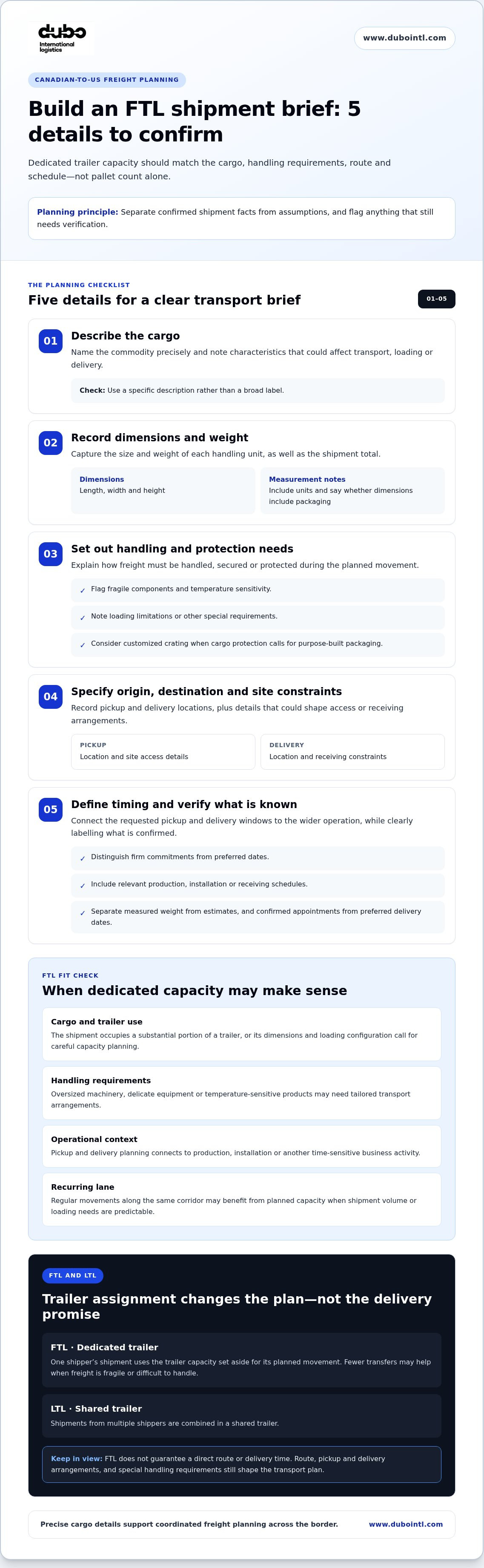
Use this sequence to prepare a clear planning brief. Separate confirmed facts from assumptions, and flag details that still need verification. For example, distinguish a measured shipment weight from an estimate, or a confirmed receiving appointment from a preferred delivery date. This helps the logistics team plan around the actual shipment rather than an incomplete picture.
- Describe the cargo. Identify the commodity and note characteristics that could affect transport, loading or delivery. Use a precise description rather than a broad label.
- Record dimensions and weight. Provide the length, width, height and weight of each handling unit, along with the shipment total. Include measurement units and clarify whether dimensions include packaging.
- Set out handling needs. Explain how the freight must be handled, secured or protected. Identify fragile components, temperature sensitivity, loading limitations or other relevant requirements.
- Specify origin and destination. Record pickup and delivery locations, site access details and receiving constraints that could shape the transport plan.
- Define timing. State required pickup and delivery windows, distinguishing firm commitments from preferred dates. Include relevant production, installation or receiving schedules.
Match cargo details to the transport plan
Assemble the commodity, dimensions, weight, packaging and handling requirements before capacity is coordinated. These details help identify suitable carrier capacity and equipment, especially for oversized machinery, fragile equipment or temperature-sensitive products that call for tailored coordination. Customized crating may be appropriate when the cargo’s protection requirements call for purpose-built packaging. Include that need in the brief rather than assuming standard packaging will suffice.
Be specific about what is known. If a measurement or handling instruction is provisional, label it as an estimate and identify who will confirm it. Uncertainty in a cargo description can affect equipment planning, loading arrangements and communication with the receiving site.
Set lane and delivery requirements clearly
Document the pickup and delivery points, required timing, site access considerations and receiving limitations. For repeat shipments, compare past and planned movements to define a consistent lane profile, including recurring cargo details and scheduling needs. Cross-border freight forwarding between Canada and the USA also depends on coordinating shipment information and the requirements that apply to the goods.
Dubo International Logistics supports freight planning across North America and coordinates carriers and shipment details. Explore its freight forwarding services as you prepare the shipment brief.
FTL vs. LTL for USA shipments: compare capacity, handling, and fit
Neither FTL nor LTL is automatically the better option for freight moving from Canada to the United States. FTL dedicates trailer capacity to one shipment, while LTL freight shipping shares trailer capacity among several shipments. Compare how each mode fits the cargo and the operation, not just the space available.
| Consideration | FTL | LTL |
|---|---|---|
| Trailer use | Capacity is assigned to one shipper’s shipment. | Capacity is shared among shipments from multiple shippers. |
| Typical shipment fit | May suit larger loads or freight with specific handling and scheduling needs. | May suit a shipment that doesn’t need a dedicated trailer. |
| Handling | May involve fewer cargo transfers, depending on the movement plan. | Shared-trailer arrangements may involve additional handling as freight is consolidated and separated. |
| Planning considerations | Coordinate dedicated capacity, cargo requirements, lane and timing. | Coordinate shared capacity, cargo compatibility, handling and delivery requirements. |
The table is a starting point, not a fixed rule. Handling steps and schedules depend on the shipment plan, route and service requirements. Neither mode guarantees a particular transit time, and dedicated capacity alone doesn’t ensure a direct movement.
When dedicated truckload capacity may be the stronger fit
FTL may be appropriate when the shipment uses a substantial amount of trailer space or when the shipper wants to limit transfers because of handling priorities. For sensitive or high-value freight, the decision should reflect the cargo’s protection needs, not value alone. Repeat shipments on the same lane can also make capacity planning more consistent when volumes and schedules follow a dependable pattern.
Consider an ongoing movement of equipment with particular loading or handling requirements. Dedicated capacity may help align the transport plan with those priorities, but details still need to be coordinated for each shipment. Full truckload shipping to USA destinations is a fit when dedicated trailer use supports the freight and the business’s operational needs.
When shared LTL capacity may suit the shipment
LTL can be suitable when a shipment doesn’t need a trailer reserved for its exclusive use. Multiple shipments share trailer capacity and handling arrangements, so this option may fit freight that can move within those shared processes. Suitability depends on the shipment’s dimensions, packaging, handling needs, lane and timing, not an assumed size cut-off.
For a regular shipment that occupies only part of a trailer and has no special requirement for dedicated capacity, LTL may align with the operating plan. Confirm the freight details and delivery needs so the shared arrangement can be assessed against the actual shipment rather than a general assumption.
Decision rule: Choose FTL when cargo needs, shipment volume or operational priorities justify dedicated trailer use. Choose LTL when shared capacity can meet the shipment’s handling and delivery requirements. Dubo coordinates freight and shipment details across North America. Learn about its freight forwarding services.
Plan Canadian-to-USA FTL shipping around cargo and cross-border coordination
A dedicated trailer is only one part of a cross-border shipment plan. For full truckload shipping to USA destinations, cargo information, lane requirements, documentation and carrier arrangements need to align before dispatch. Requirements depend on the goods and the shipment’s circumstances, so use shipment-specific planning rather than relying on assumptions or a generic checklist.
A practical sequence keeps responsibilities and details clear:
- Confirm the shipment profile. Assemble the cargo description, quantity, dimensions, weight, packaging and handling instructions. Mark estimates clearly and identify who will verify them.
- Define the lane. Record pickup and delivery points, requested timing, receiving hours or appointments, site access and unloading constraints.
- Identify applicable requirements. Determine what information and documentation the specific goods and movement require, and organize these details before dispatch.
- Coordinate the movement. Align carrier arrangements, pickup readiness, shipment milestones and communication among the parties involved.
- Review changes. If cargo details, timing or delivery instructions change, communicate the revision promptly so the plan can be updated.
Freight forwarding coordinates the movement of freight and the flow of shipment information and documentation among the relevant parties. It supports organized cross-border transport planning while leaving the determination of requirements for particular goods to the appropriate expertise. For a closer look at the paperwork side of planning, see this guide to essential freight documentation services.
Prepare shipment information for cross-border movement
Use clear, consistent cargo descriptions and confirm quantities, dimensions and receiving details against the actual shipment. Documentation needs vary with the goods and movement, so plan them before dispatch rather than treating paperwork as an afterthought. A freight forwarder can coordinate shipment information and documentation with the parties involved, helping keep the transport plan aligned as the load moves from origin toward delivery.
For unusual cargo, include handling or protection instructions that affect loading and transport. Assess specific requirements for each shipment instead of assuming they are the same as for a previous load, even if the goods or lane appear similar.
Coordinate carriers, tracking, and shipment handoffs
Carrier coordination connects the agreed shipment plan to pickup, transit milestones and delivery communication. Dubo International Logistics coordinates freight across North America and draws on a verified carrier network. Tracking systems support its specialized transport deliveries. Tracking information can support shipment oversight without implying continuous live visibility for every movement.
Clear handoff points and communication responsibilities help parties understand when information should be shared and who needs it. This is part of end-to-end freight management, where shipment details are coordinated across connected stages rather than treated as isolated tasks.
For a cross-border plan built around your cargo, lane and coordination needs, work with Dubo on freight forwarding.
Choose a freight forwarding partner for full truckload shipping to the USA
Dedicated capacity is only one part of a cross-border freight decision. A freight forwarding partner should help you assess whether the proposed service fits your shipment’s requirements and business priorities. For full truckload shipping to USA destinations, look for a consultative process that clarifies responsibilities, communication points and how changes to the plan will be handled.
Evaluate the working relationship as carefully as the transport arrangement. A partner should listen to your operational requirements, explain the reasoning behind a proposed plan and communicate clearly. Discuss how carrier selection accounts for your shipment’s needs and how responsibilities and expectations stay aligned throughout the movement.
- Coordination: The plan accounts for the shipment’s requirements and the parties involved.
- Carrier selection: Carrier suitability is considered in relation to the freight and planned movement.
- Communication: You know who to reach and how relevant updates will be shared.
- Operational fit: The proposed service reflects your cargo’s handling needs and business priorities.
What coordinated freight forwarding adds to an FTL plan
A freight forwarder provides a planning perspective that connects your transport choice to broader supply-chain needs. Rather than treating a trailer booking as the entire solution, the partner helps frame the decision around cargo requirements, service expectations and the movement’s place in your operations.
Dubo International Logistics is a member of the Canadian International Freight Forwarders Association (CIFFA). Its logistics consulting can help businesses assess complex project-cargo requirements and make informed decisions about how to structure a shipment plan.
When expedited or specialized transport deserves consideration
Standard FTL planning assigns trailer capacity to a shipment; it doesn’t automatically provide expedited service. Consider dedicated expedited transport only when the shipment’s urgency calls for a distinct service plan. Define timing expectations clearly for the specific movement.
Specialized transportation may be appropriate when cargo requirements call for tailored planning, including unusual dimensions, careful handling or temperature considerations. If urgency is a genuine requirement, explore Dubo Expedited transport services as part of the service assessment.
Bring your shipment requirements and operational priorities into the conversation early. Discuss your full truckload shipping requirements with Dubo International Logistics.
Set your next shipment up for a confident start
A well-prepared shipment brief can become a useful reference for your team beyond a single move. Keep the agreed instructions, key contacts and updates together so colleagues can work from the same current information as plans progress.
Before scheduling the next shipment, consider what your team wants to improve in its planning process. Clear ownership of decisions and timely communication help everyone work from a shared understanding of the plan.
Put your next steps in motion with a focused conversation. Discuss your full truckload shipping requirements with Dubo.
A clear starting point makes the planning process more manageable.
Frequently Asked Questions
Is full truckload shipping suitable for a shipment that does not fill a trailer?
Yes, it can be suitable when the shipment’s requirements justify reserving the trailer. Beyond volume, consider whether the shipment needs to stay together as one consignment or whether its loading sequence must match a planned unloading sequence. For example, equipment intended for a single installation may need to arrive together. Compare those priorities with a shared-trailer arrangement, then decide whether exclusive capacity supports the actual workflow.
Can full truckload freight move from Canada to the USA?
Yes. For full truckload shipping to USA destinations, provide consistent shipment details to the parties coordinating the move and clarify who is responsible for supplying and reviewing each required document. Check that the cargo description and quantities match across the shipment information. If the receiving party has specific instructions for accepting the load, share them early so they can be considered as part of the cross-border movement plan.
Does full truckload shipping guarantee a faster delivery?
No. A delivery date depends on the planned service and operating conditions, not dedicated capacity alone. When setting timing expectations, consider what happens after arrival: a receiving appointment, installation crew or production schedule may depend on the freight being available. Identify which dates are fixed and where flexibility exists. This helps the planning team distinguish a preferred arrival from a business-critical deadline and discuss the implications of each.
Can oversized machinery be shipped by full truckload?
It may be, depending on the machinery and planned movement. For an accurate assessment, describe the machine in its transport-ready state, including any parts that will be removed, packed separately or extend beyond the main body. Photos or a clear drawing can help explain the cargo’s shape and loading orientation. Also identify who will prepare it for pickup and who will receive it, so handling responsibilities are clear in advance.
Is full truckload a suitable option for fragile or temperature-sensitive cargo?
It can be, if the planned service addresses the product’s particular protection needs. Turn general instructions such as “handle with care” into useful guidance: identify vulnerable surfaces or components, how packages should be positioned, and what environmental limits the product requires. If conditions need monitoring, state what should be recorded and who should review that information. This gives the planning team specific instructions instead of relying on assumptions.
What information should I prepare for an FTL shipping plan to the USA?
In addition to the cargo profile, prepare operational details that can affect readiness: when the load will be ready, who will release it, how the driver should check in and who can answer questions at the receiving site. Note any appointment reference or site-specific instructions the parties need to follow. For full truckload shipping to USA destinations, assign an owner to each open item and update the brief when confirmed details change.
Does FTL mean the truck travels directly without stopping?
No. A dedicated trailer doesn’t mean the vehicle will make no stops or follow a nonstop route. If uninterrupted movement is a business requirement, state it clearly and discuss how the proposed service addresses it. Don’t infer it from the FTL designation. It is also useful to agree on which shipment milestones matter to your team, such as pickup confirmation or arrival communication, and who will receive updates at each point.
