

Could a single missing digital entry in your CARM portal be the reason your entire supply chain grinds to a halt this season? It's a stressful reality for many businesses that even a minor oversight can lead to the common cross-border shipping mistakes Canada importers face daily. You likely realize that the border is no longer just a physical line; it's a complex digital gateway where precision is the only currency that ensures the seamless movement of your cargo.
We understand that staying ahead of shifting regulations, such as the January 15, 2026, deadline for Release Prior to Payment security, feels like a daunting task that does not favour the unprepared. This guide promises to help you master these complexities by identifying the most frequent compliance errors that cause costly delays and unexpected penalties. We will provide a strategic roadmap for error-free shipping, detailing everything from CUSMA rules of origin to the latest digitalization trends at the Canada Border Services Agency to help you organize a more reliable logistics strategy.
Key Takeaways
- Master the nuances of currency declaration and "Value for Duty" calculations to eliminate the common cross-border shipping mistakes Canada that often lead to unexpected financial penalties.
- Navigate the transition to digital-first customs platforms with strategic foresight; ensuring your CARM portal entries meet the latest CBSA compliance standards is essential for 2026.
- Evaluate the importance of security certifications like C-TPAT and PIP when selecting carriers to protect the integrity and speed of your North American supply chain.
- Implement a rigorous documentation audit process that ensures HS codes and commercial invoices match your bills of lading with absolute precision to avoid administrative delays.
- Recognize how professional freight forwarding and logistics consulting act as stabilizing forces, transforming complex compliance requirements into a distinct competitive advantage.
Navigating Cross-Border Shipping Compliance in Canada
Precision is the cornerstone of every successful international transaction. In 2026, cross-border shipping compliance Canada represents a commitment to the rigorous standards established by both the Canada Border Services Agency (CBSA) and U.S. Customs and Border Protection (CBP). It's no longer enough to simply fill out forms; you must understand the deep integration of Canada-United States trade relations to ensure your goods move without friction. As digital customs platforms like the CARM portal become the mandatory system of record, the margin for error has narrowed significantly. We view this challenge through the lens of logistics architecture, where every document and data point serves as a structural component of a larger, more resilient supply chain. Failing to account for these details often leads to the common cross-border shipping mistakes Canada businesses encounter, resulting in stalled shipments and unnecessary stress.
A single error at the port of entry doesn't just delay a truck; it creates a ripple effect that destabilizes your entire operation. When cargo is held for inspection or due to missing data, the consequences cascade through your warehouse and onto your customers' shelves. Maintaining a steady flow of goods requires a proactive stance that anticipates regulatory shifts before they impact your bottom line.
The Real Cost of Non-Compliance
The financial repercussions of a compliance breach extend far beyond a simple fine. Under the Administrative Monetary Penalty System (AMPS), even unintentional errors can trigger substantial costs that erode your profit margins. These oversights are among the most common cross-border shipping mistakes Canada shippers face when they prioritize speed over meticulous preparation. Perhaps more damaging is the potential loss of "trusted trader" status within programs like PIP or C-TPAT. Losing these credentials removes the expedited processing benefits that keep your operations lean and competitive. When a shipment is held, the delay impacts downstream manufacturing schedules and erodes the customer trust you've worked hard to build. Utilizing expert cross-border freight forwarding Canada USA provides a necessary layer of protection, ensuring your cargo meets every regulatory requirement before it reaches the border.
Documentation: The Foundation of Seamless Freight
Documentation remains the primary foundation of every seamless freight movement. The Bill of Lading and the Commercial Invoice must be perfectly aligned to prevent manual inspections that consume valuable time and resources. A frequent error involves using vague product descriptions; terms like "industrial parts" or "general merchandise" often trigger red flags for customs officials who require specific details to verify contents. For 2026, the correct application of the Harmonized System (HS) code is the single most critical factor in determining your duty rates and ensuring legal entry for every SKU in your shipment.
Financial Accuracy: Avoiding Valuation and Currency Errors
Financial precision serves as the bedrock of a stable supply chain. Among the most common cross-border shipping mistakes Canada importers make, failing to explicitly state the currency of sale (CAD versus USD) remains a leading cause of preventable delays. When customs officials encounter an invoice without a clear currency indicator, they're forced to halt the shipment to verify the actual value. This creates a friction point that can be easily avoided through meticulous data entry and strategic foresight. Beyond simple currency labels, understanding the "Value for Duty" (VFD) calculation is essential. The VFD is the adjusted transaction value of the goods, and miscalculating this figure can lead to significant underpayment or overpayment of duties. Accurate financial record-keeping isn't just a best practice; it's your primary defence during a CBSA audit.
Your choice of Incoterms also plays a pivotal role in your financial obligations. These international commerce terms define exactly where the risk and cost transition from the seller to the buyer. If you use an incorrect term, you might inadvertently assume responsibility for taxes and duties you didn't budget for, or worse, find your cargo uninsured during a critical leg of the journey. Professional logistics consulting can help you align your commercial agreements with your operational realities to ensure every dollar is accounted for.
Declaring the Correct Value for Duty
The CBSA utilizes six distinct valuation methods to determine the worth of imported goods. While the "Transaction Value" method is the standard for most commercial sales, it requires that the price be paid or payable for the goods when exported to Canada. If a sale doesn't meet specific criteria, you must move through the alternative methods, such as the "Transaction Value of Identical Goods" or the "Deductive Value." We strongly advise against "low-balling" declared values to reduce duty costs. This practice invites severe scrutiny and can result in your business being flagged for frequent, time-consuming manual inspections. Specialized cargo, such as used machinery or warranty replacements, requires a bespoke valuation approach to remain compliant with 2026 standards.
Currency Discrepancies and Tax Miscalculations
Consistency across all shipping documents is vital for a smooth border crossing. You should implement a final check to ensure the currency on the Commercial Invoice matches the Bill of Lading and the CARM portal entry exactly. For Canadian businesses, mismanaging GST and HST on imports often leads to double taxation or missed input tax credits. Modern logistics software can automate these currency conversions using the official Bank of Canada exchange rates, reducing the risk of human error. By integrating these digital tools, you can ensure that your tax calculations remain accurate and your supply chain stays moving.
Logistics Strategy: Beyond the Paperwork
Successful logistics requires more than just administrative accuracy; it demands a physical strategy that mirrors your digital precision. One of the most common cross-border shipping mistakes Canada exporters make is selecting a carrier based solely on the lowest freight quote. While cost management is essential, a carrier with a poor compliance history can quickly turn a budget-friendly shipment into a logistical nightmare. We believe in building a national logistics framework that prioritizes reliability and strategic coordination above all else. Your choice between LTL vs. FTL shipping to USA from Canada directly influences border wait times, as consolidated loads often face more complex inspection protocols than dedicated full truckloads. A strategic carrier partner acts as an extension of your own business, protecting your reputation at every port of entry.
Selecting Certified and Reliable Carriers
A carrier's credentials serve as a testament to their commitment to security and efficiency. You should prioritize partners who hold C-TPAT (Customs-Trade Partnership Against Terrorism) and PIP (Partners in Protection) certifications. These programs signify a high level of trust with border authorities, often leading to fewer inspections and faster transit times. When a shipment is flagged for a secondary inspection, an experienced carrier remains calm and prepared. They possess the organizational depth to provide additional documentation immediately, preventing a minor inquiry from becoming a multi-day delay. This level of expertise is typically found in carriers with a robust North American footprint who understand the nuances of both Canadian and American transit corridors, ensuring that your goods move through a predictable and secure channel.
Mishandling Specialized and Oversized Cargo
Transporting non-standard freight introduces a unique set of compliance hurdles that many general carriers simply aren't equipped to handle. Ignoring specific permit requirements for oversized loads is a frequent error that leads to heavy fines and the immediate grounding of the vehicle. Whether you are moving sensitive medical equipment or heavy industrial machinery, these specialized transportation projects require bespoke logistics planning that accounts for route surveys, height restrictions, and varying provincial regulations. We often see businesses overlook the necessity of specialized equipment or escort vehicles, which can stall a project before it even leaves the yard. By addressing these niche requirements through specialized transportation services, you ensure that even the most complex movements remain seamless and secure.
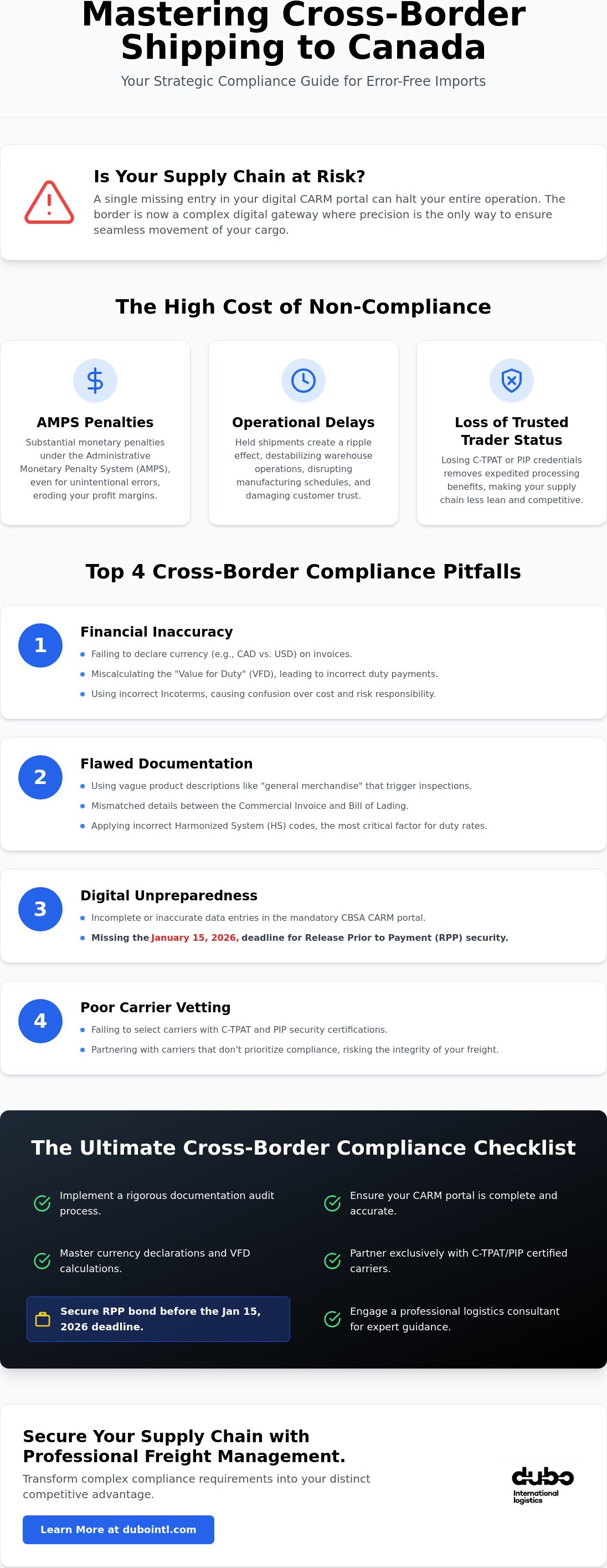
The Ultimate Cross-Border Compliance Checklist for 2026
A robust checklist converts complex regulations into a manageable workflow. It acts as the final barrier against common cross-border shipping mistakes Canada importers often overlook during high-volume periods. By following a structured verification process, you provide your business with a layer of professional security that protects both your cargo and your reputation. Precision isn't just about avoiding fines; it's about building a dependable bridge between your warehouse and your international partners.
- Step 1: Verify HS Codes and Product Descriptions: Confirm that every SKU in your shipment is classified under the correct Harmonized System code for 2026. Vague descriptions like "industrial equipment" invite manual inspections; use specific technical terms instead.
- Step 2: Align Commercial Invoices and Bills of Lading: Ensure these documents match exactly. Any discrepancy in weight, piece count, or declared value will trigger a border delay that ripples through your entire delivery schedule.
- Step 3: Identify the Customs Broker Clearly: Your transport documents must clearly name your broker. This ensures the CBSA can facilitate a smooth release by contacting the right party for any necessary clarifications.
- Step 4: Conduct a Pre-Shipment Audit of Carrier Certifications: Verify that your chosen carrier maintains active C-TPAT or PIP certifications. Additionally, confirm their insurance coverage is sufficient for the specific value of your freight rather than relying on standard industry minimums.
- Step 5: Establish a Digital Trail: Since CARM is now the official system of record, every entry must be logged within your portal. This ensures you have a complete, accessible record for post-entry compliance and future audits.
Pre-Shipment Verification Protocol
Before any truck leaves your dock, a "final five" check ensures that your logistics strategy remains sound. This protocol embodies the "measure twice, ship once" philosophy that defines elite supply chain management. Shipping managers must confirm that no prohibited or restricted items have been inadvertently included in the load. It's essential to check for any items that may have shifted status under current 2026 laws. Precision at this stage is the only way to realize true efficiency and maintain the steady flow of goods. If you find these requirements overwhelming, our freight forwarding services can help you integrate these checks into your daily operations seamlessly.
Post-Entry Compliance and Record-Keeping
The border process doesn't end when the truck arrives at its destination. In Canada, importers are legally required to maintain all shipping records for six years plus the current year. This includes commercial invoices, customs entries, and proof of payment for duties and taxes. Should you receive a CBSA "Verification Notice," a professional and organized response is essential to maintain your standing. Conducting periodic internal audits allows you to identify potential weaknesses before they become liabilities. This proactive approach ensures your logistics architecture remains resilient against future regulatory changes and keeps your costs predictable.
Securing Your Supply Chain with Professional Freight Management
Stability in global trade is not accidental; it is meticulously engineered. A professional freight forwarder acts as a stabilizing force, ensuring that the common cross-border shipping mistakes Canada businesses often struggle with are identified and corrected long before they reach the border. By integrating strategic foresight into your daily operations, you transform your logistics from a source of stress into a scalable asset. The complex movements of cargo across the 49th parallel require more than just a carrier; they require a dedicated guide who understands the grand scale of international movement while remaining focused on the minute details of your specific needs. Embracing freight forwarding North America is a vital step for any organization looking to realize long-term growth in a competitive marketplace.
Dubo International Logistics serves as this hands-on guide, acting as a sophisticated bridge between your local operations and the intricate regulatory systems of North America. We believe that logistics consulting is not just about moving boxes; it is about optimizing your entire supply chain to withstand the pressures of evolving digital customs platforms and shifting trade agreements. Our approach focuses on creating a seamless flow of goods through precision and partnership, allowing you to focus on your core business while we manage the complexities of the border.
The Role of a Strategic Logistics Partner
Transitioning from tactical shipping to strategic supply chain management is essential for modern business success. While tactical shipping focuses only on the next load, a strategic partner looks at the entire narrative of your cargo movement to identify patterns and efficiencies. This strategic approach is also vital when expanding into international markets; for example, Vostok Consult assists businesses in navigating the regulatory landscape of the UAE. Bespoke solutions are necessary to solve unique cargo challenges, such as specialized transportation for oversized equipment or high-value electronics that require extra security. When you move beyond the "lowest price" mentality, you realize the peace of mind that comes with expert coordination. This level of professional stewardship ensures that your cargo is not just moving, but moving with purpose and protection.
Leveraging CIFFA Standards for Reliability
The Canadian International Freight Forwarding Association (CIFFA) sets the benchmark for professional standards and ethical conduct in our industry. Choosing a partner that adheres to these rigorous standards protects your interests by ensuring that every transaction is handled with integrity and technical excellence. These standards provide a framework for accountability that is vital when navigating the common cross-border shipping mistakes Canada importers face during peak seasons. CIFFA membership signifies that a forwarder possesses the specialized knowledge and financial security required to manage complex international shipments. By partnering with a certified and dependable expert, you realize the benefits of a logistics architecture designed for longevity and consistency.
Mastering Your North American Logistics Strategy
Achieving a seamless flow of goods across the border requires a sophisticated blend of digital precision and strategic foresight. By prioritizing accurate valuation and rigorous documentation, you eliminate the common cross-border shipping mistakes Canada importers often face in an increasingly complex regulatory environment. You've learned that success isn't just about moving freight; it's about building a resilient logistics architecture that anticipates shifts in CBSA requirements and digital customs platforms. As a CIFFA Certified Member with deep expertise in specialized North American transportation, we're committed to acting as your dedicated guide through these intricate challenges.
Our strategic logistics consulting for Canadian businesses provides the clarity needed to turn compliance into a distinct competitive advantage. We invite you to partner with Dubo International Logistics for seamless cross-border success and realize the peace of mind that comes with professional coordination. Your cargo represents your commitment to your customers, and we're here to protect that promise at every port of entry. Let's work together to ensure your supply chain remains a stabilizing force for your business growth in 2026 and beyond.
Frequently Asked Questions
What are the most common documentation errors in Canadian cross-border shipping?
Mismatched data between the Bill of Lading and the Commercial Invoice is the most frequent documentation error. These discrepancies in weight, piece counts, or descriptions often lead to the common cross-border shipping mistakes Canada shippers face at the border. When customs officials find inconsistent information, they're forced to move the shipment to a secondary inspection area, causing delays that ripple through your entire supply chain.
How do I determine the correct HS code for my specialized cargo?
You should consult the CBSA Customs Tariff or utilize specialized logistics consulting to analyze the technical specifications of your goods. Determining the correct Harmonized System code requires a deep understanding of the material composition and primary function of every SKU. Specialized cargo often falls into complex categories where a single digit error can lead to incorrect duty rates and potential compliance audits.
Why is the Value for Duty (VFD) so important for CBSA compliance?
The Value for Duty is the primary figure used to calculate the total duties and taxes payable to the Canadian government. It's essential for compliance because an incorrect VFD can lead to Administrative Monetary Penalty System (AMPS) fines or the loss of your "trusted trader" status. Maintaining precise financial records for your VFD ensures that your business remains a reliable partner in the eyes of border authorities.
Can I ship oversized cargo across the border without a specialized freight forwarder?
While technically possible, shipping oversized cargo without specialized expertise often results in permit violations and the immediate grounding of your vehicle. Specialized transportation requires meticulous planning, including route surveys and coordination with various provincial authorities for height and weight restrictions. A professional partner ensures that all necessary permits are secured and that the equipment used is appropriate for the unique dimensions of your freight.
What is the difference between a customs broker and a freight forwarder in Canada?
A customs broker manages the legal entry and tax payment for your goods, whereas a freight forwarder acts as the architect of the physical movement. While brokers focus on administrative compliance with the CBSA, forwarders provide specialized transportation services and strategic logistics consulting. This partnership ensures that your cargo is not only legally cleared but also physically moved through the most efficient and secure channels available.
How long must Canadian businesses keep their cross-border shipping records?
Canadian importers are legally required to maintain all shipping and customs records for six years plus the current calendar year. This requirement includes commercial invoices, bills of lading, and digital entries made within the CARM portal. Keeping these records organized and accessible is your best defence during a CBSA verification audit and helps ensure the long-term stability of your supply chain.
What are the benefits of using a CIFFA-certified logistics provider?
CIFFA certification ensures that your logistics provider adheres to the highest professional standards and ethical codes in the industry. This certification offers you peace of mind, as it signifies the provider has the specialized knowledge and financial security required to manage complex international movements. By choosing a certified partner, you're aligning your business with a dependable expert committed to technical excellence and professional stewardship.
How does the USMCA/CUSMA agreement affect my shipping compliance in 2026?
CUSMA requires a valid certification of origin to qualify for preferential tariff treatment on goods moving between Canada, the USA, and Mexico. In 2026, compliance also involves navigating the updated Low-Value Shipment (LVS) threshold, which has increased to $3,300 for simplified procedures. Failing to meet these specific rules of origin is one of the most common cross-border shipping mistakes Canada businesses make, resulting in the loss of duty-free status.

