
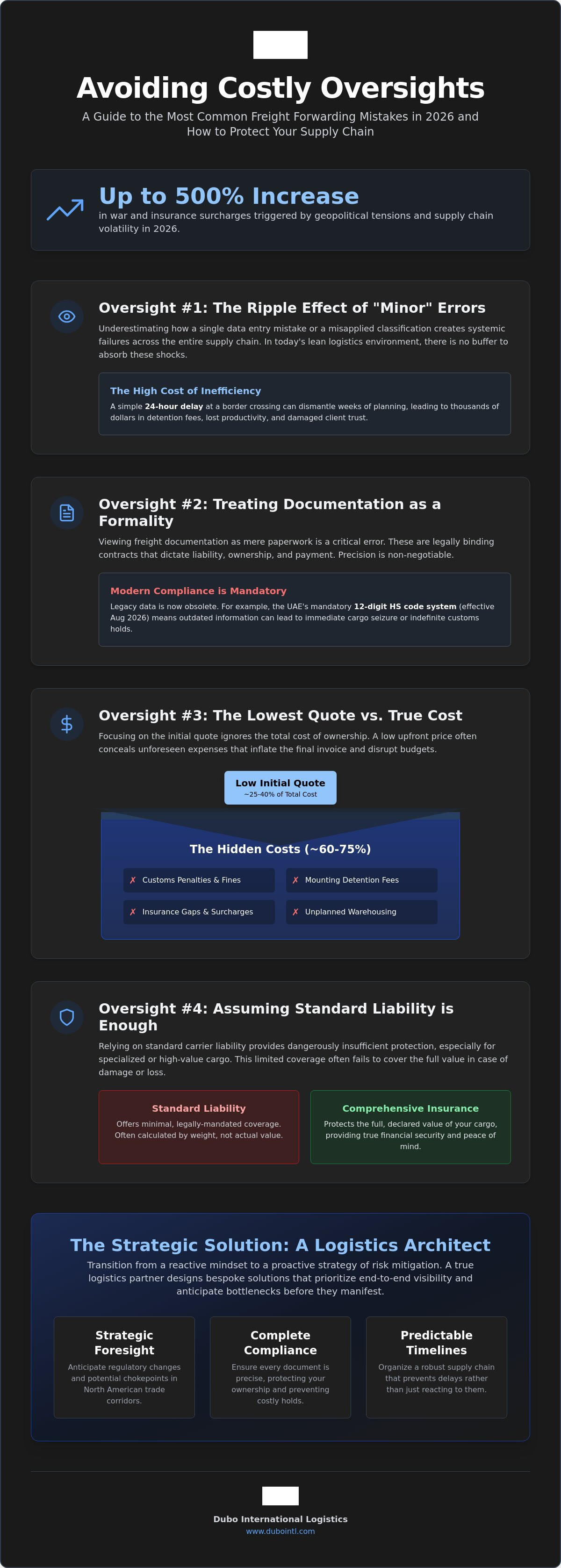
Did you know that rerouting ships around Africa due to geopolitical tensions has triggered up to a 500% increase in war and insurance surcharges in 2026? In this volatile environment, even a minor oversight in your documentation can lead to cascading failures. Understanding the most common freight forwarding mistakes to avoid is no longer a secondary task; it's a fundamental requirement for protecting your margins. You likely realize that the complexity of global trade, from EU ETS maritime surcharges to the new 12-digit HS code mandates in the UAE, has made "business as usual" a risky strategy. It's exhausting to manage these shifting variables while striving for a predictable bottom line.
At www.dubointl.com, we believe that logistics is a discipline of risk management where precision in the planning phase dictates the success of the execution. This guide provides the strategic foresight you need to bypass errors that cause costly delays and supply chain disruptions. We will explore how to achieve complete regulatory compliance, manage hidden costs, and secure your specialized cargo. By the end of this article, you will have a clear roadmap for maintaining predictable delivery timelines and reducing the stress of international shipping through methodical, end-to-end support.
Key Takeaways
- Understand why minor errors in classification or timing lead to systemic failures in the highly interconnected supply chains of 2026.
- Identify the critical freight forwarding mistakes to avoid when handling documentation, ensuring these legal contracts properly protect your ownership and liability.
- Learn to recognize the difference between a low initial quote and the true total cost of ownership to prevent unforeseen expenses from inflating your final invoice.
- Uncover the limitations of standard carrier liability and the essential steps required to ensure your specialized cargo is fully protected against damage.
- Discover the value of a strategic partnership with a logistics architect at www.dubointl.com to achieve predictable delivery timelines and complete regulatory compliance across North America.
The Complexity of Modern Logistics: Why Simple Errors Lead to Systemic Failure
Global trade in 2026 operates as a finely tuned machine where every component depends on the absolute precision of the last. When a single piece of data is entered incorrectly or a classification is misapplied, the resulting friction doesn't just slow down one shipment. It creates a systemic failure that echoes through warehouses, retail shelves, and manufacturing floors. One of the primary freight forwarding mistakes to avoid is underestimating how quickly a small oversight transforms into a logistical crisis. In an environment where supply chains are leaner than ever, there's no longer a buffer to absorb the shock of a delayed manifest or a missing permit.
The High Cost of Inefficiency
A simple 24-hour delay at a border crossing can dismantle weeks of careful planning. These disruptions often translate into thousands of dollars in lost productivity and mounting detention fees that erode your profit margins. Consider the impact on specialized cargo. If a temperature-controlled shipment is held up due to a documentation error, the loss isn't just the cost of the freight; it's the total value of the inventory and the potential loss of a contract. These "minor" mistakes in timing often result in major financial penalties that can cripple a business.
Beyond the immediate financial impact, the professional toll is significant. Unreliable logistics damage your brand's reputation and erode the hard-earned trust of your clients. In a volatile market where shipping costs are rising, professional oversight from a seasoned Freight forwarder serves as a stabilizing force at the centre of your operations. It provides the peace of mind that allows you to focus on growth as you realize your long-term business goals.
A Strategic Framework for 2026
Moving cargo successfully in this environment requires a transition from a reactive mindset to a proactive strategy of risk mitigation. At www.dubointl.com, we operate as a logistics architect, designing bespoke solutions that prioritize end-to-end visibility. This approach relies on "Strategic Foresight," where we anticipate potential bottlenecks before they manifest. By integrating advanced planning with a deep understanding of North American trade corridors, we help businesses bypass the common freight forwarding mistakes to avoid.
True success in 2026 isn't about solving problems after they occur; it's about how you organize a supply chain robust enough to prevent them entirely. Reliability is the cornerstone of our partnership, ensuring your cargo moves with the smoothness and completeness your business deserves. We act as a protective steward of your interests, ensuring that every detail is meticulously executed to maintain the integrity of your entire supply chain.
Myth: Documentation is Merely an Administrative Formality
Freight Documentation is the legal and financial foundation of any shipment. While it's tempting to view these files as mere "paperwork" to be completed at the end of a busy day, they are actually a sophisticated set of legal contracts that dictate liability, transfer of ownership, and payment obligations. Treating these records with anything less than absolute precision is one of the most frequent freight forwarding mistakes to avoid. In the high-stakes environment of 2026, a single clerical error can transform a routine delivery into a legal dispute or a frozen asset.
The danger of "copy-pasting" information from previous years is particularly acute right now. For example, the UAE's transition to a mandatory 12-digit HS code system, which became fully effective for all international trade in August 2026, means that legacy data is now obsolete. Relying on outdated codes or old shipping and documentation requirements doesn't just cause a delay; it often leads to immediate cargo seizure or indefinite customs holds. Precision in your records acts as a protective steward for your business, ensuring that your goods move across borders without friction.
Mastering Incoterms and Liability
Incoterms define the exact moment risk and cost transfer from the seller to the buyer. For many Canadian businesses, choosing a familiar term like EXW (Ex Works) without realizing the full burden of export formalities can lead to unbudgeted expenses and compliance failures. This is especially critical for cross-border freight forwarding Canada USA, where the regulatory landscape demands clear accountability. Selecting the wrong term often leaves you responsible for insurance and transport costs that were never factored into your final invoice.
The Bill of Lading (BoL) as a Title of Goods
The Bill of Lading is the most critical document in your logistics portfolio because it functions as a title of goods. Errors here are unforgiving. Whether it's an incorrect weight, a vague cargo description, or a failure to properly detail specialized transportation project fees, even a minor discrepancy can prevent you from claiming your cargo at the destination. We emphasize meticulous execution in every BoL we handle, as this document is the ultimate proof of your contract of carriage. If you are looking for a partner to help you organize a more resilient documentation process, the experts at www.dubointl.com can provide the strategic oversight required for complete peace of mind.
Myth: The Lowest Initial Quote Represents the Most Cost-Effective Solution
Precision in budgeting is just as vital as precision in documentation. In the volatile market of 2026, a low entry price often functions as a distraction from the complex financial realities of global trade. With the Drewry World Container Index reaching $4,639 per 40ft container in July 2026, the temptation to shave a few hundred dollars off an initial quote is understandable. However, falling for the "lowest price" bait is one of the most persistent freight forwarding mistakes to avoid. A quote that sits significantly below the market average often lacks the comprehensive coverage required for a smooth journey, leading to significant back-end charges that inflate the final invoice far beyond the original estimate.
Evaluating the difference between "price" and the "total cost of ownership" is a hallmark of a mature supply chain. When a business ignores the necessity of strategic logistics consulting Canada, they often face budget overruns caused by inefficient routing or poor compliance planning. Transparent, all-inclusive pricing models provide the predictability you need to protect your margins and maintain peace of mind. While a forwarder is a vital partner, you must remember that your Exporter Responsibilities include the ultimate financial liability for compliance and documentation errors. Relying on a "cheap" provider who cuts corners in these areas creates a risk profile that few businesses can afford.
Identifying Hidden Logistics Fees
Hidden fees are the primary reason "cheap" quotes become expensive. In the current climate, carriers are implementing quarterly bunker fuel surcharges ranging from $300 to $400 per 40-foot container. Additionally, the EU ETS maritime surcharge can increase freight costs by 8% to 12% on trade lanes touching European ports. If these variables aren't clearly outlined in your initial agreement, you'll realize the true cost only when it's too late to adjust your pricing. Poor communication often follows these low-cost offers. You pay a heavy price when your forwarder becomes unreachable during a disruption, leaving you to handle detention and demurrage fees alone.
Value-Based Forwarding vs. Commodity Shipping
Choosing a CIFFA certified freight forwarder ensures that you're investing in expertise rather than just buying space on a vessel. A logistics architect understands how to optimize routes to reduce both transit time and overall expense, providing a much higher long-term ROI. For instance, strategic project management in specialized transportation can prevent the 20% cost overruns typically seen when heavy or oversized cargo is mismanaged. We prioritize a partnership model at www.dubointl.com, acting as a stabilizing force that ensures your cargo movement is both cost-effective and meticulously executed from the first mile to the last.
Myth: Standard Carrier Liability Provides Sufficient Protection for Your Cargo
Assuming that a carrier's standard liability will cover the full replacement value of your goods is a dangerous gamble. In reality, most shipping contracts contain "Limited Liability" clauses that cap compensation at a specific dollar-per-pound or dollar-per-package rate. This amount is often a mere fraction of the actual cargo value. Relying on these baseline protections is one of the most critical freight forwarding mistakes to avoid, as it leaves your business exposed to catastrophic financial loss in the event of an accident or theft. Professional logistics management requires a shift from passive acceptance to active risk mitigation, which includes utilizing resources like the Sale of cardboard boxes and custom packaging materials to ensure your goods are structurally protected from the start.
A robust risk management plan doesn't simply hope for the best; it prepares for the unforeseen through comprehensive cargo insurance. In 2026, geopolitical instability has already caused a 300% to 500% jump in war and insurance surcharges for certain routes. Without bespoke coverage, you are essentially self-insuring your supply chain against a global landscape that is increasingly unpredictable. We act as a protective steward of your interests, ensuring that your insurance profile matches the specific vulnerabilities of your trade lane.
Carrier Liability vs. All-Risk Insurance
The distinction between carrier liability and all-risk insurance is often the difference between business continuity and insolvency. Carriers are generally not responsible for damage caused by "Acts of God," "Force Majeure," or maritime perils beyond their control. If a vessel is rerouted around Africa due to regional conflict, adding 10 to 15 days to the journey, any resulting spoilage or delay-related loss may not be compensable under a standard contract. Realizing this gap is essential for maintaining peace of mind. By integrating end-to-end freight management, you gain access to a stabilizing force that prioritizes your cargo's safety through every transition.
Protecting Specialized and Sensitive Freight
Oversized or highly sensitive goods require more than just a standard policy; they need meticulous execution and professional packaging protocols. For example, as of January 2026, lithium-ion batteries are classified as Class 9 Dangerous Goods and must be restricted to a 30% state of charge for air transport. Failure to adhere to these specific securing and labelling requirements can void your insurance coverage entirely. Strategic consulting helps identify these hidden vulnerabilities in your transport route before the cargo ever leaves the facility. If you want to ensure your high-value shipments are truly protected, contact the seasoned experts at www.dubointl.com to design a bespoke risk management strategy for your 2026 operations.
Navigating the North American Supply Chain with Strategic Logistics Support
A transactional approach to logistics is no longer sustainable in the volatile environment of 2026. With the U.S. logistics labour market reporting 298,000 job openings and the USMCA trade agreement now subject to an annual review cycle, the variables affecting your cargo are constantly shifting. You need more than a service provider; you require a partner who views your supply chain as a cohesive architecture. Transitioning from a reactive model to a partnership allows you to move beyond simply identifying freight forwarding mistakes to avoid and toward a standard of operational excellence. This strategic shift is the final step in mastering freight forwarding North America, ensuring your business remains resilient despite regional uncertainties.
Integrating professional logistics consulting into your annual business planning provides a stabilizing force for your operations. Instead of treating shipping as an after-the-fact necessity, you can organize your procurement and distribution around verified data and strategic foresight. This proactive integration helps you realize significant efficiencies, particularly when managing the early and compressed peak shipping seasons that have become the norm in mid-2026. A dedicated partner acts as a protective steward of your interests, navigating the complexities of inland capacity and port pressures with a calm, steady authority.
The Dubo International Difference
Dubo International Logistics stands apart as a CIFFA-certified independent provider. Our membership in the Canadian International Freight Forwarders Association isn't just a badge; it's a guarantee that we adhere to the highest ethical and professional standards in the industry. We prioritize precision and bespoke solutions that are tailored to the minute details of your specific cargo needs. By focusing on North American expertise, we ensure your goods move reliably across the continent, utilizing our deep understanding of local regulations and specialized transportation requirements to maintain the smoothness of your supply chain.
Your Next Strategic Step
The most effective way to secure your future growth is to conduct a comprehensive logistics audit. This process allows you to identify current vulnerabilities, from documentation gaps to insufficient insurance coverage, before they result in a systemic failure. Early engagement with a logistics consultant is especially vital for complex projects involving oversized or sensitive freight where the margin for error is non-existent. We invite you to visit www.dubointl.com to realize a more dependable supply chain strategy. By choosing a seasoned expert to guide your cargo movement, you can reduce the stress of global trade and focus on the long-term success of your business.
Securing Your Competitive Edge through Strategic Logistics
Mastering global trade in 2026 requires a move away from reactive problem-solving toward a model of meticulous planning and risk mitigation. By prioritizing precise documentation and looking beyond the surface of a low-cost quote, you protect your business from the systemic failures that define modern supply chain disruptions. Understanding the most common freight forwarding mistakes to avoid is the first step in transforming your logistics from a source of stress into a stable foundation for growth. As a CIFFA Certified Member, we provide the specialized North American cargo expertise and strategic logistics consulting for Canadian businesses necessary to navigate this complex landscape with quiet confidence.
Reliability is built on professional standards and a commitment to end-to-end support. Ready to secure your supply chain? Contact Dubo International Logistics today to realize a seamless freight strategy. We look forward to acting as the protective steward of your interests and ensuring your cargo moves with the excellence it deserves. Your journey toward a more predictable and resilient supply chain starts with a single strategic partnership.
Frequently Asked Questions
What are the most common freight forwarding mistakes to avoid in 2026?
The most prevalent freight forwarding mistakes to avoid in 2026 include misclassifying goods under new 12-digit HS code mandates and failing to account for regional maritime carbon surcharges. These errors often stem from a lack of strategic foresight during the initial planning phase. By working with the seasoned experts at www.dubointl.com, you ensure that every detail of your cargo movement is meticulously executed to prevent costly systemic failures.
How do incorrect Incoterms affect my shipping costs and liability?
Incorrect Incoterms lead to immediate financial surprises because they define the exact point where liability and transport costs transfer from the seller to the buyer. For example, selecting a term that leaves you responsible for export formalities in a foreign country can cause significant budget overruns. Realizing the nuances of these legal definitions is essential for protecting your margins and maintaining a predictable bottom line through every shipment.
Is standard carrier liability enough to protect my high-value cargo?
Standard carrier liability is rarely sufficient for high-value cargo because it typically caps compensation at a low dollar-per-pound rate rather than the full replacement value. Carriers are also exempt from liability during "Acts of God" or regional conflicts that disrupt shipping lanes. All-risk insurance provides the necessary security to ensure your specialized transportation projects are protected against the unpredictable nature of modern global trade.
Why do freight quotes vary so much between different forwarders?
Variation in freight quotes usually reflects the difference between a transactional "commodity" service and a value-based logistics strategy. A lower quote might omit essential surcharges like the EU ETS maritime fee or bunker fuel fluctuations, leading to significant back-end charges. At www.dubointl.com, we prioritize transparent, all-inclusive pricing that reflects the true total cost of ownership for your North American supply chain.
How can I ensure my documentation is compliant with Canadian and US regulations?
Compliance with Canadian and US regulations requires a methodical approach to documentation and a deep understanding of the USMCA's annual review cycles. You can ensure accuracy by conducting regular logistics audits and engaging a partner who specializes in North American trade corridors. Precision in your records acts as a protective steward for your business, preventing indefinite customs holds or cargo seizures at the border.
What is the benefit of hiring a CIFFA-certified freight forwarder?
Hiring a CIFFA-certified freight forwarder guarantees that your logistics partner adheres to the highest professional and ethical standards in Canada. This certification signifies a commitment to industry-literate expertise and continuous education regarding complex regulatory changes. It provides peace of mind, knowing that your cargo is in the hands of a stabilizing force that prioritizes reliability and a high professional standard.
How do I avoid hidden fees in my freight forwarding invoices?
Avoiding hidden fees begins with requesting a fully itemized quote that explicitly details surcharges for fuel, emissions, and potential detention. You should also verify if the quote includes specialized transportation project fees for oversized or non-standard goods. Partnering with a logistics architect who values longevity and consistency ensures that you receive honest, end-to-end pricing without the "bait and switch" tactics of low-quality providers.
What should I do if my shipment is delayed at the border?
If your shipment is delayed at the border, your first step should be to contact your forwarder to identify the specific documentation or compliance issue. Immediate communication with customs is vital to realize the cause of the hold and resolve it before detention fees accumulate. Once the delay is resolved, perform a root cause analysis with your logistics consultant to strengthen your future supply chain resilience.

