

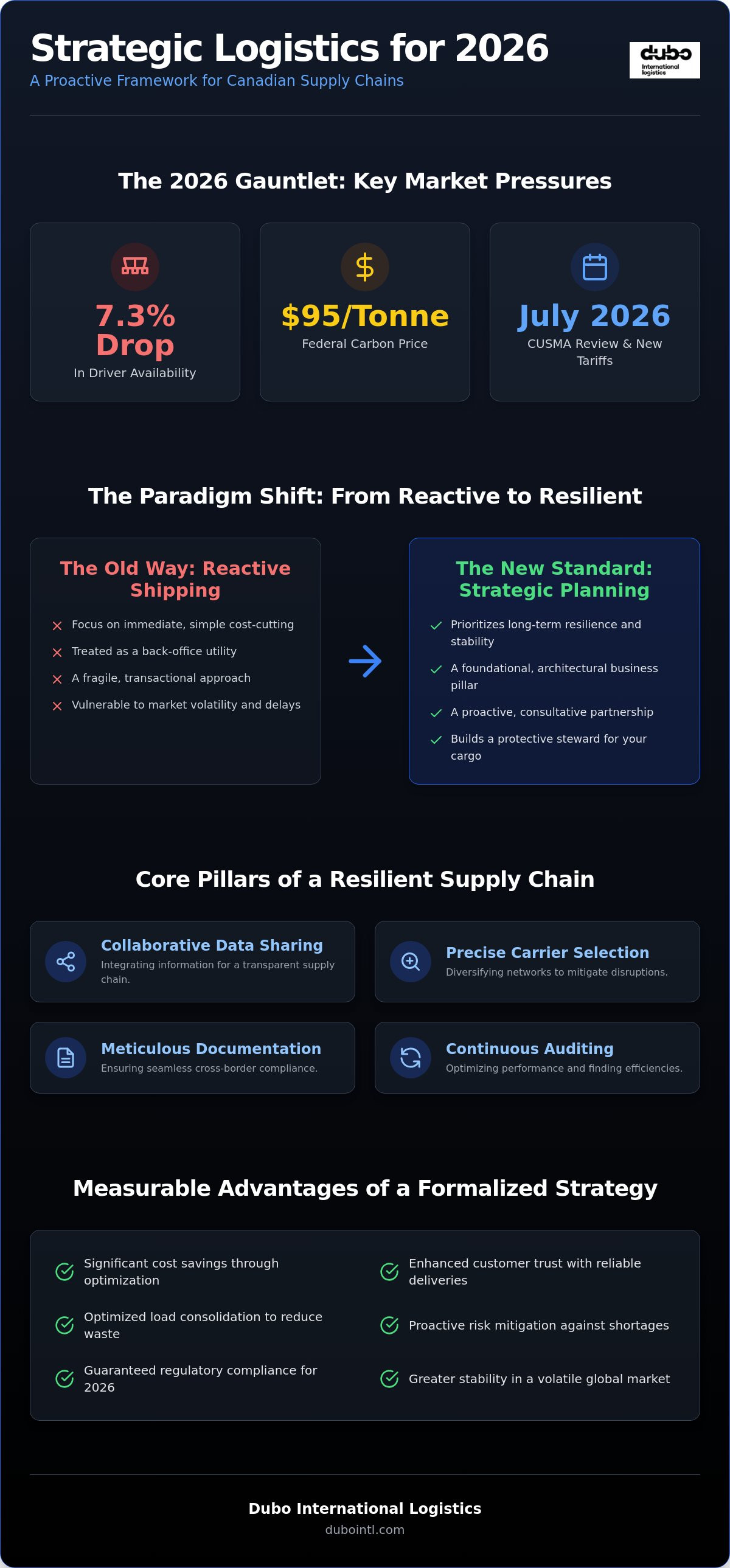
Could your current operations withstand a 7.3 percent drop in driver availability while the federal carbon price climbs to $95 per tonne? For many firms, the 2026 trade environment feels less like a predictable market and more like a high-stakes gauntlet. Implementing strategic logistics planning Canada wide has become the essential difference between a business that merely survives and one that thrives. It's understandable to feel the weight of unpredictable delays at the border or the rising costs of coordinating specialized cargo.
We believe that your supply chain should be a source of stability rather than a constant source of stress. This article outlines how leveraging expert consulting and Collaborative Planning, Forecasting, and Replenishment can secure a seamless, end-to-end cargo management process. By visiting www.dubointl.com, you can see how a dedicated partner helps you manage the July 2026 CUSMA review and new tariff structures with complete peace of mind. We'll examine the specific methodologies that reduce operational overhead and ensure your freight moves with precision across every border.
Key Takeaways
- Understand the shift from reactive freight movement to a proactive architectural strategy designed to withstand the unique economic pressures of the 2026 landscape.
- Explore how strategic logistics planning Canada professionals use consultative models to identify and eliminate hidden operational costs within your current carrier coordination.
- Discover how integrating Collaborative Planning, Forecasting, and Replenishment (CPFR) creates a more resilient and predictable supply chain across North America.
- Learn to navigate cross-border complexities and the specific documentation requirements for specialized or oversized cargo with precision and foresight.
- Find out how a partnership with Dubo International (www.dubointl.com) provides the expert guidance needed to transition from tactical shipping to a fully integrated logistics framework.
The Evolution of Strategic Logistics Planning in Canada for 2026
Logistics has moved beyond simple transport management to become a foundational business pillar. It's no longer sufficient to treat shipping as a back-office utility. Instead, we define strategic logistics planning Canada as the proactive coordination of goods, data, and physical resources to ensure stability in an unpredictable market. This shift represents a move from reactive shipping to architectural supply chain management foresight. By designing a logistics framework that anticipates disruptions, businesses can protect their interests against global volatility. We view this process as building a structural map where every carrier choice serves a long-term goal.
For many years, the industry focused almost exclusively on minimizing immediate shipping costs. However, the 2026 landscape proves that simple cost-cutting is a fragile strategy. With the federal carbon tax reaching $95 per tonne and a 7.3 percent drop in driver employment reported in April 2026, the margin for error has disappeared. Adopting a framework for strategic logistics planning Canada helps firms prioritize resilience over simple price reductions. Resilience is now the primary objective. A resilient strategy prioritizes precision in documentation and meticulous carrier coordination to prevent the delays that often follow poorly planned shipments. When you organize your logistics with this level of detail, you create a protective steward for your cargo.
Why 2026 Demands a New Logistics Paradigm
The current trade environment is shaped by complex regulations and rising operational pressures. The upcoming CUSMA review on July 1, 2026, has introduced a layer of uncertainty that requires expert navigation. Fluctuating fuel costs and new tariffs on steel and derivative products mean that traditional shipping solutions are no longer effective. Technology now allows for real-time cargo tracking and visibility, but these tools are only useful when paired with professional insight. This is why logistics consulting has emerged as a vital tool for business growth. It provides the strategic foresight needed to bridge the gap between local production and complex international requirements.
Key Benefits of a Formalized Strategy
A formalized approach to strategic logistics planning Canada delivers measurable advantages that go beyond the balance sheet. You can realize significant cost savings through optimized routing and load consolidation, ensuring that every shipment is as efficient as possible. Beyond the financial impact, a strategic approach builds immense customer trust. Reliable, compliant deliveries across North America demonstrate a commitment to excellence that transactional shipping simply cannot match. You can learn how to solve supply chain inefficiencies by moving away from tactical fixes and toward a holistic planning model. At Dubo International (www.dubointl.com), we act as a stabilizing force, helping you transition to a model that values longevity and consistency.
- Optimized Load Consolidation: Reducing empty kilometres and maximizing trailer capacity.
- Regulatory Compliance: Ensuring all documentation meets the evolving 2026 standards for cross-border trade.
- Risk Mitigation: Diversifying carrier networks to handle the ongoing driver shortage.
Core Pillars of a Resilient Canadian Supply Chain Strategy
Building a resilient supply chain requires more than just booking a truck. It demands a structural foundation where every movement is intentional and every resource is optimized. In the context of strategic logistics planning Canada, this means integrating four critical pillars: collaborative data sharing, precise carrier selection, meticulous documentation, and continuous auditing. These elements transform a reactive shipping department into a proactive logistics architecture. By focusing on the strategic flow of information rather than just the physical movement of crates, businesses can insulate themselves from the volatility of the 2026 market.
Documentation management is often where even the most sophisticated strategies fail. With the CUSMA review scheduled for July 2026, regulatory scrutiny at the border has intensified. A single missing permit or an incorrectly filed manifest can halt a specialized shipment for days, leading to high operational costs. Effective planning incorporates end-to-end documentation management as a non-negotiable standard. This ensures that every oversized load or sensitive shipment arrives with its paperwork perfectly aligned, providing the peace of mind that comes from knowing regulations are fully met.
The Role of CPFR in Modern Planning
Collaborative Planning, Forecasting, and Replenishment (CPFR) is the cornerstone of modern industrial coordination. For Canadian manufacturers, this process aligns supply with actual demand, effectively neutralizing the "bullwhip effect" where small shifts in consumer buying lead to massive, costly swings in inventory levels. By sharing data across the supply chain, you can ensure that transport capacity is booked exactly when it's needed. This level of coordination is particularly vital given the rapid growth of e-commerce in Canada, which has placed unprecedented strain on traditional transport networks. For a deeper look at this methodology, we recommend Understanding CPFR as a starting point for your team.
Selecting the Right Professional Partners
Choosing a partner is an exercise in trust and professional alignment. Working with a CIFFA certified freight forwarder ensures that your operations adhere to the highest professional standards in the country. While some businesses focus solely on transaction costs, viewing logistics consulting fees as an investment in long-term efficiency often yields better results. A seasoned consultant identifies hidden bottlenecks and optimizes your carrier mix before they become expensive problems. This expertise is especially critical for specialized transportation projects, where non-standard freight requires bespoke routing and handling. If you're ready to stabilize your operations, you might consider how expert logistics consulting can refine your current process and protect your interests in a complex global environment.
Consultative Logistics vs. Traditional Freight Forwarding
The traditional approach to freight forwarding often focuses on the "transactional" model, where the primary goal is simply moving a box from point A to point B. In a stable market, this might suffice. However, strategic logistics planning Canada requires a more sophisticated, "consultative" approach that prioritizes the optimization of the entire flow. While a traditional forwarder reacts to a shipping request, a consultative partner acts as a logistics architect, designing a system that anticipates bottlenecks before they occur. This distinction is vital in 2026, where thin margins and regulatory shifts make every inefficiency a significant financial risk.
A one-size-fits-all approach inevitably fails within the Canadian geographic context. The sheer scale of the country, combined with the complexities of the Canada-USA border, demands bespoke solutions for complex cargo. Traditional forwarding often overlooks the hidden operational costs associated with poor carrier coordination or misaligned documentation. Strategic consulting identifies these leakages, such as excessive wait times at border crossings or underutilized trailer capacity. By analyzing data and resources holistically, you can transform your supply chain from a cost centre into a competitive advantage.
When to Move Beyond Basic Forwarding
If your business faces frequent delays or rising overhead despite consistent volume, it is time for strategic intervention. A carrier moves your freight, but a logistics architect ensures that freight movement aligns with your broader business goals. While some hesitate at the mention of consulting fees, these investments typically pay for themselves by reducing wastage and preventing compliance-related fines. You can explore our methodology further at www.dubointl.com to see how we bridge the gap between basic shipping and architectural foresight.
Case for Outsourcing to Specialists
Outsourcing allows you to focus on your core competency while experts manage the intricate details of logistics documentation and carrier vetting. Navigating the 2026 landscape requires access to a broad network of vetted carriers who understand the specific demands of North American trade. Using Professional Freight Forwarding in North America as your baseline, you can build a system that is both cost-effective and resilient. This partnership ensures that specialized transportation projects are handled with the precision they deserve, protecting your reputation and your bottom line.
Managing Specialized Cargo and Cross-Border Complexity
Specialized cargo requires a level of precision that standard freight simply does not demand. In the 2026 environment, moving oversized machinery or sensitive industrial components involves more than just a large trailer. It requires a deep understanding of the 7.3 percent decrease in transport driver availability and how this shortage specifically impacts specialized operators. Effective strategic logistics planning Canada wide ensures that your non-standard freight is not left sitting at a terminal because of a lack of qualified handling. We approach these challenges as logistics architects, designing a complete movement plan that accounts for physical dimensions, weight restrictions, and the specific timing needs of your production schedule.
Manufacturers often face the most significant hurdles when their cargo crosses the Canada-USA border. With new 25 percent tariffs on certain steel-derivative products and the impending CUSMA review in July 2026, the margin for administrative error has vanished. Tailored freight solutions are no longer a luxury for these businesses. They are a requirement for survival. By integrating your specialized transportation needs into a broader strategic framework, you ensure that every permit is secured and every tariff classification is accurate before the wheels even turn.
Strategic Planning for Heavy Equipment
Transporting non-standard goods safely requires a specialized skill set and a network of vetted carriers. You can find detailed insights in our guide on Heavy Equipment Shipping for Manufacturers in Canada, which explores the technical requirements for 2026. Because these shipments often require pilot cars, specific route surveys, and unique tie-down procedures, specialized transportation project fees are a necessary investment in the safety of your assets. These costs reflect the high level of professional oversight required to move heavy equipment without incident or delay.
Seamless Cross-Border Integration
The goal of any international shipment is to achieve a state of "frictionless" trade. Strategic planning minimizes the disruptions that often occur at the border by ensuring the completeness of every digital and physical document. This proactive stance is a core part of our Cross-Border Freight Forwarding pillar. When your documentation is handled with precision, your cargo moves through customs with a smoothness that protects your timelines. If you are ready to secure your international supply chain, you can contact our specialized transportation team to begin building a more resilient cross-border strategy today.
- Route Surveys: Identifying height and weight restrictions before dispatch.
- Permit Management: Coordinating with provincial and state authorities for oversized loads.
- Tariff Precision: Ensuring accurate HTS codes for specialized industrial parts.
Implementing Your Strategic Logistics Framework with Dubo International
The transition from tactical shipping to a strategic framework is a deliberate evolution. It requires moving away from the "firefighting" of daily shipping and toward a structured architecture. Implementing strategic logistics planning Canada wide ensures that your business is prepared for the volatility we've analyzed, from driver shortages to shifting trade agreements. Dubo International acts as a stabilizing force, providing the professional stewardship needed to manage these complexities with quiet confidence and meticulous execution. We don't just move freight; we design the systems that keep your business moving forward.
A strategic approach turns your supply chain into a source of competitive advantage rather than a source of stress. When you prioritize resilience over simple cost-cutting, you build a foundation that can withstand market fluctuations. This involves a shift in perspective, where logistics is viewed as a bespoke solution tailored to your specific industrial needs. By focusing on the minute details of carrier coordination and documentation, we ensure that your operations remain seamless and compliant. This level of professional insight is what separates a standard forwarder from a true logistics architect.
Your Roadmap to Logistics Excellence
The journey begins with a comprehensive assessment of your current supply chain. We identify hidden inefficiencies, such as poor carrier coordination or documentation gaps that lead to costly border delays. Following this, we develop a tailored plan that integrates standard freight forwarding with specialized transportation projects for non-standard cargo. This isn't a "one-size-fits-all" solution. It's a bespoke framework designed to grow with your business. The process involves continuous monitoring and optimization of the freight management process. We refine your strategy as market conditions change, ensuring your logistics remain cost-effective and resilient throughout 2026.
Partnering for Peace of Mind
Success in Canadian logistics depends on a partner who understands the minute details of the industry. From the specifics of specialized permits to the nuances of North American carrier networks, Dubo International Logistics provides a sophisticated bridge between your business and complex global systems. As a CIFFA member, we adhere to the highest professional standards, ensuring that every shipment is handled with precision. We value longevity and consistency, positioning ourselves as a mature partner rather than a disruptive newcomer. We invite you to visit www.dubointl.com for a comprehensive consultation that addresses your unique operational needs. Our focus is on lowering your stress by serving as a protective steward of your interests. By choosing a partner dedicated to excellence, you secure the future of your cargo. Contact Dubo International Logistics to realize your supply chain potential and experience the difference of architectural foresight.
Securing Your Supply Chain for the 2026 Landscape
The 2026 logistics environment demands a definitive shift from simple freight movement to sophisticated architectural foresight. By prioritizing strategic logistics planning Canada wide, businesses can effectively navigate the complexities of cross-border trade and the unique requirements of specialized cargo movement. We've explored how consultative models and Collaborative Planning, Forecasting, and Replenishment (CPFR) move your operations beyond tactical fixes toward long-term stability. This transition isn't just about efficiency; it's about building a resilient framework that protects your business from the volatility of a shifting global market.
As a CIFFA member with deep expertise in North American cross-border logistics, Dubo International Logistics provides the professional stewardship your cargo deserves. Our focus remains on the minute details that ensure your freight moves with precision and regulatory compliance, regardless of the challenges at the border. You don't have to face global volatility alone when you have a seasoned partner acting as your guide through shifting regulations. It's time to transform your supply chain into a resilient asset that supports your long-term growth. Optimize your supply chain strategy with Dubo International Logistics and gain the peace of mind that comes from true professional partnership. We look forward to building a more predictable future for your operations together.
Frequently Asked Questions
What is the difference between logistics planning and supply chain management?
Logistics planning focuses on the precise movement and storage of goods, whereas supply chain management encompasses the entire network from raw materials to the final consumer. Strategic logistics planning Canada professionals focus on optimizing the flow within that larger network. By refining the specific movement of cargo and data, businesses can ensure their broader supply chain goals are met with precision and quiet confidence.
How much can strategic logistics planning save a Canadian business annually?
Strategic planning identifies hidden operational costs that often go unnoticed in transactional shipping models. While specific savings depend on your industry and volume, businesses realize significant gains through better carrier coordination and reduced border wait times. Eliminating empty kilometres and optimizing trailer loads directly impacts the bottom line by ensuring every shipment is as efficient as possible.
Why is CIFFA membership important for a freight forwarder in Canada?
CIFFA membership serves as a hallmark of professional excellence and ensures adherence to the highest Canadian standards. It reassures clients that their partner is committed to ethical practices and industry-literate methodology. For businesses navigating the complexities of 2026, this membership represents a foundation of trust and a commitment to professional stewardship.
Can strategic logistics planning help with shipping specialized or oversized cargo?
Specialized transportation requires the meticulous route surveys and permit management that only a formalized strategy can provide. Planning ensures that oversized or sensitive freight isn't delayed by physical restrictions or missing documentation at the border. It turns a high-risk movement into a controlled, professional process that protects your assets and your reputation.
How does CPFR improve logistics forecasting for manufacturers?
CPFR aligns transport capacity with actual demand through collaborative data sharing between supply chain partners. This visibility reduces the "bullwhip effect" that often leads to wasted resources and excess inventory. For manufacturers, it means booking trucks only when they're truly needed, ensuring a leaner and more responsive operation that avoids the stress of last-minute shipping.
What are the main causes of logistics delays at the Canada-USA border in 2026?
Delays in 2026 are primarily driven by documentation errors and shifting regulations following the July CUSMA review. New tariffs on steel and derivative products also require more precise classification at the border than in previous years. Without a proactive plan, these administrative hurdles can lead to significant disruptions in cargo movement and high operational costs.
Is strategic logistics consulting only for large enterprises?
Consulting is highly beneficial for businesses of all sizes that wish to move beyond reactive, tactical shipping. Smaller firms often have thinner margins and can't afford the hidden costs associated with logistics inefficiencies or compliance failures. A strategic framework provides these businesses with the same level of architectural foresight used by global enterprises to maintain stability.
How does Dubo International Logistics handle specialized transportation projects?
Dubo International Logistics handles specialized projects by acting as a dedicated guide for non-standard freight across North America. We coordinate the minute details of routing, permits, and carrier selection to ensure every oversized load reaches its destination safely and on time. You can explore our bespoke solutions further at www.dubointl.com to see how we stabilize even the most complex cargo movements.

