

The bullwhip effect isn't an inevitable part of logistics; it's a symptom of a fragmented strategy that relies on guesswork instead of synchronized data. You've likely felt the strain of inventory imbalances or the sudden, high costs of emergency freight when transparency with your suppliers and carriers breaks down. It's frustrating to realize that your logistics spend is climbing even as your predictability falls. By mastering the principles of cpfr, or Collaborative Planning, Forecasting, and Replenishment, you can transform these operational pains into a streamlined competitive advantage that stabilizes your entire network.
This guide provides a strategic roadmap to help you synchronize your supply chain and enhance partnership reliability across North America. We'll examine how a disciplined approach to shared data can reduce inventory levels by up to 40% and improve forecast accuracy by as much as 20% to 40%. You'll learn to move beyond reactive shipping toward a predictable replenishment cycle that fosters stronger, trust-based relationships with your logistics providers. To see how these strategies integrate with professional freight forwarding and consulting, visit www.dubointl.com to explore our specialized transportation services.
Key Takeaways
- Understand how to integrate disparate supply chain links by replacing reactive guesswork with a shared, real-time commitment to data.
- Master the four-stage cpfr framework to align your joint business plans with collaborative demand and supply management.
- Transition from fragmented legacy systems to cloud-integrated platforms that establish a single source of truth for all participants.
- Leverage predictive planning to navigate North American trade complexities and reduce customs delays before your freight even reaches the border.
- Identify the essential qualities of a logistics architect at www.dubointl.com to ensure your partnerships are built on longevity and consistency.
What is CPFR? Defining the Collaborative Planning, Forecasting, and Replenishment Model
CPFR is more than a technical protocol; it's a strategic architecture designed to harmonize the movement of goods between suppliers and retailers. At its foundation, Collaborative Planning, Forecasting, and Replenishment (CPFR) represents a shift from isolated decision-making to a unified, data-led process. Instead of each partner guessing what the other requires, they commit to sharing real-time information to meet actual customer demand. This level of integration acts as a stabilizing force, especially as North American trade faces increased regulatory scrutiny and tariff volatility in 2026.
Unlike traditional Vendor Managed Inventory (VMI), where the supplier often bears the sole burden of replenishment, or Just-in-Time (JIT) systems that can leave businesses vulnerable to sudden disruptions, cpfr creates a balanced partnership. It's about mutual accountability. By aligning goals and sharing risks, companies can organize their logistics with greater precision and confidence. For those seeking to refine these processes, visit www.dubointl.com to learn how our logistics consulting and specialized transportation services can help realize these efficiencies.
The Evolution of Supply Chain Collaboration
Supply chains have historically operated in a reactive state. When consumer demand shifts slightly, the ripple effect known as the bullwhip effect often leads to massive upstream disruptions and bloated inventory. CPFR changes this dynamic by moving from transactional vendor relationships to strategic logistics partnerships. It transforms the movement of goods into a proactive, synchronized flow where every participant has visibility into the joint business plan. This evolution is essential for maintaining resilience in a complex global environment.
Core Objectives of the CPFR Framework
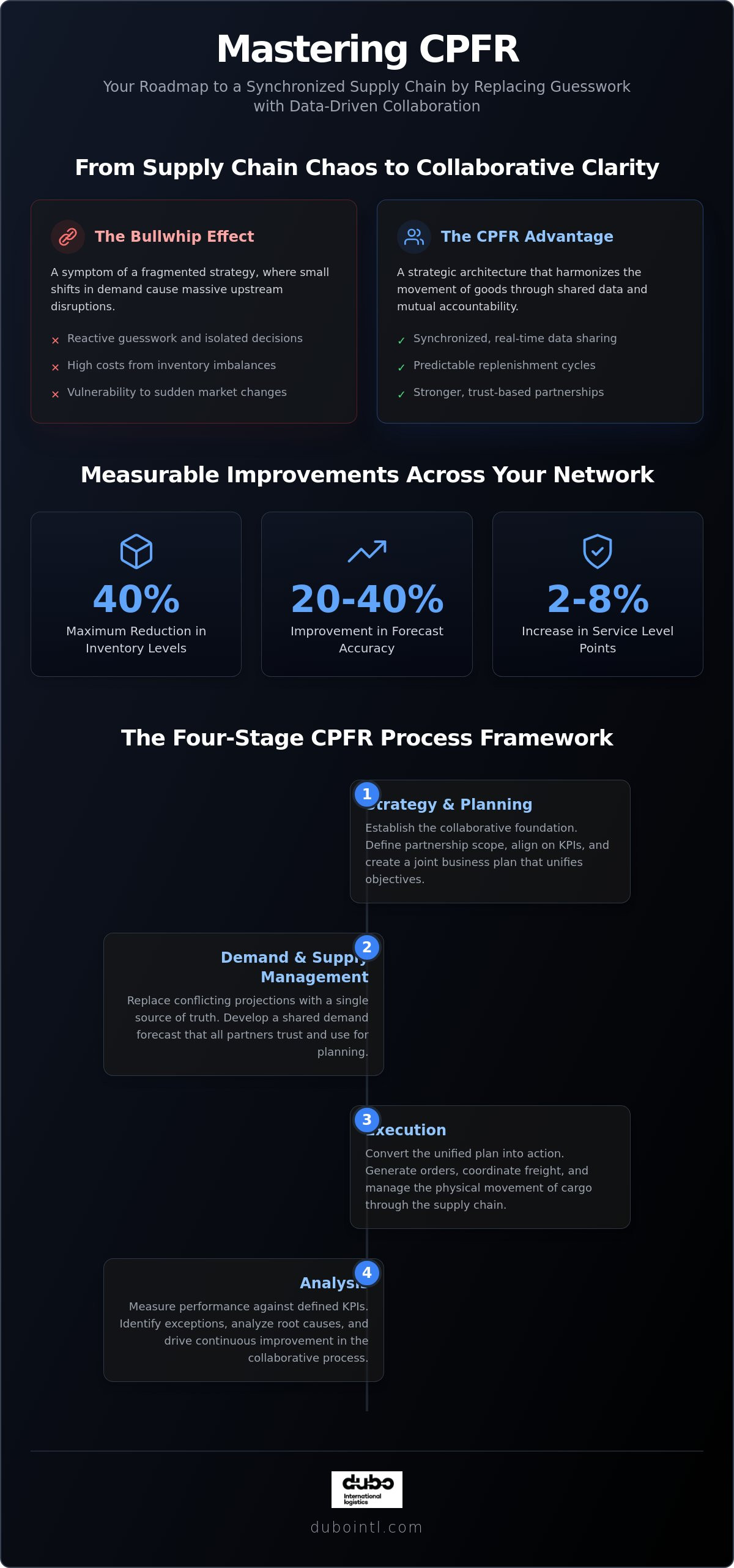
The primary goal of this framework is to replace uncertainty with clarity. By analyzing historical data and sharing current insights, partners can significantly improve forecast accuracy. Industry data shows that successful cpfr implementations can improve forecast accuracy by 20% to 40%. This allows businesses to reduce safety stock levels without compromising delivery reliability. It ensures the right cargo reaches the correct distribution centre at the precise moment it's needed, lowering operational costs and improving service levels by 2 to 8 percentage points.
The Four Stages of the CPFR Process: A Strategic Framework
The cpfr model operates as a continuous loop, ensuring that every link in the supply chain remains aligned with the ultimate goal of customer satisfaction. It's a disciplined architecture that moves through four distinct stages: Strategy and Planning, Demand and Supply Management, Execution, and Analysis. By following this sequence, partners replace reactive firefighting with a methodical, shared process that prioritizes stability. This structured approach allows businesses to organize their resources with precision, ensuring that every shipment serves a documented purpose within the broader business plan.
Stage 1 & 2: Building the Collaborative Foundation
Success begins with a formal agreement on the ground rules. Partners must define the scope of their collaboration and identify the key performance indicators (KPIs) that will measure their collective success. A robust CPFR implementation strategy involves creating a joint business plan that aligns the objectives of manufacturers, retailers, and logistics providers. This alignment is critical. It eliminates conflicting internal projections, replacing them with a single, shared demand forecast that everyone trusts. When everyone looks at the same data, the risk of overproduction or costly stockouts diminishes significantly. For businesses looking to stabilize their North American operations, consulting with a seasoned partner at www.dubointl.com can help establish these collaborative frameworks.
Stage 3 & 4: Execution and Continuous Improvement
Once the foundation is set, the focus shifts to converting the plan into actual cargo movement. This stage involves generating orders and coordinating end-to-end freight management to meet the established forecast. However, even the best plans face reality. This is where exception management becomes vital. Rather than reacting with panic to a sudden demand spike or a port delay, partners use pre-defined tolerance levels to trigger specific actions. If a forecast misses by more than a set percentage, a pre-arranged response protocol is activated immediately. This ensures that communication remains calm and purposeful. Following the movement of goods, performing post-execution reviews allows partners to realize efficiencies and refine the next planning cycle. This commitment to analysis ensures that the supply chain becomes more resilient with every iteration of the cpfr process.
Overcoming Barriers: Information Sharing and Technology in 2026
Implementing a successful collaborative strategy requires more than just a mutual agreement; it demands a robust technological infrastructure that establishes a single source of truth. For decades, many businesses relied on Electronic Data Interchange (EDI) to exchange basic documents. However, in the current trade environment, these legacy systems often lack the speed and depth required for true integration. Transitioning to cloud-integrated logistics platforms allows for a seamless flow of data that legacy EDI simply can't match. This shift is essential for the modern application of Collaborative Planning, Forecasting, and Replenishment (CPFR), where real-time updates replace delayed batch processing.
The integration of Artificial Intelligence (AI) has further revolutionized this space. By 2026, AI-enhanced collaborative forecasting can cut lost sales due to unavailability by up to 65%. These tools don't just process historical data; they identify emerging patterns and external variables that human planners might overlook. This predictive power allows partners to move beyond simple replenishment into a state of strategic foresight. To explore how these advanced methodologies can be tailored to your specific needs, visit www.dubointl.com for expert logistics consulting.
The Infrastructure of Transparency
A transparent supply chain relies on the deep integration of Enterprise Resource Planning (ERP) systems with specialized logistics management tools. This connection ensures that every participant has immediate access to inventory levels, production schedules, and transit statuses. Real-time cargo tracking is no longer a luxury; it's a validation tool that confirms whether replenishment timelines are being met. When data is shared accurately, businesses can organize more efficient transport routes and consolidate shipments, directly reducing the logistics spend that often climbs due to emergency freight or underutilized capacity.
Building Trust Through Data Integrity
The primary objection to deep collaboration is often the fear of compromising sensitive business intelligence. Protecting your proprietary forecasts and sales data is paramount. This is why establishing clear data-sharing protocols is a critical first step in any cpfr initiative. Partners must realize that "radical transparency" doesn't mean exposing every corporate secret; it means sharing the specific data points that drive mutual value. Working with a CIFFA certified freight forwarder provides an additional layer of security. These professionals act as trusted data stewards, ensuring that information is handled with the highest level of industry-standard integrity while maintaining the smooth flow of North American trade.
Strategic Advantages: Why CPFR is Essential for North American Trade
North American trade operates within a high-stakes environment where policy uncertainty and logistical friction can quickly erode profit margins. With intraregional trade under the USMCA surpassing $1.6 trillion in 2024, the scale of movement requires more than just reactive coordination. Implementing cpfr provides a stabilizing layer of strategic foresight that is particularly vital for navigating the complexities of cross-border freight forwarding. By aligning forecasts between shippers and carriers well in advance, businesses can ensure that customs documentation is prepared and validated before the cargo ever reaches the border, effectively neutralizing the risk of costly administrative delays.
While many discussions around collaborative planning focus on retail giants, the true competitive edge of the cpfr model lies in its application to industrial and non-standard sectors. For companies managing specialized freight or oversized cargo, the margin for error is nearly non-existent. Predictive planning allows these firms to secure specialized equipment and permits during peak seasons when capacity is at its tightest. To organize your next complex shipment with this level of precision, visit www.dubointl.com to explore our specialized transportation services.
Resilience in Cross-Border Logistics
The North American landscape is frequently challenged by regional labour disruptions and infrastructure bottlenecks. A collaborative framework allows partners to see these challenges coming and adjust their joint business plans accordingly. This proactive information exchange is critical for managing regulatory compliance, especially as 72% of supply chain professionals identify tariff volatility as their primary concern in 2026. By coordinating closely with carriers, shippers can also reduce the cost of "empty miles" through better-planned backhaul opportunities, ensuring that every kilometre driven contributes to the bottom line rather than adding to operational waste.
CPFR for Specialized and Industrial Cargo
Industrial projects often involve high-value machinery that requires precise scheduling to minimize downtime. Collaborative forecasting ensures that the arrival of specialized transport matches the readiness of the site, preventing expensive bottlenecks. This level of synchronization is only possible when all parties move beyond transactional interactions and embrace a shared commitment to data integrity. When you treat your logistics provider as a strategic architect, you gain the ability to execute complex transportation projects with a level of precision that protects your capital investments and reinforces your reputation for reliability.
Implementing CPFR: How to Choose a Strategic Logistics Partner
Selecting the right partner is the most critical decision in your cpfr journey. You aren't just looking for a carrier; you're seeking a logistics architect who understands the grand scale of global movement but remains focused on the minute details of your specific needs. This partner must possess a deep expertise in supply chain optimization consulting to act as a neutral facilitator between disparate supply chain links. Their ability to handle complex, end-to-end cargo movement across North America ensures that your collaborative plans are supported by reliable execution and technological maturity.
A sophisticated forwarder values consistency and commitment over short-term gains. They act as a stabilizing force, providing the quiet confidence needed to manage a predictable replenishment cycle. You should prioritize firms with a proven track record in specialized transportation and project cargo, as these areas require the highest levels of precision and strategic foresight. Their communication should be direct and highly organized, mirroring the efficiency of the industry they represent. By choosing a partner that functions as a dedicated, hands-on guide, you establish a foundation of trust that is essential for the "radical transparency" required by the cpfr model.
The Qualities of a Collaborative Forwarder
A truly collaborative forwarder moves beyond transactional relationships to become a protective steward of your business interests. This involves a commitment to longevity and a high professional register that reflects the serious nature of global trade. They should demonstrate an ability to integrate their systems with yours, ensuring that data flows seamlessly between all participants in the replenishment cycle. When evaluating potential partners, look for those who prioritize bespoke solutions over one-size-fits-all shipping. This level of dedication ensures that your specialized transportation projects are executed with the precision your customers expect.
Next Steps for Your Supply Chain
Moving toward a more synchronized supply chain begins with a few deliberate actions. Start by conducting an internal audit to pinpoint where a lack of transparency is causing inventory imbalances or emergency freight costs. Once these gaps are identified, choose a pilot product line to test the cpfr framework with a trusted partner. This methodical approach allows you to refine your processes and see tangible service level improvements before expanding the scope. To begin this transformation, visit www.dubointl.com and consult with Dubo International Logistics. Our team is ready to help you realize a more resilient and cost-effective logistics network through expert planning and dependable partnership.
Building a Resilient North American Network Through Collaboration
Transitioning to a cpfr model represents a fundamental shift from reactive logistics to a state of strategic foresight. By replacing isolated guesswork with a shared commitment to data, you'll significantly lower operational costs and stabilize your replenishment cycles. This alignment isn't merely about efficiency; it's about building the trust and transparency needed to navigate a complex global trade environment with quiet confidence. It ensures that every shipment moves with purpose, protecting your capital and your reputation.
Success in this area requires a partner who acts as a dedicated steward of your interests. As a CIFFA Certified Member with bespoke logistics consulting expertise, Dubo International Logistics provides the architectural guidance necessary to synchronize your supply chain. Our team of specialized project cargo specialists understands how to integrate these high-level principles into your daily operations with precision. To learn more about optimizing your supply chain through strategic partnership, visit Dubo International Logistics. You have the tools to transform your logistics from a cost centre into a lasting competitive advantage.
Frequently Asked Questions
What is the primary difference between cpfr and traditional forecasting?
Traditional forecasting relies on internal historical data and isolated assumptions, whereas cpfr integrates real-time demand signals and inventory levels from all supply chain participants into a single joint business plan. This collaborative approach replaces the uncertainty of siloed projections with a synchronized commitment to accuracy. It allows partners to realize efficiencies by aligning their production and shipping schedules before disruptions occur. By sharing a single source of truth, you eliminate the conflicting forecasts that typically lead to the bullwhip effect.
Can small to medium-sized Canadian businesses implement this model?
Small to medium-sized Canadian enterprises can absolutely implement this framework by starting with a focused pilot program. You don't need to overhaul your entire network at once. Instead, identify one high-volume supplier or a key retailer to test the collaborative model. By utilizing scalable cloud technology and professional logistics consulting, smaller firms can achieve the same improvements in forecast accuracy and inventory reduction seen by larger corporations. It's about the quality of the partnership, not just the size of the business.
How does the collaborative model specifically help with cross-border shipping to the USA?
This model streamlines cross-border logistics by ensuring that documentation and customs requirements are addressed well before the cargo reaches the border. Predictive planning allows you to secure carrier capacity during peak seasons and minimize the risk of administrative delays. Because both the shipper and the receiver are aligned on the replenishment schedule, the movement of goods becomes a predictable flow that reduces the need for expensive emergency freight. This synchronization is vital for maintaining a smooth supply chain in the face of tariff volatility.
What kind of technology is required to start a collaborative program?
Starting a program requires a platform that supports real-time data exchange and integrates with your existing Enterprise Resource Planning (ERP) system. While legacy EDI is still used, modern cloud-based logistics management tools offer the visibility needed for true integration. These platforms act as a single source of truth, allowing all partners to track inventory levels and transit statuses simultaneously. This ensures the replenishment cycle remains on schedule and allows for the exception management mentioned in earlier sections of this guide.
Does cpfr increase the workload for my logistics team?
While the initial setup of a collaborative framework requires an investment of time, it ultimately reduces the total workload by eliminating reactive "firefighting." Your team will spend less time managing emergency shipments and resolving inventory stockouts. By shifting the focus toward proactive planning, the daily operations of your logistics department become more methodical and less stressful. This stability allows your staff to focus on long-term strategic growth rather than immediate crisis management.
How long does it typically take to see results from an implementation?
Most businesses begin to realize measurable results within three to six months of launching a pilot implementation. Initial gains often appear as reduced safety stock levels and a noticeable improvement in service reliability. As the partnership matures and the data quality improves, the efficiencies in transport routing and inventory management become even more pronounced. Consistency is the key to achieving the full strategic benefits of this architectural approach to logistics.
What are the biggest risks involved in sharing data?
The primary risk involves the potential exposure of proprietary business intelligence, which is why clear data-sharing protocols are essential. Protecting your competitive advantage requires a structured agreement that defines exactly what data points are shared and how they are used. Working with a trusted steward ensures that your sensitive information is handled with professional integrity. This is where the expertise of a CIFFA certified forwarder becomes invaluable, as they maintain the transparency required for the program while safeguarding your data.
How do I choose the right partner for a collaborative logistics model?
You should prioritize a partner that acts as a sophisticated guide rather than a simple transportation provider. Look for a firm with deep expertise in specialized transportation and a commitment to long-term partnership over transactional gains. A reliable partner will have the technological maturity to participate in a cpfr data exchange and the consulting insight to help you organize your network. For more information on selecting a strategic logistics architect to support your collaborative goals, visit www.dubointl.com.

