
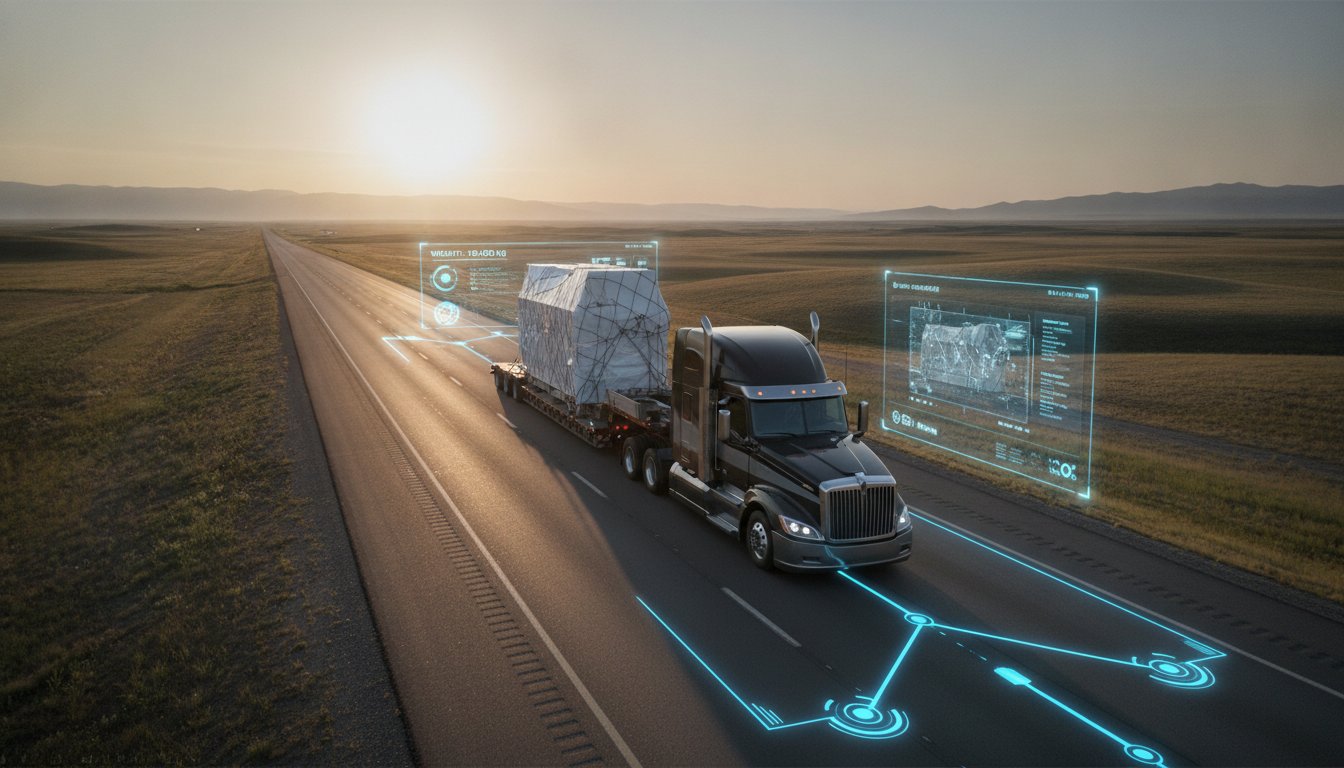
Transporting sensitive, non-standard cargo across the 49th parallel is no longer a simple trucking task; it is a high-stakes engineering project that happens to be on wheels. As the landscape for specialized freight North America evolves in 2026, the margin for error has effectively vanished. You likely feel the pressure of this reality every time a shipment nears the border, knowing that a single missing permit or an illegible inspection report can lead to thousands of dollars in fines and days of lost time.
We understand that your priority isn't just movement, but the absolute integrity of your equipment and the reliability of your timeline. This guide will show you how to master these complexities, ensuring your cargo crosses borders without friction or damage. We'll explore the latest regulatory shifts, including the impact of the 2026 USMCA review, and explain how a strategic partnership at www.dubointl.com provides the architectural precision required to turn your logistics challenges into a seamless, competitive advantage.
Key Takeaways
- Identify the specific cargo characteristics that demand a specialized approach to prevent the high risk of damage to sensitive equipment.
- Determine the optimal equipment configurations, including RGNs and air-ride technology, required to protect your most valuable assets during transit.
- Master the intricate documentation and permit requirements for specialized freight North America to ensure a seamless crossing under 2026 regulatory standards.
- Implement a rigorous selection process to find a logistics partner who acts as a dedicated architect rather than a simple carrier.
- Explore how to integrate professional logistics consulting from www.dubointl.com to achieve full compliance and eliminate unpredictable border delays.
Defining Specialized Freight: Navigating Complexity in North American Logistics
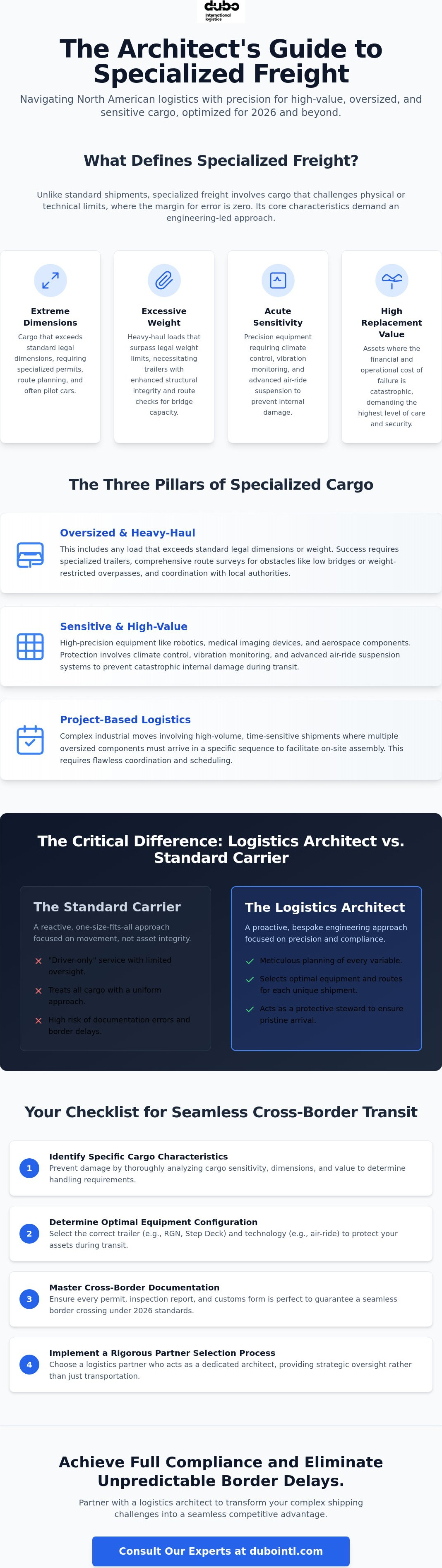
Specialized freight in North America is a category defined by its refusal to fit into a standard box. While traditional logistics focus on the efficient movement of uniform pallets, specialized transportation addresses cargo that challenges the physical limits of the road or the technical limits of standard handling. The core characteristics of this sector involve extreme dimensions, excessive weight, acute sensitivity, and high replacement value. When these factors converge, the standard logistics framework, designed for speed and volume, inevitably fails to provide the necessary protection for your assets.
The emotional and financial stakes of specialized cargo failure are exceptionally high. For a project manager in the aerospace or medical technology sector, a damaged component isn't just a financial loss; it is a catastrophic delay that can halt entire production lines or jeopardize critical research. This is where the concept of the logistics architect becomes essential. Rather than simply booking a truck, a specialized partner meticulously plans every variable to ensure a seamless arrival. You can find more about these bespoke strategies at www.dubointl.com, where our focus remains on reliability and precision.
The Three Pillars of Specialized Cargo
- Oversized and heavy-haul: This includes any Oversize load that exceeds standard legal dimensions or weight, requiring specialized trailers and often pilot cars to navigate public infrastructure safely.
- Sensitive and high-value: High-precision equipment like robotics and medical imaging technology requires climate control, vibration monitoring, and advanced suspension systems to prevent internal damage.
- Project-based logistics: These are industrial moves involving high-volume, time-sensitive shipments where multiple components must arrive in a specific sequence to facilitate assembly.
Why Specialized Freight Requires Strategic Foresight
Success in this field depends on the ability to anticipate constraints before the wheels ever turn. This means mapping out route constraints such as bridge heights, weight-restricted overpasses, and narrow urban centres that a standard dry van would never need to consider. Managing the colour of risk also requires a balance between comprehensive insurance and the expert handling that prevents a claim from ever being filed. It's about being proactive rather than reactive. Specialized freight is the precise intersection of engineering and transportation.
By understanding that specialized freight North America requires a bespoke approach, businesses can avoid the unpredictable delays that plague standard carriers. A dedicated partner acts as a protective steward, ensuring that your most complex shipments move with the quiet confidence of a well-executed plan.
The Logistics Architecture of Specialized Transportation: Equipment and Strategy
Specialized transportation is a discipline where the choice of hardware is as critical as the strategy behind the move. While standard carriers often provide a "driver-only" service that treats every load with a one-size-fits-all mentality, a true logistics architect views equipment as a bespoke tool designed for a specific engineering challenge. Success in specialized freight North America depends on this distinction. It is the difference between a shipment that merely arrives and one that arrives in pristine condition, fully compliant with every regional safety standard.
The foundation of this architecture is a diverse fleet of specialized trailers. Flatbeds serve as the versatile baseline for durable materials, but more complex loads require more sophisticated solutions. Step decks and double drops allow for the transport of taller items by lowering the centre of gravity and increasing overhead clearance. For heavy industrial machinery, the Removable Gooseneck (RGN) is indispensable, allowing equipment to be driven directly onto the trailer bed. Maintaining this equipment to the rigorous safety benchmarks of the Specialized Carriers & Rigging Association ensures that the physical risks of the journey are managed with professional rigor.
Matching Equipment to Cargo Requirements
Protection goes beyond the trailer frame. For sensitive cargo that requires shelter from wind and debris without the abrasive contact of traditional chains and tarps, a Conestoga trailer with a retractable tarping system is the ideal choice. Furthermore, for robotics or aerospace components, air-ride technology is a mandatory requirement. These systems use pressurized air bags to absorb road vibrations that would otherwise damage delicate internal calibrations. You can find detailed specifications on these protective systems and how they integrate into a broader strategy at www.dubointl.com.
Strategic Planning: The Invisible Advantage
The true value of a specialized partner is often found in the planning that occurs before the wheels ever turn. Logistics consulting fees provide immense value by identifying route optimizations that avoid costly delays. This includes mapping out every bridge height, weight restriction, and narrow turn on a transcontinental journey. For "super-loads," this coordination extends to the management of pilot cars and police escorts, ensuring safe passage through public infrastructure. Our project cargo logistics Canada experts specialize in these high-stakes transitions, turning the complexity of multi-modal movement into a predictable, well-ordered process. This methodical approach establishes a foundation of trust, allowing you to focus on your core business while your most valuable assets are in steady hands.
Cross-Border Specialized Freight: Compliance and Regulatory Precision
Crossing the 49th parallel with non-standard cargo is a regulatory gauntlet that demands absolute precision. As we move through 2026, the landscape of specialized freight North America is shaped by the scheduled July 2026 formal review of the USMCA. This review introduces a layer of strategic uncertainty for manufacturers, making it vital to ensure all goods remain compliant to avoid the 25 per cent tariffs imposed on non-compliant imports since early 2025. A single documentation error can lead to more than just a delay; it can result in significant financial penalties and a fractured supply chain.
Regulatory enforcement has reached a new peak this year. The Federal Motor Carrier Safety Administration (FMCSA) recently increased penalties for the willful falsification of Driver Vehicle Inspection Reports (DVIR) to as much as $19,000 per violation. For specialized moves involving sensitive equipment, these standards are non-negotiable. At www.dubointl.com, we prioritize a methodology that treats compliance as a foundational element of the logistics architecture, ensuring every permit and declaration is verified well before the cargo reaches the port of entry.
The Canada-USA Border: A Specialized Perspective
Seamless delivery across the border relies on the expert synchronization of PARS (Pre-Arrival Review System) for shipments entering Canada and PAPS (Pre-Arrival Processing System) for those heading into the United States. Since March 2026, all commercial goods entering the U.S. require a formal entry regardless of value, making precise freight documentation services more critical than ever. To mitigate the risk of invasive border inspections that could jeopardize sensitive equipment, we utilize trusted trader programs like C-TPAT and PIP. You can explore our deep dive into these requirements in our guide to cross-border freight forwarding Canada USA.
Permits and Escorts: The Legal Landscape
Coordinating an oversized move requires managing a patchwork of state and provincial regulations. Each jurisdiction maintains its own standards for weight tolerances, travel times, and escort requirements. A "super-load" moving from Ontario to Texas might require separate permits for every state and province it traverses, along with coordinated police escorts in specific urban centres. We manage this complexity by verifying all carrier certifications through the SAFER database and securing permits that align with the specific dimensions of your cargo. This proactive stance eliminates legal friction and ensures that your specialized shipment moves with the quiet authority of a professional, well-planned operation.
Selecting a Specialized Freight Partner: A Decision-Making Framework
Selecting a partner for specialized freight North America requires a fundamental shift in perspective. You aren't simply hiring a transportation provider; you're commissioning a strategic architect to protect your most valuable assets. This decision-making framework ensures that your choice reflects the sophistication of your cargo and the complexity of its journey across provincial and state lines. When your equipment involves oversized dimensions or sensitive technology, the lowest bidder often presents the highest risk of damage or regulatory delay. You need a partner who functions as a stabilizing force in the complex North American trade environment.
Start by verifying industry certifications. CIFFA (Canadian International Freight Forwarders Association) membership remains the gold standard for professional benchmarks. A certified partner adheres to a strict code of ethics and demonstrates a high level of competency in managing complex international movements. You can explore the role of these standards in our comprehensive guide to freight forwarding North America.
Next, evaluate their specific experience with your cargo category. Transporting a medical MRI machine requires vastly different protocols than moving a 50-tonne excavator. A qualified partner will offer a consultative approach to supply chain optimization, identifying potential bottlenecks before they manifest. This includes a thorough audit of insurance coverage and risk management protocols to ensure your financial interests are protected at every stage. Finally, review their network of specialized carriers. A forwarder with a broad reach can source niche equipment, such as double-drop trailers or climate-controlled Conestogas, that asset-heavy carriers may lack in their local fleet.
The Value of CIFFA Certification
Professional standards matter most when the stakes are highest. A CIFFA-certified partner provides the reassurance that your cargo is being managed by experts who understand the legal and ethical requirements of global trade. This certification ensures that the methodology used to move your freight is both efficient and transparent. It creates a sense of security, knowing your interests are being stewarded by a seasoned expert who prioritizes longevity and consistency over short-term gains.
Carrier Coordination vs. Asset Ownership
While asset-based carriers offer direct control over specific trucks, a forwarder-led network provides unparalleled flexibility for niche equipment needs. This model allows us to source the exact trailer configuration required for your specific load rather than forcing your cargo to fit the available equipment in a local yard. Rigorous carrier vetting ensures that every driver in the network meets our internal safety and reliability standards. This end-to-end management reduces the burden on your internal team, allowing you to focus on your core operations while we handle the minute details of movement. For a partner who acts as a dedicated architect for your cargo, consult with the specialists at Dubo International Logistics.
Dubo International Logistics: Precision-Engineered Specialized Freight Solutions
At Dubo International Logistics, we operate with the understanding that complex cargo requires more than a carrier; it requires a logistics architect. Our philosophy centres on the idea that every piece of specialized freight North America moves is a unique engineering challenge that demands a bespoke solution. We don't just facilitate transportation. We provide integrated logistics consulting that identifies the most efficient routes and equipment configurations before the first mile is ever driven. This strategic foresight ensures that your project moves with a quiet confidence, anchored by a professional process that prioritizes the safety of your assets. We believe that a well-planned move is a silent move, where the complexity is managed behind the scenes so that your delivery remains seamless.
Our commitment to dependability is not just a promise; it's a methodology. By positioning ourselves as a stabilizing force in a complex global environment, we seek to lower the stress often associated with high-value movements. We act as a protective steward of your interests, ensuring that every shipment is handled with a level of care that reflects its importance to your business. This partnership-focused approach creates a sense of security that suggests we aren't just moving a load, but managing a critical component of your company's future.
Bespoke Solutions for Non-Standard Cargo
Every shipment has its own set of requirements, whether it's a high-value medical device or an oversized industrial component. We customize every move to the specific needs of the cargo, ensuring that the equipment and the route are perfectly aligned. Based in Saint-Philippe, Quebec, our team possesses a deep expertise in navigating both provincial and national regulations. This local knowledge provides a seamless bridge between Quebec-based manufacturing and the complexities of the broader North American market. We focus on precision and integration. This means ensuring that every detail, from retractable tarping systems to multi-jurisdictional permits, is handled with meticulous care. Our approach is hands-on and dedicated, reflecting a commitment to the minute details that ensure a damage-free delivery.
Your Partner in North American Trade
Reliability is the cornerstone of our partnership. Businesses trust Dubo International Logistics to act as a stabilizing force, lowering their logistics-related stress by managing the high-stakes variables of specialized movement. Our CIFFA membership serves as a testament to our commitment to professional excellence and ethical cargo handling. We don't just move freight. We act as a protective steward of your interests, ensuring full regulatory compliance without the friction of border delays or unpredictable costs. This sense of security is what allows our clients to focus on their core business while we manage the intricate details of their supply chain. Secure your supply chain today by visiting www.dubointl.com to learn how our seasoned experts can architect your next move with precision and care.
Secure Your Strategic Advantage in 2026
Success in specialized freight North America depends on your ability to transform a transportation task into a meticulously engineered project. We've explored how the right equipment, combined with strategic foresight regarding USMCA compliance, ensures that your high-value assets move without the friction of border delays or physical damage. By prioritizing a logistics architect approach, you move from a reactive stance to one of controlled, predictable excellence. This methodology transforms your supply chain into a reliable engine for growth, even in a complex regulatory environment.
As a CIFFA Certified Member with deep expertise in project cargo planning, Dubo International Logistics is dedicated to being the stabilizing force your business requires. We provide the specialized knowledge and rigorous vetting needed to navigate the complexities of cross-border trade with absolute precision and quiet confidence. Experience the peace of mind that comes with precision-planned logistics. Consult with our specialized freight experts at www.dubointl.com today. Your most complex cargo is in steady, seasoned hands, and we're ready to help you navigate the road ahead.
Frequently Asked Questions
What qualifies as specialized freight in North America?
Specialized freight North America includes any cargo that cannot be transported via standard dry vans due to its physical dimensions, extreme weight, or acute sensitivity. This category encompasses oversized loads like industrial turbines, heavy-haul machinery, and delicate technology such as medical imaging devices. These shipments require niche equipment, including RGNs or step decks, and demand meticulous route planning to navigate infrastructure constraints across different regions.
How do specialized freight costs differ from standard shipping?
Specialized freight costs are typically higher because they reflect the engineering complexity and risk management involved in the move. Unlike standard freight, these projects incur additional expenses for multi-jurisdictional permits, pilot cars, and specialized trailers. Investing in professional logistics consulting through www.dubointl.com ensures that these costs are optimized through strategic route planning, which prevents expensive delays and protects the integrity of high-value assets.
What permits are required for oversized cargo crossing the Canada-USA border?
Moving oversized cargo across the border requires a combination of regional permits and federal customs documentation. You must secure specific over-dimensional or overweight permits from every province and state along the transit route, as each jurisdiction has its own rules for travel times and escorts. Coordinating these permits with PARS and PAPS filings is essential to ensure a seamless crossing that remains fully compliant with current USMCA standards.
Can specialized freight be shipped via LTL (Less Than Truckload)?
Certain high-value or sensitive items can be shipped using specialized LTL services if they don't require a full trailer. This approach is ideal for smaller robotics or medical instruments that need air-ride suspension and professional handling but fit within standard trailer dimensions. However, if the cargo is oversized or requires heavy-haul equipment, a dedicated specialized transportation solution is necessary to manage the legal and physical requirements of the move.
How does air-ride technology protect sensitive cargo?
Air-ride technology replaces traditional steel springs with a system of pressurized air bags to support the trailer. This suspension system absorbs road vibrations and shocks that would otherwise damage delicate internal components. For aerospace sensors or laboratory equipment, this technology is a mandatory requirement to maintain precise calibrations and ensure the cargo arrives in the same condition it left the facility.
Why should I use a freight forwarder instead of a direct carrier for specialized moves?
A freight forwarder acts as a logistics architect, offering access to a broader network of niche equipment than a single asset-based carrier can provide. This flexibility ensures you get the exact trailer configuration required for your specific load. Forwarders also handle the end-to-end coordination of permits, escorts, and customs documentation, which reduces the administrative burden on your internal team while ensuring every carrier is rigorously vetted.
How long does it take to secure permits for heavy-haul transport?
Securing heavy-haul permits generally takes between three and ten business days, though the timeline varies by jurisdiction. More complex "super-loads" that require engineering studies for bridges or the temporary lifting of utility lines can take several weeks to coordinate. It's vital to integrate permit acquisition into the early stages of your project planning to account for these administrative lead times and prevent scheduling conflicts.
Is insurance included in specialized transportation project fees?
Standard carrier liability is typically included in the project fees, but it often doesn't cover the full replacement value of specialized cargo. We recommend auditing your coverage to determine if an "all-risk" cargo insurance policy is necessary for your specific shipment. This additional layer of protection ensures your financial interests are fully secured against unforeseen incidents during the complex movement of high-value industrial or technological assets.

