
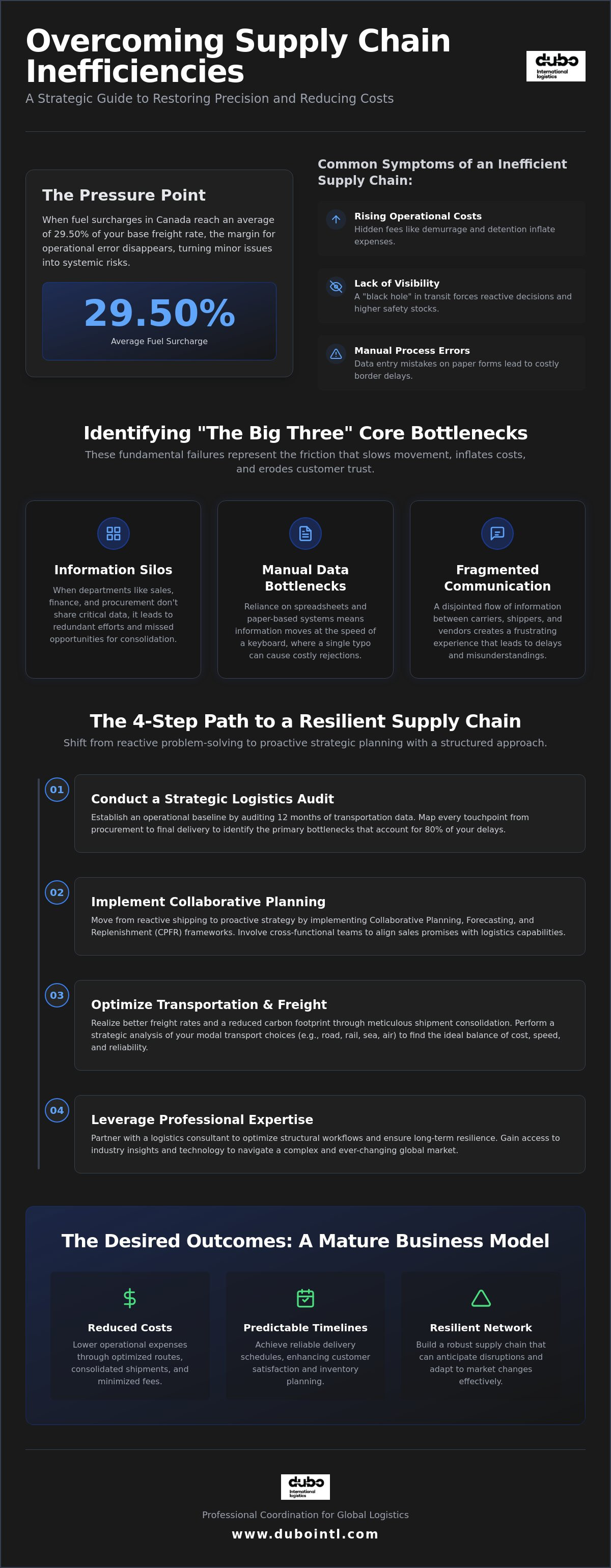
When fuel surcharges in Canada reach an average of 29.50 percent of your base freight rate, the margin for operational error essentially disappears. You likely recognize that rising costs and a persistent lack of visibility into shipment status aren't just minor inconveniences; they're systemic risks to your stability. It's exhausting to manage inconsistent carrier performance while manual data entry errors quietly drain your resources. This strategic guide offers the supply chain inefficiencies solutions needed to restore precision and peace of mind to your logistics. You'll learn how to resolve bottlenecks through meticulous planning and the professional coordination found at www.dubointl.com. We will detail the path toward reduced operational costs, predictable delivery timelines, and the seamless cross-border movement that defines a mature, well-integrated business model. By the end of this article, you'll realize how to organize your vendor communication to foster a truly resilient network.
Key Takeaways
- Learn how to establish an operational baseline by auditing 12 months of transportation data to map every touchpoint from procurement to final delivery.
- Discover practical supply chain inefficiencies solutions by identifying and resolving the "Big Three" bottlenecks: information silos, manual data entry, and fragmented communication.
- Shift your approach from reactive shipping to proactive strategic planning by implementing Collaborative Planning, Forecasting, and Replenishment (CPFR) frameworks.
- Realize better freight rates and a reduced carbon footprint through meticulous shipment consolidation and the strategic analysis of your modal transport choices.
- Understand when to leverage professional logistics consulting at www.dubointl.com to optimize your structural workflows and ensure long-term resilience in a complex global market.
Identifying the Core Supply Chain Inefficiencies in Modern Logistics
Supply chain inefficiency is the measurable gap between your operation's potential output and its actual performance. It represents the friction that slows movement, inflates costs, and complicates what should be a seamless flow of goods. Fundamentally, supply chain inefficiency is a persistent drain on corporate capital and a slow erosion of customer trust. To begin implementing supply chain inefficiencies solutions, one must first look at the foundational principles of supply chain management to understand where the system breaks down and where value is lost.
We generally categorize these failures into "The Big Three": information silos, manual data bottlenecks, and fragmented communication. Information silos occur when departments don't share critical data, leading to redundant efforts and missed opportunities for consolidation. Manual data bottlenecks arise when information moves at the speed of a keyboard rather than the speed of the market. Fragmented communication between carriers, shippers, and vendors creates a disjointed experience that frustrates every stakeholder involved. By identifying these specific pain points, you can begin to tailor supply chain inefficiencies solutions that address the root cause of the waste.
These aren't just abstract concepts. They manifest as tangible financial penalties that impact your bottom line. Hidden costs like demurrage and detention fees often stem directly from these core issues. When a container sits at a port because documentation is missing or a carrier wasn't notified of a delay, the resulting daily charges reflect a failure of coordination, not just bad luck. These fees can quickly snowball, turning a profitable shipment into a net loss for the business.
The High Cost of Limited Visibility
Many Canadian firms experience a "black hole" effect when cargo enters the cross-border transit phase. Without real-time data, you're forced into reactive decision-making, scrambling to solve problems only after they've disrupted your schedule. This lack of transparency forces businesses to maintain higher safety stock levels. This increases inventory carrying costs and ties up valuable working capital that could be better used elsewhere. True visibility means knowing the status of every SKU, not just the general location of a truck, allowing you to anticipate delays and redirect resources before a minor hiccup becomes a major disruption.
Manual Processes and Human Error
The reliance on paper-based documentation and legacy spreadsheets remains a significant vulnerability in modern trade. Data entry errors in freight documentation frequently lead to costly border delays. A single typo on a commercial invoice can trigger an exhaustive secondary inspection or a complete rejection at the port of entry. Transitioning to integrated logistics systems ensures data integrity and creates a smoother, more predictable flow. Professional coordination at www.dubointl.com helps bridge these gaps, ensuring that precision replaces guesswork in your international movements. By modernizing these manual touchpoints, you don't just save time; you protect your reputation for reliability.
Conducting a Strategic Logistics Audit to Measure Performance
Measurement is the precursor to mastery. To implement effective supply chain inefficiencies solutions, you must first quantify the current state of your operations through a rigorous strategic audit. This process begins by aggregating the last 12 months of transportation data to establish a reliable baseline, allowing you to filter out seasonal anomalies and focus on systemic issues. By mapping every touchpoint from the initial procurement request to the final mile delivery, you gain a clear view of where your capital is truly being spent and where it's being wasted.
An academic perspective on supply chain challenges suggests that many organizations fail because they treat logistics as an isolated function rather than an integrated ecosystem. To avoid this, involve cross-functional teams from sales, finance, and procurement during your audit. Friction often occurs at the intersections of these departments; for example, a sales team might promise delivery windows that the current carrier network simply cannot meet. By identifying the primary bottlenecks that account for 80 percent of your delays, you can prioritize interventions that offer the most significant impact on your bottom line. If you're unsure where to begin this deep dive, the experts at www.dubointl.com can provide the professional consulting needed to illuminate these hidden costs.
Essential KPIs for Supply Chain Health
Reliability is measured through data, not intuition. Focus on On-Time In-Full (OTIF) rates as your primary metric for carrier performance and customer satisfaction. You should also measure Transportation Cost per Unit to realize exactly where your margins are being eroded by rising fuel surcharges or inefficient routing. Finally, track Documentation Accuracy rates; even minor errors can lead to significant regulatory compliance risks and costly border delays.
Process Mapping: Visualizing the Flow
Visualizing your logistics network is essential when developing robust supply chain inefficiencies solutions because it helps you spot redundant steps that add time without adding value. Create a comprehensive map of both cargo movement and the corresponding information exchange to identify "single points of failure." This might include a heavy reliance on a single border crossing or a specific carrier that lacks the capacity to scale during peak seasons. Eliminating these vulnerabilities creates a more resilient foundation, ensuring your business remains a stabilizing force even in a complex global environment.
Implementing Collaborative Planning and Forecasting Solutions
Strategic foresight is the most effective antidote to the chaos of reactive shipping. While many businesses struggle to manage daily disruptions, a mature organization realizes that the most robust supply chain inefficiencies solutions are built on a foundation of proactive planning. This shift requires a move away from siloed decision-making toward a model where demand data and inventory levels are shared transparently across the entire network. By adopting Collaborative Planning, Forecasting, and Replenishment (CPFR), you can effectively neutralize the "bullwhip effect." This phenomenon occurs when minor fluctuations in consumer demand are amplified as they move upstream, leading to either excessive safety stock or critical inventory shortages. Establishing rhythmic communication cycles with your key suppliers ensures that every partner operates from a single version of the truth, creating the stability needed to navigate a volatile global market.
Enhancing Supplier and Partner Communication
Professional logistics coordination relies on moving beyond transactional, one-off emails toward integrated communication platforms. These systems allow for real-time adjustments and shared visibility, which significantly reduces the likelihood of the manual data entry errors that often plague cross-border trade. It's essential to conduct regular performance reviews with your freight forwarding partners to ensure that operational goals remain aligned. Establishing clear Service Level Agreements (SLAs) provides a framework for accountability, ensuring that every stakeholder understands their specific responsibilities. At www.dubointl.com, we understand that this level of consistent, high-level coordination is the bedrock of a dependable supply chain.
The Role of Technology in Synchronization
Cloud-based platforms now act as a central nervous system for modern logistics, centralizing data for all stakeholders to access simultaneously. Integrating your internal ERP systems with your logistics providers allows for a seamless information flow that minimizes the need for manual intervention and reduces administrative waste. This synchronization ensures that your procurement and transportation teams are always in sync, preventing the departmental silos that typically lead to transit delays. Technology is an enabler of strategy, not a replacement for it. While sophisticated software provides the necessary data, the "logistics architect" must still interpret these insights to develop bespoke supply chain inefficiencies solutions that support long-term business resilience and growth.
Optimizing Transportation and Freight Management Workflows
Execution is where strategy meets the road. To implement effective supply chain inefficiencies solutions, you must critically analyze your modal choices to ensure you're using the most efficient transport method for your specific cargo type. Many businesses default to familiar routes; however, consolidating shipments can realize significantly better freight rates while reducing your carbon footprint. With the 2026 federal carbon tax at $95 per tonne of CO2 equivalent, reducing empty miles and optimizing load density is no longer just an environmental goal, it's a financial necessity. Evaluating the efficiency of your current route planning and carrier selection process ensures that your logistics remain a stabilizing force rather than a source of volatility.
Complexity increases significantly when cargo moves across international lines. Mastering cross-border freight forwarding is essential to prevent border bottlenecks that can derail even the most well-planned schedules. Professional freight forwarding at www.dubointl.com provides the oversight needed to ensure that transit times remain predictable despite shifting trade policies. By proactively managing these workflows, you replace reactive scrambling with a rhythmic, organized flow of goods.
Solving Inefficiencies in Specialized Transportation
Specialized cargo requires a level of bespoke planning that standard freight simply doesn't demand. Manufacturers often face unique risks associated with heavy equipment shipping, where a single oversight in permit acquisition can lead to significant project delays. Oversized loads require a logistics architect who understands the minute details of provincial regulations and oversized load permits. Working with experts who specialize in these complex movements ensures that your heavy machinery arrives safely and on schedule, protecting your capital investment from unnecessary transit damage or regulatory fines.
Streamlining Regulatory and Customs Compliance
Regulatory friction is a common source of supply chain waste that quietly erodes your margins. Proactive documentation management prevents cargo from being held at the border, a risk that has only increased with the 2026 rise in U.S. Customs and Border Protection fees, such as the annual commercial truck transponder fee increasing to $870.60 USD. Reducing friction through meticulous classification and valuation of goods ensures that your compliance remains beyond reproach. You should consider the following steps to harden your compliance framework:
- Maintain updated records for all Harmonized System (HS) codes to ensure accurate valuation and duty payment.
- Review all commercial invoices for data integrity before they reach the port of entry to avoid secondary inspections.
- Monitor changes in North American trade regulations to anticipate shifting tariff structures and avoid surprise costs.
To ensure your transportation workflows are fully optimized for the current regulatory environment, consider reaching out to the specialized team at www.dubointl.com for a comprehensive review of your logistics strategy.
Partnering with a Logistics Consultant for Long-Term Resilience
Growth often introduces a level of complexity that eventually outpaces the capacity of internal resources. While your team may excel at core operations, managing the intricate web of global trade requires a specialized set of eyes. Recognizing when your internal systems are no longer sufficient is a sign of leadership, not a failure of process. Engaging in logistics consulting in Canada allows you to step back from daily fires and focus on structural optimization. An external expert provides the objective "logistics architect" perspective needed to identify the root causes of waste. Dubo International Logistics positions itself as the stabilizing partner in this journey, ensuring that your expansion is supported by a foundation of operational excellence rather than hindered by it.
Bespoke Solutions for Unique Business Models
One-size-fits-all logistics models often create more problems than they solve because they ignore the specific nuances of your industry. Whether you are moving delicate electronics or heavy industrial machinery, your supply chain inefficiencies solutions must be as unique as your business model. We begin by designing a custom logistics strategy that aligns with your specific procurement cycles and delivery requirements. Outsourcing end-to-end management to a seasoned partner ensures that precision and peace of mind become the standard, not the exception. This bespoke approach eliminates the redundant steps that typically inflate costs in generic shipping frameworks.
Building a Resilient Supply Chain for 2026 and Beyond
Resilience in 2026 requires more than just efficient movement; it demands the agility to pivot during sudden global trade fluctuations. As you navigate a market shaped by a 2.25 percent policy interest rate and rising carbon costs, the ability to adapt your strategy in real-time is your greatest competitive advantage. We believe in the value of long-term partnerships over short-term transactional shipping. A dedicated partner understands your history and anticipates your future needs, providing the stability required to weather geopolitical shifts or capacity shortages. This collaborative depth is what transforms a standard vendor relationship into a strategic asset.
Implementing the right supply chain inefficiencies solutions is a continuous journey of refinement and adaptation. By combining strategic foresight with meticulous operational coordination, you can turn your logistics network into a source of enduring value. To explore how our professional consulting services can refine your specific operations and restore smoothness to your cargo movement, please visit www.dubointl.com today. We are ready to act as the protective steward of your interests in an increasingly complex global environment.
Securing Your Operational Future Through Strategic Alignment
Operational excellence is not a destination but a continuous process of refinement and adaptation. By integrating the strategic audits, collaborative forecasting, and modal optimizations discussed in this guide, you can effectively insulate your business from the volatility of global trade. Implementing these supply chain inefficiencies solutions ensures that your capital remains protected and your delivery timelines remain predictable. It's about moving from a reactive stance to one of quiet, steady authority in a complex environment. As a CIFFA Certified Member, Dubo International Logistics brings specialized cargo expertise across North America and a deep commitment to seamless end-to-end cargo coordination. We act as your stabilizing force, managing the minute details so you can focus on your broader mission. Partner with the logistics architects at Dubo International Logistics to refine your supply chain and realize the benefits of a truly integrated network. Your operations deserve the precision and reliability that only a seasoned expert can provide. We look forward to building a resilient future together.
Frequently Asked Questions
What are the most common causes of supply chain inefficiencies in 2026?
The primary causes include information silos, manual data entry errors, and fragmented communication between partners. These issues are currently compounded by rising operational costs, such as the federal carbon tax reaching $95 per tonne. These factors create systemic friction that delays movement and erodes your business margins.
How can a business identify hidden costs in its logistics operations?
Identifying hidden costs requires a rigorous audit of your last 12 months of transportation data. You should look specifically for demurrage, detention fees, and fuel surcharges, which often account for nearly 30 percent of the base freight rate. This audit reveals exactly where capital is leaking from your system due to poor coordination.
Does a logistics consultant help with cross-border shipping between Canada and the USA?
Yes, a consultant provides the strategic foresight needed for seamless cross-border movement. They ensure your cargo meets all Canadian and U.S. regulatory requirements while acting as a stabilizing bridge during periods of trade policy uncertainty. You can explore these professional consulting services at www.dubointl.com to harden your international operations.
What is the first step in solving a supply chain bottleneck?
The first step is to establish an operational baseline by mapping every touchpoint in your current network. This visualization helps you spot redundant steps and identify the single points of failure that cause 80 percent of your delays. It's the essential foundation for all effective supply chain inefficiencies solutions.
How does real-time visibility improve supply chain efficiency?
Real-time visibility eliminates the "black hole" effect that often occurs when cargo enters the transit phase. It provides the data necessary to anticipate delays and redirect resources before they impact your delivery timelines. This level of transparency reduces the need for maintaining expensive safety stock and lowers inventory carrying costs.
Can specialized transportation services reduce overall logistics waste?
Specialized services reduce waste by applying bespoke coordination to complex, oversized loads that standard freight models can't handle. Professional project management ensures that heavy equipment is moved with precision, preventing the significant project delays and damages that typically drain corporate resources. It's a strategic approach to managing high-value assets.
Why is documentation accuracy so critical for North American freight?
Accuracy is critical because a single typo on a commercial invoice can trigger exhaustive secondary inspections or complete border rejections. With the U.S. annual commercial truck transponder fee rising to $870.60 USD, you can't afford the cost of administrative errors. Meticulous documentation ensures your goods move through customs without unnecessary and expensive friction.
What is the role of CPFR in reducing supply chain disruptions?
Collaborative Planning, Forecasting, and Replenishment (CPFR) synchronizes demand data between all partners in the network. This synchronization is a core component of modern supply chain inefficiencies solutions because it neutralizes the bullwhip effect. It ensures every stakeholder operates from a single version of the truth, creating the stability needed to navigate global trade fluctuations.

