
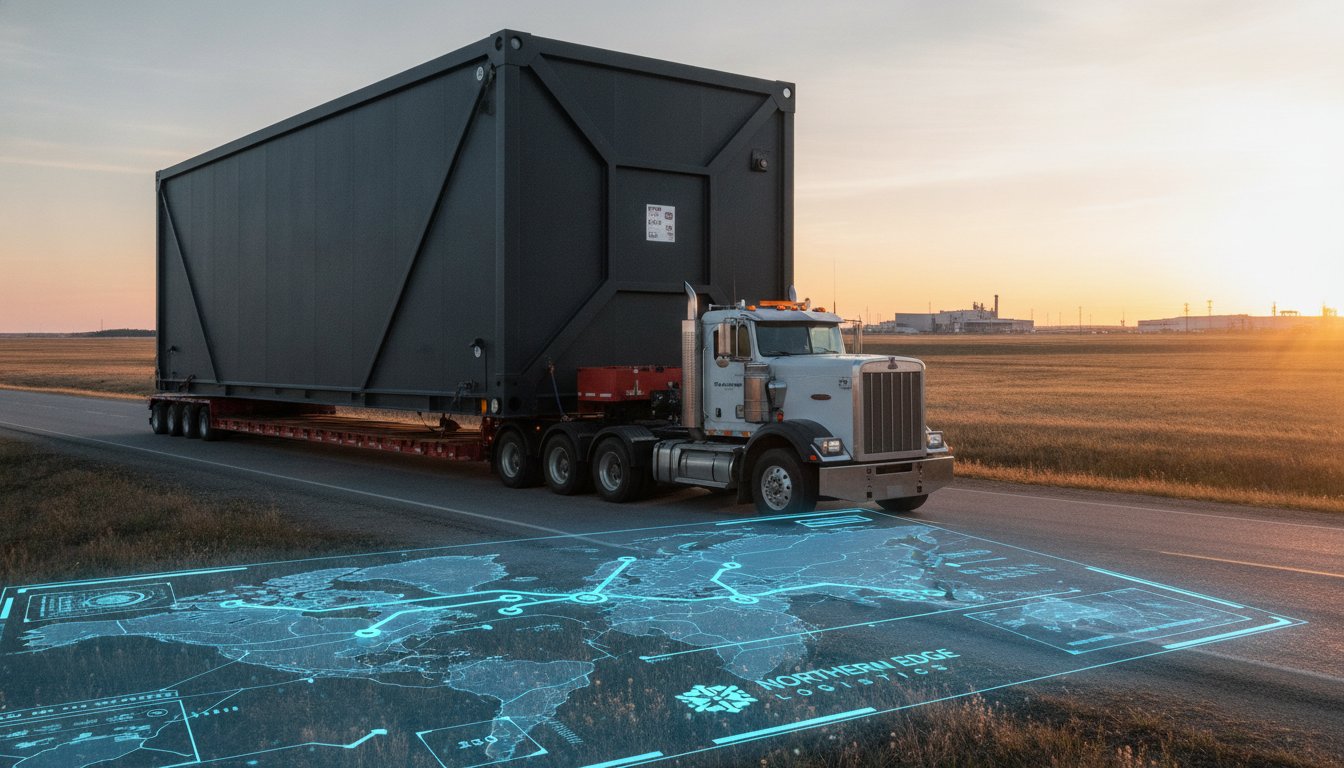
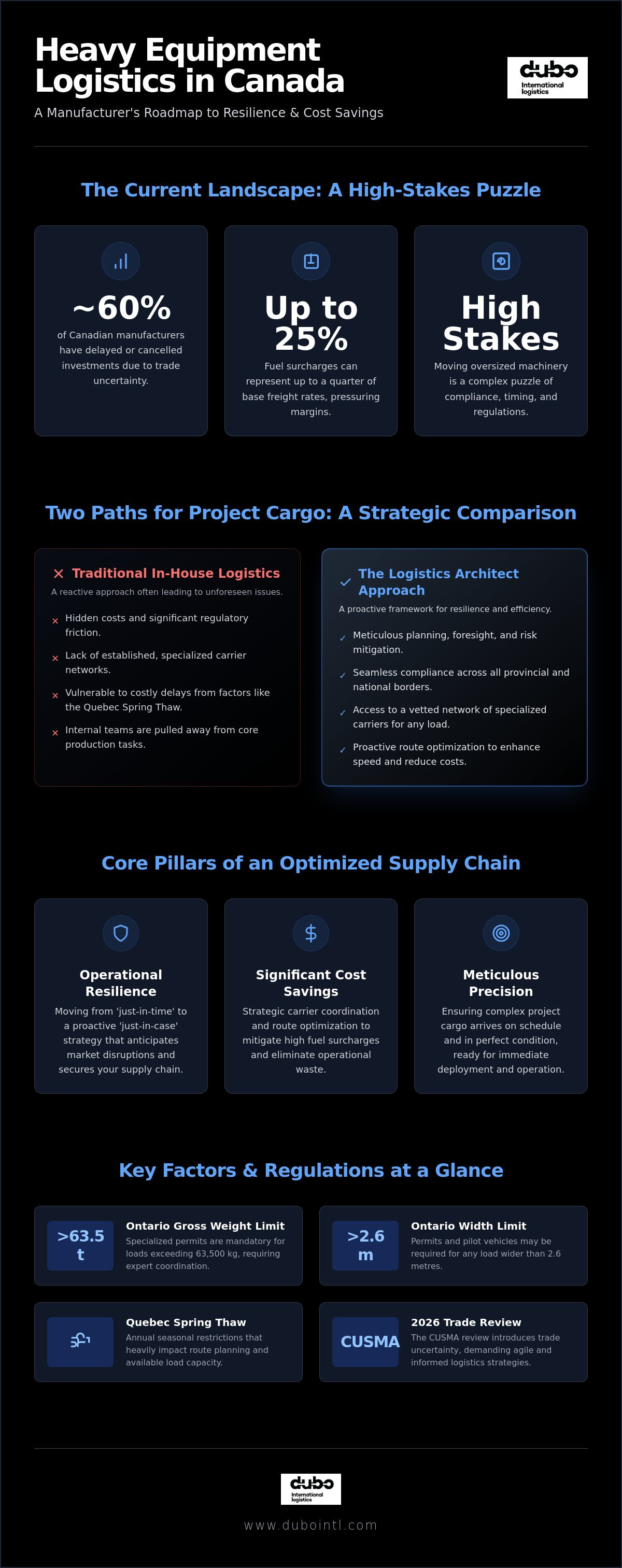
Nearly 60% of Canadian manufacturers have recently delayed or cancelled capital investments because of trade uncertainty and mounting competitiveness concerns. When your margins are already under pressure from fuel surcharges that often reach 25% of base freight rates, any inefficiency in heavy equipment shipping for manufacturers Canada becomes a significant risk to your stability. You likely recognize that moving oversized machinery is no longer just a transport task; it's a high-stakes puzzle of compliance and timing.
This guide serves as your strategic roadmap to help you realize operational resilience and substantial cost savings through specialized transportation and expert logistics consulting. We'll explore how to manage the complexities of the 2026 CUSMA review and the varying provincial regulations concerning width and weight limits across the country. By the end of this article, you'll understand how to transform your project cargo movement into a seamless process. With the right methodology and the resources available at www.dubointl.com, you can secure your supply chain against the volatility of the current year.
Key Takeaways
- Understand how the 2026 shift toward nearshoring requires a specialized approach to logistics engineering and regional supply chain integration.
- Learn to identify the specific criteria for selecting a "logistics architect" who can master the complexities of heavy equipment shipping for manufacturers Canada.
- Discover how professional route optimization and carrier coordination lead to significant cost savings and enhanced operational resilience.
- Move beyond reactive shipping by adopting a proactive framework that anticipates market disruptions and regulatory hurdles before they impact your margins.
- Explore how a dedicated partnership with the seasoned experts at www.dubointl.com ensures meticulous precision and peace of mind for every project cargo movement.
The Landscape of Heavy Equipment Logistics for Canadian Manufacturers
Heavy equipment shipping for manufacturers Canada is a specialized subset of logistics that demands far more than just a large trailer. It requires a deep understanding of structural engineering and a precise grasp of the evolving regulatory environment. As we move through 2026, the Canadian manufacturing sector is experiencing a significant shift toward nearshoring. This trend, reflected by the manufacturing sector's expansionary phase in June 2026, has fundamentally changed how regional supply chains function. The previous reliance on "just-in-time" delivery has been replaced by a focus on "just-in-case" resilience. With Canada's GDP growing at a stable 2%, manufacturers must prioritize a stabilizing force; a logistics architect who ensures that critical machinery arrives safely despite global volatility.
The Role of Strategic Consulting in Modern Manufacturing
A simple freight brokerage often treats cargo as a transaction, yet complex machinery requires a higher level of oversight. Strategic logistics consulting for manufacturers allows businesses to synchronize their production cycles with their transportation schedules. This foresight is vital for anticipating disruptions, such as the July 2026 CUSMA review or shifting tariffs on steel and aluminum. By maintaining a high-professional register, consultants coordinate with various stakeholders within the Canadian transportation systems to ensure every movement is meticulously planned. This approach mitigates the stress of global trade and provides a sense of security for your investment.
Why Traditional In-House Logistics Often Fall Short
Managing specialized documentation internally frequently leads to hidden costs and regulatory friction. A July 2026 KPMG survey found that nearly six in ten Canadian manufacturers have delayed capital investments due to trade uncertainty, making every shipping error even more costly. Internal teams may lack the established connections needed to access highly specialized transportation networks for oversized loads, such as trailers capable of handling weights exceeding Ontario's 63,500 kg legal limit. Failing to account for the dynamic start dates of the Quebec Spring Thaw Period or Ontario's specific permit requirements for loads wider than 2.6 metres can lead to expensive delays. By partnering with a dedicated guide like www.dubointl.com, manufacturers ensure seamless compliance across North American borders. This partnership allows your team to focus on production while seasoned experts handle the minute details of project cargo movement.
Core Pillars of Optimization: Resilience, Cost, and Precision
Supply chain excellence rests on three foundational pillars: financial efficiency, operational reliability, and strategic agility. In the context of heavy equipment shipping for manufacturers Canada, these elements represent the difference between a profitable quarter and a logistical crisis. True optimization requires a seamless integration between your manufacturing output schedules and logistics execution. When these two functions work in harmony, you eliminate the friction that often leads to idling machinery or missed delivery windows. Precision in specialized freight North America ensures that complex machinery arrives not just on time, but in the exact condition required for immediate deployment.
Strategic agility is particularly critical as market conditions fluctuate. By utilizing professional carrier coordination and route optimization, manufacturers can realize significant savings. This is essential when fuel surcharges typically account for 15% to 25% of the base rate for road freight in Canada. A logistics architect looks beyond the simple haul, identifying opportunities to bypass congestion or navigate around seasonal restrictions like the Quebec thaw period. This level of foresight protects your margins and reinforces your reputation for dependability.
Maximizing Financial Efficiency in Freight Management
Realizing financial excellence begins with a methodical audit of freight service fees. Identifying operational waste and redundancies often reveals that manufacturers are paying for services they don't fully utilize. For businesses with variable output volumes, consolidated shipping strategies offer a way to maintain momentum without the high cost of dedicated, partially empty trailers. Professional planning allows you to reduce logistics costs in Canada by leveraging volume and optimizing backhaul opportunities. This disciplined approach to financial management turns logistics from a cost centre into a strategic advantage. If you're looking to refine your current spend, exploring the consulting services at www.dubointl.com can provide the clarity needed for long-term savings.
Operational Reliability for Specialized Project Cargo
Transporting non-standard or sensitive manufacturing equipment across provincial lines involves rigorous requirements. Maintaining equipment integrity during transit requires end-to-end shipment handling where every transition is meticulously managed. This is not merely about moving a crate; it's about engineering a safe passage for high-value assets. Specialized project fees are structured to account for this inherent complexity, covering the risk and the necessary oversize/overweight vehicle regulations and permits.
- Structural Integrity: Specialized bracing and custom securement protocols.
- Regulatory Compliance: Adherence to height, width, and weight permits across every jurisdiction.
- Risk Mitigation: Proactive monitoring of weather and infrastructure constraints.
By prioritizing reliability over the lowest possible bid, you ensure that your equipment remains a productive asset rather than a liability in transit. This steady commitment to quality is what builds a resilient manufacturing operation in a complex global environment.
Evaluating Logistics Partners: A Strategic Framework for Manufacturers
Selecting a partner for heavy equipment shipping for manufacturers Canada shouldn't be a gamble based on the lowest bid. It requires a partner who acts as a protective steward of your cargo interests, moving beyond the transactional nature of a standard broker. A high-calibre logistics architect understands that your machinery represents a significant capital investment. They use sophisticated, industry-literate communication to bridge the gap between your local production floor and complex international systems. This level of precision ensures that every detail, from structural securement to provincial permits, is handled with meticulous care.
A strategic partner provides more value than a simple middleman. They offer foresight into the shifting trade landscape of 2026, where regional supply chains are becoming increasingly complex. By prioritizing a relationship based on quiet confidence and dependability, you lower the stress associated with moving oversized assets. This methodical approach is reflected in the standards set by professional bodies like Supply Chain Canada, which advocates for excellence in logistics management. Such a partner doesn't just transport goods; they help you organize your entire movement strategy to avoid the common pitfalls of the Canadian market.
The Importance of CIFFA Membership and Professional Certification
Trust in the logistics sector is anchored by professional credentials. Choosing a CIFFA certified freight forwarder is a non-negotiable benchmark for manufacturers who cannot afford delays. This certification guarantees that the provider adheres to strict ethical and professional standards within the Canadian market. It ensures a higher level of precision in documentation, which is vital when navigating the updated standards in the Transportation of Dangerous Goods Regulations. These certified professionals are trained to handle regulatory compliance with a level of completeness that internal teams or uncertified brokers simply can't match.
Vetting for Cross-Border Expertise and Reach
High-stakes international shipments require a partner with a proven track record in cross-border freight forwarding Canada USA. While many firms claim a global presence, manufacturers often find more value in a partner with deep North American reach. This regional expertise is crucial when navigating the active tariffs on steel and aluminum that persist into mid-2026. A methodical, rhythmic communication style is essential here. It ensures that all parties are aligned as cargo crosses borders. By focusing on a partner that offers end-to-end support, such as the experts at www.dubointl.com, you ensure that your heavy equipment shipping for manufacturers Canada remains seamless and secure.
Strategic Planning and Risk Mitigation in Specialized Transportation
Transitioning from a reactive to a proactive model is the hallmark of a mature manufacturing operation, particularly when managing heavy equipment shipping for manufacturers Canada. Reactive shipping relies on hope; proactive shipping relies on architecture. By using strategic foresight, you can anticipate and bypass potential market disruptions before they stall your production line. Meticulous documentation ensures a sense of smoothness across the border, especially for oversized cargo that requires specific permits. Optimization isn't a one-time setup. It's a continuous process of refinement that requires a partner dedicated to your long-term success.
Implementing CPFR for Manufacturing Resilience
Collaborative Planning, Forecasting, and Replenishment (CPFR) is a framework that synchronizes the efforts of manufacturers and logistics partners. Understanding CPFR allows you to align your inventory management with your shipping schedules, reducing the risk of costly idling. This methodology requires a high level of professional trust and transparent data-sharing. When you integrate your production forecasts with a logistics consultant, you create a buffer against the volatility of the 2026 market. This synergy leads to superior results for heavy equipment shipping for manufacturers Canada, ensuring that transportation capacity is secured well before it's needed.
Mitigating Risks in Project Cargo Logistics
Specialized transportation routes often contain hidden vulnerabilities. Manufacturers should regularly assess their logistics pathways for potential bottlenecks or regulatory shifts that could impact their margins. A robust risk assessment includes several critical factors:
- Infrastructure Constraints: Evaluating bridge heights and weight-restricted zones along the route.
- Regulatory Shifts: Monitoring dynamic provincial regulations, such as Quebec's dynamic thaw periods.
- Trade Uncertainty: Analyzing cross-border tariff updates following the July 2026 CUSMA review.
Specialized project fees can incorporate comprehensive contingency planning. This is an investment in stability rather than a simple extra cost. A stabilizing partner remains calm and purposeful during supply chain crises, such as the disruptions seen in mid-2026. This quiet authority protects your interests when global events threaten your delivery timelines. If you're ready to move toward a more integrated and resilient model, the experts at www.dubointl.com can help you design a bespoke logistics strategy tailored to your specific manufacturing needs.
Realizing Operational Excellence with Dubo International Logistics
Dubo International Logistics stands as the premier logistics architect for manufacturers across the country in 2026. In a year defined by the complexities of the CUSMA review and shifting trade patterns, we provide a stabilizing presence that prioritizes peace of mind. Our commitment to quiet confidence and dependability means you can release the stress of heavy equipment shipping for manufacturers Canada. We specialize in the movement of non-standard and sensitive machinery, handling the intricate details that transactional brokers often find overwhelming. By prioritizing meticulous detail, we ensure your capital assets are treated with the stewardship they deserve.
Our personality is that of a seasoned expert and a dedicated, hands-on guide. We act as a sophisticated bridge between your local production facility and the complex international systems that govern global trade. This partnership is built on consistency. We understand that your manufacturing schedule is rigid, and our role is to ensure that logistics execution never becomes a bottleneck. You can explore our full range of services and our commitment to excellence by visiting www.dubointl.com.
The Dubo Methodology: From Audit to Execution
Our process begins with a methodical logistics audit. We examine your current shipping patterns to identify operational waste and redundancies that might be impacting your bottom line. This isn't a surface-level review; it's a deep dive into the methodology of your supply chain. Once we understand your unique needs, we provide end-to-end freight management tailored specifically to your manufacturing output.
- Strategic Integration: We align our transportation schedules with your production cycles to ensure seamless movement.
- Bespoke Solutions: Every piece of heavy machinery receives a custom securement and routing plan.
- Longevity: We value long-term partnerships over short-term, price-focused transactions.
This disciplined approach ensures that your logistics strategy is both high-level and meticulously executed. We focus on the "smoothness" of the journey, ensuring that regulatory compliance and documentation are handled long before the cargo reaches the border.
Partnering for Future Growth and Stability
Manufacturers who view logistics as a strategic competitive advantage rather than a mere cost centre are the ones who thrive in volatile markets. By integrating our deep understanding of the Canadian transportation sector with your specific production requirements, we create a framework that supports your growth. Our professional process for initiating a consulting engagement is straightforward and purposeful. We begin by establishing a foundation of trust, followed by a clear outline of how our expertise can lower your operational risks. If you're ready to secure your supply chain against the uncertainties of the coming year, contact Dubo International Logistics for a professional consultation and experience the difference that a dedicated logistics architect can make.
Securing Your Manufacturing Future through Strategic Logistics
Success in the 2026 industrial landscape requires a shift from transactional hauling to a model of integrated supply chain architecture. By prioritizing collaborative planning and meticulous documentation, you can bypass the volatility that often impacts heavy equipment shipping for manufacturers Canada. True operational resilience isn't found in the lowest bid; it's found in the steady hands of a partner who understands the minute details of provincial regulations and cross-border compliance. You deserve a guide that acts as a protective steward of your capital investments, ensuring every movement is executed with absolute precision.
As a CIFFA Certified Member with decades of North American cross-border expertise, we specialize in high-value specialized transportation that others find too complex. We invite you to partner with Dubo International Logistics to optimize your manufacturing supply chain. By refining your logistics methodology today, you build a foundation for long-term stability and growth. It's time to transform your shipping challenges into a strategic advantage that strengthens your market position across North America.
Frequently Asked Questions
What is the primary benefit of logistics consulting for Canadian manufacturers?
The primary benefit is the transformation of logistics from a reactive cost centre into a strategic competitive advantage. Consulting allows you to identify operational waste and synchronize your transportation schedules with your manufacturing output cycle. This level of strategic foresight helps you realize significant cost savings while ensuring your machinery moves with the precision required for modern industrial resilience in a complex global environment.
How does a logistics architect differ from a standard freight broker?
A logistics architect offers high-level strategic oversight and bespoke engineering solutions, whereas a standard broker often focuses on transactional price-matching. Architects act as seasoned experts who understand the grand scale of global movement. They manage the minute details of heavy equipment shipping for manufacturers Canada to ensure your capital assets are treated with professional stewardship and arrive in the exact condition required for deployment.
Can strategic logistics planning help reduce cross-border delays with the USA?
Yes, strategic planning is essential for anticipating regulatory shifts and ensuring documentation is meticulously prepared before reaching the border. With the ongoing USMCA review in mid-2026 and active tariffs on steel and aluminum, a proactive framework allows you to bypass congestion. This methodical approach ensures that your oversized cargo moves through customs without the stress of unexpected delays or costly compliance failures at the gate.
Why is CIFFA membership important for heavy equipment shipping in Canada?
CIFFA membership serves as a non-negotiable benchmark for trust and professional competence in the Canadian market. It ensures that your partner adheres to strict ethical standards and possesses the industry-literate expertise needed for complex cargo. This certification provides a sense of security for manufacturers, knowing that their high-value equipment is in the hands of a dependable logistics professional who prioritizes meticulous detail and compliance.
What role does CPFR play in optimizing manufacturing supply chains?
CPFR synchronizes your production forecasts with logistics execution to ensure that specialized transportation capacity is always available when needed. This collaborative methodology reduces the risk of equipment idling and helps you avoid the high costs associated with last-minute shipping arrangements. It creates a seamless flow between your manufacturing floor and the final delivery destination, reinforcing your operational stability during periods of market volatility.
How are specialized transportation project fees calculated for oversized cargo?
Project fees are determined by the inherent complexity, risk, and regulatory requirements of the specific cargo. Calculations include the costs of oversized permits for loads exceeding Ontario’s 2.6-metre width limit and the specialized structural securement needed for non-standard equipment. These fees represent a necessary investment in the safe and compliant passage of your machinery across various provincial jurisdictions, protecting the integrity of your assets.
How can manufacturers realize cost savings without disrupting production schedules?
Cost savings are often identified through a methodical audit of current freight service fees to uncover redundancies and operational waste. Manufacturers can leverage consolidated shipping strategies or professional route optimization to reduce expenses without impacting their output. This approach allows you to lower your logistics spend while maintaining a rhythmic and purposeful production schedule that meets your delivery commitments and protects your profit margins.
Does Dubo International Logistics provide service across all of North America?
Dubo International Logistics provides comprehensive specialized transportation and consulting services across all of North America. We act as a sophisticated bridge between local Canadian manufacturers and the broader international market. You can learn more about our commitment to dependability and our end-to-end support systems by visiting www.dubointl.com. We remain focused on the minute details of your individual needs to ensure a smooth and complete service experience.

