

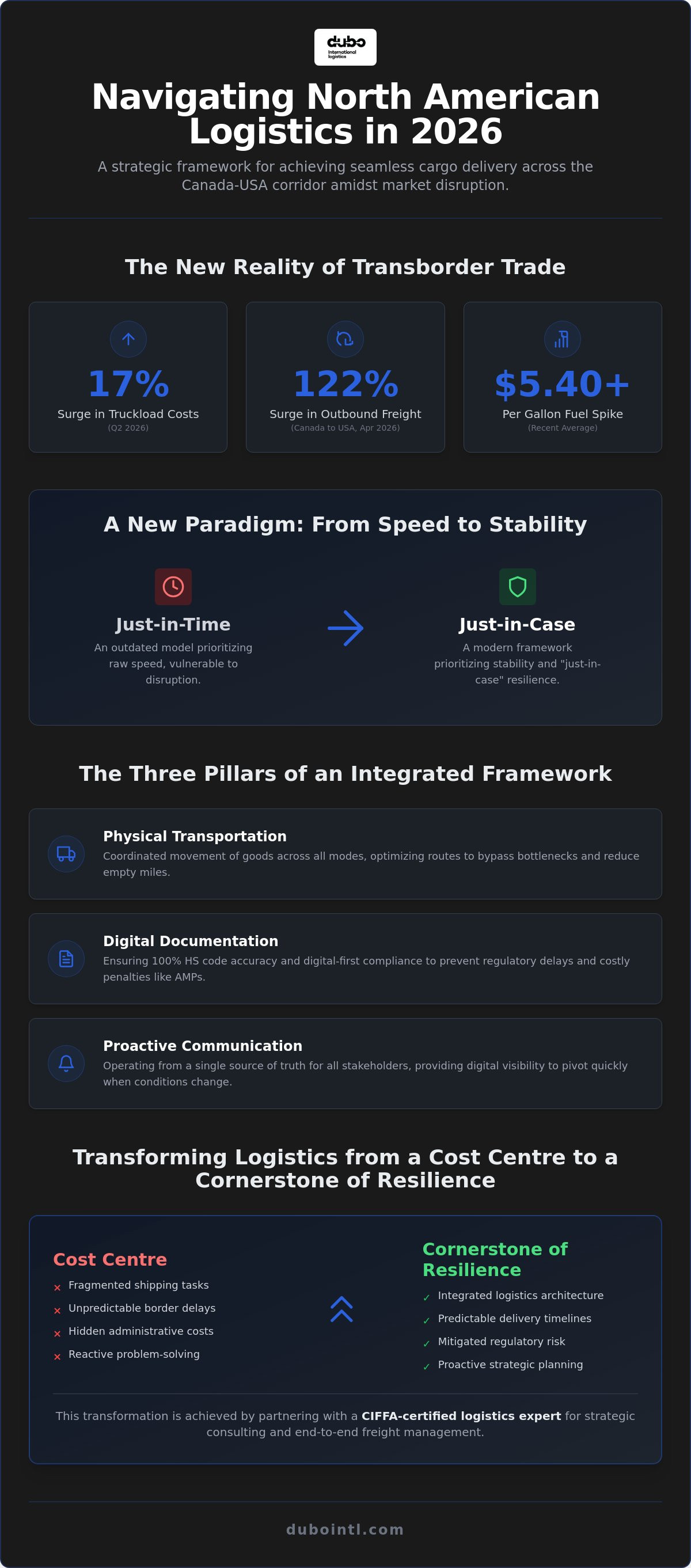
With truckload costs surging by nearly 17% in the second quarter of 2026, the margin for error in transborder logistics has effectively vanished. Achieving seamless cargo delivery North America is no longer just an operational goal; it's a strategic necessity for businesses navigating a market defined by perpetual disruption. You've likely realized that unpredictable border delays and rising fuel costs, which recently spiked to over $5.40 per gallon, can quickly erode your bottom line and damage client trust.
We understand that the complexity of modern trade requires more than just moving goods; it demands a stabilizing force at the centre of your supply chain. This guide provides the strategic framework needed to achieve frictionless freight movement and resilience across Canada and the United States. We'll examine how digital-first compliance, rigorous HS code accuracy, and the professional expertise available at www.dubointl.com can help you reduce regulatory risk and restore predictable delivery timelines to your continental operations.
Key Takeaways
- Learn how to integrate transportation, documentation, and communication to transform your logistics from a series of tasks into a frictionless, end-to-end process.
- Discover how strategic logistics consulting allows you to identify and mitigate supply chain risks well before they manifest as costly border delays.
- Master the unique regulatory requirements of the Canada-USA corridor to ensure seamless cargo delivery North America for every shipment you move.
- Explore the planning rigor necessary for specialized transportation, ensuring that even non-standard or oversized freight moves with absolute precision.
- Understand why choosing a CIFFA-certified partner at www.dubointl.com shifts your logistics from a cost centre to a cornerstone of continental resilience.
Understanding the Dynamics of Seamless Cargo Delivery in North America
True seamless cargo delivery North America requires an architectural approach to global trade. It isn't merely the act of moving freight from point A to point B; it's the frictionless integration of physical transportation, digital documentation, and proactive communication. When these three elements align, cargo moves across borders without the stuttering delays that define fragmented shipping models. Modern businesses are moving away from siloed operations, realizing that a lack of coordination leads to unpredictable costs and missed deadlines.
Friction often arises from regulatory shifts, such as the formal CUSMA review scheduled for July 2026, or from infrastructure bottlenecks that slow down the 1,500-mile long-haul routes. By adopting an integrated logistics framework, organizations can bypass these traditional obstacles. This shift toward total integration ensures that every stakeholder, from the dispatcher to the customs agent, operates from a single source of truth, maintaining a steady flow of goods even when market conditions fluctuate.
The Evolution of North American Logistics in 2026
The landscape has changed dramatically. In April 2026, outbound freight loads from Canada to the United States surged by 122%, putting immense pressure on existing infrastructure. This volume, combined with a "perpetual disruption" cycle, has forced a transition from "just-in-time" delivery to "just-in-case" resilience. Organizations now prioritize stability over raw speed. Digital visibility is the primary tool used to achieve this, allowing carriers to pivot when diesel prices spike or when regulatory crackdowns on driver classification impact availability.
In key regional hubs such as Florida, specialized providers like Reggae Jammin Transporting offer the localized courier and delivery solutions necessary to maintain this stability and ensure that goods reach their final destination without interruption.
Why Seamlessness Matters for Your Bottom Line
Inefficiency is expensive. Truckload costs rose by an estimated 17% in the second quarter of 2026, meaning administrative errors or border idling can quickly turn a profitable shipment into a loss. Beyond the immediate costs of fuel and labour, unreliable supply chains lead to customer churn. We view logistics architecture as a vital cost-saving measure. By coordinating every detail through a professional partner like www.dubointl.com, you eliminate the hidden expenses of data inaccuracies and Administrative Monetary Penalties (AMPs). Reliability builds trust, and in a fragile market, trust is your most valuable currency.
The Strategic Pillars of an Integrated Logistics Framework
Strategy precedes movement. While many providers focus solely on the physical assets of trucking, true seamless cargo delivery North America begins long before a trailer is hitched. It starts with a comprehensive logistics consulting Canada framework that treats your supply chain as a cohesive architecture rather than a series of isolated transactions. By applying strategic foresight, we identify potential friction points, such as shifting trade regulations or lane-specific demand surges, before they manifest as costly delays at the border.
Every industry requires a bespoke approach to achieve this level of integration. A manufacturer moving heavy machinery from Quebec to Texas faces vastly different regulatory and physical hurdles than a retail distributor managing high-frequency shipments into Ontario. We design solutions that respect these nuances, ensuring that the methodology matches the specific demands of the sector. This high-level coordination reduces the administrative burden on your internal teams, allowing your staff to focus on core business growth while we act as the protective stewards of your freight.
Consulting as the Foundation of Efficiency
Professional consulting uncovers the hidden inefficiencies that often go unnoticed in standard shipping routines. By utilizing data analysis to evaluate load frequency and carrier performance, we can optimize routes to avoid known bottlenecks and reduce empty miles. When you partner with an expert at www.dubointl.com, you gain access to a level of precision that standard freight services simply cannot provide. The investment in professional consulting fees represents a strategic shift that transforms unpredictable logistics expenses into predictable, long-term operational savings.
End-to-End Freight Management Explained
True seamlessness requires a meticulous hand at every phase of the journey. This process begins at the point of origin with precise documentation and extends through carrier coordination in complex, multi-modal environments. Managing the hand-off between different modes of transport requires constant vigilance to ensure that no data is lost and no timelines are compromised. For a more detailed look at how these phases integrate, you can explore our guide on end-to-end freight management. By maintaining this level of control from origin to final destination, we provide the stability and peace of mind necessary to thrive in the 2026 trade environment. If you are ready to stabilize your continental operations, consider how a refined logistics strategy can protect your interests.
Overcoming the Friction of Cross-Border Freight Movement
The Canada-USA corridor is one of the busiest trade routes in the world, yet in 2026, it's also one of the most scrutinized. With outbound freight loads from Canada to the United States having surged by 122% in April 2026, the pressure on border crossings has reached a critical threshold. Simply hiring a carrier is no longer sufficient to guarantee seamless cargo delivery North America. You require a partner that understands the intricate, digital-first compliance landscape where paper-based systems are obsolete and data accuracy is the only way to avoid the border's friction points.
A professional cross-border freight forwarding Canada USA service acts as your protective steward. We manage the essential documentation that often catches unguided shippers off guard, from precise Harmonized System (HS) codes to the mandatory Electronic Data Interchange (EDI) manifests required by the ACE and ACI systems. Errors in these filings lead to Administrative Monetary Penalties (AMPs) and significant delays. By coordinating your movements through www.dubointl.com, you ensure that every shipment arrives at the border pre-cleared and ready for immediate transit, protecting your reputation and your bottom line.
Navigating Regulatory Compliance
Staying current with evolving transport regulations is a full-time commitment that requires constant vigilance. In 2026, the transition to the USDOT number as the primary carrier identifier and the annual CUSMA reviews mean that trade rules can shift with little warning. Non-compliance isn't just a minor inconvenience; it carries the risk of heavy fines or permanent cargo holds that disrupt your entire supply chain. For a deeper look at these requirements, consult our navigating cross-border shipping challenges Canada reference guide to stay ahead of the curve.
LTL vs. FTL: Strategic Choice for Cross-Border Success
Choosing between Less-than-Truckload (LTL) and Full Truckload (FTL) is a pivotal decision that impacts both speed and budget. LTL offers cost-effectiveness for smaller volumes but requires more complex coordination at the border to manage multiple manifests. FTL provides a direct route and reduced handling, which is often the preferred choice for urgent or high-value shipments. We help you evaluate these options based on your specific volume and urgency. You can find a detailed framework in our LTL vs FTL shipping to USA from Canada comparison to help determine which model best supports your long-term goals.
Managing Specialized Cargo and Complex Project Logistics
Specialized transportation is the movement of freight that defies standard dimensions or requires extraordinary care. Whether it's oversized industrial machinery or sensitive laboratory equipment, achieving seamless cargo delivery North America in this category requires an architectural level of planning. It isn't enough to simply possess the right trailers. You must account for the meticulous coordination of permits, specialized equipment, and trained personnel who understand the unique physics of non-standard loads. This level of precision is what separates a successful delivery from a logistical failure.
This architectural precision is also a requirement for professional moving services; for organizations managing high-value relocations, Mudanzas Ajuar offers the specialized transport solutions needed for secure local and national moves.
Because these projects involve such high levels of complexity, we utilize a Specialized Transportation Project Fees model. This bespoke pricing structure reflects the meticulous detail required to move high-value assets safely. It accounts for every variable, from escort vehicles to specialized rigging, ensuring that the final cost is an accurate reflection of a meticulously executed plan rather than a series of unexpected surcharges. For those seeking a comprehensive understanding of these requirements, our specialized freight North America guide provides a strategic framework for buyers.
The Logistics of Oversized and Heavy-Lift Cargo
Moving oversized freight requires exhaustive route surveys to identify potential physical obstacles like low-clearance bridges or weight-restricted roads. This coordination must happen across multiple regional jurisdictions, as a permit in Quebec does not automatically grant passage through neighbouring states or provinces. Safety and stability are paramount. Every turn and incline is calculated to ensure the centre of gravity remains secure, preventing the kind of transit incidents that can derail a project's timeline and budget.
Handling Sensitive and High-Value Shipments
Certain cargo requires more than just physical space; it requires a controlled environment. Protocols for sensitive shipments often include climate-controlled trailers or high-security escorts to protect against both environmental damage and theft. In these instances, precision handling is the only way to prevent damage-related supply chain disruptions. Specialized insurance also plays a critical role, acting as a final layer of protection for your business assets. By treating high-value cargo with the reverence it deserves, we maintain the integrity of your most important deliveries. If your next project involves complex requirements, you can consult with our specialized transportation experts to begin the architectural planning phase.
Partnering for Long-Term Supply Chain Resilience
Selecting a freight forwarder is a strategic business decision that fundamentally shifts your logistics from a cost centre to a cornerstone of resilience. In an era where "perpetual disruption" is the baseline, you need more than a vendor; you require a "logistics architect" who understands your long-term objectives. This partnership is built on the realization that seamless cargo delivery North America is a byproduct of consistent, high-level coordination. As your business scales, your partner should grow alongside you, evolving their strategies to match your expanding footprint in the Canadian and American markets.
The journey we've explored—from understanding the dynamics of integration to mastering specialized project logistics—culminates in complete supply chain optimization. This isn't a static achievement but a continuous process of refinement. By moving away from fragmented, price-first models, you secure a stabilizing force that protects your interests against the volatility of the 2026 trade environment. Reliable logistics becomes the foundation upon which you can build a more ambitious corporate future.
The Value of a CIFFA Certified Partner
Professional excellence in the Canadian logistics industry is defined by membership in the Canadian International Freight Forwarders Association (CIFFA). This certification isn't a mere formality; it represents a commitment to rigorous industry standards and ethical practices. For the shipper, a CIFFA-certified partner provides superior risk management through a deep understanding of cargo insurance, international conventions, and evolving digital compliance requirements. These standards ensure that every professional at www.dubointl.com operates with the highest level of industry literacy. They're trained to anticipate regulatory shifts before they impact your delivery timelines, providing a proactive shield for your cargo. Ultimately, partnering with a certified organization provides the peace of mind necessary to operate confidently in an increasingly volatile global market.
Building Your North American Growth Strategy
A reliable logistics partner is the primary engine behind successful geographic expansion. When you decide to enter new markets in the United States or broaden your reach within Canada, your partner provides the local expertise and carrier networks required to move goods without friction. This expansion depends on consistent communication and transparent reporting, ensuring you have the visibility needed to make informed executive decisions. True resilience is found in the details of these long-term relationships. Whether you're managing high-frequency LTL shipments or complex project cargo, the goal remains the same: a reliable, predictable flow of goods. We invite you to move beyond the stress of unpredictable delays and organize your long-term logistics strategy at www.dubointl.com, where we act as the dedicated stewards of your continental success.
Securing Your Continental Trade Operations for 2026
Navigating the complexities of trade requires more than reactive shipping; it demands a proactive architecture built on strategic consulting and digital-first compliance. You've likely realized that identifying risks before they reach the border and mastering the nuances of specialized project logistics can transform your supply chain into a competitive advantage. Achieving seamless cargo delivery North America is possible when you prioritize precision over raw speed and partnership over transactional service.
As an independent CIFFA member with deep expertise in specialized project logistics, we provide the comprehensive North American coverage your business needs to thrive. We understand the minute details that ensure your freight moves without friction across every border and jurisdiction. Ready to optimize your supply chain? Consult with the logistics architects at Dubo International Logistics to begin building your roadmap for the years ahead. With the right foundation, your continental growth is not just possible; it's predictable. Visit www.dubointl.com to learn how we can protect your interests at every mile.
Frequently Asked Questions
What exactly is seamless cargo delivery in the North American context?
Seamless delivery is the architectural alignment of physical transportation, digital documentation, and proactive communication. It ensures that goods move across the Canada-USA border without the stuttering delays common in fragmented shipping models. By integrating every phase of the journey, businesses can maintain a steady flow of goods even during periods of market disruption.
How does a freight forwarder help with cross-border shipping compliance?
A professional forwarder acts as a protective steward by managing mandatory digital filings like the Automated Commercial Environment (ACE) and Advance Commercial Information (ACI) systems. They ensure Harmonized System (HS) codes are accurate to prevent Administrative Monetary Penalties (AMPs). This level of precision is essential for avoiding the border holds that often plague unguided shippers.
Why should a Canadian business hire a CIFFA-certified logistics provider?
CIFFA membership is a benchmark for professional excellence and ethical practices within the Canadian logistics industry. Certified providers at www.dubointl.com possess a deep understanding of cargo insurance and international conventions, which translates into superior risk management. This certification provides peace of mind by ensuring your partner adheres to the highest industry standards in a volatile trade environment.
What is the difference between standard freight forwarding and specialized transportation?
Standard forwarding typically handles palletized goods in dry vans or containers, whereas specialized transportation manages non-standard, oversized, or high-value freight. Specialized moves require bespoke equipment, such as flatbeds or climate-controlled units, and involve complex planning like route surveys and jurisdictional permits. These projects demand a higher level of coordination to ensure the safety and stability of the load.
How can logistics consulting help reduce my overall supply chain costs?
Logistics consulting identifies hidden inefficiencies by analyzing shipping routes, load frequencies, and carrier performance. By optimizing these variables, businesses can achieve seamless cargo delivery North America while reducing empty miles and administrative errors. Strategic foresight allows you to transform unpredictable expenses into a predictable, optimized budget that supports long-term growth.
What documentation is mandatory for shipping cargo from Canada to the USA in 2026?
Mandatory requirements in 2026 include Electronic Data Interchange (EDI) manifests, accurate Harmonized System (HS) codes, and proof of CUSMA eligibility for tariff exemptions. Carriers must also utilize their USDOT number as the primary identifier for all commercial movements. Ensuring these digital records are precise is the only way to facilitate a smooth transit through modern customs checkpoints.
How do you manage the coordination of multiple carriers for a single shipment?
We utilize an integrated management framework to synchronize hand-offs between different carriers in a multi-modal environment. This involves constant communication and digital visibility to ensure that no data is lost during transitions. By acting as a single point of contact, we maintain the integrity of the delivery timeline and reduce the burden on your internal resources.
Can specialized transportation project fees be estimated without a full consultation?
Accurate estimates for specialized projects are difficult to provide without a consultation because they depend on unique variables like rigging, escorts, and regional permits. A full assessment ensures that seamless cargo delivery North America is achieved through a bespoke pricing model that reflects every meticulous detail. This approach prevents the unexpected surcharges that often arise from generic, surface-level quotes.

