
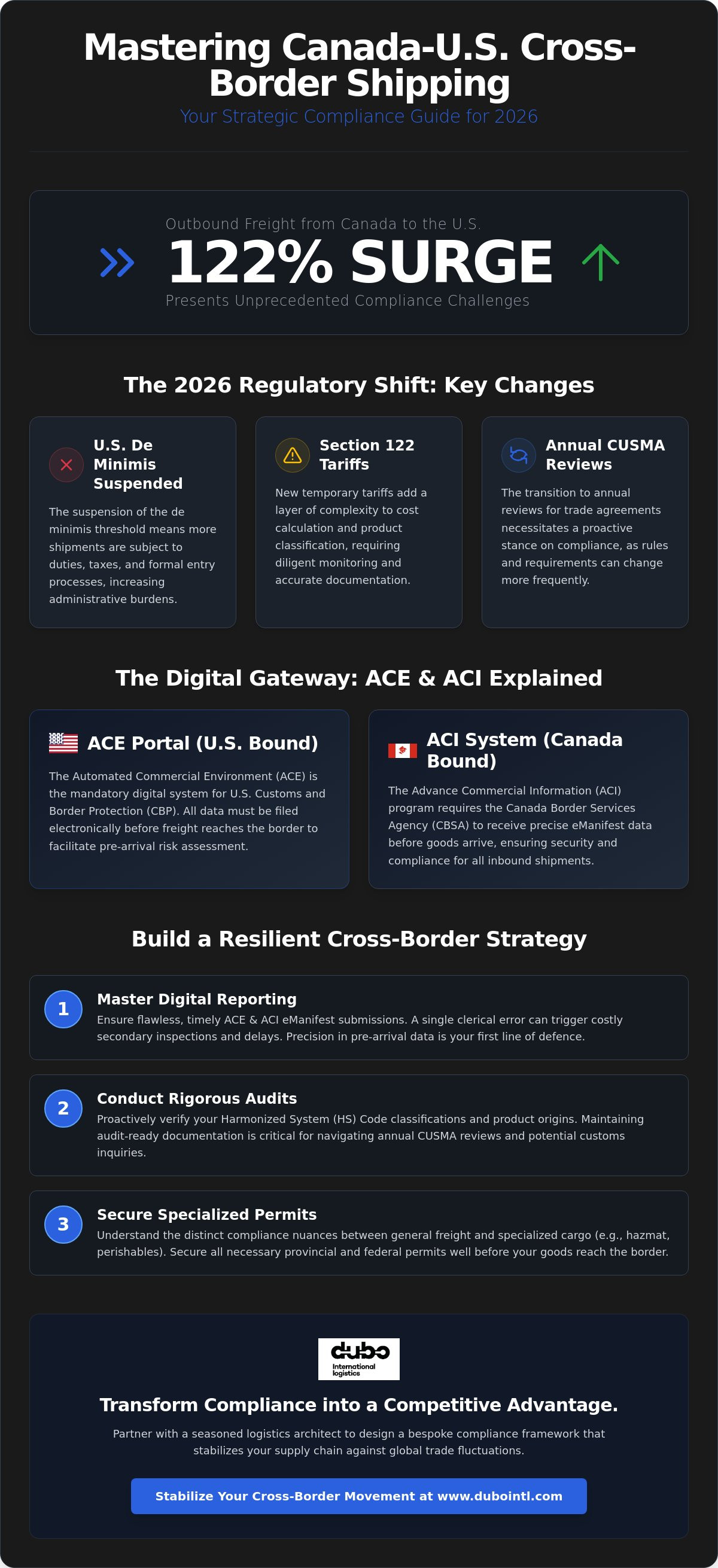
In April 2026, outbound freight loads from Canada to the United States surged by 122 percent, yet the complexity of clearing those goods has reached an all-time high. With the total suspension of the U.S. de minimis threshold and the implementation of Section 122 temporary tariffs, navigating cross-border shipping challenges in Canada requires more than just a reliable carrier. It demands a sophisticated understanding of a regulatory environment where even a minor clerical error in an ACE or ACI filing can trigger costly secondary inspections. Compliance is the fundamental architecture of cross-border velocity. We understand that the fear of shipments being held at the border creates a constant state of friction for your operations, especially as trade agreements move toward annual reviews.
This reference guide provides the strategic foresight you need to master essential regulatory frameworks and maintain audit-ready documentation in this evolving landscape. We'll explore the latest ACE portal updates and precise documentation requirements to help you reduce transit times and realise a more efficient supply chain. By prioritising regulatory precision, you can transform compliance from a hurdle into a competitive advantage. For expert logistics consulting and specialised transportation services tailored to these 2026 mandates, visit www.dubointl.com to see how our methodical approach can stabilise your cross-border movement and provide lasting peace of mind.
Key Takeaways
- Master the 2026 regulatory landscape, including the critical suspension of de minimis thresholds and the transition to annual CUSMA reviews.
- Integrate ACE and ACI digital reporting systems into your operations to ensure every manifest meets the latest technical standards for pre-arrival data.
- Develop a resilient strategy for navigating cross-border shipping challenges Canada by conducting rigorous audits of your HS Code classifications and product origins.
- Identify the distinct compliance nuances between general freight and specialized cargo to secure the necessary provincial permits before your goods reach the border.
- Partner with a seasoned logistics architect at www.dubointl.com to design a bespoke compliance framework that stabilizes your supply chain against global trade fluctuations.
Understanding the Cargo Transport Compliance Framework for 2026
Compliance is the structural foundation of cross-border movement. It represents much more than a list of rules to follow; it is the fundamental architecture that dictates the velocity of your supply chain. Navigating cross-border shipping challenges Canada requires a proactive stance on federal mandates that govern how goods transition between our borders. In 2026, this framework has evolved into a sophisticated hybrid system. It integrates real-time digital manifest reporting with rigorous physical safety standards to ensure that every shipment is both secure and documented with absolute precision.
A refined compliance strategy is a powerful commercial tool. When your documentation is flawless, you minimize dwell time at congested ports of entry and protect your bottom line from Administrative Monetary Penalties (AMPs). These penalties have become increasingly common as enforcement agencies tighten their scrutiny on data accuracy. By treating compliance as a strategic priority, businesses can transform potential bottlenecks into seamless transit points. For those seeking professional logistics consulting to refine these processes, the experts at www.dubointl.com provide the strategic foresight necessary to maintain a competitive edge.
The Interplay Between the CBSA and CBP
The movement of freight across North America is managed by two primary regulatory bodies. The Canada Border Services Agency (CBSA) oversees goods entering Canada, with a primary focus on duty collection, national security, and trade compliance. Conversely, U.S. Customs and Border Protection (CBP) manages imports into the United States, enforcing trade laws and critical agricultural protections. The ongoing collaboration between these agencies is anchored by the CUSMA trade agreement, which provides the legal scaffolding for Canada-U.S. trade relations. This partnership ensures that while each nation maintains its own sovereignty, the flow of commerce remains remarkably integrated.
The Shift Toward Digital-First Compliance
The era of paper-based logistics has ended. Electronic Data Interchange (EDI) is now the mandatory standard for all modern commercial manifests, requiring carriers and shippers to submit data well before a truck reaches the primary inspection line. This real-time data sharing allows border officers to conduct pre-arrival risk assessments, identifying high-risk cargo while allowing compliant shipments to move through with minimal friction. In 2026, the mandatory use of digital manifests has stabilized average border processing times even as outbound freight loads from Canada have surged by 122 percent year-over-year. To better understand how these digital systems integrate into your broader strategy, explore our guide on cross-border freight forwarding Canada USA.
Core Systems: Navigating ACE and ACI for Seamless Delivery
The digital infrastructure of the border rests upon two pillars: ACE for the United States and ACI for Canada. These systems aren't merely administrative portals; they're the active gatekeepers of North American trade. Successfully navigating cross-border shipping challenges Canada requires a mastery of these platforms to ensure that data arrives at the border long before the physical freight. For many businesses, the technical complexity of these filings is a source of significant stress, yet with the right framework, they become tools for predictable, scheduled movement.
Precision in timing is non-negotiable. If a manifest is filed incorrectly or outside the mandated windows, authorities issue a "Do Not Load" order. This effectively grounds your shipment before it even leaves the warehouse, leading to cascading delays and potential financial penalties. A professional freight forwarder acts as your technical bridge, translating raw shipment data into the specific formats required by government portals. If you find the technicalities of these systems overwhelming, our team at www.dubointl.com can provide the logistics consulting necessary to streamline your digital reporting.
ACE Manifest Requirements for US-Bound Cargo
For cargo destined for the United States, carriers utilize the Automated Commercial Environment (ACE) to submit electronic manifests. These must be received by U.S. Customs and Border Protection at least one hour before the truck arrives at the land border. The data must be meticulous and include:
- Precise descriptions of the goods being transported.
- Accurate quantities and weights.
- Comprehensive shipper and consignee information.
If your cargo is specialized, you'll also need to provide additional Partner Government Agency (PGA) data sets. These covers regulated industries such as agriculture, medical devices, or chemicals, requiring a higher level of scrutiny before entry is granted.
ACI eManifest and the e-HBL Requirement
When shipping into Canada, the Advance Commercial Information (ACI) system serves a similar security function for the CBSA. A critical component here is the Electronic House Bill of Lading (e-HBL). This is particularly vital when managing multiple shipments within a single load, as it ensures that every individual parcel is accounted for and cleared simultaneously. Your choice between LTL vs FTL shipping to USA from Canada significantly influences the complexity of these manifests. Consolidated loads require a more intricate web of documentation to satisfy border agents, making professional oversight essential for maintaining transit velocity.
Specialized Cargo vs. General Freight: Compliance Nuances
While general freight compliance typically rests on the triad of valuation, country of origin, and classification, specialized cargo introduces several layers of regulatory complexity. For general freight, the focus is often on the financial and trade-related data that satisfies the CBSA and CBP. However, when your shipment involves oversized machinery or sensitive materials, the requirements shift toward physical safety and environmental protection. Navigating cross-border shipping challenges Canada in these instances requires a deep understanding of how specific goods are perceived by different regulatory bodies. Beyond the standard paperwork, sensitive cargo may require specific environmental controls and meticulously documented handling procedures to maintain its integrity and legal status.
The foundation of every shipment, regardless of its nature, is the Harmonized System (HS) code. This code acts as the universal DNA for your freight, dictating duty rates and identifying any additional permits needed. Inaccurate classification is one of the most common causes of border delays. For specialized cargo, an incorrect HS code doesn't just mean a different tax rate; it could mean you've bypassed a mandatory inspection or missed a required provincial permit. Our specialized transportation services at www.dubointl.com ensure that every item is classified with the precision required to move through North American borders without friction.
Transporting Dangerous Goods (TDG)
Shipping hazardous materials across the border is a high-stakes endeavour that requires perfect alignment between Canada’s TDG Act and the US 49 CFR regulations. Compliance involves more than just filling out a form; it requires specific placards, specialized training for every handler in the supply chain, and comprehensive emergency response plans. While both nations share many standards, the primary difference between Canadian and American hazmat labelling for road transport often lies in the specific symbols used on placards and the requirement for bilingual text on Canadian documentation. Failing to respect these nuances can result in significant fines and the immediate grounding of the vehicle.
Oversized and Project Cargo Logistics
Compliance for oversized or project cargo involves a complex web of route surveys and escort requirements. Unlike general freight, which follows standard highways, an oversized load must have its path meticulously planned to account for bridge heights, weight limits, and local curfews. Each jurisdiction along the transport route, from a rural Ontario county to a major American interstate, may have unique weight and dimension restrictions to realize. Strategic logistics consulting is essential here to organize the most efficient path through these complex regulatory zones, ensuring that your project remains on schedule and within budget.
Building Your 2026 Cross-Border Compliance Strategy
A resilient supply chain is built on a foundation of repeatable, documented processes. Navigating cross-border shipping challenges Canada requires a shift from reactive problem-solving to a proactive compliance architecture that anticipates regulatory shifts before they impact your bottom line. By implementing a structured strategy, you protect your business from the volatility of international trade and ensure that your freight moves with calculated precision. This is not merely about clearing a single load; it's about designing a system that withstands market pressures and evolving federal mandates.
- Step 1: Audit your HS Code classifications for accuracy and consistency across your entire product catalogue to prevent post-entry audits.
- Step 2: Verify the CUSMA eligibility of your products to utilize duty-free status effectively, particularly since the agreement is now subject to annual reviews as of July 2026.
- Step 3: Establish a secure digital pipeline for manifest data sharing with your freight forwarder to ensure pre-arrival filings are never delayed by manual entry errors.
- Step 4: Implement a regular internal review of common cross-border shipping mistakes Canada to identify and rectify recurring documentation friction.
- Step 5: Partner with a forwarder that maintains high-level industry certifications to act as a protective steward of your commercial interests.
This methodical approach reduces the risk of shipments being held at the border and prepares your organization for the increased scrutiny that has followed the suspension of the U.S. de minimis threshold. To begin refining your current processes, our team offers specialized logistics consulting to help you build a bespoke compliance framework that stabilizes your operations.
The Importance of HS Code Precision
Harmonized System (HS) codes are the universal language of global trade. They determine your duty rate, identify necessary permits, and dictate the specific regulatory requirements of your cargo. Inaccurate codes are the leading cause of border delays and costly post-entry audits, which can surface months after a shipment has been delivered. Consulting with a logistics expert can help you organize your product catalogue, ensuring that every item is classified correctly and that you're paying the precise amount of duty required by law.
Leveraging Bonded Carriers
Bonded carriers provide a strategic advantage for businesses managing complex or time-sensitive loads. These carriers can move goods inland to a sufferance warehouse before final customs clearance is completed, which is a strategic tool for managing cash flow and avoiding physical congestion at the border. This allows your freight to move past the primary inspection line while documentation is finalized at an inland port. Ensure your transport partner is fully bonded in both Canada and the USA to realize the full benefits of this logistical flexibility.
The Dubo Advantage: Precision in Cross-Border Logistics
Dubo International Logistics operates as a logistics architect, designing custom compliance frameworks that prioritize both the security and the velocity of your freight. We recognize that moving goods across the border is not a simple transaction; it is a complex orchestration of data, timing, and regulatory adherence. While some providers focus solely on the physical movement of a trailer, we focus on the minute details that ensure your individual business needs are met within the grand scale of global trade. Navigating cross-border shipping challenges Canada requires a partner that understands how to bridge the gap between local operations and international regulatory systems with quiet confidence.
Our team provides end-to-end management, from high-level strategic consulting to the precise execution of specialized transportation services. We act as a stabilizing force in an environment often characterized by volatility and sudden shifts in border policy. By taking on the burden of meticulous documentation and manifest reporting, we allow you to focus on your core business goals. This partnership is built on a foundation of dependability, ensuring that your interests are protected at every stage of the journey.
Why CIFFA Membership Matters for Your Compliance
Our status as a member of the Canadian International Freight Forwarders Association (CIFFA) ensures professional excellence and a commitment to the highest industry standards. CIFFA members are held to a strict code of ethics and professional conduct, providing you with the peace of mind that your cargo is in the hands of a protective steward. We maintain constant access to the latest regulatory updates and industry best practices. This ensures that our clients are always prepared for changes in border protocols, such as the recent shifts in de minimis thresholds or annual trade agreement reviews. This membership signals a commitment to excellence that goes beyond mere transportation; it is a promise of integrity and strategic foresight in every manifest we file.
Bespoke Logistics Consulting and Support
We don't just move cargo. We optimize your entire cross-border strategy for long-term resilience and growth. Our team acts as a seasoned expert, helping you manage the complexities of ACI and ACE filings while ensuring your HS code classifications remain beyond reproach. Our specialized project fees reflect the tailored care and strategic planning required for non-standard or sensitive freight, ensuring that your unique requirements are never compromised by a one-size-fits-all approach. By integrating our expertise into your supply chain, you gain a partner dedicated to consistency and longevity. Visit www.dubointl.com to explore how our expertise can stabilize your supply chain and help you master the intricacies of navigating cross-border shipping challenges Canada with absolute confidence.
Mastering the Architecture of Cross-Border Velocity
The regulatory landscape of 2026 demands a shift from reactive logistics to a proactive, digital-first compliance strategy. By integrating ACE and ACI portals with precision and conducting rigorous audits of your product classifications, you ensure that your freight moves without friction. Navigating cross-border shipping challenges Canada is a complex undertaking, but it's manageable when you treat compliance as a tool for supply chain stability rather than a series of hurdles.
As a proud member of CIFFA with deep expertise in ACE/ACI digital reporting, Dubo International Logistics provides the seasoned guidance your business deserves. We are specialists in specialized cargo transport, offering the strategic foresight and meticulous attention to detail required for even the most sensitive freight. We invite you to partner with a logistics architect for your cross-border needs at www.dubointl.com. With a dedicated partner by your side, you can move your goods across North America with the quiet confidence that every detail is professionally managed.
Frequently Asked Questions
What are the main documents required for cargo transport compliance between Canada and the USA?
The essential documentation for cross-border transit includes the commercial invoice, the Bill of Lading, and the CUSMA Certificate of Origin. These records must be meticulously prepared to ensure accurate duty assessment and security screening by border authorities. For specialized freight, you may also require specific permits or safety data sheets depending on the nature of the cargo and its intended use.
How does the ACE manifest system differ from the ACI eManifest?
ACE (Automated Commercial Environment) is the mandatory portal for reporting cargo data to U.S. Customs and Border Protection, while ACI (Advance Commercial Information) is the Canadian equivalent managed by the CBSA. Both systems require electronic manifest submission before the truck reaches the border. While their goals are similar, the technical data fields and filing timelines differ slightly between the two nations, requiring precise attention to detail for each.
What happens if my shipment is found to be non-compliant at the border?
Non-compliant shipments typically face immediate delays, Administrative Monetary Penalties (AMPs), and the potential seizure of goods. Beyond the immediate financial impact, frequent errors can lead to a "red flag" on your business profile, resulting in a higher frequency of secondary inspections for future loads. Navigating cross-border shipping challenges Canada effectively prevents these disruptions and protects your operational reputation from long-term damage.
Do I need a customs broker if I already have a freight forwarder for compliance?
A freight forwarder and a customs broker perform distinct but complementary roles in your supply chain. The forwarder manages the strategic movement and logistics of your freight, while the broker focuses on the legal entry and duty payment for the goods. While they are separate functions, a forwarder's logistics consulting can help integrate these processes for a smoother end-to-end experience that reduces administrative friction.
Are there specific compliance rules for shipping oversized machinery to the USA?
Shipping oversized machinery requires specific provincial and state permits that define the exact route and hours of operation allowed for the transport vehicle. These loads often necessitate pilot cars and specialized equipment to meet safety standards. Since regulations vary by jurisdiction, professional oversight is necessary to ensure that every permit is secured before the machinery leaves your facility, avoiding costly rerouting or fines.
How often do cargo transport regulations change in North America?
Trade regulations in North America are subject to frequent updates, with major reviews of the CUSMA agreement now occurring on an annual basis as of 2026. Smaller administrative changes to HS codes and digital filing requirements can happen throughout the year without significant public notice. Staying informed through a dedicated partner at www.dubointl.com ensures that your compliance strategy remains current and resilient against these ongoing shifts.
Can logistics consulting help reduce the costs associated with compliance?
Logistics consulting is a highly effective tool for reducing total landed costs by identifying inefficiencies in your documentation and routing. By optimizing HS code accuracy and utilizing bonded carriers where appropriate, you can avoid unnecessary duties and the heavy costs associated with border dwell time. This strategic approach transforms compliance from a mandatory expense into a value-driven component of your business growth, ensuring every dollar spent contributes to supply chain velocity.

