

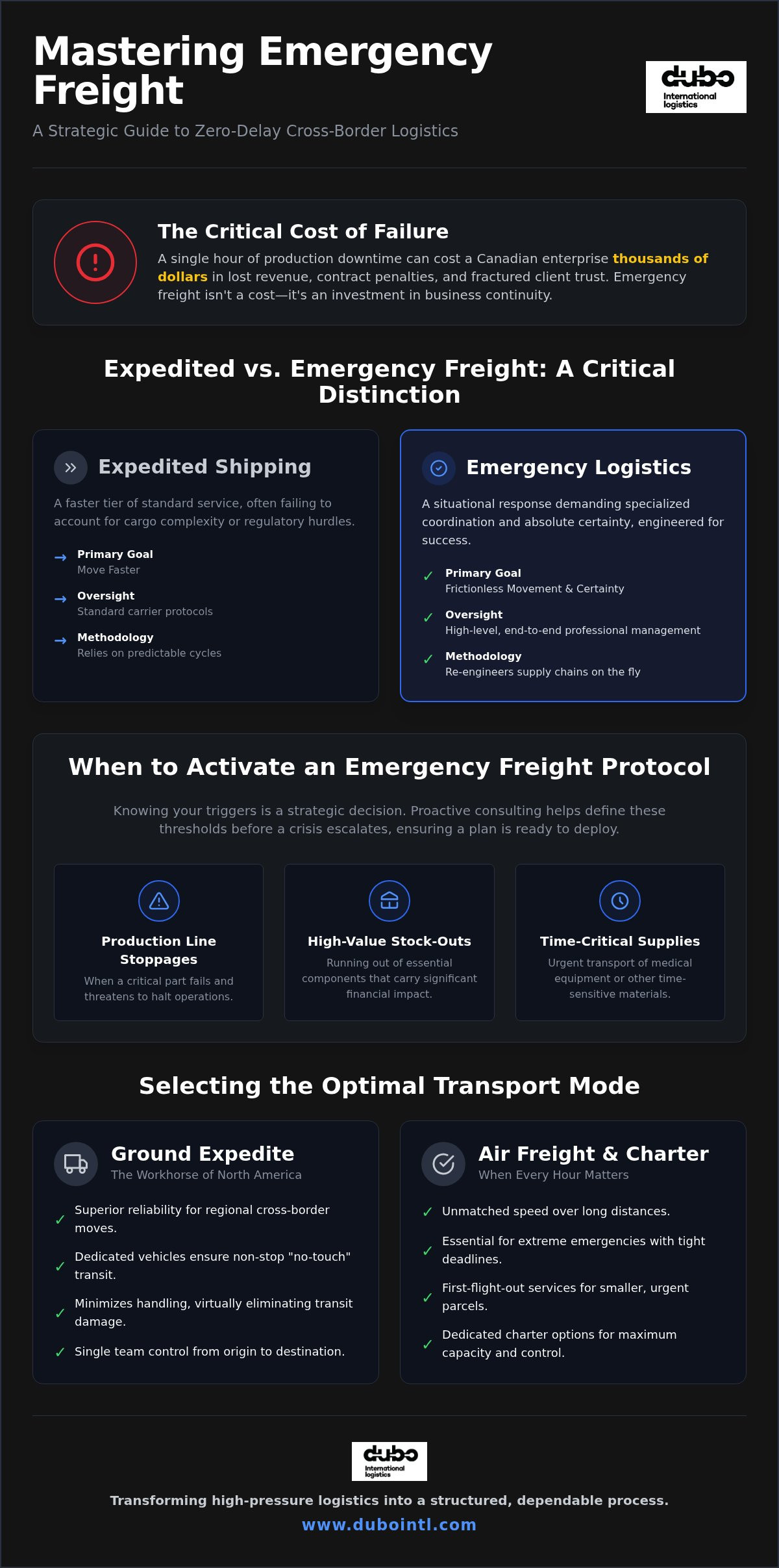
A single hour of production downtime can cost a Canadian enterprise thousands of dollars in lost revenue and fractured client trust. When a critical supply chain link breaks, the need for emergency freight becomes more than a logistical requirement; it's a high-stakes race where every second counts. You've likely felt the pressure of a looming deadline while staring at complex cross-border documentation, fearing that a minor clerical error might leave your cargo stranded at the border for days.
It's natural to feel the weight of these risks, especially as CUSMA reviews and mandatory digital manifests add layers of complexity to North American trade. This article outlines how to manage urgent cargo with the precision of a logistics architect, ensuring your shipments move through specialized transportation channels without the friction of international transit. You'll learn to integrate strategic coordination with rigorous regulatory compliance to achieve zero-delay crossings and maintain real-time visibility. By visiting www.dubointl.com, you can see how professional oversight transforms high-pressure logistics into a structured, dependable process that secures your business interests.
Key Takeaways
- Understand the critical "cost of failure" in logistics and how to mitigate the financial risks of production downtime through prioritized emergency freight coordination.
- Learn to evaluate the most effective transport modes for urgent cargo by balancing the speed of air freight with the robust capacity of specialized transportation solutions.
- Discover how proactive logistics consulting identifies supply chain vulnerabilities before they escalate, providing a foundation of preparedness for any time-critical scenario.
- Master the complexities of cross-border documentation to ensure your shipments clear customs without the delays that often compromise urgent delivery schedules.
- Realize the peace of mind that comes with end-to-end management and seasoned professional oversight, which you can explore further at www.dubointl.com.
Understanding Emergency Freight: Beyond Simple Expedited Shipping
Emergency freight represents a sophisticated tier of logistics where the priority shifts from routine efficiency to absolute certainty. It's a situational response that demands specialized coordination and high-level priority handling. While many carriers treat speed as the only variable, a true logistics architect understands that precision is the real engine of success. Standard freight forwarding relies on predictable cycles, but emergency scenarios break those cycles. This requires a professional who can re-engineer a supply chain on the fly to prevent the catastrophic cost of failure.
Manufacturing downtime is perhaps the most visible consequence of a logistics breakdown. When a critical part doesn't arrive, the financial impact ripples through the entire organization, affecting labour costs and contract penalties. Avoiding these outcomes requires more than just a fast driver; it requires the end-to-end management found at learn more. The methodology often mirrors Humanitarian and emergency logistics, where success depends on a proactive framework that prioritizes the integrity of the cargo alongside transport speed.
The Critical Difference Between Expedited and Emergency Freight
Expedited shipping is often sold as a simple speed tier, similar to choosing a faster delivery option at a checkout. Emergency logistics is fundamentally different. It's a situational response that requires a higher level of oversight than routine loads. Standard expedited services often fail because they don't account for the complexity of the cargo or the specific regulatory environment. The goal isn't just to make the truck move faster. The focus remains on the smoothness of the entire movement. This includes ensuring that documentation is flawless and that specialized transportation assets are ready the moment they're needed. Success is measured by the lack of friction, not just the tachometer reading.
When Should Your Business Trigger an Emergency Freight Protocol?
Knowing when to shift from standard operations to an emergency protocol is a strategic decision. Common triggers include production line stoppages, stock-outs of high-value components, or the urgent transport of medical supplies. These situations justify the professional fees associated with bespoke management because the alternative is significantly more expensive. Strategic logistics consulting helps businesses define these triggers before a crisis occurs. By identifying vulnerabilities in your supply chain, you can establish clear thresholds for when to engage specialized services. You can explore how these strategies are built by visiting www.dubointl.com to realize a more resilient logistics framework. This proactive approach ensures that when a crisis hits, the plan is already in motion.
Evaluating Ground and Air Solutions for Urgent Cargo
Selecting the right mode for emergency freight isn't a matter of habit; it's a calculated decision based on distance, cargo dimensions, and the specific timeline of the crisis. A logistics architect evaluates these variables to determine if a dedicated ground vehicle or a charter aircraft offers the highest probability of success. While air is faster over long distances, ground transport often provides superior reliability for regional cross-border moves by avoiding the complexities of airport handling and potential tarmac delays.
Ground Expedite: The Workhorse of North American Logistics
Ground expedite serves as the reliable workhorse for North American logistics. By deploying dedicated sprinters or straight trucks, coordinators ensure non-stop transit without the delays inherent in traditional hub-and-spoke networks. This "no-touch" freight model is particularly valuable for sensitive components, as it minimizes handling and virtually eliminates the risk of transit damage. Within a specific geographic radius, ground transport remains the most stable option for navigating border crossings with precision, as the vehicle stays under the control of a single team from origin to destination.
Air Freight and Charter: When Hours Matter Most
Air freight and dedicated charters become necessary when every minute impacts the bottom line. Commercial "first-flight-out" services are effective for smaller parcels, but extreme emergencies often require the capacity of a dedicated charter. These bespoke flights accommodate specialized transportation needs for cargo that cannot fit on standard aircraft, providing a direct link between distant centres. For companies transporting hazardous or sensitive materials, following the cross-border emergency response guide is a mandatory step in maintaining safety and compliance during these high-velocity moves.
Effective carrier coordination ensures that the transition between modes, such as moving from a truck to a plane and back to a truck, is entirely seamless. This end-to-end management prevents the handoff errors that often derail urgent shipments at the last kilometre. You can realize a more resilient supply chain by partnering with a firm that understands these nuances at www.dubointl.com. By choosing the right mode for the specific cargo requirement, you protect both your timeline and your professional reputation.
The Role of Strategic Logistics Consulting in Emergency Preparedness
Effective emergency freight management isn't a reaction; it's the execution of a well-designed blueprint. Many businesses treat logistics as a series of isolated events, but a seasoned logistics architect views it as an integrated system. Strategic logistics consulting provides the foresight needed to identify supply chain vulnerabilities before they manifest as costly delays. While professional fees for these services represent an upfront investment, they deliver immense value by establishing the "Standard Operating Procedures" (SOPs) required for high-pressure scenarios. These protocols ensure that every stakeholder knows their role the moment a disruption occurs, replacing panic with precision.
By utilizing supply chain optimization consulting, Canadian businesses can actually reduce the frequency of crisis moments. This framework ensures that your logistics partner isn't just a carrier but a strategic steward of your interests. A proactive approach allows for the identification of bottleneck points in North American trade routes, enabling you to build a more resilient foundation that can withstand unforeseen shocks. You can explore how these strategies are tailored to individual business needs at www.dubointl.com.
Building Resilience into Your Supply Chain
Resilience is built through diversification. Relying on a single route or carrier creates a single point of failure that can paralyze operations during a disruption. Strategic foresight allows companies to map out alternative paths and pre-qualify specialized transportation assets. This preparation ensures that when a crisis occurs, the response is methodical rather than panicked. For organizations looking to extend their reach beyond North American borders, specialized foreign trade consultancy from abbras.com helps navigate complex international regulations. Investing in consulting leads to long-term operational cost reductions by replacing expensive, last-minute scrambles with pre-negotiated, structured responses. This steady authority helps lower the stress associated with global movement, positioning your business as a stabilizing force in its market.
Part of this collaborative planning involves securing the business against unforeseen disruptions; RJ Blanchard Benefit Services provides the comprehensive insurance solutions necessary to protect your operations and personnel.
Collaborative Planning and Forecasting (CPFR) bridges the gap between business goals and logistical reality. By integrating logistics partners into the planning cycle, companies can better predict seasonal spikes in urgency. For instance, aligning your internal response plans with the Canadian government cross-border emergency guide helps maintain safety and compliance during high-velocity moves. A proactive partnership with a freight forwarder ensures that your forecasting data informs their capacity management. This synergy allows for smoother transitions during peak periods and helps you realize better outcomes for time-sensitive cargo. It's about moving from a reactive stance to one of quiet confidence and partnership.
Navigating Cross-Border Regulations for Time-Sensitive Shipments
The border between Canada and the United States represents the most significant hurdle for any urgent shipment. While a truck can travel at highway speeds, a single missing digit on a manifest can halt progress for hours or even days. This is where the true value of cross-border freight forwarding between Canada and the USA becomes apparent. A logistics architect doesn't just hire a driver; they build a compliance bridge that ensures the cargo never stops moving. Zero-delay border crossings aren't the result of luck. They're the product of meticulous planning and a deep understanding of the 2026 regulatory landscape.
Customs Compliance: The Real Speed Limit
Fast trucks cannot overcome slow paperwork. In 2026, the use of digital manifests through the ACE and ACI portals is mandatory for all cross-border movements. These systems allow for real-time data sharing and pre-arrival risk assessments that are vital for emergency freight. Without precise documentation, such as accurate commercial invoices and detailed manifests, the physical speed of the transport is nullified. Pre-clearance strategies are essential for time-critical loads. They involve submitting all required data to authorities well before the vehicle reaches the primary inspection line, allowing any potential issues to be resolved while the cargo is still in transit.
The Value of CIFFA Membership in Emergency Logistics
Working with a CIFFA-certified forwarder provides a layer of security that standard carriers cannot match. The Canadian International Freight Forwarders Association ensures that members adhere to high professional standards and rigorous codes of conduct. This certification translates to better risk management and reliability for the client. A professional forwarder acts as a dedicated steward of your interests during high-stress border crossings, maintaining a calm authority when facing complex international systems. They realize that specialized transportation project fees cover more than just the movement of goods; they cover the strategic foresight needed to navigate shifting tariffs and driver classification crackdowns.
Precision in documentation is the only way to guarantee that your urgent cargo reaches its destination without administrative interference. You can ensure your supply chain remains resilient by coordinating your next critical move through the experts at www.dubointl.com. By prioritizing compliance alongside speed, you protect your production timelines and your professional reputation from the costs of border delays.
Executing Seamless Emergency Logistics with a Professional Partner
Execution is the final test. While planning and compliance create the framework, the physical movement of emergency freight requires a partner capable of precise tactical execution. Utilizing end-to-end freight management ensures that every variable is accounted for, from the initial pickup to the final delivery signature. This holistic approach eliminates the communication gaps that often occur when multiple disconnected carriers handle a single shipment. Instead, a single point of coordination provides real-time visibility, offering the peace of mind that comes from knowing your critical cargo is under professional stewardship.
Specialized Solutions for Non-Standard Urgent Freight
Not all urgent cargo fits into a standard sprinter van. When dealing with oversized machinery or sensitive medical equipment, speed must be balanced with meticulous care. Specialized freight solutions in North America are tailored to these unique requirements, ensuring that non-standard cargo receives the specific handling it demands. Precision is just as vital as velocity. A logistics architect understands that an urgent delivery is only successful if the goods arrive in perfect condition, making specialized transportation assets a critical component of any emergency response.
Choosing Your Logistics Architect
Selecting a partner for your most critical moves requires more than just looking at a fleet size. You need a steward who offers both strategic consulting and flawless tactical execution. When evaluating a potential partner, consider their commitment to professional standards and their ability to provide bespoke support for complex projects. For those requiring immediate, specialized project support, visiting duboexpedited.com provides access to the expertise needed to manage high-stakes movements. A final checklist for your selection should include:
- Proven expertise in cross-border compliance and digital manifest documentation.
- Access to specialized transportation assets for non-standard or oversized cargo.
- A track record of transparent, real-time communication during the shipment life cycle.
- Active membership in recognized industry bodies like CIFFA.
You can stabilize your supply chain and lower your operational stress by exploring the professional management options available at www.dubointl.com. Reliability isn't an accident; it's the result of a partnership built on trust, foresight, and a shared commitment to excellence.
Securing the Future of Your North American Supply Chain
Managing emergency freight effectively requires more than just high-velocity transport; it demands a sophisticated alignment of regulatory precision and specialized transportation expertise. Throughout this guide, we've explored how flawless documentation and the strategic choice between ground and air modes prevent the high cost of production downtime. By prioritizing strategic logistics consulting for supply chain resilience, you don't just react to disruptions. You build a sturdy foundation that allows your business to remain a stabilizing force in a complex global trade environment.
As a CIFFA Certified Freight Forwarder with recognized expertise in specialized transportation projects, Dubo International Logistics serves as a dedicated logistics architect for your most critical moves. We provide the strategic foresight and end-to-end management needed to maintain complete peace of mind, ensuring that your cargo clears the border without administrative friction. You can partner with Dubo International Logistics for strategic freight management and peace of mind by visiting our website today. Let's work together to transform your urgent logistics into a seamless, well-planned operation that protects your professional reputation and secures your bottom line.
Frequently Asked Questions
What exactly qualifies as emergency freight in the logistics industry?
It's time-critical cargo that requires immediate intervention to prevent severe operational consequences. Unlike standard expedited shipping, which is simply a faster speed tier, emergency freight involves situational responses to production line stoppages, stock-outs of high-value components, or urgent medical needs. It demands specialized coordination and priority handling to ensure the cargo moves through the supply chain without the friction of routine delays.
How much more does emergency freight cost compared to standard shipping?
The cost is higher due to the dedicated resources and professional management fees required for end-to-end oversight. While standard shipping utilizes shared networks to lower costs, emergency solutions often employ dedicated vehicles or aircraft to ensure non-stop transit. Businesses justify these expenses by contrasting them against the "cost of failure," such as manufacturing downtime or missed contract deadlines, which can far exceed the premium paid for specialized transportation services.
Can any freight forwarder handle emergency cross-border shipments?
No, because managing urgent cross-border moves requires a specific level of expertise in North American trade regulations. A standard provider might lack the specialized coordination or the deep understanding of mandatory digital manifest systems needed for zero-delay crossings. It's essential to partner with a seasoned expert who acts as a logistics architect, ensuring that every regulatory requirement is met with precision to prevent cargo from being held at the border.
What is the fastest way to ship cargo from Canada to the USA in an emergency?
The fastest method depends on the distance and the nature of the cargo. For long-distance moves, a dedicated air charter or "first-flight-out" commercial service provides the highest velocity. However, for regional cross-border shipments, a dedicated ground expedite vehicle is often more reliable. Ground transport avoids the time-consuming airport handling processes and allows for a single team to maintain control from the point of origin to the final destination.
How does a logistics consultant help with emergency freight planning?
A consultant identifies supply chain vulnerabilities and establishes Standard Operating Procedures (SOPs) before a crisis occurs. This proactive approach includes diversifying routes and pre-qualifying specialized transportation assets to ensure a methodical response to disruptions. By integrating strategic foresight into your business planning cycle, a consultant helps reduce the frequency of emergencies and ensures that when they do happen, the response is characterized by quiet confidence rather than panic.
What documentation is most critical for avoiding border delays during an emergency?
Accurate digital manifests and commercial invoices are the most critical documents for seamless transit. In 2026, mandatory use of the ACE and ACI portals means that all data must be submitted electronically well before the cargo reaches the border. Precise product classifications and pre-clearance strategies ensure that customs authorities can perform risk assessments while the vehicle is in motion, effectively removing the administrative barriers that often slow down time-sensitive shipments.
Is air charter always faster than ground expedite for North American shipments?
Not necessarily, particularly for shipments within a specific geographic radius. While aircraft travel faster than trucks, the time required for airport drayage, security screening, and tarmac loading can add significant hours to the timeline. Ground expedite offers a "no-touch" freight model where the vehicle travels non-stop from the pickup point. For many North American routes, this direct transit is more efficient and provides greater visibility than multi-modal air solutions.
Why is CIFFA certification important for emergency freight management?
CIFFA certification ensures that a freight forwarder adheres to the highest professional standards and rigorous codes of conduct in Canada. This membership signifies a commitment to excellence and risk management, which is vital when handling high-stakes emergency freight. A certified partner acts as a protective steward of your interests, providing the reassuring authority needed to navigate complex international systems. You can learn more about these professional standards at www.dubointl.com.

