

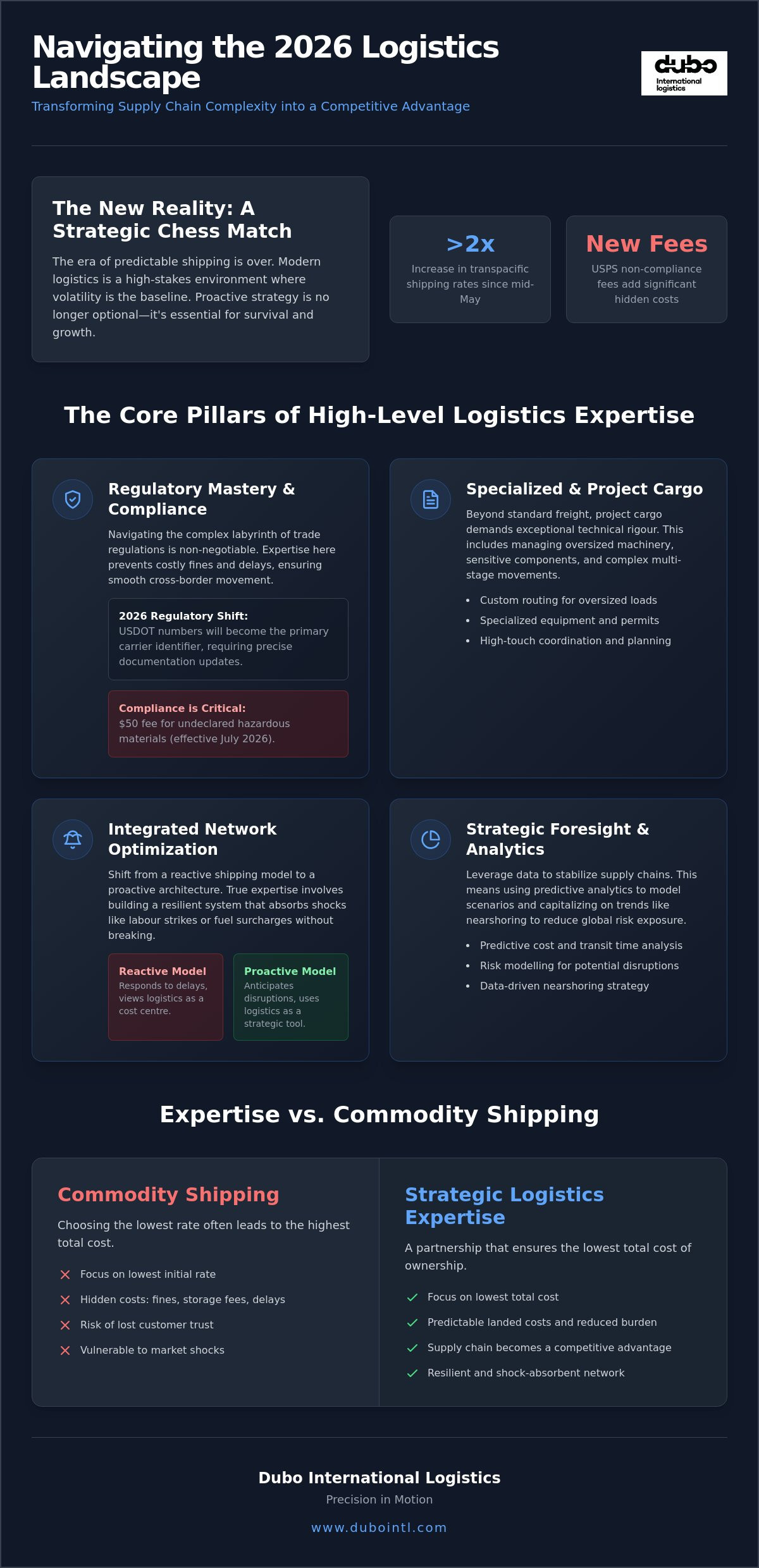
In 2026, the ability to move goods across borders has evolved from a routine operational task into a high-stakes strategic chess match. With transpacific shipping rates more than doubling since mid-May and new USPS non-compliance fees adding layers of cost, the margin for error has effectively vanished. You likely feel the pressure of these unpredictable delays and the weight of tightening cross-border regulations that seem to change by the week. This is where modern logistics expertise becomes your most valuable asset. It acts as a stabilizing force that protects your bottom line from the turbulence of global trade.
It's exhausting to manage rising costs while trying to maintain supply chain resilience in a climate of perpetual disruption. We understand that your goal is to achieve predictable landed costs and a reduced administrative burden, allowing you to focus on growth rather than troubleshooting. This guide will show you how to leverage specialized freight forwarding and consulting to turn logistical complexity into a distinct advantage. We will preview the latest regulatory shifts, including the transition to USDOT carrier identifiers, and outline a roadmap for securing your operations through 2026 and beyond. For more information on navigating these changes, visit www.dubointl.com.
Key Takeaways
- Transition from a reactive shipping model to a strategic framework that anticipates market volatility and protects your margins.
- Master the regulatory labyrinth of North American trade to ensure the seamless movement of specialized and oversized cargo across borders.
- Evaluate the scalability benefits of outsourcing to gain high-level logistics expertise without the overhead of increasing your permanent headcount.
- Leverage the rise of nearshoring and predictive analytics to stabilize your regional supply chain networks against global economic shocks.
- Partner with a dedicated "logistics architect" at www.dubointl.com to achieve predictable costs through integrated consulting and freight forwarding.
Defining Logistics Expertise in a Volatile Global Market
The global supply chain has moved past the era of simple transportation. While a foundational definition of logistics focuses on the movement of goods, modern reality demands far more than just moving freight from point A to point B. The post-2024 economic landscape has dismantled the "status quo" approach, where businesses could once rely on stable rates and predictable schedules. Today, volatility is the baseline. True logistics expertise now lives at the intersection of strategic consulting, regulatory precision, and physical execution. It's no longer enough to react to a delayed ship or a blocked border; you must architect a system that absorbs these shocks without breaking. Logistics expertise is the ability to anticipate disruptions before they impact the bottom line.
Moving from a reactive to a proactive model is the hallmark of sophisticated supply chain management. In the past, logistics was often tucked away in the back office, viewed as a cost centre to be minimized. Now, it's a front-line strategy. Proactive architecture involves mapping out potential failure points, from labour strikes to fuel surcharges, and building in the flexibility to pivot. This shift requires a deep commitment to integration, where freight forwarding isn't just a service but a core component of business planning. By aligning physical execution with long-term goals, businesses can transform their logistics from a vulnerability into a predictable engine for growth.
The Evolution of the Logistics Architect
Simple cargo movement has matured into complex network optimization. The logistics architect replaces the traditional dispatcher, using intelligence to reduce lead times across North America. Every movement must be purposeful and data-driven. A partner who understands the "why" behind the "how" identifies efficiencies that standard carriers often overlook. This depth of knowledge ensures your supply chain remains a competitive advantage rather than a source of constant stress.
Expertise vs. Commodity Shipping
Choosing the lowest shipping rate often leads to the highest total cost of ownership. Treating logistics as a commodity ignores hidden costs like regulatory fines, terminal storage fees, and lost customer trust. Distinguishing between a simple carrier and a strategic partner is vital for long-term health. At www.dubointl.com, we prioritize precision over the quick fix. High-level logistics expertise ensures freight moves smoothly through trade labyrinths, preventing costly delays that plague less prepared competitors.
The Core Pillars of High-Level Logistics Expertise
Success in modern trade isn't accidental. It's the result of a meticulously built foundation that prioritizes precision over speed and strategy over luck. When we look at the leaders in the North American market, their logistics expertise is anchored by four critical pillars: regulatory mastery, specialized handling, network integration, and strategic foresight. These elements work in concert to ensure that even the most complex shipments move without friction, regardless of the geopolitical or economic climate. It's a holistic approach that treats every shipment as a vital link in a larger strategic chain.
Compliance and the Value of CIFFA Membership
Regulatory compliance is the most immediate hurdle for any business moving goods across borders. Membership in the Canadian International Freight Forwarders Association (CIFFA) serves as a non-negotiable marker of professional excellence. It signifies a commitment to the highest industry standards and a deep understanding of evolving trade laws. For those managing cross-border freight forwarding Canada USA, this expertise is essential for navigating new 2026 requirements, such as the transition to USDOT numbers as the primary carrier identifier. Ensuring documentation is perfect doesn't just save time; it prevents the heavy fines associated with non-compliance, such as the $50 fee for undeclared hazardous materials implemented in July 2026.
Managing Specialized and Project Cargo
Standard freight follows a predictable path, but project cargo requires a different level of technical rigour. Whether you're moving oversized machinery or sensitive components, the technical knowledge required for specialized freight North America involves detailed risk mitigation and precision planning. It's about more than just finding a large enough trailer. It requires a partner who can coordinate specialized equipment and secure the necessary permits while maintaining cargo integrity throughout the journey. This level of care ensures that high-value assets arrive in pristine condition, ready for immediate use.
Beyond compliance and handling, true logistics expertise relies on integrating diverse carrier networks and exercising strategic foresight. By using predictive data to anticipate lane congestion or equipment shortages before they happen, a seasoned partner can reroute shipments to avoid bottlenecks. This proactive stance keeps your supply chain moving when others stall. If you're looking to stabilize your operations, exploring strategic logistics consulting can provide the clarity needed to navigate these complexities. It's about building a resilient system that turns potential delays into a predictable competitive advantage.
The Make vs. Buy Decision: Developing Internal Expertise vs. Outsourcing
Deciding whether to build an internal logistics department or partner with an external firm is a pivotal choice for any growing enterprise. While hiring a dedicated team might seem to offer more control, the true cost of maintaining in-house logistics expertise often extends far beyond simple salaries. You must account for specialized software licences, ongoing regulatory training, and the substantial overhead required to manage complex carrier relationships. For many North American businesses, the "Knowledge Gap" represents a significant vulnerability; if a key internal strategist departs, years of institutional knowledge and critical network connections can vanish overnight. This leaves your operations exposed at a time when the market is least forgiving.
External partners provide a level of scalability that internal departments simply cannot match. When shipping volumes surge or new regulations like the 2026 USPS HAZMAT fees are introduced, a professional firm absorbs the administrative burden without requiring you to increase your permanent headcount. This flexibility is supported by access to advanced technology. Most 3PLs utilize predictive analytics and digital twin simulations that are often too expensive for individual manufacturers to realize on their own. By choosing to partner, you're not just buying a service; you're integrating a sophisticated suite of tools designed to stabilize your supply chain against global volatility.
When to Invest in External Support
Identifying the tipping point where internal management becomes a bottleneck is essential for sustained growth. Mid-sized firms often find that their internal teams are overwhelmed by the administrative weight of cross-border documentation and carrier negotiation. Engaging in supply chain optimization consulting allows you to access high-level strategy without the long-term commitment of a full-time executive hire. This transition ensures that your logistics capacity flexes with market demand. If you decide to outsource freight management in Canada, you gain immediate access to global carrier networks that provide priority access even during the compressed peak seasons of 2026.
The Hybrid Approach: Augmenting Your Team
A professional partner doesn't replace your team; they act as a sophisticated extension of your existing operations. This hybrid model bridges the gap between local production and international distribution, providing the specialized intelligence needed to optimize lead times. By leveraging an external partner's established networks, you secure better carrier rates and priority equipment access. This partnership provides a sense of security, knowing that your interests are protected by seasoned experts who understand the minute details of global movement. For a closer look at how these strategic systems integrate, visit www.dubointl.com.
2026 Trends Reshaping Logistics Expertise
The logistics environment has reached a point where traditional efficiency is no longer enough to guarantee success. In 2026, logistics expertise is defined by its ability to pivot toward resilience in a climate of perpetual disruption. We've seen transpacific shipping rates more than double in just a few months; this volatility has forced a fundamental move away from the lean models of the past. Instead, seasoned experts are prioritizing a "Just-in-Case" strategy, often frontloading inventory to mitigate the risks of fuel surcharges and potential tariff changes. This transition requires a deep understanding of market signals and the foresight to act before a bottleneck becomes a crisis. Sustainability has also become a core metric, requiring specialized knowledge to optimize for carbon efficiency without sacrificing speed. You can learn more about how eco-friendly packaging solutions support these green initiatives while maintaining cargo safety.
Nearshoring and Regional Network Resilience
Regional networks are the new backbone of stability. Nearshoring has moved from a boardroom concept to an operational reality as manufacturing shifts closer to North American consumers. By reconfiguring supply chains to focus on regional trade agreements, businesses can reduce their exposure to volatile overseas lanes. This strategic shift requires a partner who understands the nuances of local regulations and the logistical architecture needed to support a more compact, responsive network. It's about building resilience through proximity and reducing the lead times that once left companies vulnerable to global shocks.
Technology and Data Transparency
Real-time data is now the minimum requirement for success. Modern end-to-end freight management relies on predictive analytics and AI agents to anticipate disruptions. These tools allow us to move beyond simply tracking what happened; we can now simulate scenarios using digital twins to optimize routes and consolidate shipping for maximum cost-efficiency. Automated documentation also plays a critical role in reducing the human error that leads to border delays. This level of transparency ensures that every stakeholder is aligned and every movement is purposeful. To see how these trends can be integrated into your business model, explore our specialized transportation services at www.dubointl.com.
The focus of automation in 2026 is not about replacing humans but empowering them through collaboration. Logistics roles now centre on employees working alongside AI to manage complex warehouse operations and AR-guided picking. This integration of technology and human logistics expertise creates a more agile workforce capable of responding to the rapid shifts in e-commerce demand. By embracing these technological advancements, businesses can maintain a competitive edge while ensuring their operations remain sustainable and efficient in an increasingly complex global market.
Precision in Motion: The Dubo International Logistics Approach
Precision is the cornerstone of reliability in a market defined by its volatility. At Dubo International Logistics, we don't just move freight; we architect solutions that stabilize your entire supply chain. Our approach integrates high-level strategic consulting with the physical rigour of freight forwarding to ensure that every shipment is handled with meticulous care. This methodology allows us to transform logistics expertise from a theoretical concept into a tangible competitive advantage for our clients across North America. We act as a protective steward of your interests, ensuring that your goods move seamlessly through even the most complex regulatory environments. By aligning our professional process with your specific business goals, we create a narrative of end-to-end support that is both cohesive and well-planned.
Bespoke Solutions for Complex Cargo
Standard shipments are simple, but specialized projects require a deeper level of intelligence. We thrive on the complexity that others avoid, coordinating the specialized transportation services needed for oversized or sensitive freight. By integrating our consulting expertise directly into the execution phase, we create a seamless experience that reduces the administrative burden on your team. Our national focus ensures that Canadian businesses receive the precision they require to compete on a global scale. We understand the specific nuances of the local market, which allows us to optimize networks with a level of detail that generic providers simply cannot match. This commitment to bespoke service ensures that your most challenging cargo is moved with quiet confidence and total transparency.
Partnering for Long-Term Growth
The challenges of 2026 require more than just a vendor; they demand a dedicated partner. As we move toward a future of nearshoring and AI-driven analytics, we help you optimize your supply chain to meet these shifts head-on. Trust and reliability are the primary currencies of global trade, and we prioritize these values in every interaction. We provide the steady authority needed to lower your stress and provide peace of mind in a turbulent economy. We move beyond the transactional nature of commodity shipping to offer a partnership built on longevity. This commitment is what separates true logistics expertise from basic cargo movement. By positioning ourselves as a sophisticated bridge between your local operations and complex international systems, we ensure that your growth is never hindered by logistical bottlenecks. To explore how our full suite of professional services can support your business, visit www.dubointl.com. Let's build a resilient future together, anchored by consistency and strategic foresight.
Securing Your Supply Chain for a Resilient 2026
The transition from reactive shipping to a proactive, architected supply chain is no longer a luxury for North American businesses. It's a fundamental requirement for survival in a market defined by perpetual disruption. We have explored how the right logistics expertise transforms volatility into a predictable advantage by integrating regulatory precision with strategic foresight. Whether you're managing the shift toward nearshoring or navigating the technical rigour of high-value cargo, success depends on a foundation of trust and reliable execution. You don't have to face these complexities alone.
As a CIFFA member specialized in North American cross-border compliance and high-value, oversized cargo, Dubo International Logistics provides the steady authority your operations require. We lower the administrative burden while ensuring your goods move with unmatched precision. It's time to move past the uncertainty of rising costs and unpredictable delays. We invite you to consult with a logistics architect at Dubo International Logistics to discover how a dedicated partnership can stabilize your future. Your growth deserves a partner who is as committed to your success as you are. Together, we can turn 2026 into a year of unprecedented stability and growth.
Frequently Asked Questions
What is the difference between a freight forwarder and a logistics expert?
A freight forwarder focuses on the physical movement of goods, while a logistics expert provides strategic oversight and network optimization. While forwarding is about execution, expertise involves consulting to improve the entire supply chain architecture. This high-level logistics expertise ensures that every movement aligns with your long-term business goals rather than just moving a single box from one port to another. It is the difference between a simple service and a strategic partnership.
How can logistics expertise help reduce our overall shipping costs?
Strategic oversight reduces costs by optimizing routes, consolidating shipments, and preventing regulatory fines. By analyzing your supply chain, experts identify inefficiencies that lead to terminal storage fees or wasted fuel. This precision planning ensures you realize the lowest total cost of ownership. It moves beyond chasing the lowest carrier rate to finding sustainable savings through better network integration and administrative efficiency across North America. Every decision is data-driven to protect your bottom line.
Why is CIFFA membership important when choosing a logistics partner in Canada?
CIFFA membership is a non-negotiable marker of professional standards and ethical conduct in the Canadian market. It guarantees that your partner adheres to a strict code of ethics and possesses the technical knowledge required to manage complex trade laws. This membership provides peace of mind, knowing your cargo is handled by a steward committed to industry excellence and standardized practices that protect your interests during every border crossing. It is a badge of reliability.
Can a logistics consultant help with cross-border compliance between Canada and the USA?
Yes, consultants specialize in navigating the labyrinth of North American customs and trade regulations. They ensure your documentation is accurate, preventing costly border delays and non-compliance fees like the $50 USPS HAZMAT charge introduced in July 2026. By acting as a sophisticated bridge between local operations and international systems, they mitigate the risks associated with evolving requirements like the transition to USDOT carrier identifiers. This expertise keeps your shipments moving without friction.
What are the most important logistics trends to watch in 2026?
The most critical trends include the rise of nearshoring, the adoption of AI-driven predictive analytics, and a shift toward verifiable sustainability. Businesses are moving production closer to North American consumers to reduce reliance on volatile overseas lanes. Additionally, the focus has shifted from "Just-in-Time" to "Just-in-Case" inventory models to protect against the perpetual disruptions that have become the new global norm. Success now requires a resilient approach that prioritizes stability over lean efficiency.
How does predictive analytics improve supply chain resilience?
Predictive analytics uses real-time data to anticipate disruptions before they impact your operations. By simulating various scenarios, experts can reroute shipments to avoid lane congestion or equipment shortages. This proactive approach allows you to move from tracking what happened to predicting what will happen. It builds a resilient system that maintains steady movement even when geopolitical events or extreme weather patterns threaten traditional shipping routes. This foresight is essential for maintaining a predictable competitive advantage.
Is it better to hire an internal logistics manager or partner with an external firm?
Partnering with an external firm often provides better scalability and access to advanced technology without the overhead of a permanent headcount. An external partner offers a depth of logistics expertise that is difficult to maintain in-house, especially when key staff members depart. This partnership allows you to flex your capacity based on market demand while ensuring your supply chain is managed by a team of seasoned architects. It reduces the risk of institutional knowledge gaps.
How do specialized transportation services differ from standard freight forwarding?
Specialized transportation services handle cargo with unique technical requirements, such as oversized machinery or high-value sensitive equipment. Standard forwarding follows predictable paths, but specialized projects require bespoke planning, custom permits, and non-standard equipment. This level of precision ensures the integrity of your most challenging shipments. You can explore these tailored solutions and our full suite of professional services by visiting www.dubointl.com. We prioritize the minute details to ensure every specialized movement is executed flawlessly.

