

In 2026, the most resilient supply chains aren't built on the lowest spot rates, but on the depth of the trust established between shippers and their transport providers. It's understandable if you're frustrated by unpredictable capacity shortages or the rising operational costs caused by poor coordination across the Canada-USA border. You likely realize that yesterday's transactional approach can no longer support the precision required for modern commerce. By adopting refined carrier relationship management best practices, you'll move beyond these friction points to secure preferential treatment and lower total landed costs even during volatile peak seasons.
Dubo International Logistics (www.dubointl.com) acts as a seasoned expert to help you navigate this complex environment with quiet confidence. This article provides a comprehensive overview of the strategic frameworks and communication protocols required to organize your shipping operations into a high-performance partnership. We will explore how to integrate professional consulting and methodical coordination to achieve seamless cross-border movement and zero-defect compliance records.
Key Takeaways
- Understand why the "lowest-price-wins" procurement model is failing in the volatile 2026 market and how to transition toward strategic freight provider partnerships.
- Implement carrier relationship management best practices by adopting standardized reporting and automated milestone triggers to ensure total shipment transparency.
- Evaluate the Total Cost of Ownership (TCO) rather than the initial per-mile rate to foster long-term stability and prioritize carrier flexibility.
- Establish rigorous safety protocols and handling requirements for specialized cargo to maintain zero-defect compliance across North American borders.
- Leverage the strategic foresight of logistics consulting at www.dubointl.com to audit performance and architect a more resilient, high-performance supply chain.
Defining Carrier Relationship Management (CRM) in the 2026 Supply Chain
Carrier Relationship Management (CRM) is the strategic discipline of selecting, nurturing, and optimizing freight provider partnerships to build long-term resilience. It's no longer just a procurement task relegated to the bottom of a spreadsheet. In today's environment, CRM represents a move away from seeing carriers as interchangeable utilities and instead viewing them as essential extensions of your own operational team. Effective carrier relationship management best practices focus on creating a symbiotic environment where both the shipper and the carrier thrive through mutual transparency and shared goals.
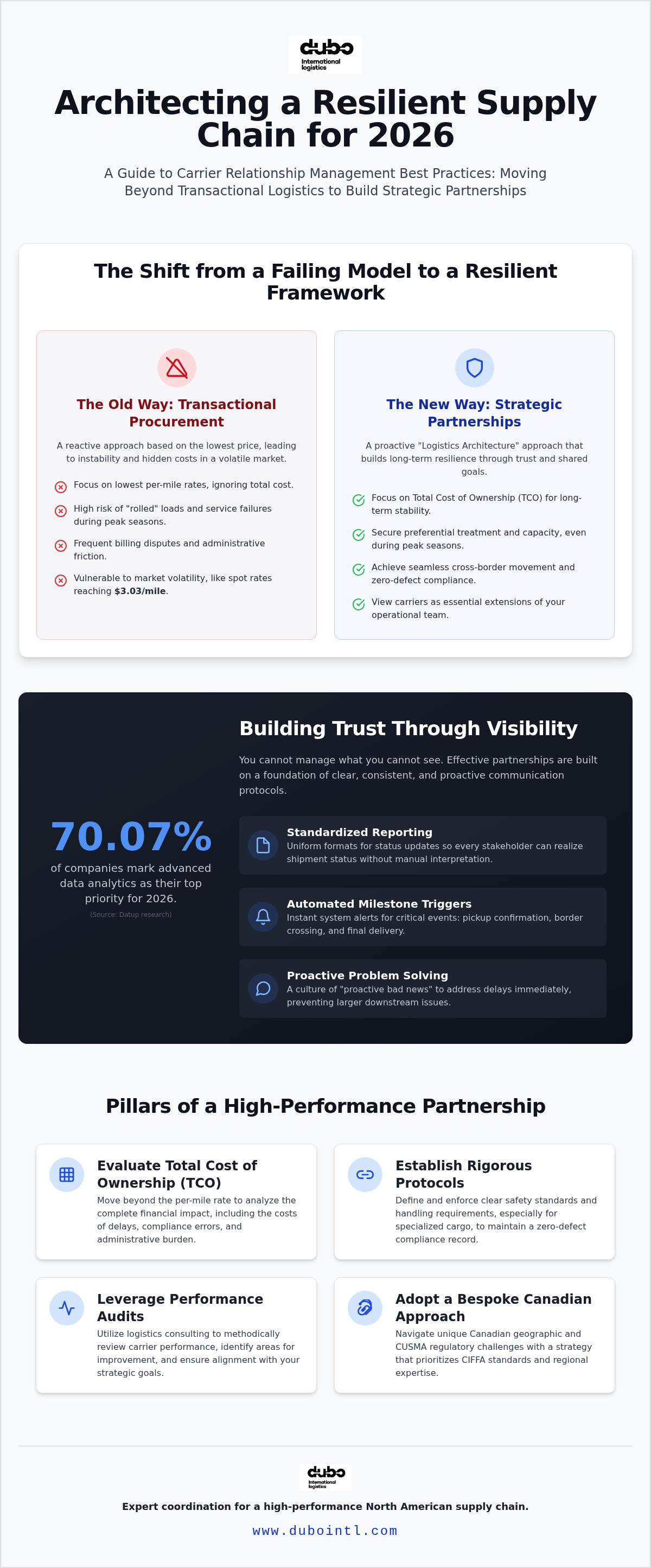
The "lowest-price-wins" model has reached its breaking point in the volatile 2026 market. Shippers who prioritize the cheapest quote often find themselves abandoned when capacity tightens or market rates fluctuate. For instance, with national average spot rates for van loads reaching $3.03 per mile in July 2026, those relying on transactional, low-bid relationships frequently face "rolled" loads and service failures. We advocate for a shift toward "Logistics Architecture," where the expert coordination provided by a firm like Dubo International Logistics (www.dubointl.com) acts as a stabilizing force. In this framework, sophisticated coordination is the primary value-add that protects your bottom line from the hidden costs of delays and border compliance errors.
The Evolution from Transactional to Strategic Logistics
Transitioning from the traditional spot market approach to long-term contract stability is a hallmark of modern carrier relationship management best practices. Steady partnerships significantly reduce the administrative friction that leads to billing disputes and data entry errors. When a carrier understands your specific lanes and cargo requirements, they operate with a level of precision that a one-off provider cannot match. Professional freight forwarders act as the bridge in this evolution, utilizing their deep industry networks to vet providers and manage the day-to-day nuances of these strategic alliances.
Why Canadian Businesses Require a Bespoke Approach
Canadian enterprises navigate a unique set of geographic and regulatory challenges, from the vast distances of the Prairies to the strict enforcement of the Canada-United States-Mexico Agreement (CUSMA). Maintaining high standards of professional integrity is essential, which is why we prioritize CIFFA standards in every partnership we architect. A bespoke approach ensures that your logistics strategy accounts for specific North American distribution hurdles while maintaining a zero-defect compliance record. For a deeper dive into these regional complexities, we invite you to read our guide on Professional Freight Forwarding in North America.
Establishing Clear Communication and Data Transparency Protocols
Trust is the byproduct of visibility. In a complex supply chain, you cannot manage what you cannot see, and your carriers cannot perform at their peak without a clear understanding of your expectations. By integrating carrier relationship management best practices into your communication strategy, you replace guesswork with precision. This shift is essential in a market where 70.07% of companies have marked advanced data analytics as their top priority for 2026, according to Datup research. Establishing a centralized documentation hub ensures that both the carrier and the coordinator have immediate access to the same "single version of the truth."
Effective communication protocols should prioritize the following elements:
- Standardized Reporting: Use uniform formats for status updates to ensure every stakeholder can realize the current shipment status without manual interpretation.
- Automated Milestone Triggers: Implement systems that provide instant alerts for critical events, such as pickup confirmation, border crossing arrival, and final delivery.
- Proactive Problem Solving: Foster a culture of "proactive bad news" where carriers feel comfortable reporting delays immediately. It is always better to address a border backlog in the morning than a missed delivery in the afternoon.
Standardizing Freight Documentation for Seamless Flow
Precision in paperwork is the engine of speed. An accurate Bill of Lading (BOL) and meticulously prepared customs documentation are not just administrative requirements; they are tools that reduce carrier "wait time" at loading docks and border crossings. When documentation is digitized and integrated, the entire operation moves with a noticeable smoothness. This professional level of preparation protects you from the rising costs of carrier detention fees and ensures that specialized cargo moves without unnecessary friction. Engaging a partner like Dubo International Logistics ensures that these digital bridges are built correctly from the start, providing you with peace of mind through every mile.
Leveraging Real-Time Visibility Tools
Real-time tracking is now a non-negotiable standard for North American logistics. Integration with GPS and Electronic Logging Devices (ELD) provides the granular data required to build deep trust between shippers and carriers. This transparency is particularly vital given the new FMCSA rule, effective February 7, 2026, which gives enforcement officers the authority to place vehicles out of service if they use revoked ELDs. Implementing end-to-end freight management allows you to synchronize these tools, ensuring that your data is not just present, but actionable. When everyone realizes the exact location and status of the cargo, the relationship shifts from one of suspicion to one of collaborative success.
Transitioning to Strategic Partnerships: Beyond the Per-Mile Rate
Focusing solely on the per-mile rate is a short-sighted strategy that often leads to hidden expenses. When you evaluate the Total Cost of Ownership (TCO) instead of the initial freight quote, you begin to see the true value of a reliable partner. A cheaper carrier might offer a lower price, but if they lack the flexibility to handle a sudden volume spike or the safety record to clear the border without inspection delays, the final cost to your business will be significantly higher. At Dubo International Logistics (www.dubointl.com), we view every shipment as part of a larger architectural plan where reliability is the primary currency.
Strategic alliances thrive on accountability and shared objectives. By developing collaborative KPIs that reward carriers for safety, reliability, and flexibility, you align their incentives with your long-term success. Regular Quarterly Business Reviews (QBRs) provide the necessary forum to discuss these metrics and adjust goals as your business grows. This methodical approach is a cornerstone of carrier relationship management best practices, ensuring that both parties remain focused on mutual growth rather than short-term gains. Backhaul optimization and route consistency further strengthen these bonds, as they help carriers maximize their asset utilization while providing you with more predictable pricing.
Identifying the 'Shipper of Choice' Criteria
Securing priority capacity requires more than just a signed contract. Carriers are increasingly selective about the shippers they work with, favouring those who offer clean driver facilities, professional treatment at the loading dock, and punctual payment terms. Being a "good" shipper isn't just about ethics; it's a financial strategy that reduces the "difficulty premiums" carriers often charge for complex or unpleasant lanes. Shipper of Choice status is the ultimate competitive advantage for securing priority capacity in a constrained market.
Maintaining a clean and organized facility is a key component of this status; for businesses looking to streamline their onsite waste management, you can learn more about Book Your Dumpster USA for professional roll-off rentals.
Collaborative Planning, Forecasting, and Replenishment (CPFR)
Efficiency is born from foresight. The Collaborative Planning, Forecasting, and Replenishment (CPFR) framework allows you to share volume forecasts with your carriers well in advance. This transparency helps them organize their equipment and driver schedules more effectively, leading to higher service levels and more consistent pricing. We utilize Strategic Logistics Consulting in Canada to help our clients implement these advanced frameworks, transforming their supply chains into models of architectural precision and dependable performance.
Managing Compliance and Specialized Cargo Requirements
Compliance serves as the bedrock of a dependable supply chain. In 2026, carrier relationship management best practices require a rigorous vetting process that extends far beyond a simple insurance check. You must ensure all carriers meet specific safety ratings and maintain active certifications such as C-TPAT, PIP, and CSA to protect your cargo from avoidable delays. Maintaining a centralized database of these certifications allows you to mitigate risk before a vehicle even arrives at your facility, ensuring that your providers are as committed to security as you are.
Specialized freight presents unique challenges that demand expert foresight and meticulous planning. For oversized or sensitive cargo, establishing clear protocols for handling and transit is essential to prevent damage and regulatory fines. This coordination isn't a one-time event; it's a continuous process of verification. Shippers who invest in these deep-level partnerships realize fewer defects and more consistent cross-border performance. It's about building a protective steward for your interests through every mile of the journey.
Cross-Border Compliance as a Relationship Anchor
Regulatory knowledge is a powerful tool for preventing costly border delays and administrative fines. The North American trade landscape in 2026 is marked by significant shifts, including the 15% global surcharge on imports implemented on February 24, 2026, under Section 122 of the Trade Act. Additionally, the U.S. Merchandise Processing Fee (MPF) for formal entries currently stands at 0.3464% of the goods' value. Carriers must be deeply familiar with these customs protocols to navigate the Canada-USA border efficiently. For a detailed analysis of these complexities, consult our guide on Cross-Border Freight Forwarding: Canada-USA Logistics.
Handling Specialized and Oversized Cargo
Coordinating escorts, permits, and specialized equipment requires intensive relationship management and longer lead times than standard dry van loads. You must work with carriers who understand the nuances of regional permitting and the technical requirements of oversized transport. This collaborative approach ensures that every specialized move is executed with architectural precision. To master the intricacies of these complex shipments, refer to our Specialized Freight North America buyer's guide. If you require expert assistance in coordinating your next specialized shipment, contact the specialists at Dubo International Logistics to ensure your cargo moves with total peace of mind.
Leveraging Logistics Consulting to Optimize Performance
Professional logistics consulting acts as the strategic brain behind a high-performance supply chain. While the previous sections of this guide detailed the tactical execution of carrier relationship management best practices, consulting provides the high-level foresight required to integrate these elements into a cohesive architecture. By engaging an external expert to audit carrier performance and identify operational gaps, you gain an objective perspective that internal teams often overlook. This meticulous auditing process ensures that every provider in your network is contributing to your long-term resilience rather than just filling a temporary capacity hole.
This strategic oversight often extends to understanding the historical and operational significance of major global transit points; to gain perspective on how such infrastructure shapes modern trade, you can learn more about the evolution of the Panama Canal.
Consulting fees shouldn't be viewed as an added expense, but as a calculated investment in your company's stability. These costs are consistently offset by the realization of significant supply chain efficiencies, such as optimized route planning and reduced detention fees. Research from TwinCore in June 2026 indicates that enterprises leveraging advanced AI and expert-led data analytics have seen an average 15% reduction in overall logistics costs. We invite you to visit www.dubointl.com for a strategic assessment of your current network to see how these efficiencies can be applied to your specific business model.
The Role of the Logistics Architect
A dedicated logistics partner provides the hands-on guidance necessary to bridge the gap between your local business needs and the complexities of global trade. We act as your "logistics architect," focusing on the minute details of individual client requirements while maintaining a view of the grander North American movement. This role is about more than just moving freight; it's about providing a sophisticated bridge between your operations and a complex international system. For those requiring specialized support for time-sensitive or unique cargo, the experts at Dubo Expedited offer bespoke solutions that maintain the integrity of your most critical shipments.
Achieving Long-Term Supply Chain Resilience
Mastering CRM best practices transforms your logistics from a source of stress into a stabilizing force for your business. The peace of mind that comes from a meticulously executed logistics plan allows you to focus on your core operations, knowing that your cargo is in the hands of a protective steward. Consistency and longevity are the hallmarks of a mature partnership. To organize your North American freight with the precision it deserves, partner with a CIFFA-certified expert who understands the nuances of the 2026 market. Let us help you architect a supply chain that isn't just functional, but exceptional.
Architecting a Resilient Future for Your North American Supply Chain
Mastering carrier relationship management best practices is no longer optional in a market defined by rapid regulatory shifts and capacity volatility. By moving beyond transactional shipping and embracing strategic partnerships, you realize a level of network stability that protects your bottom line. We have explored how standardized communication, rigorous border compliance, and total data transparency create the "smoothness" required for modern commerce. This methodical approach ensures that your specialized cargo and cross-border movements are handled with the precision they deserve.
As you look to organize your logistics for the year ahead, remember that you don't have to navigate these complexities alone. Partner with the logistics architects at Dubo International for reliable North American freight management. Our team provides CIFFA Certified Expertise, specialized project cargo management, and comprehensive cross-border compliance to serve as a stabilizing force for your business. We are committed to your success and look forward to building a dependable partnership that provides you with total peace of mind.
Frequently Asked Questions
What is Carrier Relationship Management in freight forwarding?
Carrier Relationship Management is the strategic process of selecting, nurturing, and optimizing freight provider partnerships to build long-term supply chain resilience. It moves beyond the traditional transactional model to focus on mutual transparency and shared operational goals. Implementing carrier relationship management best practices ensures that carriers are treated as essential extensions of your own team rather than interchangeable utilities.
How can I become a 'Shipper of Choice' for my carriers?
Becoming a "Shipper of Choice" requires prioritizing driver treatment, maintaining clean facility amenities, and ensuring punctual payment terms. Carriers are increasingly selective about their partners in a capacity-constrained market. If you provide a professional environment at the loading dock, carriers are less likely to charge the "difficulty premiums" often associated with complex or unpleasant lanes.
Why is data transparency important in logistics partnerships?
Data transparency is vital because it ensures all stakeholders realize the exact status and location of a shipment in real time. Utilizing automated triggers for milestones like border crossings reduces administrative friction and builds deep trust between the shipper and the carrier. When everyone has access to a single version of the truth, the relationship shifts from suspicion to collaborative success.
What are the key KPIs for measuring carrier performance?
Key KPIs should focus on safety ratings, on-time reliability, and operational flexibility rather than just the initial freight quote. You should also evaluate the Total Cost of Ownership (TCO) to understand the financial impact of delays or compliance errors. Rewarding carriers for consistent performance through collaborative KPIs fosters a high-performance partnership that benefits both parties.
How does a professional freight forwarder improve carrier relationships?
A professional freight forwarder acts as a sophisticated bridge that manages the day-to-day nuances of carrier interactions with quiet confidence. They utilize deep industry networks to vet providers and ensure that all carrier relationship management best practices are consistently applied. This oversight provides you with peace of mind while reducing the administrative burden on your internal team.
Can strategic logistics consulting reduce my total shipping costs?
Strategic logistics consulting reduces costs by auditing carrier performance and identifying structural gaps in your supply chain network. These efficiencies often lead to a 15% reduction in overall logistics costs, according to 2026 industry data from TwinCore. You can explore these optimization strategies further at www.dubointl.com to see how professional coordination protects your bottom line.
What compliance certifications should I look for in a North American carrier?
Look for carriers with recognized certifications such as C-TPAT, PIP, and CSA to ensure they meet rigorous safety and security standards. These certifications are essential for navigating the Canada-USA border without unnecessary inspections or costly delays. Maintaining a database of these credentials is a critical step in mitigating risk across your entire North American distribution network.
How do I manage relationships with specialized or oversized cargo carriers?
Managing specialized cargo carriers requires intensive coordination, longer lead times, and clear protocols for permits and escorts. Because oversized freight is technically complex, you must work with providers who understand regional permitting and specific handling requirements. Establishing these collaborative frameworks early ensures that your project cargo moves with architectural precision and dependability.

