

A single centimetre of error in a route survey can result in weeks of delays and substantial lost productivity when moving oversized industrial machinery. In the high-stakes environment of project cargo logistics Canada, precision is the only safeguard against the inherent risks of transporting out-of-gauge equipment across provincial borders. You likely understand that moving a large-scale stamping press or heavy assembly tool isn't a standard shipment; it's a multi-stage engineering feat where the margin for error is non-existent.
We recognize the pressure of managing these complex movements while ensuring full compliance with the updated ELD Technical Standard Version 1.3.1 and various provincial regulations. This strategic guide provides the clarity you need to navigate technical and operational hurdles, from securing specialized lowbed trailers to establishing rigorous service level agreements (SLAs) with a vetted carrier network. By visiting www.dubointl.com, you can explore how a dedicated logistics architect transforms these volatile variables into a predictable, zero-damage delivery process. We will examine the essential frameworks for route engineering, CUSMA certification documentation, and the proactive planning required to maintain project continuity across North America.
Key Takeaways
- Understand why standard freight forwarding is insufficient for oversized machinery and how specialized project cargo logistics Canada requires a meticulously engineered approach.
- Identify the technical requirements for moving out-of-gauge equipment, including the strategic use of a lowbed trailer to navigate overhead clearance restrictions.
- Learn how a rigorous carrier vetting process and clearly defined service level agreements (SLAs) mitigate operational risks and protect your capital investment.
- Navigate the regulatory landscape of North American trade by mastering CUSMA certification requirements and provincial permit lead times.
- Discover the long-term value of a CIFFA-certified partnership for ensuring seamless freight transitions, which you can explore further at www.dubointl.com.
Defining Project Cargo Logistics in the Canadian Market
Project cargo is not merely "large freight"; it is a specialized discipline involving the movement of high-value, oversized, or technically complex equipment that exceeds standard transport dimensions. In the context of project cargo logistics, success relies on a meticulous integration of engineering and transport. Standard freight forwarding models often fail here because they treat cargo as a commodity rather than a critical project component. These models lack the specialized oversight needed for out-of-gauge (OOG) machinery, where a single oversight in permitting or route analysis can halt a multi-million dollar industrial installation.
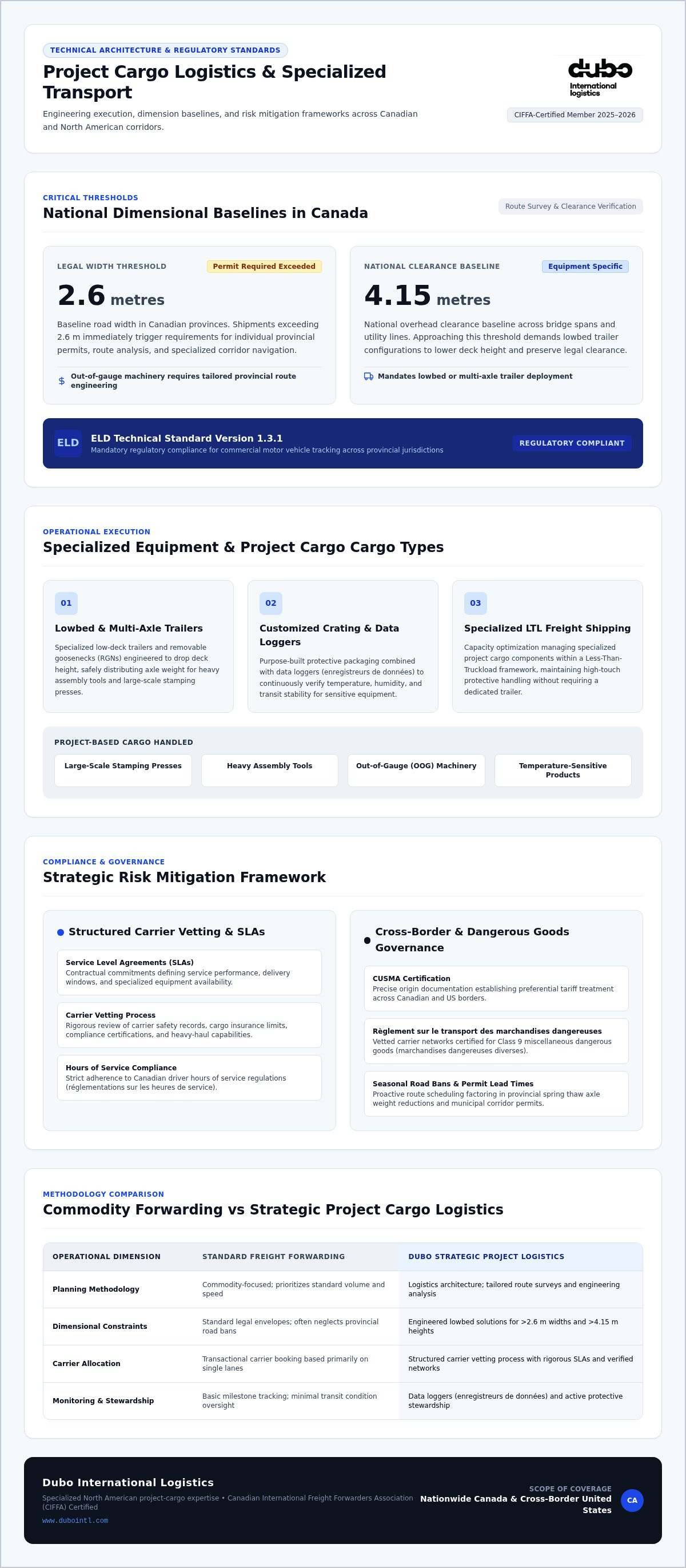
Standard logistics models typically prioritize volume and speed over technical detail. When moving a heavy assembly tool across Canadian provinces, the baseline road width of 2.6 metres is frequently exceeded, which triggers the need for individual provincial permits and route surveys. A standard model doesn't account for these legal dimension baselines or the impact of seasonal road bans across remote and rural transport corridors. This is why project cargo logistics Canada requires a more sophisticated approach. We view these complex movements through the lens of "logistics architecture," a methodology where precision is the cornerstone of reliability. It ensures every variable is accounted for before the first trailer arrives on-site, providing a stabilizing force in a volatile market.
Characteristics of Project-Based Shipments
Project-based shipments are defined by their unique physical and operational footprints. Out-of-gauge machinery often requires specialized trailers, such as lowbeds, to maintain legal heights under Canadian bridges and utility lines. These moves are inherently time-sensitive, tied to specific project phases where a delay in delivering a large-scale stamping press can cause a ripple effect across an entire production timeline. High-value industrial tools demand a level of protective stewardship that standard carriers simply aren't equipped to provide, necessitating customized crating and constant monitoring.
The Strategic Role of a Freight Forwarder
A strategic partner acts as a sophisticated bridge between local business needs and complex international systems. Unlike a transactional carrier focused on a single lane, a strategic forwarder manages the entire lifecycle of the move. This involves the coordination of multiple vetted carriers for a single project, ensuring that every leg of the journey is synchronized and compliant. End-to-end freight management is essential for maintaining continuity and security throughout the transition. For businesses requiring this level of precision, specialized services like Dubo International Logistics provide the necessary framework for reliable execution. You can explore our full range of strategic solutions at www.dubointl.com.
Technical Requirements for Oversized and Specialized Freight
Managing specialized freight requires more than just a standard truck; it demands a technical alignment of equipment and infrastructure. In the field of project cargo logistics Canada, the physical constraints of the road network dictate the equipment selection process. When cargo height approaches the 4.15-metre national overhead clearance baseline, a lowbed trailer becomes indispensable. These trailers drop the deck height to ensure the load passes safely under bridges and utility lines without triggering infrastructure damage or legal violations. Compliance with provincial oversize and overweight vehicle regulations is a mandatory part of this technical planning, ensuring every axle weight and dimension meets the safety standards of each jurisdiction.
Specialized Transport Equipment
Standard flatbeds and step-decks serve many industrial needs, but heavy assembly tools often require multi-axle configurations or removable goosenecks (RGNs) for safe loading. It's a common misconception that all project cargo requires a full trailer. Some specialized transport projects can be managed within an LTL freight shipping framework, which allows for cost optimization while maintaining the high-touch handling required for sensitive industrial components. Heavy-lift operations require a synchronized plan involving rigging and transport teams to ensure the load's centre of gravity remains stable throughout the journey. You can find more about these tailored configurations at Dubo Expedited.
Protecting Sensitive and Fragile Cargo
Precision machinery isn't just heavy; it's often incredibly delicate. Customized crating provides a bespoke protective shell that absorbs vibration and prevents structural stress during multi-modal transitions. For high-value electronics or climate-sensitive equipment, we rely on enregistreurs de données (data loggers) to maintain a continuous record of environmental conditions. These devices track temperature, humidity, and shock levels, providing a transparent chain of custody from origin to destination. Strict securement protocols are the final layer of protection, ensuring that even during sudden stops or sharp turns, the cargo remains completely immobile.
The complexity of these technical requirements highlights why a "one-size-fits-all" approach to transport often leads to equipment damage or regulatory delays. Establishing a precise technical plan is the only way to guarantee a zero-damage delivery. If you are preparing for a move involving out-of-gauge machinery, consulting with a logistics architect can help you identify the specific equipment needed for your project. By addressing these technical variables early, you ensure your shipment moves through the Canadian corridor with the highest level of security and efficiency.
Strategic Risk Mitigation and Carrier Vetting Processes
Proactive planning is not a luxury. It is the foundation of project security. In the complex landscape of project cargo logistics Canada, waiting for a problem to arise before seeking a solution is a recipe for costly delays and equipment damage. We position ourselves as a stabilizing force, moving beyond transactional shipping to offer a framework of quiet confidence. By identifying potential bottlenecks in the supply chain weeks before a load moves, we ensure that every transition is a calculated step rather than a reactive scramble. This level of strategic foresight is what separates a successful project from one plagued by cost overruns.
The Carrier Vetting Methodology
A structured carrier vetting process is the first line of defence in protecting high-value industrial assets. We perform a meticulous review of every partner in our network, verifying safety fitness certificates, Transport Canada NSC ratings, and specific insurance limits that exceed the standard CIFFA liability cap of 2 SDR per kilogram. This is particularly vital when managing a vetted dangerous-goods carrier network for shipments involving marchandises dangereuses diverses. We prioritize carriers with documented experience in specialized freight, ensuring they understand the nuances of securement for heavy assembly tools. Knowledge of the CBSA commercial importing guide is also a prerequisite for our cross-border partners to ensure they can align with mandatory reporting mechanisms and prevent border holds.
Reducing Waste and Inefficiency
Efficiency in project logistics is measured by the absence of friction. Strategic coordination is designed to minimize empty miles and temps d'attente, two of the most significant contributors to hidden logistics costs. When a specialized carrier is forced to wait for loading because site preparations were incomplete, the resulting idle time can derail the entire project budget. We use ERP systems to integrate operational and business data, providing a single source of truth for scheduling and resource allocation. This integration allows for Just-in-Time systems to function even within the constraints of heavy haulage, ensuring that specialized equipment like lowbed trailers are on-site exactly when needed. For time-sensitive industrial moves, Dubo Expedited provides the dedicated focus required to maintain these tight performance windows.
Reliability is anchored in contractual commitment. We utilize service level agreements (SLAs) to define precise performance windows and equipment availability, ensuring all parties are held to a high standard of professional execution. Throughout the journey, tracking systems provide the real-time visibility needed for true peace of mind, allowing you to monitor the progress of your cargo across North American corridors. You can learn more about our commitment to dependable partnership at www.dubointl.com. By combining rigorous vetting with advanced data integration, we transform the uncertainty of global trade into a predictable, managed process.
Navigating Cross-Border Compliance and Regulatory Frameworks
Cross-border movement of industrial machinery requires a level of regulatory precision that standard shipments never face. In the context of project cargo logistics Canada, success depends on the seamless alignment of provincial movement permits with federal requirements. As the first formal six-year joint review of the Canada-United States-Mexico Agreement (CUSMA) commenced on July 1, 2026, the need for documented compliance has never been more critical. We act as a protective steward of your interests, ensuring that every piece of specialized equipment moves through these corridors without the friction of regulatory uncertainty.
Documentation and Regulatory Precision
Precision in documentation acts as the stabilizing force for your supply chain. Obtaining proper CUSMA certification is essential to ensure your specialized equipment qualifies for preferential treatment, preventing unexpected border holds. When moving sensitive materials, adherence to the Règlement sur le transport des marchandises dangereuses is mandatory. This includes the correct classification of marchandises dangereuses diverses (Class 9) to ensure safety and legal compliance. Additionally, carriers must strictly follow the réglementations sur les heures de service, especially under the updated ELD Technical Standard Version 1.3.1, to maintain predictable delivery timelines without compromising safety.
Ensuring Smooth Border Transitions
Smooth transitions through complex border corridors are achieved through meticulous preparation. Our approach involves a detailed review of all freight documentation before the cargo reaches the point of entry. By aligning the Pre-Arrival Review System (PARS) for Canada and the Pre-Arrival Processing System (PAPS) for the U.S. with provincial oversized approvals, we eliminate unnecessary temps d'attente. This level of coordination between freight forwarding experts and compliance teams ensures that specialized transportation projects maintain their momentum across the trilateral trade corridors, which govern nearly C$2 trillion in annual commercial exchange. You can find end-to-end support for these transitions at www.dubointl.com. For projects requiring high-priority coordination, Dubo Expedited provides the dedicated oversight needed to manage these complex transitions successfully.
Managing the intersection of provincial road permits and international trade law is a task for a seasoned expert. We provide the strategic foresight needed to anticipate regulatory shifts and ensure your cargo remains compliant at every stage of the journey. Reliability is not just about the truck; it's about the integrity of the data and documentation supporting the move. Connect with our compliance experts to secure your cross-border project cargo and ensure a seamless entry into the North American market.
Selecting a CIFFA-Certified Partner for Project Execution
Choosing a partner for heavy assembly tools or large-scale stamping presses requires looking beyond basic transportation. Dubo International Logistics acts as a dedicated guide and protective steward, positioning itself as a logistics architect for the modern industrial sector. We don't just move freight; we optimize the entire supply chain to enhance operational efficiency and reduce the risk of unforeseen delays. This partnership ensures that your specialized equipment transitions through complex corridors with absolute smoothness, providing a stabilizing force in a volatile global market. When managing project cargo logistics Canada, our goal is to lower your stress by providing quiet confidence and meticulous execution.
The Value of CIFFA Certification
Adherence to high professional standards is the hallmark of a reliable logistics partner. Our CIFFA-certified membership for 2025-2026 serves as a verified trust signal, confirming our commitment to ethical conduct and financial reliability. Working with a certified expert provides the peace of mind that your cargo is in hands that understand the default forwarder liability caps and the necessity of purpose-built SLAs. This certification ensures that every move follows a structured methodology, prioritizing cargo securement and regulatory compliance. For a broader look at these industry standards, you can read our guide on Professional Freight Forwarding in North America.
Commencing Your Project Cargo Journey
Your next move deserves a consultative approach that prioritizes precision over simple transit speed. We invite you to explore our specialized solutions at www.dubointl.com, where you can see how we manage out-of-gauge machinery and fragile equipment across the continent. For detailed purchasing insights, our Specialized Freight North America buyer's guide provides the technical clarity needed for informed decision-making. Whether you require full project oversight or specific support through Dubo Expedited, our team is ready to act as the stabilizing force your business needs. Reliable project cargo logistics Canada begins with a conversation about your specific operational needs and risk profile.
Longevity and consistency are the pillars of our service model. We realize that your industrial projects represent significant capital investments, and we treat every shipment with the respect that commitment deserves. By integrating strategic foresight with a vetted carrier network, we ensure your equipment arrives safely and on schedule. Trust us to be your partner in logistics, dedicated to optimizing your supply chain and enhancing your operational efficiency through every stage of the journey.
Strategic Oversight for Your Next Industrial Movement
Managing the movement of oversized industrial equipment across North American corridors requires more than just transportation; it demands the strategic foresight of a logistics architect. Success in this field relies on technical precision, from selecting the correct lowbed trailer to utilizing customized crating for fragile components. Aligning your project with the latest regulatory standards, such as CUSMA certification and provincial weight thresholds, is the only way to avoid costly delays and ensure project continuity.
Reliable project cargo logistics Canada depends on a foundation of trust and professional certification. By partnering with an expert who maintains CIFFA-certified membership for 2025-2026, you gain access to a vetted carrier network for dangerous goods and specialized North American project-cargo expertise. This steady authority lowers your operational stress and transforms complex logistical hurdles into a seamless, predictable process. You can explore our full range of bespoke solutions at www.dubointl.com.
Ready to move your most critical assets with absolute confidence? Secure your project's success with Dubo International Logistics and experience the peace of mind that comes from a dedicated, hands-on partner. We look forward to realizing your project goals together.
Frequently Asked Questions
What exactly is considered project cargo in Canada?
Project cargo involves the movement of high-value, oversized, or technically complex equipment that cannot be transported via standard freight methods. In the Canadian market, this includes out-of-gauge machinery such as large-scale stamping presses and heavy assembly tools used in manufacturing. These shipments require specialized handling, route engineering, and provincial permits to navigate infrastructure safely. You can find more details on how we manage these complex moves at www.dubointl.com.
How do lowbed trailers help with oversized machinery transport?
A lowbed trailer is essential for maintaining legal height clearances when transporting tall industrial machinery across provincial road networks. By utilizing a dropped deck, these trailers allow cargo to pass safely under bridges and utility lines that standard flatbeds cannot clear. This specialized equipment is a critical component of project cargo logistics Canada, ensuring that even the largest components move through the country without damaging public infrastructure or the equipment itself.
What is the carrier vetting process for specialized freight?
Our carrier vetting process involves a structured review of safety fitness certificates, insurance limits, and verifiable experience in heavy haulage. We prioritize partners who demonstrate a consistent history of securement excellence and compliance with federal transport rules. This rigorous screening ensures that every carrier in our network is equipped to handle the unique demands of specialized freight, providing the peace of mind that your capital investment is protected by seasoned professionals.
How does CUSMA certification affect project cargo between Canada and the USA?
CUSMA certification is vital for ensuring that industrial machinery qualifies for preferential tariff treatment when crossing North American borders. Proper documentation establishes the rules of origin, which helps businesses avoid unnecessary duties and prevents administrative holds at customs. We coordinate these requirements as part of our strategic freight forwarding services, ensuring that cross-border movements remain seamless and compliant with the latest trilateral trade regulations governing the primary Canada-USA commercial corridors.
What are the common risks in project cargo logistics and how are they mitigated?
Common risks include physical equipment damage, regulatory delays, and cost overruns due to poor route planning. We mitigate these through proactive route surveys, customized crating, and the use of enregistreurs de données to monitor transit conditions. Establishing clear service level agreements (SLAs) with vetted carriers also ensures that performance windows are met, while strategic coordination reduces empty miles and unnecessary temps d'attente during multi-stage project moves across North America.
Why is CIFFA certification important when choosing a freight forwarder?
CIFFA-certified membership for 2025-2026 confirms that a forwarder adheres to the highest professional and ethical standards in the Canadian industry. This accreditation provides a layer of financial security and operational reliability that non-certified brokers can't match. It signifies that the partner has the expertise to manage complex project cargo logistics Canada while following standardized trading conditions, ensuring your business is supported by a mature and established logistics architect.
How do data loggers protect sensitive industrial equipment during transit?
Data loggers, or enregistreurs de données, provide a continuous record of environmental and physical conditions throughout the shipment's journey. These devices track critical variables such as shock, tilt, temperature, and humidity, which is essential for protecting delicate electronics or high-precision assembly tools. By maintaining this transparent chain of custody, we can verify that cargo remained within safe parameters, allowing for immediate intervention if any environmental thresholds are breached during the transportation process.
Can project cargo be managed within an LTL shipping framework?
Yes, specialized transport projects can often be managed within an LTL freight shipping framework when the cargo doesn't require a full trailer. This approach allows for cost optimization while still providing the high-touch handling and specialized securement protocols required for industrial components. It's an efficient solution for moving smaller, high-value parts that are critical to a larger project, ensuring they receive the same level of strategic oversight as oversized machinery.
