

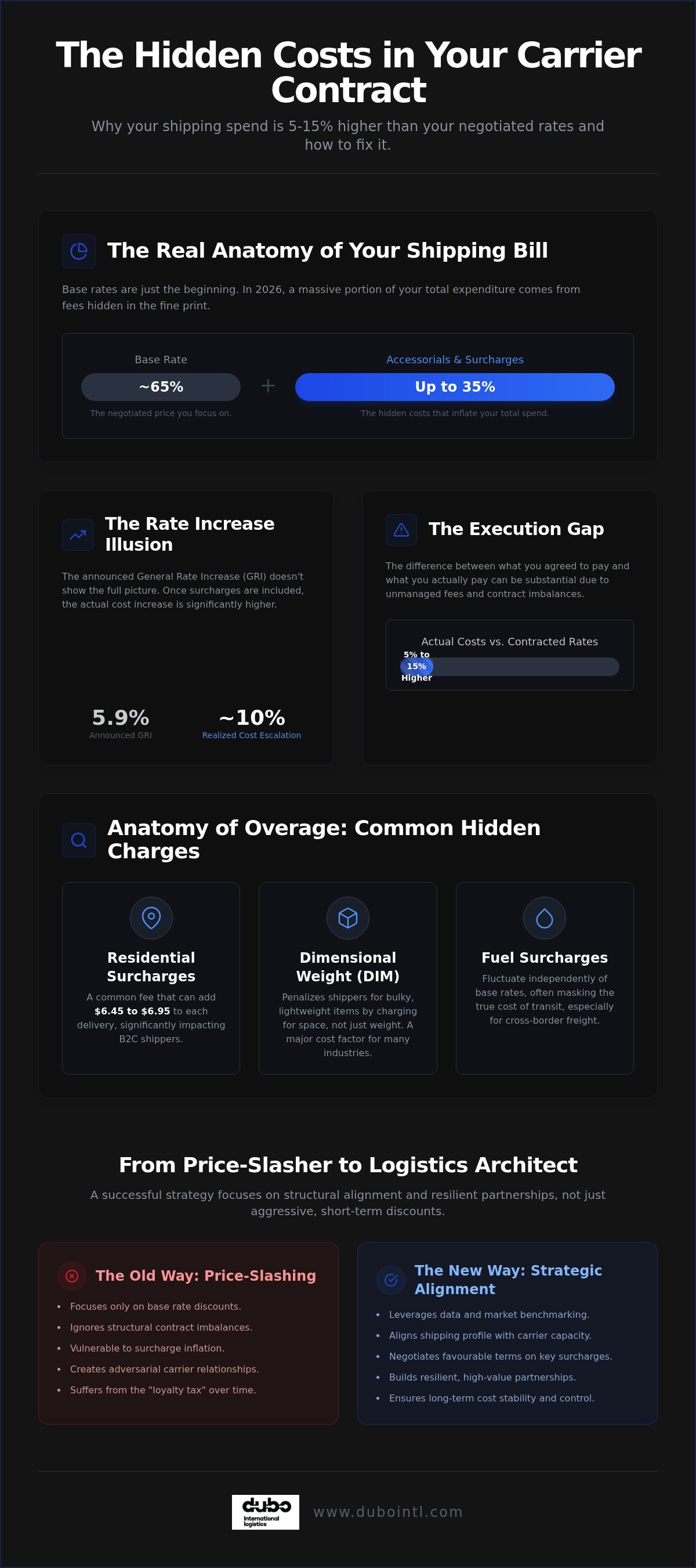
While base rates often take centre stage, accessorial charges and opaque fuel surcharges have quietly climbed to represent as much as 35% of total shipping expenditure in 2026. This shift means that even a well-negotiated discount can be erased by a lack of oversight on the fine print. You likely recognize the frustration of managing increasing complexity in cross-border freight between Canada and the USA, where the execution gap often results in actual costs being 5% to 15% higher than your contracted rates. Engaging professional carrier contract negotiation services is no longer just an option for the largest players; it's a vital step for any shipper looking to maintain stability in a volatile market.
At www.dubointl.com, we believe that true optimization requires more than just aggressive price-slashing. It demands a structural alignment between your unique shipping profile and carrier network capacity. Data tells the true story. In this guide, we'll show you how to leverage data-driven benchmarking and expert logistics consulting to reclaim control over your spend. You'll discover how to navigate the 5.9% general rate increases seen this year and use strategic foresight to build a resilient, cost-effective supply chain that supports your long-term growth.
Key Takeaways
- Recognize the shift from simple base rates to complex, accessorial-heavy billing structures that, as of 2026, represent a significant and often hidden portion of modern shipping costs.
- Learn how to leverage market benchmarking and internal data intelligence to identify leverage points and uncover savings that internal audits alone might overlook.
- Understand the distinct strategic toolkits required for negotiating LTL and FTL contracts compared to standard parcel shipping in a volatile capacity market.
- Discover how professional carrier contract negotiation services at www.dubointl.com can provide a strategic audit to align your shipping profile with carrier network capacity.
- Shift your focus from aggressive price-slashing to a "logistics architect" approach that favours long-term supply chain resilience and dependable, high-value partnerships.
The Complexity of Modern Carrier Agreements: Why Shippers Overpay
Carrier pricing has evolved into a labyrinth of tiered discounts and shifting surcharges that often leave shippers paying far more than their volume warrants. Most businesses view their annual rate increase as a fixed cost of doing business. This passive approach ignores the structural imbalances within the agreement. Professional carrier contract negotiation services act as a strategic audit of these pricing structures; they peel back the layers of base rates to reveal the true net effective cost of every shipment. While the legal contract of carriage establishes the foundational rights and duties of both parties, the financial outcomes are determined by the complex annexes and service guides that carriers update frequently.
In 2026, the industry has seen a definitive shift away from simple base-rate competition. Major carriers like FedEx and UPS announced a 5.9% general rate increase (GRI), but for many Canadian businesses, the realized cost escalation is closer to 10% once surcharges are factored in. Carriers hold a significant psychological advantage during the renewal cycle. They possess superior market data and understand exactly how to structure fees to maximize their yield without triggering immediate alarm. Success requires a counter-balance of data-driven insight.
Anatomy of a 2026 Carrier Contract
The gap between base rates and net effective rates has never been wider. Accessorial charges like residential fees, which now sit between $6.45 and $6.95 per package, can account for up to 35% of total transportation spend. Dimensional weight (DIM) factors also play a critical role. They effectively penalize shippers for bulky, lightweight items by charging based on volume rather than actual weight. In Canada, fuel surcharges require a bespoke analysis because they fluctuate independently of base rates, often masking the true cost of cross-border movement.
The Cost of Inertia in Logistics
Longevity doesn't always lead to better pricing. Many shippers suffer from a "loyalty tax" where long-term partners pay higher rates than new customers who benefit from aggressive introductory incentives. Over years of service, hidden surcharges accumulate without a formal review, quietly eroding margins. At www.dubointl.com, we utilize logistics consulting to identify these invisible costs. By conducting a meticulous review of historical data, we uncover where your current agreement no longer aligns with your shipping profile. It's about precision, not just persistence.
Leveraging Benchmarking and Data Intelligence for Leverage
Data is the bedrock of any successful negotiation. While your internal records show what you've paid, they don't reveal what you should be paying. Carriers enter the boardroom with a massive information advantage; they see thousands of shipping profiles across the country every day. Professional carrier contract negotiation services bridge this gap by providing the objective context needed to challenge the status quo. Relying solely on your own history is like trying to navigate a forest with a map of your backyard. You need a broader perspective to realize true value. Data tells the truth.
The Power of Comparative Benchmarking
Market benchmarking is the process of comparing a shipper's specific freight profile against an anonymized database of similar-volume peers. This intelligence reveals whether your discounts are truly market-competitive or if you're lagging behind industry standards. For instance, while a 50% discount on LTL might sound impressive, it means little if the base rate is inflated or if peers in similar lanes are securing 65%. Analyzing lane-specific data for LTL and FTL shipments ensures your pricing reflects current capacity realities rather than outdated models. This analysis typically focuses on:
- Regional Lane Density: Ensuring rates are optimized for your most frequent Canadian routes.
- Cross-Border Complexity: Benchmarking the surcharges associated with USA-Canada freight movement.
- Capacity Commitments: Aligning your volume with carrier equipment availability in specific corridors.
This level of detail allows you to enter meetings with a clear understanding of your standing in the 2026 market. Precision matters here.
Converting Spend Analytics into Strategy
Transforming raw spend into a coherent strategy requires more than just a basic spreadsheet. We use historical invoice data to predict future savings, identifying "low-hanging fruit" such as accessorial fee waivers or more favourable DIM factors. This level of detail is a core component of strategic logistics consulting in Canada. By using sophisticated "rerating engines," we model exactly how proposed contract changes would have affected your previous year's shipping activity. This process simulates every package, lane, and surcharge under the new terms, providing a crystal-clear picture of your potential ROI. It moves the conversation from vague "gut feelings" to concrete, data-driven demands that carriers find difficult to refute. If you're looking to refine your approach and ensure your logistics architecture is sound, exploring the resources at www.dubointl.com can help clarify your next steps. Our goal is to provide the precision required for a seamless and dependable supply chain that protects your interests.
Multimodal Negotiation Strategies: Beyond Parcel Shipping
While parcel shipping often dominates the conversation around rate reductions, road freight accounted for nearly 61% of Canada's logistics revenue in 2025. This scale demands a specific, technical approach. Comprehensive carrier contract negotiation services must extend beyond small packages to address the nuances of palletized, heavy, and specialized cargo. For Canadian shippers, the complexity increases when freight crosses the 49th parallel, requiring a strategy that integrates multimodal coordination with regulatory foresight. Precision in these agreements ensures that your supply chain remains a stabilizing force rather than a source of unexpected costs.
Negotiating LTL and FTL Agreements
Negotiating LTL (Less-Than-Truckload) requires a deep dive into "Freight All Kinds" (FAK) classifications. Without a robust FAK agreement, shippers are frequently hit with unpredictable re-classification fees that derail budgets. In the FTL (Full Truckload) space, where capacity remains volatile, it's essential to negotiate detention and demurrage terms upfront. As driver time is strictly regulated by 2026 Hours-of-Service rules, these fees accumulate rapidly if not capped. When your cargo involves oversized or sensitive shipments, referencing a strategic guide for specialized freight North America helps in structuring contracts that account for pilot cars, permits, and specialized equipment requirements.
Cross-Border Considerations for Canadian Shippers
Cross-border movement introduces unique financial risks, particularly regarding currency fluctuations between the CAD and USD. A contract that looks favourable in Canadian dollars might become a liability if USD-denominated surcharges spike. We recommend negotiating fixed conversion rates or specific fuel pegs to maintain financial predictability. Additionally, border crossing fees and customs-related surcharges require a meticulous audit to avoid double-billing or misapplied discounts. Ensuring that cross-border freight forwarding compliance is explicitly baked into your carrier agreements reduces the risk of costly delays at the port of entry.
At www.dubointl.com, we act as a seasoned expert and a dedicated guide through these complexities. We understand that the lowest price is irrelevant if the carrier lacks the equipment or the compliance pedigree to move your goods across the border seamlessly. By treating your contract as a living logistics architecture, we help you build a resilient framework that supports long-term growth and dependable movement across all modes of transport.
A Professional Framework for Navigating Contract Renewals
Successful renewals aren't the result of aggressive posturing; they're the product of a methodical architecture. To secure a contract that protects your margins, you must follow a disciplined sequence that begins long before the expiry date. Most Canadian shippers start too late, leaving them with little leverage as deadlines loom. A professional approach to carrier contract negotiation services ensures that every step, from initial data cleansing to the final post-implementation audit, is anchored in precision and strategic foresight. This structured path lowers stress and positions your business as a sophisticated partner rather than just another account.
- Step 1: Data Extraction and Cleansing. We begin by removing outliers and correcting errors in your historical shipping records to ensure carriers bid on your true profile.
- Step 2: Objective Benchmarking. Your cleansed data is measured against 2026 Canadian market rates to identify exactly where your current pricing lags behind industry standards.
- Step 3: Creating the RFP. We draft a Request for Proposal that mirrors your actual shipping patterns, providing carriers with the clarity they need to offer their best possible terms.
- Step 4: Multi-Round Negotiation. This phase involves refining discounts and accessorial waivers through several layers of feedback, ensuring the final offer aligns with your specific needs.
- Step 5: Post-Implementation Audit. Once the contract is signed, we verify that the carrier is honouring the new rates on every invoice.
The RFP Process: Setting the Stage for Success
Drafting a "clean" RFP is essential because carriers price based on risk and clarity. If your data is messy, they'll build "buffer" pricing into their bid to protect themselves. We recommend inviting a strategic mix of incumbent carriers and new challengers to the table. This competitive environment encourages transparency and reveals the true market value of your volume. Standardizing these bids is the only way to allow for an apples-to-apples comparison, ensuring that a lower base rate isn't secretly offset by higher surcharges elsewhere.
Implementation and Contract Compliance
The danger of many negotiations is the gap between "paper savings" and "realized savings." It's common for shippers to celebrate a 10% reduction on paper, only to find their actual spend remains flat due to billing errors or misapplied discounts. Setting up a robust freight audit system allows you to catch these discrepancies immediately. Integrating end-to-end freight management ensures that your contract remains compliant throughout its entire lifecycle. If you're ready to move beyond generic templates and secure a bespoke agreement, we invite you to explore our specialized consulting at www.dubointl.com. We provide the steady authority required to stabilize your costs in a complex global environment.
Beyond the Discount: Building Resilient Partnerships with Dubo
Efficiency is more than a line item on a spreadsheet. While securing a lower rate is a significant milestone, the lowest price is rarely the best value if it comes at the expense of capacity guarantees or service quality. In a market where road freight represents nearly 61% of national revenue, your supply chain requires a foundation built on stability rather than just short-term savings. Professional carrier contract negotiation services provide the strategic foresight needed to ensure your agreements remain robust during peak seasons and market shifts. We act as your "Logistics Architect", designing a framework that balances cost-efficiency with uncompromising reliability. Data tells the story, but partnership ensures the results.
Getting started with a professional contract assessment is a straightforward process that begins with a review of your current spend and service requirements. We don't just look for immediate cuts; we look for structural alignment. By identifying where your carrier network may be misaligned with your growth objectives, we help you pivot toward a more sustainable logistics model. This proactive stance is essential for Canadian shippers who must manage the dual pressures of domestic distribution and cross-border complexity.
The Dubo Approach: Steady Authority and Precision
Our methodology at Dubo International Logistics prioritizes longevity and consistency in every carrier relationship. We believe in building partnerships that endure, acting as a sophisticated bridge between your local operations and the intricate demands of global trade. By utilizing our CIFFA-certified expertise, we provide the steady authority required to navigate shifting regulations and complex cross-border requirements. This professional standard ensures that your interests are protected by a steward who understands the minute details of individual client needs. For a thorough consultation on how your current agreements measure up against the 2026 market, visit us at www.dubointl.com. We're here to offer the precision and peace of mind your business deserves.
Integrating Negotiation into a Broader Logistics Strategy
Effective negotiation is just one component of a larger vision. When you integrate these efforts into supply chain optimization consulting, you transform your logistics from a cost centre into a competitive advantage. Outsourcing the technical burden of freight management allows your internal team to focus on core business growth while we handle the complexities of compliance and carrier relations. For those requiring time-sensitive support or specialized movement, our Dubo Expedited solutions offer the same level of meticulous execution for urgent cargo needs. It's time to move beyond the simple discount and build a supply chain that's truly resilient and well-planned.
Securing Your Competitive Edge in a Volatile Market
The 2026 shipping landscape requires more than just a passive acceptance of general rate increases. As accessorial fees now represent as much as 35% of total transportation spend, the path to supply chain resilience lies in precision and data-driven benchmarking. You've seen that true savings are found by closing the execution gap and ensuring your contract mirrors your actual freight profile. Integrating professional carrier contract negotiation services into your strategic planning isn't just about reducing costs; it's about building a dependable foundation for your international trade operations. Precision in your agreements today prevents the "loyalty tax" of tomorrow.
As a CIFFA Certified Member with decades of strategic consulting experience, Dubo International Logistics serves as a protective steward of your interests. We bring specialized expertise in North American logistics to ensure every lane and surcharge is optimized for your specific needs. The complexity of global movement shouldn't be a source of stress for your business. Secure your supply chain's future—contact Dubo International Logistics for a professional carrier contract assessment today. We look forward to helping you architect a more stable and predictable future for your cargo movement.
Frequently Asked Questions
What exactly are carrier contract negotiation services?
These services are a specialized form of logistics consulting that audits your current shipping profile against market benchmarks to secure better rates and terms. This process involves a deep dive into base rates, fuel surcharges, and accessorial fees. By using these services, businesses gain the data intelligence needed to level the playing field with carriers. It's about structural alignment, not just asking for a discount.
How much can a Canadian business typically save through contract negotiation?
While results vary based on volume and current contract health, many shippers identify an execution gap between 5% and 15% of their total spend. These savings often come from uncovering hidden surcharges and optimizing dimensional weight factors rather than just lowering base rates. Professional carrier contract negotiation services at www.dubointl.com focus on these nuanced areas to reclaim lost margins and stabilize your long-term logistics budget.
Do I need to change carriers to see significant savings?
No, significant savings are frequently achieved with your incumbent carriers by renegotiating existing terms to reflect your current shipping profile. Carriers value longevity and consistency; they're often willing to adjust pricing to retain a dependable partner. We use competitive benchmarking to show your current provider where their rates have drifted from the market standard, allowing for a seamless transition to better pricing without operational disruption.
How long does a typical carrier contract negotiation process take?
A comprehensive negotiation cycle typically spans three to six months, depending on the complexity of your freight requirements. we recommend starting the process at least six months before your current contract expires to allow for thorough data cleansing and multiple rounds of bidding. This timeline ensures you aren't forced into a rushed agreement, providing the breathing room needed for strategic foresight and meticulous execution of the new terms.
Can professional services help with both parcel and heavy freight contracts?
Yes, professional services cover the entire spectrum of transportation, including parcel, LTL, and FTL shipments. Each mode requires a distinct toolkit; parcel focuses on accessorial waivers and DIM factors, while heavy freight demands a focus on lane-specific density and FAK classifications. Our approach ensures that your multimodal coordination is cohesive, protecting your interests across every segment of your supply chain through a unified logistics architecture.
What data do I need to provide to start a carrier contract audit?
You'll need to provide at least 12 months of historical invoice data, ideally in a digital format that includes origin, destination, weight, and a breakdown of all surcharges. This raw data is then cleansed to remove outliers and create a "clean" profile for carriers to bid on. Having a complete picture of your shipping activity allows us to model proposed changes with precision, ensuring the projected ROI is grounded in reality.
How do negotiation services handle cross-border shipping between Canada and the USA?
We handle cross-border complexities by auditing border crossing fees, customs surcharges, and currency fluctuation clauses within your agreements. Negotiating these specific terms is vital for Canadian businesses moving goods to or from the USA, as these "invisible" costs can quickly erode the benefits of a low base rate. We ensure that compliance and financial predictability are baked into the contract to keep your cross-border movements seamless.
Is there a risk of my service levels dropping if I negotiate lower rates?
There's no inherent risk to service levels when negotiations are handled professionally and focused on market-fair pricing. Carriers prioritize high-volume, reliable shippers who understand their network capacity needs. By positioning your business as a sophisticated partner rather than just a price-shopper, we help you secure better rates while maintaining the high service standards required for your supply chain's success. It's about mutual value, not just cost-cutting.

