

The implementation of 50% tariffs on Canadian goods entering the United States has fundamentally rewritten the rules of North American commerce. You likely feel the pressure of these shifting tides; managing a cross-border operation now requires more than just moving goods from point A to point B. It demands a level of precision that balances rising costs with the necessity of improving supply chain efficiency Canada-US. As regulatory friction increases, the margin for error has effectively disappeared, leaving many businesses to grapple with unexpected border delays and the complexities of the latest USMCA reviews.
This guide provides the strategic foresight needed to master these complexities, offering expert insights into specialized cargo handling and regulatory compliance. You'll learn how to achieve zero compliance penalties and reduced transit times through meticulous network planning. By integrating professional logistics consulting and freight forwarding expertise from partners like Dubo International Logistics at www.dubointl.com, you can transform your operations into a resilient asset. We'll explore the mandatory digital manifest requirements, the impact of retaliatory tariffs, and the methodologies used by a logistics architect to ensure seamless movement across the border.
Key Takeaways
- Master the 2026 regulatory landscape by learning how to navigate new tariff structures and USMCA reviews without incurring costly compliance penalties.
- Identify proven methodologies for improving supply chain efficiency Canada-US by synchronizing digital manifest requirements with high-velocity delivery schedules.
- Gain clarity on the complex route surveys and provincial regulations required for the seamless, end-to-end movement of specialized and oversized project cargo.
- Learn why partnering with a professional freight forwarder at www.dubointl.com provides the strategic foresight needed to mitigate border delays and rising transport costs.
- Shift from a reactive to a proactive logistics model by utilizing strategic consulting to build long-term resilience within your North American trade lanes.
The Landscape of Canada-US Trade Lane Logistics in 2026
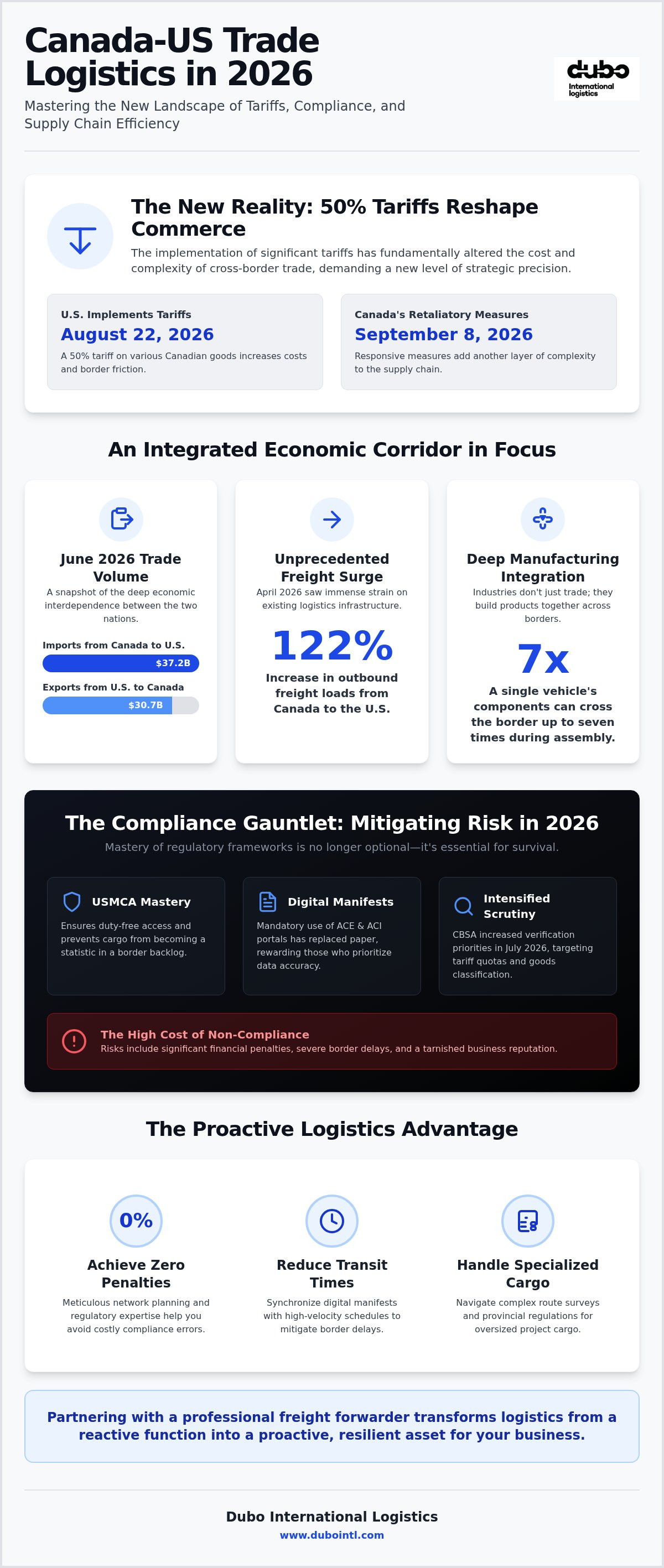
The economic bond between Canada and the United States represents more than a simple exchange of goods; it is the most integrated economic corridor in the world. This relationship has matured into a sophisticated ecosystem where raw materials and components cross the border multiple times before reaching a final consumer. In June 2026, the United States exported $30.7B to Canada, while imports from Canada reached $37.2B. These figures highlight a deep-seated interdependence that requires meticulous coordination. For businesses operating within this space, improving supply chain efficiency Canada-US is no longer a goal but a necessity for survival in a high-stakes market.
Precision is paramount. Modern manufacturing relies heavily on "just-in-time" delivery models, where even a minor border delay can halt production lines across the continent. This reliance was tested in April 2026 when outbound freight loads from Canada to the U.S. surged by 122%, placing immense strain on existing infrastructure. To maintain stability, industry leaders now view logistics not as a back-office function, but as a strategic pillar of resilience. A professional freight forwarder acts as a stabilizing force, providing the steady hand needed to navigate these high-volume lanes with quiet confidence.
The Economic Significance of Integrated Supply Chains
Canadian and American industries don't just trade; they make things together. The automotive sector is a prime example, where a single vehicle's components might cross the border up to seven times during the assembly process. This level of integration extends to agriculture and technology, where seasonal demands and rapid innovation cycles require seamless movement. Whether it is moving specialized machinery or perishable produce, the complexity of these operations demands a partner who understands the minute details of cross-border flow. Integrated logistics is the backbone of North American commerce. By understanding the historical context of Canada-United_States trade relations, businesses can better appreciate why precision in every shipment is the standard, not the exception.
Evolving Trade Dynamics in 2026
The logistics landscape has shifted toward regionalized supply chains as nearshoring becomes the dominant strategy for 2026. This shift aims to reduce exposure to global disruptions, yet it introduces new local challenges, such as the 50% tariffs implemented by the U.S. on August 22, 2026, and the subsequent Canadian retaliatory measures effective September 8, 2026. Transit speed now depends on a digital-first approach to documentation. The mandatory use of ACE and ACI portals for digital manifests has replaced paper-heavy processes, rewarding those who prioritize data accuracy. For a deeper look at these shifts, see our guide on Professional Freight Forwarding in North America. At Dubo International Logistics, we serve as a "logistics architect," ensuring your cargo moves through these complex systems with total transparency. Visit www.dubointl.com to see how we organize bespoke solutions for the modern trade environment.
Navigating Regulatory Frameworks and USMCA Compliance
Compliance in 2026 is a moving target. With the U.S. implementing 50% tariffs on various Canadian goods as of August 22 and Canada responding with retaliatory measures in September 2026, the regulatory environment is more volatile than ever. Mastery of the United States-Mexico-Canada Agreement (USMCA) is no longer just about duty-free access; it's about operational survival. Strategic documentation ensures your cargo doesn't become a statistic in a border backlog. Professional documentation services act as a shield, reducing border friction by ensuring every filing is precise, proactive, and fully aligned with the latest legislative reforms.
The risks of non-compliance are severe. Beyond simple delays, the Canada Border Services Agency (CBSA) intensified its verification priorities in July 2026, specifically targeting tariff rate quotas and the classification of supply-managed goods. An audit can lead to significant financial penalties and a tarnished reputation with customs authorities. These administrative hurdles often cost more than the freight rates themselves. By prioritizing accuracy, businesses can avoid the "compliance tax" that erodes profit margins in the North American trade lane.
Key Compliance Pillars for Cross-Border Shipping
A structured approach to paperwork prevents most transit interruptions. Every shipment requires a core set of documents to move smoothly:
- Commercial Invoices: These must detail precise values, currency, and Harmonized System (HS) classifications.
- Bills of Lading (BOL): This serves as the legal contract between the shipper and carrier, detailing the cargo's journey.
- Certificates of Origin: These are essential for claiming preferential treatment under the USMCA.
We adopt a "Logistics Architect" mindset, pre-clearing cargo through ACE and ACI portals long before the vehicle reaches the crossing. This digital-first strategy is central to improving supply chain efficiency Canada-US. Working with a CIFFA-certified partner like Dubo International Logistics provides the peace of mind that your freight follows international best practices. You can explore our full range of services at www.dubointl.com to see how we organize these complex requirements into a seamless process.
The Evolving Role of USMCA in 2026
The 2026 review of the trade agreement has introduced a layer of uncertainty for North American manufacturers. However, strategic logistics planning allows businesses to leverage specific provisions to reduce duties and excise taxes, even amidst current trade friction. Understanding these shifts is vital for cross-border freight forwarding: navigating Canada-USA logistics in this new era. If you require a partner to manage these complexities, consulting with a logistics expert can help you realize significant savings through proper tariff engineering and origin verification.
Managing Specialized and Project Cargo Across the Border
Standard containerized shipping follows a predictable rhythm. However, specialized cargo operates on an entirely different plane of complexity. In the North American market, this category encompasses everything from massive industrial turbines and aerospace components to sensitive medical equipment requiring climate stability. Moving these items across the Canada-U.S. border involves navigating a web of provincial and state regulations that vary significantly by jurisdiction. Success in this area is a core component of improving supply chain efficiency Canada-US, as one oversight in a route survey can lead to weeks of delays and thousands of dollars in recovery costs.
Project cargo requires a methodical, end-to-end strategy. We approach these movements as logistics architects, beginning with a comprehensive analysis of the cargo physical and regulatory requirements. This includes verifying the current U.S.-Canada Trade Facts to ensure all tariff and trade balance considerations are accounted for before the first mile. Bespoke solutions are the only way to handle non-standard freight; a one-size-fits-all approach simply doesn't work when bridge clearances and axle weight limits are the primary constraints. You can find more about our specialized coordination at www.dubointl.com.
Handling Sensitive and High-Value Shipments
Precision is the baseline for sensitive cargo. Whether it is high-value electronics or temperature-controlled pharmaceuticals, the cargo demands a stable environment and constant monitoring. Professional coordination minimizes the risk of damage or loss by selecting the right equipment and vetted carriers who specialize in these unique niches. For shipments that require immediate attention and specialized handling, Dubo Expedited provides the necessary infrastructure to maintain cargo integrity from door to door. Our focus remains on the minute details, ensuring that high-value goods reach their destination without the stress of transit-related disruptions.
The Logistics of Oversized and Heavy-Lift Cargo
Oversized freight presents a logistical puzzle that requires strategic foresight. Moving heavy-lift cargo across multiple jurisdictions involves securing a sequence of permits and organizing pilot cars or police escorts. Every route must be surveyed to avoid infrastructure bottlenecks like low bridges or construction zones that could impede progress. This level of planning is essential for maintaining supply chain velocity. For a more detailed look at the procurement process for these complex movements, refer to Specialized Freight North America: A Strategic Buyer’s Guide. By identifying potential obstacles early, we ensure that project cargo moves with the same smoothness as standard freight.
Strategic Consulting: Optimizing Your North American Supply Chain
Logistics consulting serves as the strategic brain behind every successful shipment. It moves beyond the transactional nature of transport to look at the holistic health of your operations. As a logistics architect, we don't just facilitate movement; we build the frameworks that support it. This approach is fundamental to improving supply chain efficiency Canada-US, especially as trade friction increases. By investing in professional consulting fees, businesses gain a partner who prioritizes long-term operational savings over short-term fixes. This partnership provides a stabilizing force in a complex global environment, allowing you to focus on growth while we manage the minute details of your cargo flow.
Identifying Hidden Inefficiencies
Waste often hides in plain sight within complex networks. Redundant handoffs between carriers or suboptimal route selections can quietly erode profit margins. Our methodology involves a comprehensive supply chain audit for cross-border lanes, examining every touchpoint from the point of origin to final delivery. We analyze your current carrier mix and documentation processes to identify where bottlenecks occur. We look for patterns where consolidation or modal shifts could reduce transit times and lower total landed costs. Strategic logistics is the alignment of movement with growth goals. By stripping away these inefficiencies, we ensure that every dollar spent on freight contributes directly to your bottom line.
Designing for Resilience and Scalability
The volatility of 2026 demands a supply chain that can pivot. With the ongoing USMCA review and the introduction of new tariffs on dairy, motor vehicles, and steel, businesses must be able to adapt to sudden market fluctuations. Consulting helps you build this resilience by diversifying carrier networks and integrating specialized transportation into your broader strategy. This foresight allows for scalability, ensuring that your logistics can grow alongside your business without becoming a bottleneck. For more detailed insights into these methodologies, explore our Strategic Logistics Consulting in Canada guide.
Success in the modern trade environment requires a steady hand and a clear vision. We act as a seasoned expert, helping you navigate the complexities of international systems with quiet confidence. If you are ready to refine your operations and build a more robust network, speak with our consulting team at Dubo International Logistics to begin your supply chain audit. Our commitment to excellence ensures that your business remains competitive in the face of evolving trade dynamics.
Partnering with a Professional Freight Forwarder for Seamless Delivery
End-to-end freight management provides Canadian businesses with a singular point of accountability, which is vital when navigating the friction of 2026 trade. When you consolidate your forwarding, consulting, and specialized transport under one roof, you eliminate the fragmented communication that often leads to border delays. This integrated approach is the final piece of the puzzle in improving supply chain efficiency Canada-US. It allows your team to step back from the daily stressors of customs documentation and carrier follow-ups, knowing that a seasoned partner is managing the minute details. Professional coordination ensures that the strategic foresight developed during the consulting phase is executed with precision on the ground.
Dependability is the currency of global trade. In an era where U.S. and Canadian tariffs can shift within weeks, having a partner committed to your long-term success is a stabilizing force. We don't just move boxes; we act as a protective steward of your interests. This commitment means we anticipate disruptions before they impact your bottom line, providing a sense of security that is rare in modern logistics. By choosing a partner with CIFFA membership and a proven track record in North American lanes, you aren't just buying a service; you're securing a strategic asset.
The Value of End-to-End Cargo Coordination
True peace of mind comes from knowing that every variable is being monitored by a single expert team. Our end-to-end management model integrates carrier selection, route optimization, and digital documentation into a single, cohesive workflow. This prevents the information silos that typically occur when multiple vendors are involved in a single shipment. For a deeper analysis of how this structure benefits your operations, read our End-to-End Freight Management: A Strategic Guide. By centralizing these functions, we ensure that your cargo moves through the ACE and ACI portals without a second thought.
Securing Your Supply Chain for the Future
A professionally managed trade lane is a significant competitive advantage that helps you realize better margins. While others struggle with the complexities of the 2026 USMCA reviews and new tariff structures, your business can maintain a steady pace. We invite you to visit www.dubointl.com to explore how our bespoke logistics solutions can be tailored to your specific needs. Whether you are moving standard freight or require the precision of Dubo Expedited for time-sensitive goods, our team is ready to assist. Contact the team at Dubo International Logistics today to organize your next specialized shipment and experience the difference that a logistics architect can make.
Securing Your North American Trade Advantage
Navigating the Canada-US trade lane in 2026 requires more than just reactive fixes; it demands a proactive architecture built on regulatory mastery and strategic foresight. By understanding the nuances of USMCA compliance and the complexities of oversized project cargo, your business can turn logistical hurdles into a sustainable competitive edge. The focus must remain on improving supply chain efficiency Canada-US to mitigate the impact of shifting tariffs and high-volume surges. This methodical approach ensures that your operations remain resilient, regardless of external market pressures.
As a CIFFA Certified Member with deep specialized project cargo expertise, Dubo International Logistics provides the steady hand needed to stabilize your operations. Our strategic supply chain consulting identifies hidden waste, ensuring every movement is purposeful and precise. We invite you to explore our bespoke solutions at www.dubointl.com and partner with a professional logistics architect at Dubo International Logistics to build a more resilient future. Together, we can ensure your cargo moves with the smoothness and completeness your business deserves. Your next successful shipment begins with a partner who values dependability as much as you do.
Frequently Asked Questions
What are the most common challenges in Canada-US trade lane logistics?
Common challenges include the 50% tariffs implemented on August 22, 2026, and the subsequent Canadian retaliatory measures. Businesses also face mandatory digital manifest requirements through ACE and ACI portals. These shifts, combined with the suspension of the U.S. de minimis threshold, have increased the complexity of border crossings. Managing these variables requires a proactive approach to avoid unexpected delays and the high costs associated with non-compliance in a volatile trade environment.
How does USMCA affect freight forwarding between Canada and the USA in 2026?
The USMCA remains the cornerstone of trade, but the 2026 review process has introduced significant uncertainty for North American manufacturers. Mastery of the agreement is essential for leveraging duty-free provisions amidst new tariff pressures. With the CBSA focusing on tariff rate quotas and classification of supply-managed goods as of July 2026, freight forwarders must ensure every shipment aligns with these updated verification priorities to maintain velocity and cost-effectiveness.
Why should a business hire a professional logistics consultant instead of handling it in-house?
Hiring a professional logistics consultant provides access to a logistics architect who identifies hidden waste that in-house teams might overlook. These experts conduct comprehensive audits to eliminate redundant handoffs and optimize route selection. While there are professional fees involved, the long-term operational savings and improved supply chain resilience far outweigh the initial cost. Consultants align your movement with growth goals, transforming your logistics from a cost centre into a strategic asset.
What documentation is required for seamless cross-border cargo transport?
Seamless cross-border transport requires a precise set of documents, including Commercial Invoices, Bills of Lading, and Certificates of Origin. In 2026, digital manifests are mandatory; data must be submitted through ACE and ACI portals before a vehicle reaches the border. Accuracy in Harmonized System (HS) classifications is critical, as documentation errors are a primary cause of costly border delays. You can find detailed checklists for these requirements at www.dubointl.com.
Can specialized or oversized cargo be moved efficiently across the border?
Moving oversized or specialized cargo is highly efficient when managed with strategic foresight. This process involves route surveys to avoid infrastructure bottlenecks and securing permits across multiple jurisdictions. Because provincial and state regulations vary, a standard approach simply doesn't work for unique shipments. Professional coordination ensures that sensitive or heavy-lift freight moves with the same reliability as standard cargo, preventing damage and minimizing transit interruptions.
How do professional freight forwarders reduce overall logistics costs?
Professional freight forwarders reduce costs by improving supply chain efficiency Canada-US through end-to-end management. They prevent the compliance tax of audits and penalties by ensuring documentation is perfect before it reaches the border. By coordinating carriers and optimizing modal choices, forwarders realize significant savings for their clients. This expertise allows businesses to avoid the high spot rates caused by carrier consolidation and driver misclassification crackdowns seen earlier in 2026.
What is the role of CIFFA in ensuring professional logistics standards?
The Canadian International Freight Forwarders Association (CIFFA) establishes the highest levels of professionalism and ethical standards in the industry. As a member, Dubo International Logistics adheres to these rigorous standards, providing clients with peace of mind. CIFFA membership signifies that a forwarder is committed to international best practices and continuous education. This ensures that your logistics partner is equipped to handle the evolving regulatory landscape of North American trade lanes with precision.
How can I optimize my supply chain for better resilience in 2026?
Building resilience in 2026 requires a shift toward digital-first compliance and improving supply chain efficiency Canada-US. Many Canadian importers are establishing domestic inventory buffers to mitigate the risk of sudden tariff changes or border friction. Integrating strategic consulting into your planning allows you to design a network that is both scalable and flexible. Visit www.dubointl.com to learn how a professional partner can help you organize a more robust and responsive supply chain.

