

What happens when a shipment’s route, handling needs and timing all depend on different moving parts? Choosing a freight forwarding partner for Canadian businesses means finding more than transport capacity. You need coordinated planning, clear responsibilities and communication that helps you understand what’s happening at each stage.
It’s reasonable to be concerned that unusual cargo could be treated like a routine shipment, or that a delay might surface before anyone explains its impact. Freight forwarding is the strategic coordination of domestic and cross-border cargo movement. The right approach accounts for the shipment’s specific requirements, from oversized machinery to fragile or temperature-sensitive products, and aligns carrier coordination with your operational priorities.
This 2026 guide explains how to match forwarding support to your cargo and routes, clarify roles and communication, and plan for operational risks across Canada and North America. You’ll also learn what a dependable working relationship looks like, including how project-specific planning can support complex shipments. Dubo International Logistics coordinates freight movement with a focus on the details that help businesses plan with greater clarity and confidence.
Key Takeaways
- A freight forwarding partner for Canadian businesses coordinates domestic and cross-border cargo movement, while carriers physically transport shipments.
- Shipment details help shape the movement plan, including carrier coordination, equipment, handling and progress updates.
- Compare forwarding support by cargo fit, coordination scope, communication and North American experience.
- Plan complex shipments early to clarify handling, equipment and delivery-window requirements, including any need for customized crating or enregistreurs de données.
- Dubo International Logistics coordinates freight across Canada and North America, with specialized transportation experience for non-standard cargo requirements.
What a freight forwarding partner does for Canadian businesses
Freight forwarding is the strategic coordination of domestic and cross-border cargo movement, aligning shipment requirements, carriers and delivery expectations. A freight forwarder organizes how cargo moves through the transport network; a carrier provides the vehicle and physically transports it. The forwarder’s role is to connect the shipment’s needs with suitable movement arrangements and keep the process coordinated within the agreed scope.
That distinction matters because a shipment can involve more than a truck journey. Cargo may need to move through several transport stages, or its dimensions, fragility or temperature sensitivity may call for particular handling and equipment. A forwarding partner brings those details into the plan so the business has a clearer view of who is coordinating each part. For a broader overview of the role, see What is a Freight Forwarder?
For manufacturers, distributors and other businesses, the practical value is not simply having another transportation contact. It’s having a defined coordination point that can work alongside internal teams, surface shipment requirements early and help align the movement plan with operational priorities.
How a forwarding partner fits into a business supply chain
A forwarding partner can translate purchasing and delivery needs into shipment instructions, coordinate carriers for the agreed movement and communicate relevant updates to the business. This can support purchasing teams planning inbound materials, operations teams scheduling production, and logistics teams managing outbound orders. Responsibilities depend on the agreed shipment scope, so roles, handoffs and communication expectations should be clear from the outset.
For example, a business arranging delivery of a piece of production equipment can share its dimensions, handling needs, origin and delivery window. Those details help shape coordination with carriers and clarify what the business needs to prepare at each end. The forwarding partner organizes the movement within its scope; the carrier remains responsible for physically transporting the freight.
When Canadian businesses may benefit from freight forwarding
The need for coordination varies with the business and the shipment. A company with steady, familiar domestic freight may need a different level of support from one managing changing volumes, cross-border movements or project cargo. Manufacturers receiving equipment, distributors coordinating shipments across multiple destinations and businesses moving cargo for a time-bound project can all face different planning demands.
A freight forwarding partner for Canadian businesses can be especially relevant when a shipment’s requirements extend beyond a routine pickup and delivery. Consider what needs coordination:
- Changing shipment volumes that require adjustments to carrier arrangements.
- Domestic and cross-border movements with multiple handoffs or delivery expectations.
- Oversized, fragile or temperature-sensitive cargo that calls for shipment-specific planning.
- Project-based shipments where timing and cargo handling connect with wider operational plans.
These needs don’t mean every business requires the same arrangement. The right level of freight forwarding support reflects the cargo, route, shipment frequency and responsibilities the business wants coordinated. Defining those elements helps establish a practical working relationship and creates a sound basis for planning each movement.
How freight forwarding coordination moves a shipment from plan to delivery
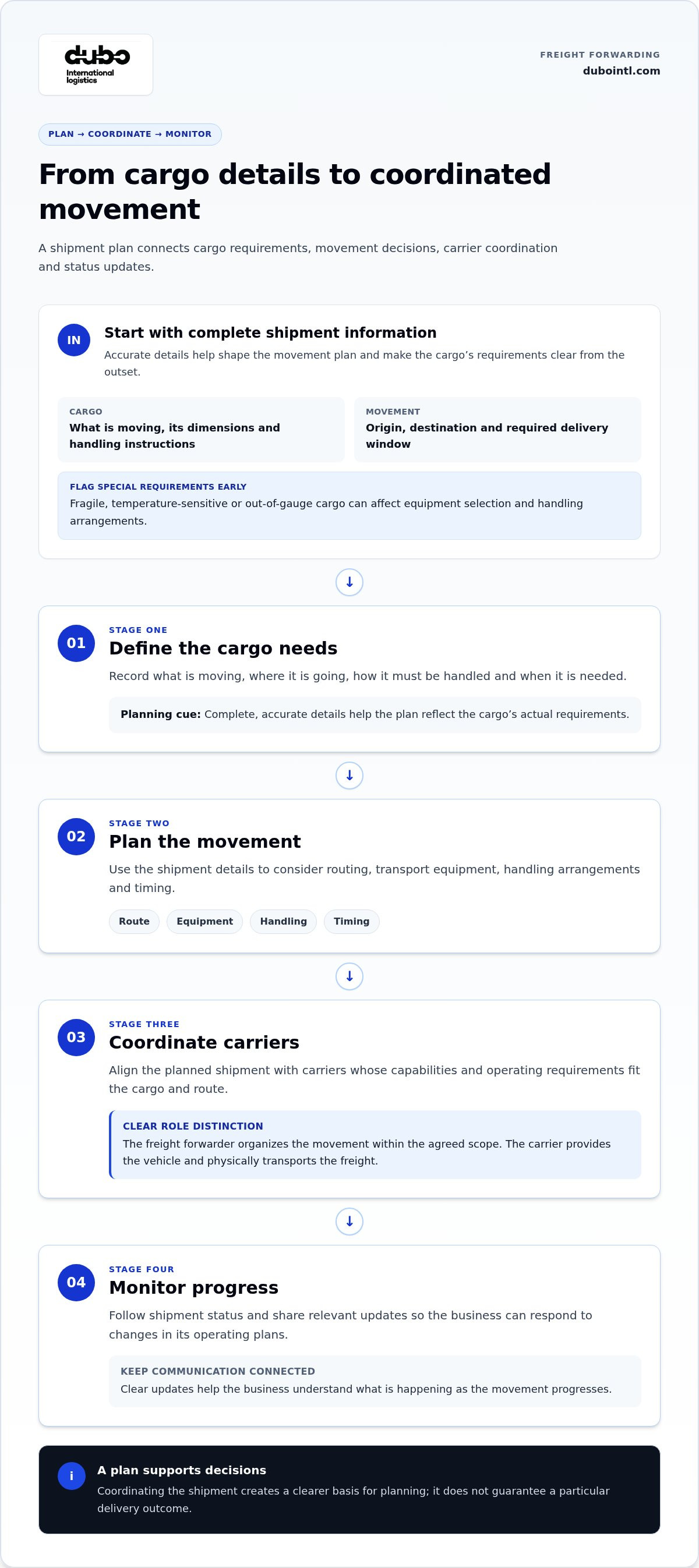
A shipment plan becomes workable when cargo information, route decisions, carrier arrangements and status communication are connected. A freight forwarder coordinates these elements across the agreed shipment scope, using the cargo’s requirements to guide planning and keeping the business informed as the movement progresses. This structure supports decisions; it doesn’t guarantee a particular delivery outcome.
The sequence is straightforward, but each step informs the next:
- Define the cargo needs. Record what is moving, where it is going, how it must be handled and when it is needed.
- Plan the movement. Use those details to consider routing, transport equipment, handling arrangements and timing.
- Coordinate carriers. Align the planned shipment with carriers whose capabilities and operating requirements fit the cargo and route.
- Monitor progress. Follow shipment status and share relevant updates so the business can respond to changes in its operating plans.
What information helps shape a freight plan
Good planning starts with complete, accurate shipment details. Provide cargo dimensions, origin, destination and the required delivery window, along with any handling instructions. Flag fragile, temperature-sensitive or out-of-gauge cargo at the outset, since these characteristics can affect equipment selection and how the shipment is handled. Missing or changing information can make it harder to coordinate the movement around the cargo’s actual needs.
Consider a temperature-sensitive shipment: the plan needs to reflect that handling requirement, rather than treating the freight as ordinary cargo. Similarly, out-of-gauge dimensions may affect which equipment and route can be considered. Sharing these details early gives the forwarding partner a clearer basis for coordinating carriers and aligning the plan with delivery expectations.
How carrier coordination and shipment updates support continuity
Carrier coordination involves more than assigning a pickup. A carrier vetting process considers safety, insurance, compliance and capabilities in relation to the shipment’s requirements. Matching those considerations to the cargo helps keep the plan grounded in practical handling needs. The precise responsibilities of the forwarder and carrier remain defined by the agreed scope.
Shipment tracking systems can support status visibility during transit, while clear update expectations help teams know what information they’ll receive and when. If a status change affects a production schedule, receiving plan or customer commitment, timely communication gives the business an opportunity to adjust its decisions. Updates don’t remove uncertainty from freight movement, but they can reduce the chance that teams are planning from outdated information.
For complex or specialized cargo, coordinated planning can help connect shipment requirements with carrier arrangements across North America. Businesses looking for a partner to coordinate freight movement can learn more about Dubo’s freight forwarding support.
How to assess a freight forwarding partner against your shipment needs
The strongest indicators of operational fit are alignment with your cargo profile, clear responsibility boundaries, useful status communication and experience coordinating the routes you rely on. Compare partners against your real shipment patterns, not just a list of services. A freight forwarding partner for Canadian businesses should be able to explain how its coordination approach connects to your cargo, destinations and internal planning capacity.
Use the framework below to identify where a partner’s approach fits your needs and where you may need more detail about the working arrangement.
| Assessment area | What to compare | Fit looks like |
|---|---|---|
| Cargo fit | Shipment frequency, dimensions, handling needs and cargo type | Planning reflects routine freight as well as any fragile, temperature-sensitive or out-of-gauge requirements. |
| Coordination scope | Carrier arrangements, handoffs and assigned responsibilities | The business and partner understand who coordinates each agreed stage. |
| Communication | Shipment updates, change notifications and escalation paths | Teams know what information they’ll receive and how operational changes are raised. |
| Cross-border experience | Familiarity with the business’s North American routes and shipment profile | Planning accounts for the route and coordination needs rather than assuming every movement is alike. |
Match the partner’s coordination model to your freight profile
Start with the pattern of your freight: how often shipments move, what they contain, where they’re going and how much planning your team can manage internally. Routine shipments may call for a different coordination model than a one-time project involving specialized equipment or complex handling. The objective is a working arrangement that matches actual requirements without adding unnecessary steps.
For compatible shipments, LTL freight shipping combines freight from multiple shippers in shared trailer capacity. It may suit cargo that doesn’t require a dedicated trailer, while specialized or project-based freight can call for more tailored planning. Compare the proposed approach with the shipment’s handling needs, delivery expectations and operational importance.
Compare communication, visibility and accountability
Before agreeing on a working model, clarify how updates are shared, what triggers a notification and who communicates a change that could affect your plans. Confirm responsibility for each handoff and establish an escalation path for issues that need a decision. These details help purchasing, operations and logistics teams work from consistent information.
Service level agreements (SLAs) can define commitments such as delivery windows or performance expectations. Set out what is being measured, which party owns each action and how exceptions are communicated. For additional context on coordinating freight forwarding across North America, consider how cross-border routes fit your shipment profile and internal processes. To discuss a coordination approach suited to your cargo, visit Dubo International Logistics.
How Canadian businesses can prepare for complex freight requirements
Complex shipments are easier to coordinate when the plan reflects the cargo before movement begins. Early preparation gives your team and forwarding partner time to clarify handling needs, suitable equipment, delivery windows and responsibilities. It also helps identify information that may affect routing or cross-border coordination, rather than leaving those details to emerge during transit.
Start by assembling a shipment brief with accurate dimensions, weight, origin, destination, readiness date and required delivery window. Describe how the cargo can be handled, including any limits on lifting, orientation or environmental conditions. Share this information early and update it if the shipment changes. A freight forwarding partner for Canadian businesses can use those details to shape coordination around the actual freight, not assumptions.
Plan for specialized and project cargo
Oversized machinery, fragile equipment and temperature-sensitive products each bring different planning considerations. Dimensions may influence route and equipment choices; delicate cargo may need handling instructions or customized crating; temperature-sensitive goods may call for agreed monitoring arrangements, such as enregistreurs de données. These measures are cargo-dependent, not standard requirements for every shipment.
For a project shipment, map the sequence around the cargo’s readiness, pickup, transit and receiving requirements. A large machine may need equipment and handling plans suited to its size, while fragile components may need protection at key handling points. For more context, specialized freight planning should account for the particular cargo and route rather than applying one template to every move.
Reduce avoidable disruption through shipment readiness
Before dispatch, align the people responsible for preparing, releasing and receiving the shipment. Confirm that cargo details and handling instructions are consistent across the teams involved, and communicate changes promptly. For cross-border movements, plan for the documentation and applicable requirements relevant to the shipment. Requirements can vary with the cargo and movement, so avoid treating a previous shipment’s paperwork as a universal template.
Schedules and service level agreements (SLAs) can clarify delivery windows, performance commitments and how changes are communicated. Agree on what status updates your team needs, who will receive them and how a schedule change should be raised. This gives operations teams a basis for adjusting their plans without assuming that a target window guarantees arrival at a particular time.
Cross-border coordination also benefits from clear handoffs and shipment information that stays consistent as the freight moves between parties. Businesses planning Canada-USA freight coordination can use the route, cargo profile and delivery expectations to identify where planning needs particular attention. For a complex movement, a structured discussion with a logistics partner can help bring those requirements together. Discuss specialized freight coordination with Dubo.
What working with Dubo as a freight forwarding partner can involve
A dependable working relationship starts with a shared understanding of the shipment. Dubo International Logistics is an independent freight forwarding partner serving businesses nationwide, coordinating cargo movement across Canada and providing logistics support across North America. Its role is to organize movement around the cargo’s requirements, not simply to provide a vehicle. Dubo is a member of the Canadian International Freight Forwarders Association (CIFFA).
For businesses assessing a freight forwarding partner for Canadian businesses, the practical question is how the partner’s coordination approach fits the shipment and the teams responsible for it. That means defining what needs to move, what the cargo requires, which delivery expectations matter and how responsibilities will be communicated. The plan can then reflect the shipment instead of relying on a uniform process for every load.
A coordinated approach for standard and specialized shipments
Shipment-specific planning can support both familiar freight movements and cargo that calls for added coordination. Oversized machinery may require attention to dimensions and equipment; fragile equipment can have handling requirements that shape the plan; temperature-sensitive products may need arrangements suited to their conditions. The route, equipment and handling approach depend on the cargo and movement.
Dubo’s experience coordinating specialized transportation for non-standard cargo requirements is relevant to businesses moving project freight across Canada and North America. A shipment plan can account for the cargo’s characteristics, the movement sequence and the agreed delivery expectations. Coordination with carriers is organized around those requirements, while responsibilities remain tied to the scope agreed for the shipment. This gives internal teams a clearer basis for preparing their part of the movement and managing operational handoffs.
For standard shipments, the coordination focus may differ, but clarity still matters: shared shipment details, assigned responsibilities and an agreed approach to updates help teams stay aligned. The level of support can be shaped around the business’s freight profile rather than assuming all shipments need specialized handling.
Start a practical conversation about your freight needs
A useful first discussion can begin with a concise shipment summary. Include the cargo type and dimensions, origin and destination, handling requirements, expected timing and any operational constraints that could affect the movement. For project freight, note how the shipment connects to the wider project schedule. These details give the conversation a practical starting point and help focus planning on the requirements that matter.
As the relationship develops, keep communication expectations and responsibilities clear. Agree on the shipment scope, how updates will be shared and how changes will be raised, so your team has a consistent reference as plans progress. A calm, structured approach can help clarify the moving parts without promising fixed outcomes.
To discuss your shipment requirements with Dubo, Discuss your freight forwarding requirements.
Make your next shipment the start of a clearer plan
A dependable freight relationship can develop with each movement. After a shipment, review which details helped coordination, where handoffs needed clarification and whether updates gave your team enough context to plan. These observations can inform the next shipment brief and help make responsibilities and communication expectations more precise over time.
That ongoing attention is part of choosing a freight forwarding partner for Canadian businesses: the relationship should support your operational priorities as they evolve, not just the immediate movement. Start with the shipment ahead, its requirements and the decisions your team needs to make with confidence.
Dubo International Logistics welcomes a practical conversation about your cargo and coordination needs. Plan your next freight movement with Dubo, and take the next step with a clearer foundation for your shipment.
Frequently Asked Questions
Is freight forwarding suitable for a small or occasional shipment?
Yes, freight forwarding can suit a small or occasional shipment when coordination needs extend beyond arranging transport. A business might need help organizing a one-time equipment move, aligning a pickup with a receiving schedule or coordinating a shipment with specific handling requirements. The useful question is whether the shipment’s planning and handoffs call for support. The appropriate scope depends on the cargo, route and responsibilities the business wants coordinated.
Can a Canadian business work with one freight forwarding partner for domestic and cross-border shipments?
Yes, one partner can coordinate both domestic and cross-border movements when its coverage and coordination approach fit the business’s routes. This can give teams a consistent point of contact as shipments move between Canadian destinations and North American corridors. A freight forwarding partner for Canadian businesses should be able to align its role with the shipment scope and keep responsibilities clear, while recognizing that each route and cargo profile may call for different planning.
Does a freight forwarder own the vehicles or equipment used to move cargo?
Not necessarily. A freight forwarder’s central role is coordinating cargo movement, while a carrier operates the vehicle that physically transports it. Equipment may be supplied through carrier arrangements rather than owned by the forwarder. For a business, the practical distinction is knowing who plans and coordinates the shipment, who carries it, and which party is responsible for each agreed task. Those roles should be clear in the shipment arrangement.
Can freight forwarding support seasonal changes in shipment volume?
Yes, coordination can be planned around expected seasonal shifts, such as a distributor preparing for a recurring busy period or a manufacturer scheduling shipments around production cycles. Sharing forecasts and known peak periods early helps the logistics plan reflect likely demand. Businesses should also agree how changes in volume will be communicated and how shipment priorities are set if plans shift. Forward planning supports coordination, but it doesn’t guarantee capacity or a fixed delivery result.
How does a freight forwarding partner work with an in-house logistics team?
A forwarding partner can complement an in-house team by taking on agreed coordination tasks while the business retains its internal planning and decision-making responsibilities. For example, the team might manage purchase orders and receiving schedules while the partner coordinates carrier arrangements and shipment updates. Define the handoff points, information owners and approval process early. This helps prevent duplicate instructions and makes it clearer who should respond when a shipment detail changes.
What information should a business provide when requesting freight coordination?
Share enough information to identify the shipment and its operating context: the cargo description, dimensions and weight, pickup and delivery locations, requested timing, and any special handling instructions. Also note whether the cargo is ready to move and whether pickup or delivery has site access or scheduling constraints. If details are still changing, identify what is provisional and when you expect to confirm it. Clear inputs help the coordination plan reflect the actual shipment.
Can a forwarding partner coordinate shipments that require specialized handling?
Yes. A forwarding partner can coordinate specialized transportation when the shipment plan accounts for the cargo’s particular requirements. Oversized machinery, fragile equipment and temperature-sensitive products may each call for different carrier, equipment or handling arrangements. Describe the cargo’s constraints early, including any limits on how it can be moved or handled. Dubo International Logistics coordinates specialized transportation for unique cargo requirements across North America, with planning shaped to the shipment.
