

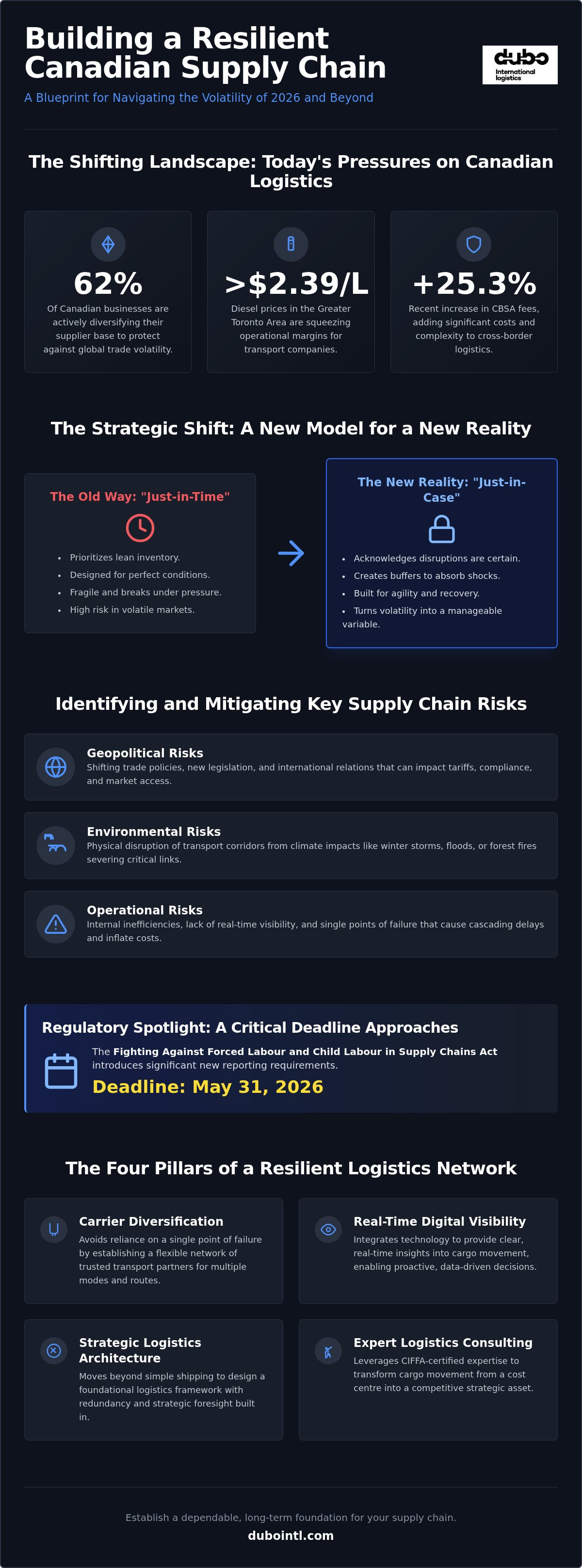
Did you know that 62% of Canadian businesses are now actively diversifying their supplier base to protect against the rising volatility of global trade? With diesel prices in the Greater Toronto Area exceeding $2.39 per litre and CBSA fees recently increasing by 25.3%, the margin for error in your logistics strategy has never been thinner. Building a resilient supply chain Canada requires more than just reactive fixes; it demands a structured, architectural approach to every movement. You likely feel the weight of unpredictable border crossings and the rising operational costs that stem from systemic inefficiencies. It's exhausting to manage a network where a lack of visibility makes every delay feel like a crisis. This guide will show you how to insulate your business from these disruptions by organizing strategic logistics and expert freight management into your Canadian operations. We will examine the critical regulatory shifts of 2026, such as the May 31 reporting deadline for the Fighting Against Forced Labour and Child Labour in Supply Chains Act, and provide a blueprint for a stable, predictable logistics network. Discover more about building these foundations at www.dubointl.com.
Key Takeaways
- Transition from "Just-in-Time" to "Just-in-Case" strategies to ensure your operations can anticipate and absorb market shocks without compromising service levels.
- Navigate the increasing complexities of North American cross-border regulations by identifying geopolitical and operational risks before they impact your bottom line.
- Master the strategic frameworks for building a resilient supply chain Canada, including carrier diversification and the integration of real-time digital visibility tools.
- Leverage professional logistics consulting and CIFFA-certified expertise to transform cargo movement from a standard cost centre into a competitive strategic asset.
- Partner with a seasoned logistics architect at www.dubointl.com to establish a dependable, long-term foundation that remains steady during periods of global volatility.
Defining Supply Chain Resilience in the 2026 Canadian Landscape
Stability is the cornerstone of successful commerce. In its simplest form, Defining Supply Chain Resilience involves the ability of a network to anticipate, absorb, and adapt to disruptions while maintaining consistent service levels. For decades, Canadian businesses operated on the "Just-in-Time" model, which prioritized lean inventory and immediate delivery. However, the realities of 2026 have shifted the focus toward a "Just-in-Case" strategy. This approach acknowledges that disruptions aren't exceptions; they're certainties. Building a resilient supply chain Canada requires moving away from fragility toward a system that treats volatility as a manageable variable. It's about creating a buffer that protects your operations when the unexpected occurs.
Our geography presents a unique set of challenges. We manage vast distances across ten provinces and three territories, often facing seasonal climate impacts that can sever critical transport links in hours. Whether it's winter storms in the Rockies or the increasing frequency of summer forest fires affecting rail lines, the Canadian landscape demands a higher level of strategic foresight. For manufacturers and distributors, this reliability has become a primary competitive differentiator. Customers no longer just look for the lowest price; they look for the partner who will actually deliver when the market gets difficult. Reliability builds trust that price alone can never replace.
The Evolution from Robustness to Agility
Rigidity is a liability in a shifting market. A rigid supply chain is designed for efficiency under perfect conditions, but it breaks the moment those conditions change. An agile network, by contrast, is designed to bend and recover. This shift requires a deep commitment to what we call logistics architecture. It's about designing a framework where every component, from carrier selection to route planning, is built with redundancy in mind. Strategic foresight allows us to see the storm before it hits, enabling a proactive rather than reactive stance. Professional logistics consulting in Canada provides the expertise needed to transition from a fragile setup to one that thrives on adaptability.
National Infrastructure and the 2026 Reality
Connectivity determines the speed of your growth. Canada's national transport corridors are currently under immense pressure. Trade patterns have evolved, and our existing infrastructure often struggles to keep pace with the volume of movement. Recognizing critical points of failure, such as specific mountain passes or border bottlenecks, is essential for maintaining flow. Without professional end-to-end freight management, these bottlenecks can lead to cascading delays that inflate costs and erode trust. We must view our logistics not just as a series of shipments, but as a continuous, integrated system that requires constant oversight and expert management. This level of diligence ensures that your cargo moves through the most efficient channels possible, even when traditional routes are compromised. Discover how we can support your growth at www.dubointl.com.
Identifying and Mitigating Key Supply Chain Risks
Identifying risk is the first step toward long-term stability. In the current environment, we categorize these threats into three distinct buckets: geopolitical, environmental, and operational. Geopolitical risks often manifest as shifting trade policies or legislative changes, such as the reporting requirements for the Fighting Against Forced Labour and Child Labour in Supply Chains Act due by May 31, 2026. Environmental risks involve the physical disruption of transport corridors, while operational risks stem from internal inefficiencies or a lack of oversight. Building a resilient supply chain Canada requires a methodical audit of these categories to ensure no single point of failure can paralyze your entire network.
A lack of visibility is often the catalyst for cascading risks. When you lose sight of cargo movement, a minor delay at a terminal can spiral into a total production halt. This lack of transparency prevents you from making data-driven decisions during market volatility. Without real-time insights, costs escalate as you're forced into expensive, reactive solutions. We believe that clarity is the antidote to stress. Establishing a transparent flow of information allows you to anticipate bottlenecks before they manifest as financial losses. Working with a dedicated partner for strategic logistics consulting can help you illuminate these blind spots.
Cross-Border Complexity and Regulatory Shifts
Compliance is a moving target. As of April 1, 2026, several CBSA fees increased by 25.3%, adding a new layer of cost to every shipment. For those moving goods south, the U.S. CBP transponder fee rose to $870.60 USD on October 1, 2026. These shifts make expert cross-border freight forwarding between Canada and the USA more critical than ever. To maintain regulatory readiness, consider this essential checklist:
- Confirm all HS codes are updated to reflect 2026 tariff classifications.
- Ensure eManifest filings are completed well in advance of arrival at the primary inspection point.
- Verify that all suppliers comply with the enhanced tracing requirements of Bill C-35.
Climate Adaptation in Logistics Planning
Weather is no longer a seasonal concern; it's a constant operational variable. Building "buffer capacity" means more than just holding extra stock. It involves diversifying your transport lanes so that a closure on one highway doesn't cut off your entire market. When moving sensitive or high-value cargo during extreme events, specialized transportation services provide the necessary equipment and expertise to maintain integrity. Regular route audits help identify alternative lanes that remain viable when primary corridors are stressed by climate events. This proactive planning transforms a potential crisis into a manageable detour, ensuring your commitments to your customers remain unbroken. Discover how a tailored approach can secure your cargo movement at www.dubointl.com.
Strategic Frameworks for a More Robust Logistics Network
Resilience isn't an accident; it's the result of intentional design. While many organizations focus solely on supplier diversification, building a resilient supply chain Canada requires equal attention to the transportation layers that connect those suppliers to your customers. A robust framework balances the immediate need for cost-efficiency with the long-term necessity of redundancy. It's about creating a system where a single failure doesn't lead to a total collapse of operations. By implementing collaborative planning, forecasting, and replenishment (CPFR) with your logistics partners, you can align your inventory needs with actual transport capacity. This shared foresight reduces the stress of market volatility and ensures that every stakeholder is working toward the same goal of consistency.
Achieving this balance requires a shift in perspective. We often see businesses trapped in a cycle of reactive decision-making because their frameworks are too rigid. A sophisticated logistics architect looks at the entire movement of goods as a single, integrated process. This involves not just moving cargo from point A to point B, but ensuring the infrastructure supporting that movement is sound. When you prioritize the structural integrity of your network, you gain a competitive advantage through reliability that your peers may lack. It's this quiet confidence in your system that allows your business to remain steady while others are forced into costly, last-minute adjustments.
Diversifying Your Transportation Portfolio
Relying on a single carrier is a high-risk strategy in 2026. With fuel surcharges frequently adding 20% to 40% to freight bills, and peaking much higher in specific regions, the financial impact of a carrier's capacity crunch is severe. Partnering with a forwarder that maintains a broad North American network provides the flexibility to pivot when a specific lane or provider becomes unavailable. When you evaluate carriers, look beyond the initial quote. Prioritize reliability, safety records, and their ability to scale during peak demand periods. This diversified portfolio acts as an essential insurance policy, ensuring your goods keep moving even when your primary options are compromised by labour disruptions or infrastructure failures.
Digital Integration and Real-Time Visibility
Technology serves as the nervous system of a modern logistics network. Integrating digital visibility tools allows you to realize inefficiencies before they escalate into full-blown crises. When you have access to real-time cargo tracking, you're no longer guessing where your inventory is; you're making data-driven decisions that optimize flow and reduce operational waste. Professional supply chain optimization consulting can help identify the digital gaps in your current setup, ensuring your systems are fully integrated with your logistics providers. This level of transparency transforms your supply chain from a black box into a clear, manageable asset that supports your long-term growth. You can explore more about these integrated solutions at www.dubointl.com.
The Essential Role of Logistics Consulting and Freight Forwarding
Logistics should never be viewed as a mere line item on an expense sheet. When managed correctly, it transforms from a standard cost centre into a powerful strategic asset that drives growth. Building a resilient supply chain Canada requires a partner who understands that every shipment is a component of a larger business ecosystem. This is where the distinction between a simple carrier and a "logistics architect" becomes clear. While a carrier moves goods from one point to another, a logistics architect designs the entire framework to ensure those movements are seamless, compliant, and cost-effective. By engaging in professional logistics consulting in Canada, you gain access to the strategic foresight needed to navigate a complex global trade environment with quiet confidence.
Trust is the foundation of any successful partnership. We believe that professional standards are non-negotiable, which is why CIFFA certification is so vital. This membership ensures adherence to the highest international standards of cargo handling and ethical conduct. It provides you with the security of knowing that your interests are being protected by a steward who values longevity and consistency. This level of professional dedication is what allows a business to remain a stabilizing force even when global routes are under pressure. It lowers your operational stress by providing a reliable bridge between your local needs and the complexities of international movement. You can establish this level of security for your own operations at www.dubointl.com.
Leveraging Specialized Expertise for Complex Cargo
Not all cargo fits into a standard dry van. Moving non-standard or sensitive freight involves unique hurdles that can quickly derail a supply chain if not handled with precision. Whether you are dealing with oversized machinery or high-value sensitive equipment, the challenges of specialized freight in North America demand bespoke solutions. Expert coordination ensures that every permit is secured and every safety protocol is followed, preventing the costly delays that often plague unique shipments. This specialized expertise allows you to expand your market reach without the fear of your most difficult cargo becoming a bottleneck.
Outsourcing for Strategic Agility
Focus is your most valuable resource as a business leader. By outsourcing end-to-end cargo management to a dedicated partner, you free your internal teams to focus on core growth and innovation. Professional forwarders act as a stabilizing force, absorbing the shocks of market volatility so your daily operations remain unaffected. This partnership provides the peace of mind that comes from knowing a seasoned expert is managing the minute details of your supply chain. It's a commitment to dependability that ensures your business remains agile and ready to capitalize on new opportunities as they arise. To see how a dedicated logistics partner can support your long-term goals, consult with our team today.
Partnering with Dubo International for Long-Term Resilience
Building a resilient supply chain Canada is a methodical process that requires both strategic foresight and meticulous execution. As we have explored throughout this guide, the 2026 landscape is defined by rising costs, such as the $110 per tonne industrial carbon tax and increased CBSA fees, alongside stringent new reporting requirements like the Fighting Against Forced Labour and Child Labour in Supply Chains Act. Dubo International Logistics is the premier partner for navigating these complexities, offering a steady authority that prioritizes your peace of mind. We don't just provide a service; we offer a partnership rooted in quiet confidence and a deep commitment to the longevity of your business. Our end-to-end management approach ensures that your cargo movements are not only timely but also fully compliant with the evolving North American regulatory environment.
A Commitment to Excellence and Dependability
Our identity as a "logistics architect" means we design the framework for your stability. We understand that global movement is a grand-scale operation, yet we never lose sight of the minute details that define your individual success. This persona allows us to act as a sophisticated bridge between local Canadian businesses and the intricate web of international trade. Trust is the cornerstone of this relationship, and our adherence to the highest professional standards serves as a mark of our dedication to your interests. We believe that a resilient network is built on consistency and dependability, providing a sense of security that allows you to focus on your core objectives. Taking the first step toward a more secure logistics future involves choosing a steward who is as invested in your success as you are.
Customized Solutions for the Canadian Market
No two businesses face the same logistical hurdles, and your strategy should reflect your specific market position. We specialize in providing bespoke solutions that address the unique geographic and operational challenges of the Canadian market. From managing the seamlessness of cross-border movement to providing specialized transportation services for non-standard cargo, our work is characterized by precision and integration. We ensure that every component of your supply chain is optimized for resilience, allowing you to maintain a competitive advantage through unwavering reliability. Our commitment to excellence ensures that even the most complex movements feel smooth and well-planned. Contact Dubo International Logistics today to organize your supply chain for 2026. You can explore our full suite of customized logistics solutions at www.dubointl.com.
Securing a Foundation of Certainty for Your Canadian Operations
The landscape of 2026 demands a shift from reactive logistics to a proactive, architectural approach. You've seen how integrating digital visibility tools and diversifying carrier portfolios can shield your business from the volatility of rising fuel surcharges and unpredictable border delays. Building a resilient supply chain Canada is no longer just a defensive measure; it's a strategic necessity for those who value consistency and long-term growth. By prioritizing compliance with new federal reporting standards and adapting to the realities of climate-driven route disruptions, you position your brand as a reliable partner in a complex market.
Dubo International Logistics acts as your dedicated guide through these challenges. As a proud member of the Canadian International Freight Forwarders Association (CIFFA), we adhere to the highest professional standards in every cargo movement. Whether you require specialists in North American cross-border movement or expert logistics consulting for supply chain optimization, our team provides the precision your business deserves. Secure your Canadian supply chain with Dubo International Logistics and gain the peace of mind that comes from a seasoned partnership. Visit www.dubointl.com to start designing your resilient framework today. The road ahead is complex, but with the right architecture, your business will remain steady and prepared for whatever comes next.
Frequently Asked Questions about Canadian Supply Chain Resilience
What is supply chain resilience in a Canadian context?
Supply chain resilience in Canada is the capacity of a network to anticipate, absorb, and adapt to disruptions while maintaining consistent service levels across our vast geography. It involves moving beyond lean efficiency to create a system that remains functional during extreme weather or regulatory shifts. By prioritizing strategic foresight, businesses ensure that their movement of goods remains steady despite the unique environmental and logistical hurdles found within the Canadian landscape.
How can I start building a more resilient supply chain today?
You can begin by conducting a thorough audit of your current carrier network to identify single points of failure. Start diversifying your transportation portfolio and integrating digital visibility tools that provide real-time data on cargo movement. Transitioning from a "Just-in-Time" to a "Just-in-Case" strategy allows you to build the necessary buffer capacity to handle unexpected market shocks. Professional consulting can help you design this framework effectively at www.dubointl.com.
Why is Canada uniquely vulnerable to supply chain disruptions?
Canada's vulnerability stems from its immense size and the concentration of trade along a few critical transport corridors. Our climate often presents severe seasonal challenges, such as winter storms or forest fires, that can sever primary rail and highway links. Additionally, our heavy reliance on cross-border trade with the United States means that any regulatory or labour disruption at the border has an immediate, cascading effect on national supply chains.
How does a professional freight forwarder improve my business resilience?
A professional freight forwarder acts as a stabilizing force by managing the complex ecosystem of global trade on your behalf. They provide access to broader carrier networks and specialized expertise that individual businesses often lack. By handling the minute details of regulatory compliance and route optimization, they reduce your operational stress. This partnership ensures that your cargo keeps moving through alternative channels even when your primary routes are compromised.
What is the difference between supply chain robustness and agility?
Robustness refers to the strength of a system to resist change and maintain its initial stable configuration. Agility is the ability of a supply chain to bend, adapt, and recover quickly when conditions shift. While a robust system might eventually break under extreme pressure, an agile one is designed to pivot. Building a resilient supply chain Canada requires a balance of both qualities to ensure long-term stability in a volatile environment.
How do I manage cross-border logistics risks in 2026?
Managing cross-border risks requires a commitment to meticulous documentation and staying ahead of evolving legislative requirements. Ensure your suppliers are fully compliant with the latest ethical sourcing acts and verify that all eManifest filings are submitted well in advance. Working with a CIFFA-certified partner provides the professional oversight needed to navigate fee increases and changing tariff classifications. Detailed planning at www.dubointl.com can help you mitigate these specific regulatory bottlenecks.
What role does technology play in supply chain visibility?
Technology serves as the essential nervous system that allows businesses to realize inefficiencies before they manifest as financial losses. Real-time tracking and data analytics provide the transparency needed to make informed decisions during periods of market volatility. Without this digital integration, your supply chain remains a "black box," making it impossible to identify and resolve delays proactively. Visibility is the foundation upon which true resilience and reliability are built.
Is building a resilient supply chain more expensive than traditional models?
While there are initial costs associated with building a resilient supply chain Canada, such as investing in technology or buffer stock, it is often more cost-effective in the long term. Traditional lean models frequently result in massive financial losses when disruptions occur. By investing in redundancy and strategic agility, you avoid the high costs of reactive fixes and emergency shipping fees. Resilience is an investment in your business's longevity and competitive advantage.

