

Selecting freight forwarding services Montreal shippers can rely on means evaluating mode-specific baseline costs and verifying regulatory compliance standardizations. Navigating cross-border logistics effectively relies on structured carrier vetting processes and certified association benchmarks. Detailed operational planning keeps your supply chain intact through every transport corridor managed via www.dubointl.com.
Key Takeaways: Montreal freight forwarding services provide multimodal access to North American corridors through CIFFA-certified providers specializing in road, air, and ocean logistics.
- Verify CIFFA membership to ensure your provider adheres to standard trading conditions and professional risk management protocols.
- Skip internal logistics management when shipments involve cross-border corridors or out-of-gauge project cargo requiring complex documentation.
- Choose air freight over ocean transport to act as an express insurance policy for time-critical production lines.
- The 5-step audit process for dangerous goods ensures carriers maintain specialized equipment like temperature-controlled or lowbed units.
Table of contents
- 3 Freight Scenarios: Match Your Cargo to the Right Model
- Freight Forwarding Services Montreal: How Brokerage Protects Your Cargo
- 2026 Rate Benchmarks: Why Mode Choice Shapes Your Budget
- 5 Steps That Confirm a Dangerous-Goods Carrier Is Fit for Your Load
- When Your Own Team Should Run Freight (and When It Should Not)
- Frequently asked questions
- Securing Cargo Precision Across North America
3 Freight Scenarios: Match Your Cargo to the Right Model
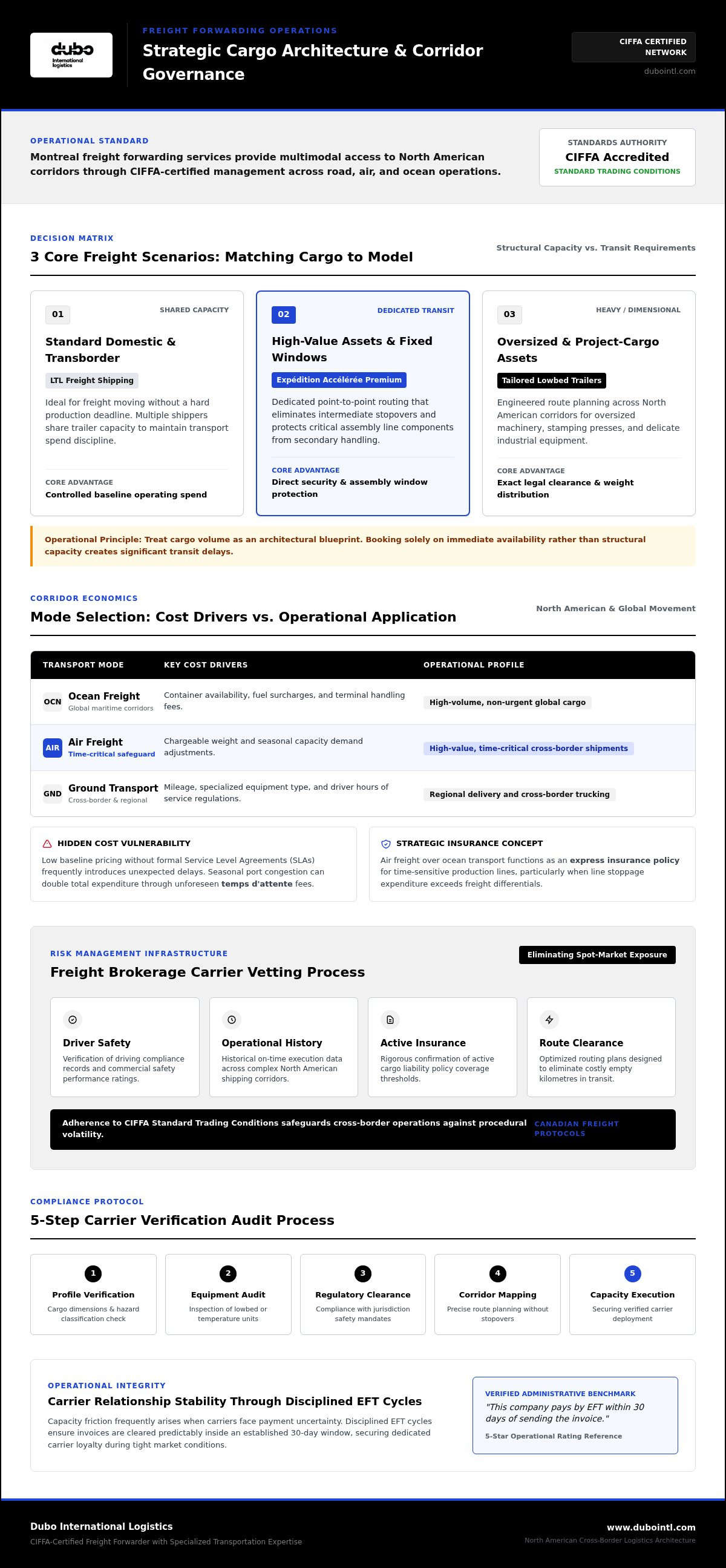
Your shipping model only works when the timeline, cargo profile, and equipment line up. Three situations come up often:
- Standard domestic or transborder freight without a hard deadline: use LTL freight shipping so you share trailer capacity and keep transport spend in check.
- High-value assets or fixed production windows: choose expédition accélérée premium for dedicated routing that skips stopovers and protects critical assembly components.
- Oversized machinery, fragile units, or high-volume equipment: move to project-cargo management with tailored lowbed trailers and precise route planning across North American corridors.
Global corridor support streamlines these complex movements through a vetted carrier network.
Treat cargo volume as an architectural blueprint: match structural weight to trailer capabilities. Booking on immediate availability instead of structural capacity creates significant transit delays.
Working alongside a CIFFA-certified freight forwarder supports full regulatory compliance in every jurisdiction. To safeguard your supply chain continuity, specialized trailers, exact route clearances, and rigorous carrier screening are coordinated under one plan.
Freight Forwarding Services Montreal: How Brokerage Protects Your Cargo
Freight brokerage services connect your business with verified carriers so road, air, and ocean cargo move with clear accountability. The right partner matches your industry requirements with specialized transportation capabilities.
A structured freight brokerage (carrier vetting process) evaluates driver safety, operational history, and active insurance coverage. If you move out-of-gauge machinery or delicate components, you need partners with proven, vetted networks rather than open-market spot picks.
Ocean and air transport suit global corridors, whereas dedicated road haulage fits regional supply chains. When you book shipping from Montreal (freight forwarding), strategic planning aligns equipment types with specific cargo dimensions. As a proud member of the Canadian International Freight Forwarders Association (CIFFA), the team at this CIFFA-certified forwarder applies high professional standards and specialized expertise to each shipment. You secure reliable capacity while cutting empty kilometres through optimized routing, and that precision is what stops costly delays before they start. More on this: Reliable Freight Forwarding Services.
An accredited freight forwarder gives you structured risk management for critical cargo. CIFFA certification brings the strategic foresight and comprehensive oversight intricate cargo schedules need. Fluctuating trucking rates (tarifs spot) show why established carrier relationships matter when you move high-value or oversized assets safely.
Tip: Verify CIFFA accreditation to ensure adherence to standard trading conditions and professional risk management.
2026 Rate Benchmarks: Why Mode Choice Shapes Your Budget
Logistics costs rest on mode selection, fuel surcharges, and terminal handling fees. An accurate figure only appears once you submit exact cargo dimensions and timing details. Generic online estimates often produce sudden budget overruns, so you need direct quotes built around your routing.
Choosing a mode on upfront shipping cost alone is a weak strategy. Low baseline pricing without service level agreements (SLAs) frequently introduces unexpected delays. Seasonal port congestion can double total expenditure through unforeseen temps d'attente fees. Air freight over ocean transport functions as an express insurance policy for time-sensitive production lines (one comparison worth keeping in mind when a line stoppage costs more than the freight itself).
| Freight Transport Mode | Key Cost Drivers | Best Suited For |
|---|---|---|
| Ocean Freight | Container availability, fuel surcharges, terminal handling | High-volume, non-urgent global cargo |
| Air Freight | Chargeable weight, seasonal capacity demand | High-value, time-critical cross-border shipments |
| Ground Transport | Mileage, equipment type, driver hours of service | Regional delivery and cross-border trucking |
Reading these cost variables keeps supply chain operations predictable. Strategic carrier contract negotiations advantage businesses that need reliable shipping from Montreal. A CIFFA-certified partner opens a verified-carrier network that keeps transit on schedule. For tailored execution across North America, use end-to-end freight management on complex supply lines.
Client experiences show how consistent administrative management shapes daily operations. Situation: carriers waiting on payment create capacity friction. Solution: disciplined EFT cycles. Result: invoices cleared inside a fixed window.
"One of the best company to work with. This company pays by EFT with in 30 Days of sending the invoice."
That Google review (from a client's specialist, 5★) underlines financial reliability and steady administrative operations with transport partners.
5 Steps That Confirm a Dangerous-Goods Carrier Is Fit for Your Load
Auditing dangerous goods carriers means checking regulatory adherence and physical equipment standards in sequence. You inspect each link in the chain so high-value cargo stays protected.
Follow this process to verify safety protocols:
- Verify carrier certifications: Review active permits for the Règlement sur le transport des marchandises dangereuses.
- Inspect specialized fleet equipment: Confirm the transport provider maintains tailored assets like temperature-controlled trailers or specialized lowbed units.
- Validate driver credentials: Ensure operators hold up-to-date hazmat credentials and complete regular safety retraining.
- Assess handling protocols: Examine safety procedures for hazardous categories, including marchandises dangereuses diverses.
- Review safety records: Audit past incident rates and insurance coverage limits.
High compliance standards limit supply chain disruptions. Strategic freight planning support rests on strict oversight: full verification is the protection you need when conditions turn demanding. For complex domestic routing, fully vetted partners deliver operational security. Carriers with proven dangerous-goods handling experience are selected only after equipment and trained personnel checks. Reach out to review your hazmat requirements with the coordination team.
Tip: Audit Class 9 packaging protocols before tendering hazardous materials under Canadian dangerous goods regulations.
When Your Own Team Should Run Freight
Managing shipping from Montreal internally makes sense when you handle simple, highly repeatable lane movements with dedicated fleets. Direct management fits local distribution runs that need no regulatory clearance or complex multi-modal transfers.
Internal teams can run standard domestic moves efficiently. Building a full in-house logistics division for one routine pattern, though, adds permanent overhead, software licenses, and compliance liability to your balance sheet.
Simple domestic point-A to point-B transfers suit high-volume local manufacturers with dedicated fleets. External freight management fits you when cross-border corridors, out-of-gauge project cargo, or strict documentation enter the picture.
External partners keep established carrier networks that absorb market volatility and reduce empty kilometres. Handling specialized cargo requirements without that support raises operational risk, driver downtime, and administrative stress.
Direct carrier booking can look cheaper at first. Managing unexpected delays, carrier vetting process (freight brokerage) steps, and regulatory filings quickly consumes internal resources.
Specialized expertise protects your supply chain. A certified specialist gives you operational continuity and cargo security with quiet confidence. To evaluate your current shipping strategy, visit www.dubointl.com for consultative guidance from a logistics architect.
Frequently asked questions
What are freight brokerage services in Montreal?
Freight brokerage connects you with vetted commercial motor carriers so cargo moves efficiently. Brokers coordinate available trailer capacity and oversee transportation details across North America without performing direct customs clearance or overall strategy.
Are freight broker services and freight brokerage services the same?
Yes. Both terms describe the same practice: matching your shipping demand with authorized third-party carriers and verified equipment across domestic and cross-border corridors.
Do freight brokerage services include owning trucks?
No. Freight brokers act as non-asset intermediaries and do not maintain their own fleets of power units. Their work centres on vetting independent transport providers, verifying active motor carrier insurance, and organizing logistics execution for commercial clients.
How are freight forwarding services Montreal priced for cross-border cargo?
Cross-border freight forwarding (shipping from Montreal) pricing depends on trailer selection, total shipment dimensions, route distance, and required transit timelines. You can review detailed options at www.dubointl.com and request a quote sized to your operational specifications.
What compliance documents are required for dangerous goods in Quebec?
Transporting hazardous materials under the Règlement sur le transport des marchandises dangereuses requires a properly structured shipping document with accurate hazard classifications. If you move Class 9 items (marchandises dangereuses diverses), complete compliance documentation must sit alongside carrier safety verifications.
Securing Cargo Precision Across North America
Complex supply chains still come down to the same decisions you faced at the start: which mode fits the cargo, which carriers pass vetting, and whether in-house coordination or a certified forwarder owns the risk. Shippers who need dependable freight forwarding services Montreal routes can count on disciplined planning to cut costly transit delays.
In 2026, strict adherence to Canadian regulations remains essential for cross-border success. Canadian International Freight Forwarders Association (CIFFA) certified membership shows adherence to professional standards. Logistics coordinators handle specialized cargo through a vetted dangerous-goods carrier network across major trade corridors, acting as a stabilizing force when schedules tighten.
Obtain an accurate, transparent quote for your multimodal cargo by visiting dubointl.com and protect your operational continuity with end-to-end freight management. More on this: Freight Forwarding Quotes in Canada.

