

What if a single clerical oversight on a CUSMA declaration cost your business C$5,000 in avoidable storage fees before your cargo even cleared customs? For those managing oversized freight shipping Canada to US, this scenario isn't just a possibility; it's a recurring reality in an increasingly complex trade environment. You recognize that moving heavy equipment or specialized industrial components requires more than just a truck and a driver. It demands a level of strategic foresight that accounts for every regulatory shift and logistical hurdle. At Dubo International Logistics, we believe that clarity is the foundation of every successful transit. By visiting www.dubointl.com, you can access the expertise needed to transform a chaotic border crossing into a predictable, professional operation.
This article provides a comprehensive checklist designed to ensure your cargo crosses the border without delay or deficit. You'll learn how to master the 2026 documentation requirements, manage the rising costs of specialized transport, and implement a zero-error shipping process. We're outlining the precise steps needed to achieve total compliance and predictable delivery timelines in the year ahead.
Key Takeaways
- Understand the evolving 2026 trade landscape and the strategic shifts required to avoid costly border friction and administrative delays.
- Master the documentation process by crafting precise commercial invoices and ironclad bills of lading that withstand high-scrutiny customs reviews.
- Identify the specific criteria for selecting partners experienced in oversized freight shipping Canada to US to ensure your specialized cargo is handled with technical precision.
- Execute a 10-step compliance framework that focuses on HS code accuracy and CUSMA eligibility to protect your margins from unexpected duties.
- Leverage the strategic foresight of CIFFA-certified experts at www.dubointl.com to build a resilient, zero-error supply chain for all your cross-border logistics needs.
Navigating the 2026 Canada to US Freight Shipping Landscape
The 2026 trade environment between Canada and the United States has matured into a system defined by digital integration and rigorous enforcement. While the flow of goods remains the lifeblood of North American industry, the margin for error has narrowed significantly. For companies involved in oversized freight shipping Canada to US, the stakes are particularly high. Large scale cargo naturally attracts more attention from border officials; consequently, a strategic checklist is no longer a luxury. It is a vital defensive tool against border friction. Modern logistics requires a proactive stance to ensure that heavy machinery and industrial components move without the burden of unexpected delays or administrative penalties.
The Impact of 2026 Regulatory Reviews
The year 2026 marks the first formal joint review of the Canada-United States-Mexico Agreement (CUSMA). This milestone has introduced a layer of complexity for Canadian shippers, as regulatory bodies reassess rules of origin and specialized labour requirements. Staying ahead of shifting tariff schedules is essential for maintaining healthy margins. Compliance isn't a static target. It is a moving objective that requires constant monitoring. Strategic logistics consulting helps businesses realize significant savings by accurately identifying duty-free eligibility and preparing for potential tariff adjustments before the cargo reaches the 49th parallel. This foresight transforms a reactive shipping department into a centre of excellence that prioritizes long-term stability.
Why "Business as Usual" is a Risk
Don't assume that legacy processes will suffice in a high-scrutiny environment; it's a recipe for supply chain stagnation. Documentation errors that might have been overlooked in the past now result in immediate holds and escalating storage fees. Many firms find that internal logistics teams are stretched thin by the minute details of specialized transport permits and axle weight restrictions. The cost of a single error can quickly exceed the investment in professional support. Partnering with experts in cross-border freight forwarding Canada USA ensures that your methodology evolves alongside changing regulations. At Dubo International Logistics (www.dubointl.com), we serve as a stabilizing force. We provide the technical precision and dependability required to keep your operations seamless and your cargo moving.
The Essential Documentation Checklist for Border Compliance
Accuracy in documentation represents the difference between a seamless transit and a costly administrative halt. For oversized freight shipping Canada to US, the complexity of the cargo often invites higher levels of scrutiny from customs officials. It's not enough to simply list the items; you must provide a transparent narrative of the shipment's value, origin, and purpose. This precision acts as a digital handshake with border agents, establishing trust before the wheels even turn. When documentation is ironclad, your cargo moves with the steady authority that modern trade demands.
Beyond the standard paperwork, specialized machinery often requires specific filings. If your shipment includes industrial vehicles or engines, you'll need to provide Environmental Protection Agency (EPA) and Department of Transportation (DOT) forms to prove compliance with American standards. Additionally, qualifying for duty-free status under the 2026 CUSMA review requires a valid Certificate of Origin. Without this, your business could face unnecessary duties that erode your project's profitability. At Dubo International Logistics, we act as your dedicated guide, ensuring every form is meticulously prepared to protect your interests. You can explore our specialized transportation services to see how we integrate these requirements into a cohesive strategy.
Mastering the Commercial Invoice
The commercial invoice is the most critical document in your packet. Precise 10-digit Harmonized Tariff Schedule (HTS) codes are non-negotiable for border agents; they determine the exact duty rates and regulatory requirements for your goods. A common pitfall is using vague descriptions like "heavy equipment," which often triggers manual inspections and delays. Instead, use specific terminology such as "Industrial excavator with hydraulic attachment." By 2026, all Canadian exporters must utilize standardized digital portals for real-time document submission to ensure immediate customs visibility.
The Strategic Role of the Bill of Lading
A Bill of Lading (BOL) serves as both a receipt and a contract of carriage. Canadian shippers must choose between a "straight" BOL, which is non-negotiable and delivered to a specific consignee, and an "order" BOL, which allows for the transfer of goods during transit. It's vital that weight and piece counts align perfectly across the BOL and the commercial invoice. If a border agent finds four units on a truck but only three on the paperwork, the shipment will be held indefinitely. For comprehensive document management support, you can find more at www.dubointl.com to ensure your counts are always verified.
Strategic Carrier Selection for Oversized and Specialized Freight
Selecting a partner for oversized freight shipping Canada to US requires a fundamental shift in perspective. While price is always a consideration, cross-border expertise is the true currency of success in 2026. A carrier's technical knowledge determines whether your industrial assets move smoothly or become entangled in a web of regulatory holds. You need a partner that views logistics as a partnership rather than a mere transaction. This level of dedication ensures that your cargo is treated with the care it deserves, backed by the strategic foresight necessary to anticipate border requirements.
Determining whether your load requires Full Truckload (FTL), Less-than-Truckload (LTL), or a specialized solution depends on both dimensions and urgency. For oversized cargo, specialized trailers like RGNs (Removable Goosenecks) or drop decks are often the only viable options. Evaluating these needs early allows you to book the correct equipment, avoiding the high cost of last-minute changes. A seasoned consultant can help you realize these efficiencies by matching your specific cargo profile to the most effective transportation mode. At Dubo International Logistics, we provide the consulting and specialized transportation services needed to make these decisions with confidence.
Evaluating a carrier's security profile is another vital step. Look for organizations that actively participate in programs like C-TPAT and PIP. These certifications indicate that the carrier has undergone rigorous vetting and maintains high security standards. This commitment to compliance often leads to faster border crossings and fewer physical inspections. Additionally, verify that their insurance coverage is comprehensive enough to protect high-value industrial cargo. A carrier with a strong safety rating and the right insurance provides the peace of mind that your investment is secure throughout its journey.
Oversized Freight Shipping Canada to US: Permits and Escorts
Moving non-standard cargo demands what we call a "logistics architect" approach to route planning. It's a meticulous process that involves verifying bridge clearances, turn radii, and construction zones across thousands of kilometres. Every state and province has unique rules for wide or heavy loads, making a universal strategy impossible. You must secure specific permits for every jurisdiction your freight touches. Our specialized freight North America guide offers a deeper dive into these technical requirements.
- Secure state-specific permits well in advance of the ship date.
- Coordinate with certified escort services for pilot car requirements.
- Verify axle weight limits to ensure compliance with seasonal road bans.
- Review route surveys to identify potential physical obstructions.
Technology and Real-Time Coordination
Precision in 2026 is driven by digital integration and real-time visibility. When you're managing complex, multi-leg specialized shipments, coordination becomes the most critical factor. Every handoff between teams must be synchronized to prevent equipment from sitting idle. Real-time tracking reduces anxiety for Canadian exporters by providing a transparent window into the cargo's journey across the continent. At Dubo International Logistics, we integrate these technologies to provide end-to-end support. You can explore our specialized transportation services or visit www.dubointl.com to see how we maintain this level of control for our clients.
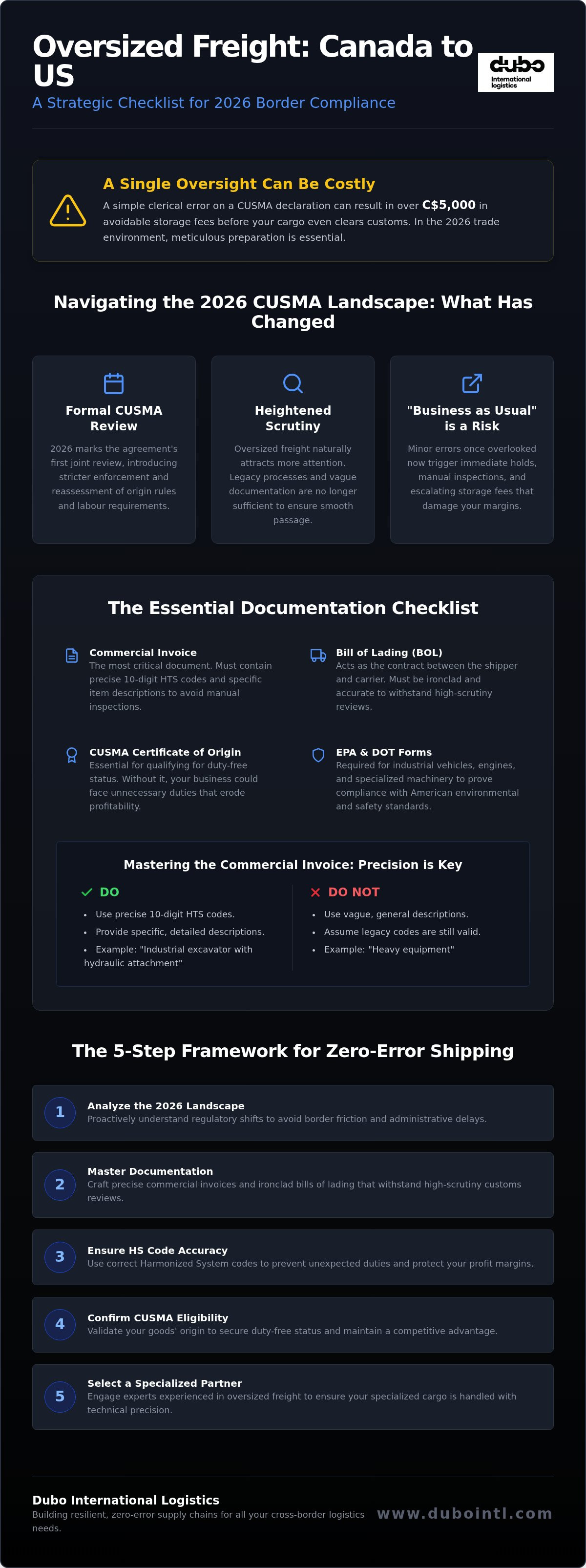
The 10-Step Strategic Checklist for Cross-Border Execution
Executing a flawless transit requires a shift from passive observation to active coordination. For oversized freight shipping Canada to US, the complexity of the cargo necessitates a methodical approach that leaves nothing to chance. This ten-step framework serves as your operational blueprint, ensuring that every detail is verified before the shipment leaves your facility. By following these steps, you protect your business from the administrative friction that often plagues less prepared shippers. At Dubo International Logistics, we provide the consulting and management expertise to guide you through every phase of this process.
- Step 1: Verify HS Codes. Ensure every item is classified with the correct 10-digit code to guarantee tariff accuracy and avoid customs delays.
- Step 2: Confirm CUSMA Eligibility. Review the latest 2026 rules of origin to minimize duty payments and maximize your project's overall profit.
- Step 3: Prepare the Commercial Invoice. Detail every component with exacting precision, ensuring digital clarity for immediate customs portal upload.
- Step 4: Early Broker Coordination. Engage your customs broker well before the ship date to identify potential bottlenecks and resolve them proactively.
- Step 5: Select a Strategic Partner. Choose a freight forwarder with a proven North American coordination network to manage the movement.
Pre-Shipment Verification Steps
Consistency across documents is the primary indicator of a professional operation. Border agents look for discrepancies that might suggest a lack of oversight. To maintain a zero-error process, you must verify that the technical specifications on your Bill of Lading align perfectly with your Commercial Invoice. This alignment is step six of our strategic process. Step seven involves a rigorous inspection of packaging and labelling to ensure your cargo meets both international and US-specific safety standards. Finally, step eight requires you to confirm pickup and delivery windows with all stakeholders. This coordination is essential to realize maximum supply chain efficiency and avoid the high costs of equipment idling.
Final Execution and Monitoring
The journey doesn't end when the truck pulls away from the dock. Step nine focuses on active monitoring of the Pre-Arrival Processing System (PAPS) status. This real-time visibility allows you to confirm that the shipment is cleared for entry before the driver reaches the primary inspection booth. If you need a detailed guide on these technical requirements, learn more about how to ship cargo from Canada to USA through our specialized resources. The final step, step ten, involves conducting a post-delivery audit. Reviewing the transit history helps you identify areas for improvement and strengthens your future supply chain resilience. To begin building your bespoke logistics strategy, visit www.dubointl.com and connect with our consulting team today.
Building Supply Chain Resilience with Professional Freight Support
Logistics is often viewed as a series of isolated events, yet true supply chain resilience stems from a cohesive, strategic framework. For those managing oversized freight shipping Canada to US, the complexity of the operation demands more than just a carrier; it requires a logistics architect who can integrate transportation with high-level strategy. Professional freight forwarding in 2026 involves a deep dive into your operational DNA to identify and eliminate hidden inefficiencies. These might include redundant handling steps or misaligned permit schedules that silently erode your bottom line. By positioning Dubo International Logistics as your protective steward, you gain a partner dedicated to the long-term health of your trade lanes.
Logistics consulting serves as the bridge between current challenges and future stability. It allows you to move beyond the daily stress of border crossings and focus on broader business objectives. A seasoned expert doesn't just react to problems; they build systems that prevent them from occurring in the first place. This proactive approach ensures that your industrial cargo moves with a level of precision that mirrors your own professional standards. When you prioritize strategy over simple transit, you transform your logistics department from a cost centre into a competitive advantage.
The Assurance of CIFFA Membership
Working with a CIFFA certified freight forwarder provides a layer of security that is indispensable in a high-scrutiny trade environment. Membership in the Canadian International Freight Forwarders Association signifies a commitment to the highest professional standards and ethical practices in the industry. In 2026, where regulatory oversight is at its peak, this certification acts as a badge of reliability. It assures you that your logistics partner adheres to a strict code of conduct and possesses the technical depth required to manage complex cross-border movements. This professional alignment reduces risk and fosters a culture of transparency throughout the shipping process.
Strategic Partnership for Future Growth
Transitioning from reactive shipping to proactive supply chain optimization is the hallmark of a mature business. It involves a shift in mindset where logistics is viewed as a strategic asset. By integrating foresight into your operations, you can realize a more seamless flow of goods that supports your expansion into new markets. We invite you to visit www.dubointl.com to explore how a tailored logistics strategy can transform your approach to oversized freight shipping Canada to US. Our team is ready to provide a specialized transportation project consultation, acting as your dedicated guide through the intricacies of North American trade. Contact us today to begin building a more resilient, zero-error supply chain for the years ahead.
Secure Your Cross-Border Advantage in 2026
Success in 2026 hinges on your ability to transform complex regulatory requirements into a streamlined operational advantage. By mastering the nuances of documentation and adhering to a rigorous execution checklist, you ensure that your cargo remains a priority at the border rather than a casualty of administrative delay. Precision isn't just about avoiding fees; it's about maintaining the integrity of your supply chain in a high-scrutiny environment. Every verified HS code and synchronized permit represents a commitment to the steady, reliable movement of your industrial assets.
Managing oversized freight shipping Canada to US requires a level of technical depth that only a seasoned partner can provide. As a CIFFA Certified Forwarder and strategic logistics architect, Dubo International Logistics acts as your dedicated steward for North American cargo coordination. We invite you to partner with Dubo International Logistics for your next cross-border shipment to experience the peace of mind that comes with professional excellence. Your industrial assets deserve a journey defined by strategic foresight and seamless execution. Let's build a more resilient future for your logistics together.
Frequently Asked Questions
What are the most common reasons for freight delays at the Canada-US border in 2026?
Incomplete documentation and HS code inaccuracies remain the primary drivers of border delays. In 2026, increased scrutiny on rules of origin requires precise CUSMA declarations. Additionally, physical inspections for oversized freight often occur if the weight or piece counts on the Bill of Lading don't align perfectly with the Commercial Invoice. Strategic coordination ensures these details are verified before the truck reaches the primary inspection booth.
Do I need a customs broker if I use a freight forwarder for shipping to the US?
Yes, you typically need a customs broker to clear your goods through US Customs and Border Protection, even when partnering with a freight forwarder. While Dubo International Logistics provides end-to-end freight management and specialized transportation, we don't sell customs brokerage services directly. We coordinate closely with your chosen broker to ensure all documentation is submitted correctly and on time, preventing administrative bottlenecks at the 49th parallel.
How has the 2026 CUSMA review changed requirements for Canadian shippers?
The 2026 CUSMA review has introduced more rigorous certification standards for rules of origin and labour value content. Canadian shippers must now provide more granular data regarding the components of their industrial goods to qualify for duty-free status. These updates prioritize digital transparency, requiring exporters to utilize standardized portals for real-time document submission. Staying compliant with these shifting schedules is essential for maintaining supply chain resilience and protecting your business margins.
What is the difference between FTL and LTL when shipping oversized freight?
Full Truckload (FTL) involves dedicating an entire trailer to your cargo, while Less-than-Truckload (LTL) combines smaller shipments from multiple clients. For oversized freight shipping Canada to US, FTL is often the only viable option because the dimensions of the cargo require specialized equipment like RGNs or drop decks. LTL is rarely suitable for non-standard freight due to the physical space constraints and the specific handling requirements of heavy industrial components.
Can I ship specialized cargo from Canada to the US without a state-specific permit?
No, you cannot legally transport oversized cargo across state lines without the required state-specific permits. Every jurisdiction has unique regulations regarding axle weight limits, bridge clearances, and escort requirements. Attempting to move non-standard freight without these documents results in significant fines and the immediate impounding of the vehicle. Our logistics consulting services help you identify these requirements early to ensure a legal and smooth transit across every province and state.
What documents are mandatory for every Canada to US freight shipment?
Every cross-border shipment requires a Commercial Invoice, a Bill of Lading, and a CUSMA Certificate of Origin to qualify for duty-free status. If you're moving specialized machinery, you may also need EPA and DOT compliance forms. It's vital to ensure that every piece of paperwork is accurate and consistent. You can find comprehensive checklists for document management and specialized transportation strategy by visiting www.dubointl.com to support your next project.
How do I calculate the total cost of shipping oversized freight to the USA?
Calculating the total cost requires accounting for the base freight rate, specialized equipment fees, and permit costs for each jurisdiction. You must also consider the price of escort vehicles and potential pilot car services if your dimensions exceed specific thresholds. While we don't provide industry average price ranges, our team at Dubo International Logistics offers specialized transportation project fees tailored to your unique cargo profile. This bespoke approach ensures all logistical variables are covered.
What is the role of a PAPS number in modern cross-border logistics?
A Pre-Arrival Processing System (PAPS) number is a unique barcode that allows US Customs to review and clear your shipment before it arrives at the border. It links the carrier's manifest to the broker's entry, facilitating a faster crossing. For oversized freight shipping Canada to US, monitoring the PAPS status in real-time is a critical step. This visibility ensures that the driver isn't held at the primary inspection booth due to administrative errors.

