

The obvious choice for many shippers is to partner with a carrier that owns its own fleet, yet in 2026, this perceived security often leads to costly rigidity. You've likely experienced the stress of limited capacity during peak seasons or found that the benefits of non-asset based freight forwarding are missing when a provider prioritizes their own equipment utilization over your specific cargo needs. When high overhead costs for idle trucks are passed on to you, the result is a supply chain that feels heavy rather than agile.
This article explores how a neutral, non-asset approach provides the scalability and specialized equipment access required to optimize modern North American movements. We promise to show how a "logistics architect" model at www.dubointl.com ensures your freight moves with precision, regardless of market volatility. We will detail how bespoke solutions and competitive bidding lead to reduced logistics spend and a supply chain that grows seamlessly with your business, providing the peace of mind that comes from a truly dependable partnership.
Key Takeaways
- Understand how carrier neutrality ensures your shipments are routed based on merit and cost rather than a provider’s need to fill their own fleet.
- Discover the core benefits of non-asset based freight forwarding when scaling capacity instantly during peak seasons without the constraints of rigid scheduling.
- Learn how a "logistics architect" approach mitigates risk by utilizing a vast network of carriers to navigate strikes, weather delays, and equipment shortages.
- See how specialized transportation and logistics consulting at www.dubointl.com can help you organize more bespoke solutions for oversized or unique cargo.
- Recognize the value of CIFFA membership in ensuring professional standards and regulatory compliance for all your North American cross-border movements.
What is Non-Asset Based Freight Forwarding?
Non-asset based freight forwarding is a strategic partnership where the provider focuses entirely on the orchestration of the supply chain rather than the maintenance of a physical fleet. They don't own the trucks. Instead, they manage the movement. Unlike asset-based carriers, who are often burdened by the need to maximize the ROI of their own vehicles, a non-asset provider acts as a neutral coordinator. This neutrality is one of the primary benefits of non-asset based freight forwarding, as it allows the provider to select the most efficient route and carrier based on your specific requirements rather than their own equipment availability.
In the broader context of Third-party logistics (3PL), the non-asset model represents a high level of strategic coordination. By leveraging a multi-modal carrier network, these providers function as a "Logistics Architect," designing bespoke solutions that integrate road, rail, and air transport into a seamless end-to-end movement. This approach positions the shipper's needs at the centre of every decision, ensuring that every shipment is handled by the carrier best suited for that particular lane or cargo type.
The Core Difference: Equipment vs. Expertise
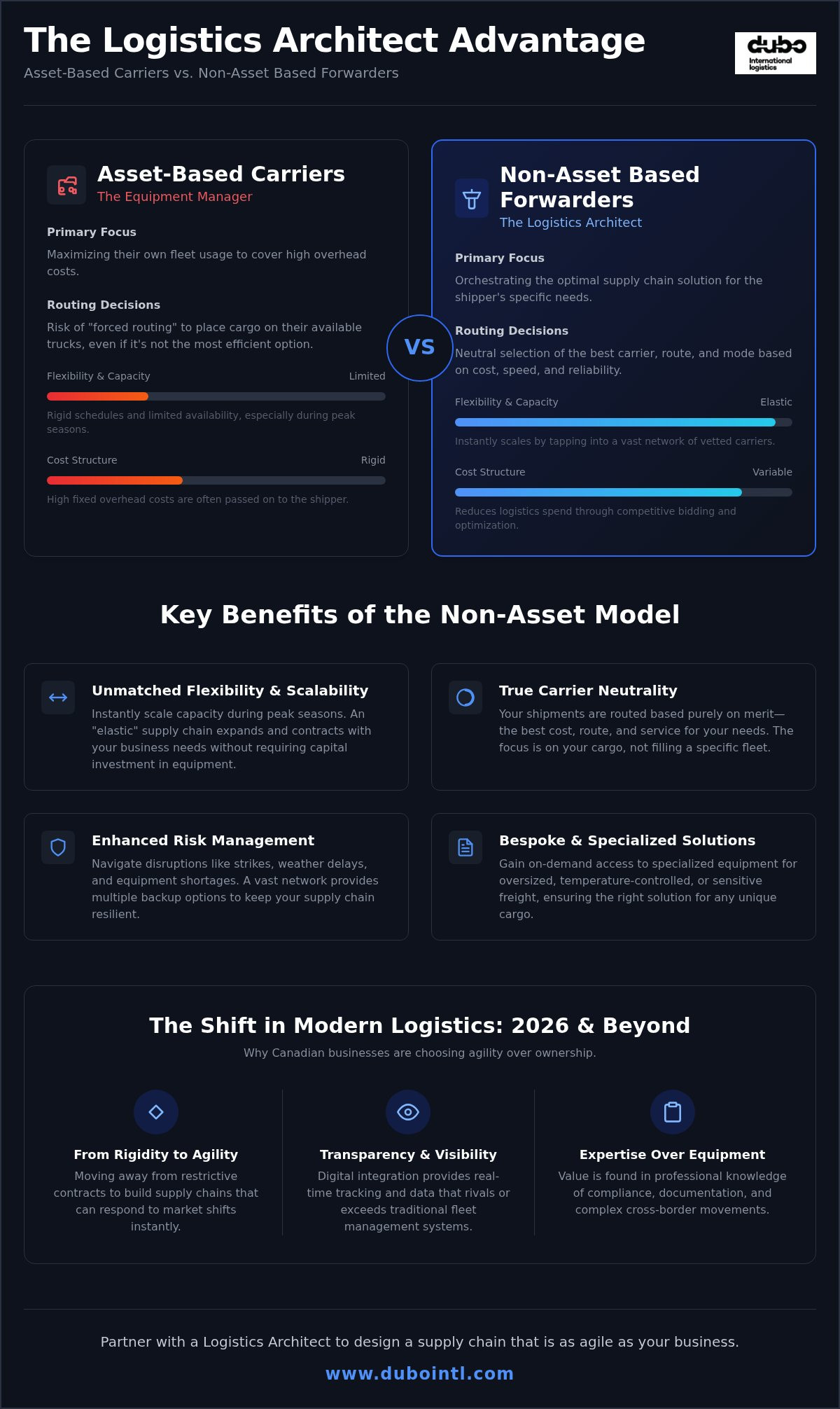
Asset-based providers are fundamentally equipment managers. Their priority is keeping their assets moving to cover overhead costs, which can sometimes lead to "forced routing" where your cargo is placed on their available truck even if a more efficient option exists. In contrast, a non-asset based partner prioritizes strategic coordination and carrier optimization. At www.dubointl.com, the focus remains on the precision of the move. Professional expertise in documentation, compliance, and specialized transportation often outweighs the simple possession of a trailer, ensuring that complex cross-border requirements are met without delay.
The Evolution of Modern Logistics in 2026
The logistics environment of 2026 has shifted toward transparency and agility. Digital integration now allows non-asset models to provide real-time visibility that rivals traditional fleet tracking. Canadian businesses are increasingly moving away from rigid, long-term carrier contracts that offer little room for adjustment during market shifts. Instead, they seek the benefits of non-asset based freight forwarding to build agile supply chains capable of responding to fluctuating demand. This shift is particularly evident in the North American market, where the ability to switch modes instantly provides a significant competitive advantage in a complex global environment.
Unmatched Flexibility and Scalability
Capacity is often the most volatile element of a supply chain. When peak seasons arrive, asset-based carriers naturally prioritize their own equipment schedules, often leaving shippers to navigate rigid timelines or limited availability. One of the key benefits of non-asset based freight forwarding is the ability to bypass these physical limitations. By operating without the constraints of a fixed fleet, a forwarder can tap into a vast network of vetted carriers, providing Unmatched Flexibility and Scalability regardless of the season. This model allows businesses to switch modes between road, rail, and air seamlessly, ensuring that the cargo moves through the most efficient channel available at that moment. You aren't forced to wait for a specific truck to return to a terminal; you simply access the truck that is already there.
Scalability Without Capital Investment
Growth requires agility. Shippers often hesitate to expand into new North American markets because of the perceived need for significant logistics overhead. A non-asset based partner allows you to build an "elastic" supply chain that expands and contracts based on real-time demand. You can test new distribution centres or customer regions without the long-term commitment of carrier contracts or capital investment in equipment. This flexibility ensures that your business remains lean while maintaining the capacity to capitalize on sudden market opportunities. It's about moving from a fixed cost model to a variable one that respects your bottom line during slower periods while supporting your ambition during growth spurts.
Bespoke Solutions for Specialized Cargo
Standard trailers aren't always the right tool for the job. For businesses dealing with oversized, sensitive, or temperature-controlled freight, the benefits of non-asset based freight forwarding include access to highly specialized equipment on demand. Rather than settling for what a single carrier has in their yard, a "logistics architect" identifies the perfect match for your cargo's unique requirements. This precision is essential for specialized transportation where the safety of the cargo depends on the right equipment. For a deeper look at managing these complex moves, consult our Specialized Freight North America guide. If you're looking to stabilize your logistics spend while increasing your reach, consider how a partnership with www.dubointl.com can provide the steady authority your supply chain needs.
Neutrality: Putting the Shipper First
Carrier neutrality is the cornerstone of a transparent supply chain. It ensures that every decision made regarding your cargo is based on merit, cost, and efficiency rather than a provider's need to cover the overhead of an idle fleet. This structural independence is one of the most significant benefits of non-asset based freight forwarding. While asset-based carriers are often forced to prioritize their own trucks to maintain their return on investment, a non-asset partner remains free to select the optimal carrier for every lane. This prevents "forced routing," a common industry pain point where shippers are locked into suboptimal schedules simply because a carrier has a trailer that needs to move to a specific terminal.
Acting as a dedicated advocate, the forwarder coordinates shipments with your specific goals as the only priority. In the event of a carrier dispute or a roadside delay, a non-asset provider isn't incentivized to protect their own fleet's reputation; they're solely focused on resolving the issue for you. This creates a protective layer around your interests, ensuring that the "logistics architect" can pivot to a new carrier or mode without hesitation if the original plan falters. It's a level of commitment that asset-based providers, tied to their own drivers and schedules, simply can't replicate.
Cost-Efficiency Through Competitive Procurement
A non-asset model drives down costs through a rigorous competitive bidding process. Because forwarders at www.dubointl.com maintain high-volume relationships with a diverse pool of carriers, they can secure rates that individual shippers often can't access on their own. This approach also eliminates the "empty mile" surcharges that asset-heavy companies frequently pass on to customers when they need to reposition equipment. By utilizing a fee-based service model, the costs remain transparent, avoiding the hidden fees often associated with maintaining and insuring a physical fleet. You pay for the movement of your goods, not the maintenance of a carrier's assets.
Asset-Based vs. Non-Asset Based Comparison
The choice between asset and non-asset models often determines how well a supply chain can handle complexity. While asset-based carriers are excellent for high-volume, repetitive lanes, they often struggle with the nuances of multi-stop deliveries or specialized cross-border requirements. A non-asset approach excels here by hand-picking specialized providers for each segment of the move. This strategic selection is fundamental to End-to-End Freight Management, providing the seamless integration required for modern trade.
| Feature | Asset-Based Provider | Non-Asset Based Provider |
|---|---|---|
| Capacity | Fixed by internal fleet size | Elastic and global network |
| Flexibility | Limited by geography and mode | High; unlimited modal options |
| Neutrality | Low; inherent carrier bias | Absolute; market-wide selection |
| Specialized Expertise | Standardized equipment-focused | Bespoke strategy-focused |
Enhanced Risk Management and Resilience
Resilience in 2026 is about more than just speed; it's about the ability to absorb shocks without breaking. A "Logistics Architect" doesn't just book a truck. They design a contingency plan that accounts for the unexpected. One of the primary benefits of non-asset based freight forwarding is the mitigation of systemic risk. When you aren't tied to a single fleet, you aren't vulnerable to that fleet's specific failures. A breakdown, a localized strike, or a sudden driver shortage doesn't halt your operations because your partner can instantly pivot to thousands of other vetted carriers across North America. This provides a stabilizing force in a complex global environment, ensuring your cargo remains in motion even when the primary path is blocked.
Integrated technology plays a vital role in this protective strategy. By utilizing sophisticated tracking systems, non-asset forwarders provide superior visibility that allows for real-time decision-making. Professional standards are further anchored by CIFFA membership. This membership ensures that every move adheres to strict regulatory compliance and provides essential liability coverage, offering a level of security that protects your interests at every stage of the journey. It's a methodical approach to movement that prioritizes dependability over mere equipment utilization.
Mitigating Disruptions in North American Trade
Dependency on a single carrier is a significant supply chain vulnerability. If their drivers are delayed by extreme weather or a border closure, your cargo sits idle without an alternative. At Dubo International Logistics, we ensure peace of mind through proactive coordination. By maintaining a bird's-eye view of trade lanes, we can reroute cargo the moment a disruption is detected. This agility is one of the core benefits of non-asset based freight forwarding, allowing your business to remain consistent while competitors struggle with rigid scheduling. We act as a dedicated guide, managing the minute details of individual client needs to ensure end-to-end support that feels cohesive and well-planned.
Compliance and Documentation Expertise
In the trade environment of 2026, "soft assets" like deep industry knowledge and established relationships are often more valuable than physical trucks. Navigating the nuances of Cross-Border Freight Forwarding requires a partner who understands the minute details of documentation and customs rules. This specialized knowledge ensures that your shipments clear regulatory hurdles without costly delays. To build a more resilient and compliant supply chain, consult with our logistics architects at www.dubointl.com to see how we can organize a bespoke solution for your business.
Choosing the Right Non-Asset Partner for Your Business
Selecting a logistics partner is a decision that defines the long-term stability of your supply chain. It requires looking beyond surface-level promises to find a "logistics architect" who understands the grand scale of global movement while remaining focused on the minute details of your needs. A primary indicator of professional standards is CIFFA membership, which ensures regulatory compliance and a commitment to excellence. When you evaluate potential partners, prioritize those with proven North American expertise and a deep portfolio in handling specialized cargo. The benefits of non-asset based freight forwarding are only fully realized when your partner maintains a rigorous carrier vetting process, ensuring that every driver and piece of equipment meets the highest safety and reliability standards.
The non-asset model is the logical choice for growth-oriented businesses because it removes the ceiling on your capacity. Instead of being limited by what one company owns, you gain access to the collective strength of the entire market. This structural independence allows for a level of precision and integration that asset-heavy companies often struggle to provide. By choosing a partner who prioritizes your cargo requirements over their own equipment utilization, you ensure that your supply chain remains agile, neutral, and meticulously executed.
The Value of Strategic Logistics Consulting
A forwarder should act as a sophisticated guide rather than a mere service provider. By offering Strategic Logistics Consulting in Canada, a partner can identify hidden inefficiencies that drain your budget and slow your movement. This proactive approach allows you to optimize the supply chain for long-term cost savings, transforming logistics from a necessary expense into a strategic competitive advantage. It's about applying foresight to organize complex movements with the completeness and smoothness your business deserves.
Partnering with Dubo International Logistics
Dubo International Logistics embodies the role of a dedicated, hands-on guide for businesses navigating the complexities of modern trade. We project a quiet confidence that prioritizes your peace of mind, acting as a stabilizing force in an often unpredictable global environment. Our commitment to seamless cargo delivery across the continent is anchored by a methodical, direct communication style that keeps you informed and secure at every stage of the journey. We invite you to visit www.dubointl.com for a tailored logistics assessment. Discover how the benefits of non-asset based freight forwarding can provide the scalability and neutrality your business requires to flourish in 2026.
Building a Resilient Supply Chain for the Future
Modern trade requires a shift from rigid fleet management to strategic orchestration. By prioritizing carrier neutrality and elastic capacity, businesses can navigate the complexities of 2026 with confidence. The benefits of non-asset based freight forwarding extend beyond mere cost savings; they offer the agility to pivot during disruptions and the specialized equipment access needed for unique cargo. This approach transforms logistics from a source of stress into a stabilizing force for your operations.
As a dedicated CIFFA member specializing in North American cross-border cargo coordination, Dubo International Logistics provides the professional oversight required for seamless movement. Whether you need bespoke solutions for oversized freight or access to a comprehensive expedited carrier network at learn more, our team acts as your trusted logistics architect. It's time to organize a supply chain that reflects your business's ambition. Request a strategic logistics consultation at www.dubointl.com today and secure the peace of mind your growth deserves.
Frequently Asked Questions
What is the main advantage of a non-asset based freight forwarder?
The primary advantage is the inherent neutrality that allows for the selection of carriers based on performance and price rather than equipment availability. Because a non-asset provider doesn't own a fleet, they aren't pressured to fill their own trucks, which prevents the forced routing often seen with asset-based companies. This independence ensures that your cargo always moves via the most efficient mode, providing a level of agility that's essential for supply chains that centre on growth.
Does a non-asset based forwarder cost more than an asset-based carrier?
Working with a non-asset provider often results in lower overall logistics spend because they utilize competitive bidding across a vast network of carriers. You don't pay for the high overhead costs associated with maintaining a physical fleet, such as insurance, fuel, and maintenance for idle vehicles. Instead, you benefit from the high-volume rates the forwarder secures, ensuring you receive market-competitive pricing while only paying for the specific services your shipment requires, helping you organize your budget more effectively.
How do non-asset forwarders ensure carrier quality and safety?
Quality and safety are maintained through a rigorous carrier vetting process that includes verifying insurance coverage, safety ratings, and regulatory compliance. Professional forwarders act as a protective steward of your interests, only partnering with carriers that meet strict internal standards. This methodical approach to selection ensures that every driver and vehicle in the network is qualified to handle your specific cargo, providing the peace of mind that comes from a meticulously managed transportation solution.
Is a non-asset based model suitable for specialized or oversized cargo?
This model is exceptionally well-suited for specialized or oversized cargo because it provides access to a diverse range of specialized equipment on demand. Instead of being limited to a single carrier's inventory, a forwarder can source the exact flatbed or temperature-controlled trailer required for your project. This flexibility is one of the key benefits of non-asset based freight forwarding, ensuring that complex shipments are matched with the most capable and specialized providers available.
How does a non-asset forwarder handle cross-border shipping between Canada and the USA?
Cross-border movements are managed through expert coordination and a deep understanding of North American regulatory requirements. The forwarder acts as a sophisticated bridge between local businesses and international systems, managing the documentation and carrier hand-offs required for seamless transit. By focusing on soft assets like compliance knowledge and carrier relationships, they ensure that your goods move across the border without the delays often caused by paperwork errors or rigid scheduling.
What role does CIFFA membership play in freight forwarding?
CIFFA membership serves as a hallmark of professional excellence and regulatory compliance within the Canadian logistics industry. It ensures that the forwarder adheres to a strict code of ethics and maintains the necessary liability insurance to protect client interests. For shippers, this membership provides a foundation of trust, confirming that their partner is a seasoned expert committed to the highest standards of cargo coordination and end-to-end support throughout the entire continent.
Can a non-asset based forwarder provide real-time tracking for my shipments?
Modern non-asset forwarders utilize integrated technology to provide comprehensive visibility and real-time tracking for every shipment. By aggregating data from various carrier systems into a single interface, they offer a complete view of your cargo's journey. This digital integration ensures that you remain informed at every stage, allowing for proactive decision-making and reducing the stress often associated with the movement of high-value or time-sensitive goods across the various North American trade lanes.
Why is carrier neutrality important for my supply chain strategy?
Carrier neutrality is vital because it ensures your logistics strategy is built on merit rather than equipment utilization. When a provider isn't focused on covering their own fleet's costs, they can prioritize the benefits of non-asset based freight forwarding by selecting the best possible route for your needs. At www.dubointl.com, this lack of bias creates a more resilient supply chain where every decision is made to optimize your specific delivery timelines and budget.
