

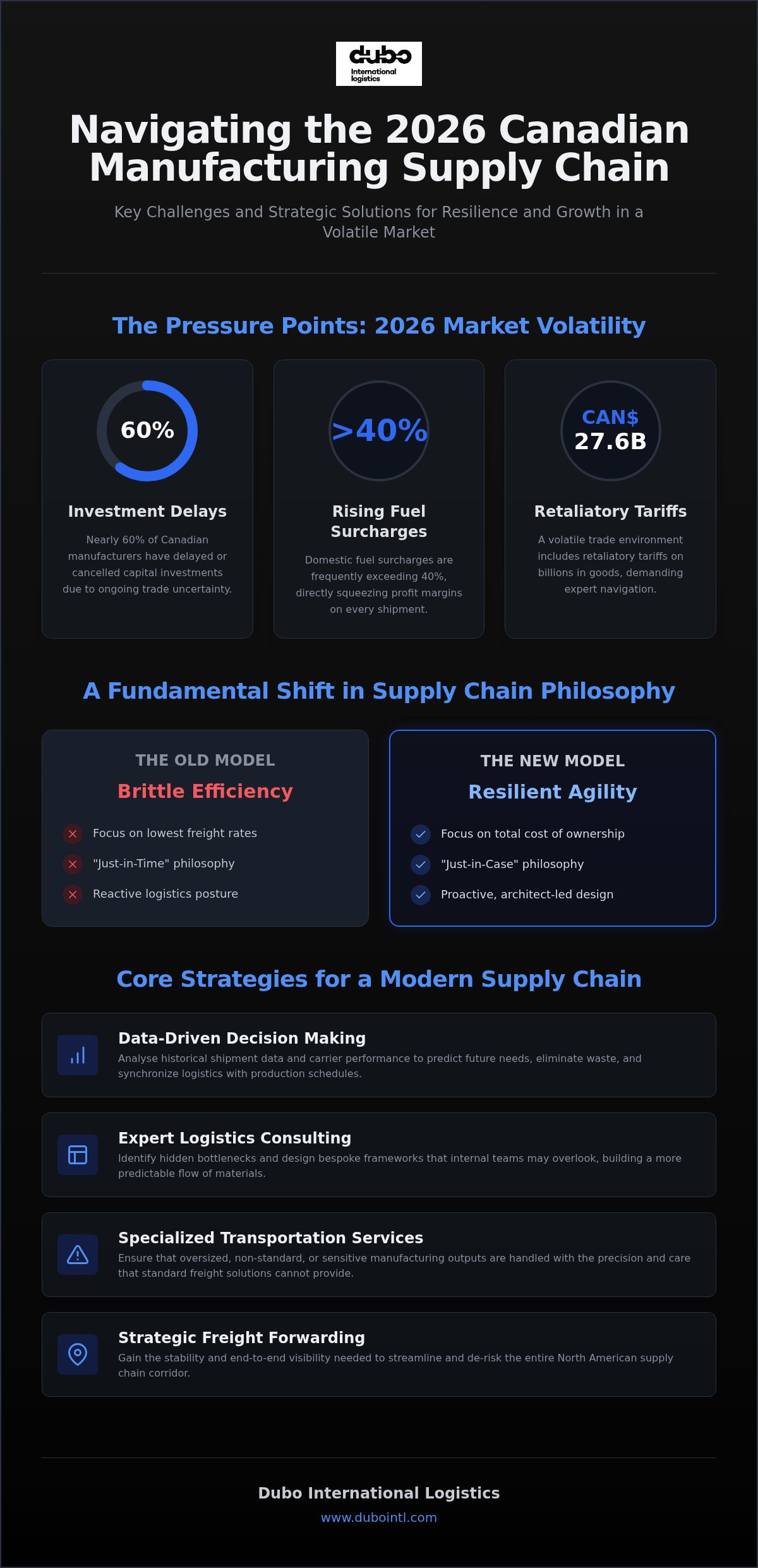
Nearly 60% of Canadian manufacturers have recently delayed or cancelled capital investments due to trade uncertainty, according to July 2026 data from Dubo International Logistics. This hesitation is understandable when fuel surcharges for domestic services frequently exceed 40% and retaliatory tariffs on billions in goods create a volatile environment. You're likely feeling the pressure of these rising expenses while trying to maintain production schedules despite inconsistent lead times. The challenge of reducing transportation costs for Canadian manufacturers has become a complex puzzle that requires more than just a standard freight quote.
We understand that your profit margins are being squeezed by these external forces; managing specialized or non-standard cargo only adds to the operational stress. This article explores how you can realize significant efficiency gains and cost reductions through strategic logistics consulting and optimized cargo coordination. By visiting www.dubointl.com, you can see how a dedicated partner acts as a logistics architect to build a more predictable flow of materials. We'll preview the methodology behind lowering your total cost of logistics while gaining greater visibility into the North American supply chain for the remainder of 2026 and beyond.
Key Takeaways
- Learn why prioritizing supply chain resilience and agility over simple cost-cutting is the essential shift for Canadian manufacturers facing 2026 trade volatility.
- Discover how focusing on the total cost of ownership, rather than just freight rates, is the most effective strategy for reducing transportation costs for Canadian manufacturers.
- Understand how professional logistics consulting identifies hidden bottlenecks and designs bespoke frameworks that internal teams may overlook.
- Explore the necessity of specialized transportation services to ensure that oversized or sensitive manufacturing outputs are handled with precision and care.
- See how partnering with a professional freight forwarder at www.dubointl.com provides the stability and visibility needed to streamline a North American supply chain.
The Evolution of Supply Chain Optimization for Canadian Manufacturers
The landscape for Canadian industry has undergone a fundamental transformation. While the objective of reducing transportation costs for Canadian manufacturers remains a primary driver, the methodology has shifted from simple procurement to a sophisticated architectural design. In 2026, optimization is no longer defined by the lowest bid for a single lane; instead, it's measured by the ability to maintain a steady flow of goods despite volatile fuel surcharges and shifting trade policies. The Evolution of Supply Chain Optimization has moved toward a model where resilience and agility are prioritized over the brittle efficiency of the past.
For many firms, the traditional "just-in-time" model has been replaced by a "just-in-case" philosophy that values reliability. This shift is essential when nearly 60% of manufacturers have recently faced investment delays due to trade uncertainty. Moving from a reactive logistics posture to a proactive, architect-led supply chain allows businesses to anticipate disruptions before they impact the production line. By visiting www.dubointl.com, manufacturers can see how professional cargo coordination acts as a stabilizing force, ensuring that raw materials and finished goods move with purposeful intent through the North American corridor.
The Role of Precision in Modern Logistics
Modern logistics requires a level of precision that basic shipping services cannot provide. It involves integrated cargo coordination that aligns every shipment with the specific rhythm of a factory's output. Visibility is the currency of this new environment; without it, manufacturers are left vulnerable to inconsistent lead times that eat into profit margins. Supply chain optimization is a strategic integration of planning and execution. This definition highlights that success depends on how well a manufacturer can synchronize their internal production schedules with the external movement of freight across complex borders.
Economic Pressures Driving Optimization in Canada
Economic volatility in 2026 has made optimization a necessity rather than a luxury. With fuel surcharges for intra-Canada services reaching 45.50% in September 2026, the margin for error has vanished. Additionally, the first joint review of CUSMA on July 1, 2026, and the imposition of retaliatory tariffs on CAN$27.6 billion worth of goods have created a regulatory environment that demands expert navigation. For those managing non-standard cargo, these pressures are even more acute. You can find deeper context in our Specialized Freight North America guide, which details how to manage complex movements when standard freight solutions fail to meet the demands of modern manufacturing output.
Core Strategies to Organize and Optimize Your Supply Chain
Achieving a streamlined supply chain requires a move away from reactive procurement toward a rhythmic balance between production and logistics. True optimization isn't a one-time event; it's a continuous process of refinement that ensures your goods move with quiet confidence across the North American corridor. By implementing structural changes to how you view movement, you can build a more resilient operation that withstands the economic pressures of 2026. This begins with a commitment to data and a shift in focus toward the long-term health of your business.
Data-Driven Decision Making in Logistics
Harnessing historical shipment data allows you to move from guessing to knowing. By analyzing past lead times and carrier performance, you can predict future transportation needs with a high degree of precision. This methodology often involves Collaborative Planning, Forecasting, and Replenishment (CPFR), which harmonizes the goals of suppliers and manufacturers to eliminate waste. Professional oversight is essential here; software alone cannot account for the nuance of Canadian market conditions. A dedicated partner translates raw data into actionable moves, ensuring that your logistics strategy supports your production schedule rather than disrupting it. Manufacturers seeking a tailored approach can consult with a logistics architect to identify these hidden savings and realize better alignment.
Total Cost of Ownership vs. Low-Cost Carriers
The "low-cost" trap is one of the most significant obstacles to reducing transportation costs for Canadian manufacturers. While a carrier might offer a lower base rate, the hidden costs of delays, damages, and poor communication can quickly erode any perceived savings. In a climate where fuel surcharges for domestic services, such as those from FedEx or Loomis Express, have reached levels as high as 45.50% in September 2026, a brittle logistics plan is a liability. Choosing a carrier based solely on the lowest bid often leads to inconsistent service that forces expensive "just-in-case" inventory holdings. A supply chain that prioritizes consistency over the lowest bid provides better long-term value. This approach focuses on the total cost of ownership, which accounts for the peace of mind and operational stability that come from professional freight management.
Establishing collaborative partnerships with CIFFA-certified forwarders ensures that your logistics provider adheres to high professional standards. Regular audits of your supply chain are also necessary to identify hidden inefficiencies that internal teams might miss. These audits often reveal that reducing transportation costs for Canadian manufacturers is more about optimizing the flow of cargo than simply cutting individual rates. By coordinating your logistics with an expert guide, you create a protective steward for your interests, allowing you to focus on the core excellence of your manufacturing output.
Leveraging Logistics Consulting to Resolve Inefficiencies
Internal manufacturing teams excel at production and quality control, yet they often lack the specialized oversight required to identify systemic logistics flaws. Professional consulting offers a stabilizing force by uncovering hidden bottlenecks that disrupt the flow of raw materials and finished goods. By partnering with a seasoned expert, businesses can move away from fragmented shipping practices and toward a unified strategy. This transition is a critical component in reducing transportation costs for Canadian manufacturers who are currently navigating a 2026 landscape defined by high volatility and complex trade regulations.
A dedicated consultant acts as a logistics architect, designing a bespoke framework that aligns with your specific manufacturing outputs. This level of strategic foresight ensures that your supply chain isn't just a cost centre but a competitive advantage. Through expert cargo coordination, you can scale your operations with the confidence that your logistics infrastructure is built for longevity. You can explore the specific methodologies of this process at www.dubointl.com, where our focus remains on providing peace of mind through meticulously planned movement.
The Logistics Architect Approach
Optimizing the end-to-end journey of materials requires more than just booking a truck. It involves mapping every touchpoint to ensure timely delivery across North America while avoiding expensive delays. By utilizing Strategic Logistics Consulting in Canada, manufacturers gain access to frameworks that prioritize route efficiency and carrier accountability. This integration of planning and execution allows for a smoother transition between production cycles and final delivery, ensuring that raw materials arrive exactly when the production line requires them.
Mitigating Risks Through Expert Planning
The current trade environment demands robust contingency plans. With the first joint review of CUSMA in 2026 and retaliatory tariffs affecting CAN$27.6 billion in goods, the risk of border delays or equipment shortages is significant. Expert planning helps you navigate these evolving North American transport regulations without compromising your production schedule. Consulting fees are often offset by the realization of logistics savings that result from more efficient load balancing and reduced detention charges. Ultimately, reducing transportation costs for Canadian manufacturers depends on the ability to anticipate disruptions before they impact the bottom line, allowing the business to remain agile while maintaining a predictable cost structure.
Specialized Transportation for Complex Manufacturing Needs
Standard freight solutions frequently fail when applied to the intricate requirements of heavy industrial projects. While a typical carrier might handle palletized goods with ease, the movement of oversized or sensitive machinery requires a level of precision that standard networks simply aren't built to sustain. For those focused on reducing transportation costs for Canadian manufacturers, the key lies in the seamless integration of specialized moves into the broader supply chain. Rather than treating non-standard cargo as an emergency exception, a logistics architect incorporates these requirements into a bespoke framework that ensures safety and cost-efficiency.
Handling non-standard goods across North America involves more than just finding a trailer; it requires a protective steward who understands the unique physics and regulatory demands of each move. By coordinating these specialized requirements within a unified logistics plan, manufacturers avoid the fragmented communication that often leads to delays. This integrated approach provides the peace of mind that high-value assets are moving with the same predictability as standard raw materials. You can see how this methodology is applied to individual client needs at www.dubointl.com.
Project Cargo Management
Managing large-scale equipment involves coordinating multi-modal moves that may span rail, road, and sea. This process demands meticulous carrier selection and the use of specialized equipment, such as drop-decks or multi-axle trailers. Errors in this phase don't just lead to delays; they can result in damage to high-value assets. For mission-critical needs that require immediate attention and expert handling, manufacturers can rely on Dubo Expedited to manage the most demanding transportation schedules. By centralizing the management of these complex projects, you eliminate the fragmentation that often leads to budget overruns and operational stress.
Cross-Border Excellence for Specialized Goods
Moving specialized goods between Canada and the USA adds a layer of regulatory complexity that can stall even the best-laid plans. National and regional regulations dictate specific width and weight limits, requiring precise permit applications and route planning for any load that exceeds standard dimensions. Seasonal factors also play a critical role; spring thaw load restrictions across various corridors significantly impact heavy haulage capacity and require strategic scheduling to avoid forced downtime. Navigating these permit requirements is essential for reducing transportation costs for Canadian manufacturers, as it prevents the heavy fines and rework associated with non-compliance.
Our guide on Cross-Border Freight Forwarding provides the necessary regulatory guidance to ensure your specialized cargo moves across the border without friction. To secure a partner who understands the minute details of North American movement, you should explore our specialized transportation services. By coordinating these moves with strategic foresight, you ensure that even the most complex cargo reaches its destination with quiet confidence.
Strategic Freight Forwarding: The Logical Conclusion of Optimization
The transition from strategic planning to physical execution represents the most critical phase of the supply chain journey. While consulting identifies the path and data provides the map, professional freight forwarding serves as the engine that drives the entire system forward. Reducing transportation costs for Canadian manufacturers is the natural result of this integrated approach, where every move is anchored by a commitment to reliability and precision. By centralizing the movement of goods under a single, authoritative partner, businesses can transform their logistics from a source of stress into a stabilizing force for growth.
A professional forwarder acts as a protective steward of your interests, ensuring that the theoretical gains identified during the optimization phase are realized in the physical world. This partnership allows manufacturers to outsource the complexities of carrier management and regulatory compliance, freeing internal teams to focus on production excellence. In a year defined by the first joint review of CUSMA and volatile fuel markets, having a dedicated guide to navigate these shifts is essential for maintaining a predictable cost structure. Dubo International Logistics provides this steady hand, acting as a logistics architect that bridges the gap between local manufacturing and the complex North American trade environment.
End-to-End Freight Management
Consolidating your logistics providers into a unified system improves both communication and control. When a single point of cargo coordination manages the end-to-end journey, the risk of information silos and mismatched schedules vanishes. This seamless integration provides the peace of mind that your raw materials and finished goods are moving in perfect harmony with your factory's rhythm. You can explore the specific implementation steps for this model in our guide to End-to-End Freight Management. By reducing the number of touchpoints, you minimize the potential for errors and realize the full vision of an optimized supply chain.
Next Steps for Your Supply Chain
True optimization requires an honest evaluation of your current logistics partners against the rigorous standards of 2026. If your current provider is struggling to manage inconsistent lead times or the complexities of specialized cargo, it's time to consider a more sophisticated approach. Reducing transportation costs for Canadian manufacturers begins with a consultation that looks beyond individual freight rates to address the total cost of ownership. We invite you to visit www.dubointl.com to explore our comprehensive logistics solutions and see how a bespoke framework can secure your business's future. The journey toward a more resilient, agile, and cost-effective supply chain is a collaborative effort, and it starts with a commitment to professional excellence in every move.
Securing the Future of Canadian Manufacturing Logistics
Navigating the complexities of the 2026 trade landscape requires a transition from fragmented shipping to a unified, architectural approach. By prioritizing resilience and focusing on the total cost of ownership, businesses can move beyond reactive logistics to a model of steady, predictable growth. We've explored how professional oversight and specialized coordination are essential for reducing transportation costs for Canadian manufacturers while maintaining production integrity. These strategies ensure that your supply chain remains a stabilizing force, even in a volatile global environment.
As a CIFFA Certified Member and specialist in North American cargo coordination, Dubo International Logistics acts as a dedicated partner to protect your interests. Our expert logistics consulting for manufacturers provides the strategic foresight needed to resolve inefficiencies and handle even the most complex specialized moves. We invite you to contact Dubo International Logistics to optimize your manufacturing supply chain today and realize the benefits of a truly integrated system. Visit www.dubointl.com to begin your journey toward a more secure and efficient operational future. You've built an excellent business; let's ensure your logistics are built to support it.
Frequently Asked Questions
What are the main benefits of supply chain optimization for Canadian manufacturers?
The primary benefits include increased operational predictability and the realization of significant efficiency gains across the North American corridor. Optimization moves beyond simple cost-cutting to build a resilient framework that can withstand fuel price volatility and trade uncertainty. By streamlining the flow of raw materials, manufacturers can reduce waste and improve their total cost of ownership. This strategic approach ensures that production schedules remain consistent even when external market pressures fluctuate.
How does logistics consulting differ from standard freight forwarding?
Logistics consulting provides a high-level strategic analysis of your entire supply chain, whereas standard freight forwarding focuses on the physical execution of moving cargo. A consultant acts as a logistics architect, identifying systemic bottlenecks and designing bespoke frameworks tailored to specific manufacturing outputs. This professional guidance ensures that every shipment is part of a larger, optimized plan. Combining these services allows for a seamless transition from strategic planning to reliable freight execution.
Can supply chain optimization help reduce cross-border delays between Canada and the USA?
Yes, optimization reduces cross-border friction by ensuring all documentation and carrier coordination are handled with meticulous precision before the cargo reaches the border. Strategic planning accounts for regulatory changes, such as the 2026 CUSMA review, to prevent unexpected hold-ups. This proactive methodology is a key factor in reducing transportation costs for Canadian manufacturers who depend on the timely movement of goods between Canada and the United States.
What role does specialized transportation play in a manufacturing supply chain?
Specialized transportation is essential for manufacturers handling oversized, sensitive, or non-standard cargo that standard freight networks cannot accommodate. It involves the use of dedicated equipment and expert handling to ensure high-value assets move safely and efficiently. Integrating these specialized moves into the broader supply chain prevents them from becoming costly exceptions. This level of precision provides the peace of mind that complex projects will be delivered without operational disruption.
Is it better to manage logistics in-house or outsource to a professional forwarder?
Outsourcing to a professional forwarder is often superior because it provides access to specialized expertise and a broader network of carriers that internal teams may lack. Managing complex North American logistics in-house can lead to hidden costs and operational stress. A dedicated partner acts as a protective steward of your interests, allowing your team to focus on core manufacturing excellence. You can explore our comprehensive solutions at www.dubointl.com to see the benefits of professional management.
How does CIFFA certification benefit a manufacturer looking for logistics support?
CIFFA certification ensures that your logistics provider adheres to the highest professional and ethical standards in the Canadian freight forwarding industry. This membership signifies a commitment to ongoing education and a deep understanding of complex global trade regulations. For a manufacturer, this translates to increased security and the assurance that their cargo is being managed by a seasoned expert. It provides a foundation of trust and reliability in an often unpredictable industry.
What are the first steps to take when realizing a supply chain needs optimization?
The first step is to conduct a thorough audit of your current logistics processes to identify areas where delays or high costs occur. This involves analyzing historical shipment data and evaluating the performance of your current carriers against 2026 standards. Engaging in a professional consultation helps translate these findings into an actionable strategy. This initial assessment is the foundation for reducing transportation costs for Canadian manufacturers by highlighting inefficiencies that internal teams might miss.
How does Dubo International Logistics support supply chain resilience?
Dubo International Logistics supports resilience by acting as a stabilizing force in a complex global environment. We provide end-to-end cargo coordination and specialized transportation services that prioritize dependability and strategic foresight. Our team designs bespoke frameworks that allow manufacturers to remain agile despite trade volatility or shifting regulations. By positioning ourselves as your dedicated logistics architect, we ensure your supply chain is built for longevity and consistent performance across North America.

