

Did you know that the US-Canada cross-border freight market is valued at a staggering USD $67.31 billion in 2026, with LTL services emerging as the fastest-growing road sub-segment? It's no secret that moving smaller shipments across the border often feels like a gamble. You've likely felt the frustration of unpredictable transit times or the headache of deciphering complex NMFC codes while costs for smaller loads continue to climb. We understand that these hurdles can stall your momentum and create unnecessary stress in your daily operations.
This strategic guide empowers you to master LTL freight shipping Canada to US, transforming a logistical hurdle into a competitive advantage for your American market expansion. By partnering with experts like those at www.dubointl.com, you gain a logistics architect to manage every minute detail of your trade route. We'll explore how to organize your documentation to reduce overhead, ensure total regulatory compliance without the administrative burden, and establish predictable delivery windows. From understanding the permanent suspension of de minimis exemptions to navigating the fully live CARM system, this guide provides the clarity you need for a seamless supply chain.
Key Takeaways
- Discover how the consolidation model allows businesses with smaller cargo volumes to share trailer space. This strategy helps reduce shipping overhead and optimizes resource use.
- Learn the strategic framework for determining when LTL freight shipping Canada to US is the most cost-effective choice. It is often ideal for shipments between 150 and 15,000 pounds.
- Understand how precise freight classification and NMFC codes influence your handling requirements. Accurate data prevents final rates from climbing due to unexpected expenses.
- Master the essential documentation, including the Bill of Lading, to maintain total regulatory compliance. Proper paperwork ensures your cargo moves smoothly across the border.
- Realize the value of professional coordination by visiting www.dubointl.com to explore bespoke solutions. A logistics architect can stabilize your cross-border operations and provide peace of mind.
Navigating the Landscape of LTL Freight Shipping from Canada to the US
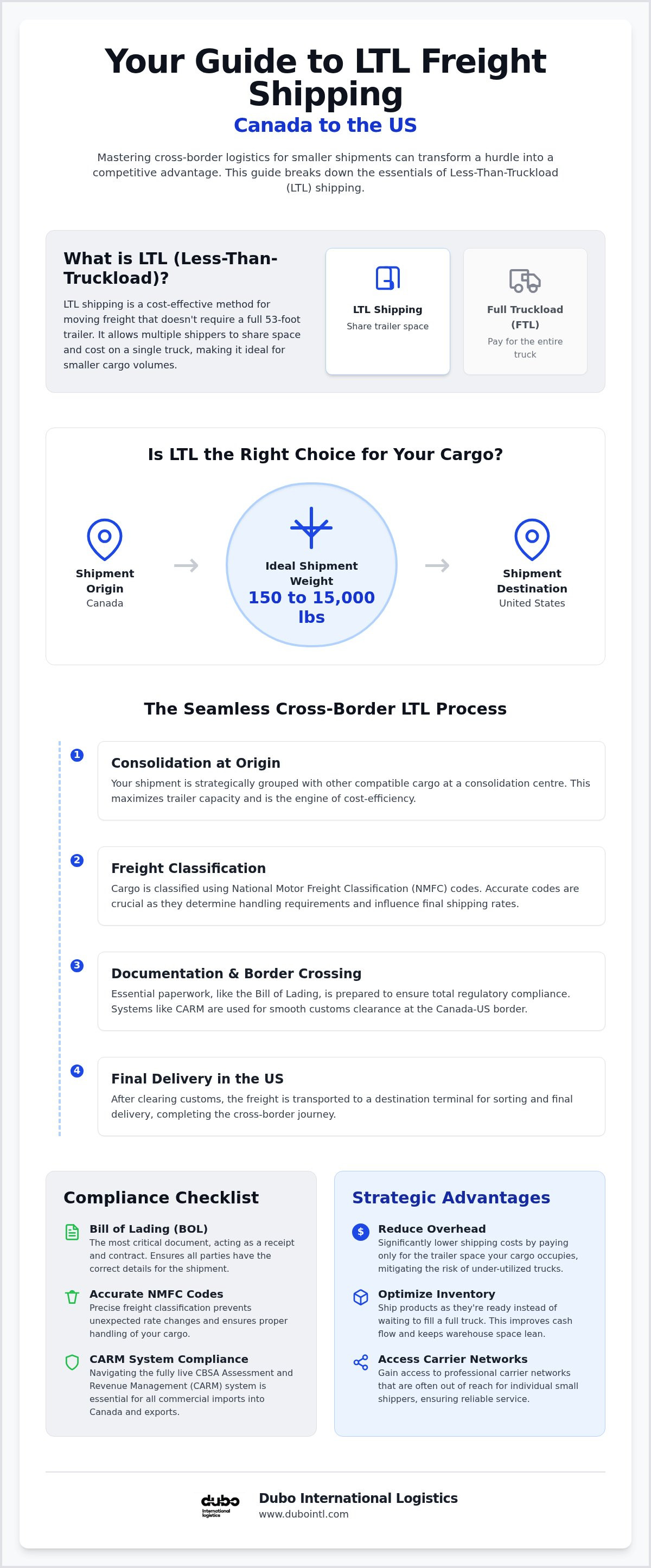
LTL shipping is essentially a collaborative logistics model designed for efficiency. Instead of paying for an entire 53-foot trailer, businesses only pay for the portion of the vehicle their cargo occupies. To understand the fundamentals of this approach, one might ask, What is LTL Freight Shipping? It's a method that enables multiple shippers to share the costs of a single journey, making it possible for businesses with smaller cargo volumes to maintain a consistent presence in the American market without the overhead of full truckloads.
Moving goods across the border involves more than just driving. It requires sophisticated coordination and strategic foresight. Domestic shipping doesn't involve the same regulatory scrutiny or documentation requirements found in LTL freight shipping Canada to US. You need a partner who understands the nuances of North American trade corridors to avoid costly border delays. Choosing a seasoned expert ensures that your supply chain remains a stabilizing force for your business. It transforms logistics from a back-office burden into a driver for scalability, allowing you to enter new markets with total peace of mind.
The Strategic Advantage of LTL for Canadian Exporters
Shipping in smaller batches allows you to reduce inventory carrying costs significantly. Instead of waiting to fill a full truckload, you can send products as they're ready. This keeps your cash flow fluid and your warehouse space optimized. Additionally, LTL freight shipping Canada to US provides access to professional carrier networks that individual small shippers often cannot reach alone. It effectively mitigates the financial risk of paying for under-utilized trailer space. Every dollar spent on transportation becomes a purposeful investment in your brand's international growth.
Why 2026 Demands a More Integrated Logistics Approach
Supply chain resilience has become the cornerstone of modern trade. In 2026, the complexity of cross-border movement requires a more integrated approach than ever before. Digital integration between forwarders and carriers now provides real-time visibility, which is essential for managing customer expectations and navigating border transit. Working with CIFFA-certified experts, like the team at www.dubointl.com, ensures that your logistics are handled with precision. These professionals act as logistics architects, bridging the gap between local production and international distribution with quiet confidence and meticulous execution.
The Mechanics of Seamless Cross-Border LTL Management
Cross-border logistics operates as a carefully choreographed sequence of movements. For LTL freight shipping Canada to US, the process begins long before a truck arrives at your dock. It starts with strategic planning to ensure that your specific pallets are grouped with compatible cargo. This consolidation is the engine of cost-efficiency. By sharing trailer space, you avoid the high costs of a dedicated truck while maintaining a steady flow of goods into the American market. Every pallet is a puzzle piece in a larger, optimized journey.
Consolidation: Maximizing Efficiency and Reducing Costs
Freight forwarders act as architects here, grouping shipments that share similar routes and handling requirements. This meticulous grouping doesn't just lower overhead; it also significantly reduces the carbon footprint of your supply chain by ensuring every trailer operates at peak capacity. Professional coordination is vital for maintaining cargo integrity. Meticulous loading protocols and securing systems prevent movement during transit, protecting your investment from the moment it leaves the warehouse. Refining your approach through strategic logistics consulting ensures that every pallet is accounted for and handled with precision.
A shipment's journey involves several critical hand-offs. After leaving the Canadian origin point, freight typically moves to a consolidation centre where it's sorted by final destination. During this phase, understanding freight classification (NMFC) is essential. These codes determine your shipping rates and how the carrier handles your cargo. Failure to classify correctly can lead to unexpected re-weighing fees or handling delays. Proper preparation is the best way of Ensuring Compliance and Mitigating Risk at the Border. Once cleared, the shipment enters the US hub-and-spoke network for final delivery.
Managing Transit Times and Expectations
Transit windows for LTL differ from Full Truckload (FTL) because of the hub-and-spoke system. Your freight doesn't travel directly from point A to point B. Instead, it moves through several sorting facilities. Factors such as border volume and seasonal weather can influence the speed of the crossing. Despite these variables, modern freight management relies on real-time tracking to provide visibility. This transparency allows you to manage customer expectations with quiet confidence. Seamless LTL freight shipping Canada to US depends on a partner who anticipates these variables before they become disruptions, ensuring a steady, reliable rhythm for your international trade.
Strategic Evaluation: Is LTL the Right Choice for Your Cargo?
Determining the most efficient mode of transport requires a delicate balance of cost, speed, and cargo safety. For many Canadian businesses, LTL freight shipping Canada to US serves as the primary bridge to American customers, offering a flexible middle ground between small parcel delivery and full truckloads. Generally, shipments weighing between 150 and 15,000 pounds fall into the LTL category. If your shipment is lighter than 150 pounds, parcel shipping is usually more economical. Conversely, once you exceed 15,000 pounds or occupy more than 10 pallet spaces, Full Truckload (FTL) often becomes the more strategic choice. However, these aren't rigid rules. A logistics architect looks beyond simple weight brackets to find the optimal path for your specific needs.
LTL vs. FTL: Finding the Tipping Point
Finding the tipping point between LTL and FTL involves evaluating more than just the invoice. While LTL is often cheaper for smaller loads because you only pay for the space you use, FTL offers a direct route with fewer hand-offs. You might choose FTL even for a smaller shipment if the cargo is exceptionally high-value or extremely fragile. In these cases, the reduced risk of damage at sorting hubs outweighs the cost savings of consolidation. A professional freight forwarder balances these variables to create a bespoke solution that prioritizes the security of your goods. They help you realize that the most expensive shipping mode is the one that results in damaged cargo or missed deadlines.
Many believe LTL is reserved for low-priority goods with flexible delivery dates. This is a misconception that overlooks the strategic agility LTL provides. By shipping more frequently in smaller volumes, you can react faster to US market demands and maintain leaner inventory levels. This responsiveness is a significant competitive advantage. Success in this area relies on meticulous preparation and Navigating the Landscape of LTL Freight Shipping from Canada to the US with a clear understanding of regulatory requirements. When you treat logistics as a strategic tool rather than a commodity, you unlock new opportunities for growth across North America.
The Role of Specialized Logistics Consulting
Expert analysis is often the missing piece in a high-performing supply chain. Through logistics consulting Canada, businesses can uncover hidden inefficiencies that inflate shipping overhead. Consultants don't just book trucks; they design end-to-end transportation projects for non-standard or sensitive freight. Whether you're moving heavy machinery or delicate electronics, professional guidance ensures your cargo is matched with the right equipment and the most reliable lanes. By visiting www.dubointl.com, you can connect with specialists who provide the strategic foresight necessary to stabilize your operations in a complex global environment. This bespoke approach ensures your logistics are as unique as the products you ship.
Ensuring Compliance and Mitigating Risk at the Border
Precision at the border is the hallmark of a mature supply chain. In the current trade environment, LTL freight shipping Canada to US requires more than just physical transit; it demands a meticulous approach to documentation and data integrity. The Bill of Lading (BOL) serves as the legal foundation of this process. It acts as a contract of carriage that defines the responsibilities of all parties involved, ensuring that your interests are protected throughout the journey. Without an accurate BOL and a precise commercial invoice, even the most efficiently consolidated trailer can face significant delays at the crossing. Professional forwarders act as a vital bridge here, ensuring that your data aligns perfectly with the expectations of customs authorities.
Essential Documentation for a Smooth Crossing
- Step 1: Accurate freight description and NMFC code assignment. Correct classification ensures that your cargo is handled appropriately and taxed accurately. It prevents the carrier from applying unexpected re-classification fees that can erode your margins.
- Step 2: Preparing the Commercial Invoice with precise valuations. Since the permanent suspension of the de minimis exemption in early 2026, every commercial shipment requires a full customs entry regardless of value. Inaccurate valuations now lead to immediate flags and potential audits.
- Step 3: Ensuring the Certificate of Origin is compliant with CUSMA. Preferential duty rates are not automatic. They require a valid, audited certificate to prove the goods qualify under North American trade rules, especially as audits have increased in frequency this year.
Navigating Regulatory Hurdles with Expert Guidance
The speed of your border crossing often depends on Pre-Arrival Review System (PARS) and Pre-Arrival Processing System (PAPS) protocols. These systems allow customs to review documentation while the truck is still in transit. However, they only function if the digital data provided is flawless. Working with a CIFFA-member forwarder provides regulatory peace of mind. These experts are trained to manage the digital complexities of the CARM platform, which is now fully operational for all importers. For a deeper look at these systems, explore our guide on cross-border freight forwarding Canada USA.
Managing these minute details requires a partner who understands the high stakes of international trade. By choosing a logistics architect, you ensure that your documentation is a stabilizing force rather than a source of stress. To secure your supply chain and ensure seamless delivery into the American market, visit www.dubointl.com to discuss your specific logistics needs with our dedicated team.
Optimizing Your Supply Chain with Dubo International Logistics
Stability is the foundation of every successful cross-border expansion. Dubo International Logistics acts as a stabilizing partner in the complex environment of global trade, providing the calm authority needed to manage volatile market conditions. We understand that for Canadian businesses, the movement of goods across the border is more than a transaction; it's a promise kept to your customers. By providing end-to-end freight management, we remove the friction from LTL freight shipping Canada to US. Our approach is built on a foundation of trust and peace of mind, positioning us as a protective steward of your interests. We don't just book a carrier. We architect a complete solution that integrates every minute detail of the journey.
The Dubo Advantage: Precision and Integration
Our team coordinates every hand-off and piece of documentation with meticulous execution to ensure your cargo never stalls. While many providers focus solely on standard pallets, we have the capability to manage specialized transportation projects within an LTL framework. This is vital for businesses moving sensitive or non-standard cargo that requires extra care and strategic foresight. Whether your freight is oversized or highly delicate, we ensure it remains secure and compliant with all North American regulations. You can visit www.dubointl.com to explore our full range of logistics services and see how we tailor our methodology to your specific needs. This integration of service ensures that your supply chain stays resilient during LTL freight shipping Canada to US, even when border volumes spike or regulations shift.
Partnering for Long-Term Success
Success in the American market requires a partner who values longevity and consistency over quick wins. We act as a sophisticated bridge between your local operations and international systems, allowing you to focus on growth while we handle the logistical weight. Our commitment extends beyond a single shipment; we work to lower your stress by providing dependable schedules and proactive communication. For those times when your cargo requires even faster transit or specialized handling, you can find support at learn more. By choosing a partner dedicated to excellence, you realize your expansion goals with the confidence that your logistics are in expert hands. We are here to ensure that every delivery into the United States is as smooth as it is certain.
Strategic Growth Through Precision Logistics
Successful cross-border expansion requires more than just a truck; it demands a meticulously planned strategy that balances cost-efficiency with total regulatory compliance. We've explored how mastering freight classification and consolidation can reduce your overhead while maintaining the agility needed for the American market. By understanding the nuances of the 2026 trade landscape, from CARM registration to the permanent suspension of de minimis exemptions, you position your business as a reliable partner to your US customers.
Achieving this level of precision doesn't have to be a source of stress. As a CIFFA Certified Member, Dubo International Logistics provides the expert logistics consulting and end-to-end freight management required to stabilize your supply chain. We manage the minute details of LTL freight shipping Canada to US so you can focus on your broader business goals. Our role as your logistics architect is to ensure that every shipment is a seamless extension of your brand's commitment to excellence. You deserve a partner who treats your cargo with the same dedication you do.
Contact Dubo International Logistics today to optimize your Canada-to-US LTL strategy. Your journey toward a more efficient and predictable international supply chain starts with a single, strategic partnership. We look forward to helping you reach your destination with quiet confidence.
Frequently Asked Questions
What is the difference between LTL and FTL shipping from Canada to the US?
LTL involves sharing trailer space with other shippers, while FTL dedicates the entire vehicle to one shipment. LTL is ideal for loads between 150 and 15,000 pounds. FTL is generally faster because it travels directly from the origin to the destination without stops at sorting hubs. LTL freight shipping Canada to US offers a cost-effective way to move smaller volumes by splitting the transportation expenses among multiple businesses.
How are LTL freight rates calculated for cross-border shipments?
Rates are calculated based on several factors, including weight, density, freight class, and the distance between the origin and destination. Carriers also consider the ease of handling and the value of the goods. Additional fees may apply for services like liftgate delivery or residential pickups. Strategic logistics consulting through www.dubointl.com can help you analyze these variables to ensure you're getting the best value for your specific cargo requirements.
What documents do I need to ship LTL freight to the United States?
Every shipment requires a Bill of Lading, a Commercial Invoice, and a Packing List. Since the de minimis exemption was permanently suspended in February 2026, you also need a full customs entry regardless of the shipment's value. A CUSMA Certificate of Origin is necessary if you wish to claim preferential duty-free treatment. Ensuring these documents are accurate is the primary way to prevent administrative burdens and costly border delays.
How long does LTL freight shipping typically take from Canada to the US?
Transit times typically range from three to ten business days, depending on the distance and the number of hub transfers involved. Unlike FTL, LTL shipments move through a hub-and-spoke system where cargo is consolidated and deconsolidated. While the opening of the Gordie Howe International Bridge on July 27, 2026, has improved border flow, factors like customs volume and seasonal weather still influence the final delivery window for LTL freight shipping Canada to US.
What is an NMFC code and why is it important for my LTL shipment?
The National Motor Freight Classification (NMFC) code is a standardized system that categorizes freight based on its transportability. It considers density, stowability, ease of handling, and liability. There are 18 different classes ranging from 50 to 500. Choosing the correct code is essential because it directly impacts your shipping rate and handling instructions. Inaccurate classification can lead to re-weighing fees or unexpected adjustments to your final invoice, creating unnecessary financial stress.
Can I ship specialized or oversized cargo using LTL services?
Yes, specialized transportation services are a core offering for expert forwarders. While standard LTL is designed for palletized goods, specialized projects handle cargo that is non-standard, sensitive, or oversized. This requires a logistics architect to coordinate specific equipment and routes. Whether you're moving industrial machinery or delicate electronics, professional management ensures that unique requirements are met without compromising the safety of the cargo or the efficiency of the transit across North American borders.
How does a freight forwarder help with customs clearance for LTL freight?
A freight forwarder acts as a strategic bridge between your business and the authorities. While they don't provide brokerage services directly, they ensure your documentation is flawless and formatted for systems like CARM and PAPS. They coordinate with your chosen broker to ensure all data is submitted before the truck reaches the border. This proactive approach minimizes the risk of inspections and ensures that your cross-border movement remains seamless and compliant with all current trade regulations.
What happens if my LTL shipment is delayed at the border?
Delays are often caused by paperwork discrepancies or random inspections. If a delay occurs, your forwarder coordinates with the carrier and customs broker to identify the root cause and provide missing information immediately. Real-time tracking allows for proactive communication, helping you manage customer expectations with quiet confidence. To mitigate these risks, visit www.dubointl.com to explore how end-to-end freight management provides the strategic foresight needed to navigate the complexities of international trade corridors effectively.

