

The lowest quote on your screen today might be the most expensive invoice you pay tomorrow. In the current 2026 trade environment, securing competitive commercial shipping rates Canada to US requires more than just a search for the cheapest carrier; it demands a sophisticated understanding of a landscape reshaped by the suspension of de minimis exemptions and new universal duties. You likely recognize the frustration of watching a carefully planned budget evaporate due to unexpected disbursement fees or non-compliance surcharges at the border. It's a challenge that turns routine exports into a source of constant financial uncertainty.
We're here to help you regain control and transform your cross-border logistics into the steady centre of your growth strategy. By visiting www.dubointl.com, you can begin to see how a professional logistics architect approaches these complexities with strategic foresight. This guide provides a comprehensive look at optimizing your freight strategy, managing the latest 2026 carrier increases, and ensuring your cargo moves across the border without the friction of regulatory fines. We'll explore how specialized transportation and consulting can stabilize your costs, allowing you to focus on expansion while we safeguard your bottom line.
Key Takeaways
- Understand the core components that form commercial shipping rates Canada to US, including the critical distinctions between business-to-business structures and standard retail parcel services.
- Learn how to navigate the 2026 logistics landscape where fuel price volatility and shifting seasonal demand exert significant pressure on carrier capacity and final pricing.
- Identify the strategic advantages of choosing between LTL and FTL freight modes to ensure you select the most efficient and cost-effective option for your specific cargo volume.
- Discover how cargo consolidation and specialized transportation can reduce unnecessary expenditures while providing a more secure path for sensitive or non-standard goods.
- Explore how professional logistics consulting from www.dubointl.com provides the strategic foresight needed to stabilize your budget and streamline every aspect of cross-border movement.
Decoding Commercial Shipping Rates from Canada to the US
Commercial shipping rates Canada to US aren't single, static numbers found in a simple table. Instead, they represent a complex composite of base freight costs, fluctuating fuel surcharges, and mandatory border fees. Understanding this structure is essential because business-to-business (B2B) rates differ significantly from retail parcel rates; while retail pricing often focuses on flat-rate convenience for small items, B2B freight pricing is built on volume efficiencies and sophisticated logistics networks. This economic complexity is a hallmark of Canada-United States trade relations, where high-volume cargo movement requires a more nuanced approach to cost management.
Freight class is a standardized classification system that categorizes commodities based on their density, ease of handling, and liability, directly determining the base cost of your shipment. To manage these variables effectively, many successful exporters partner with a logistics architect to organize their shipping spend into a predictable, scalable model. This professional approach ensures that your budget remains stable even as market conditions shift.
The Core Components of a Freight Quote
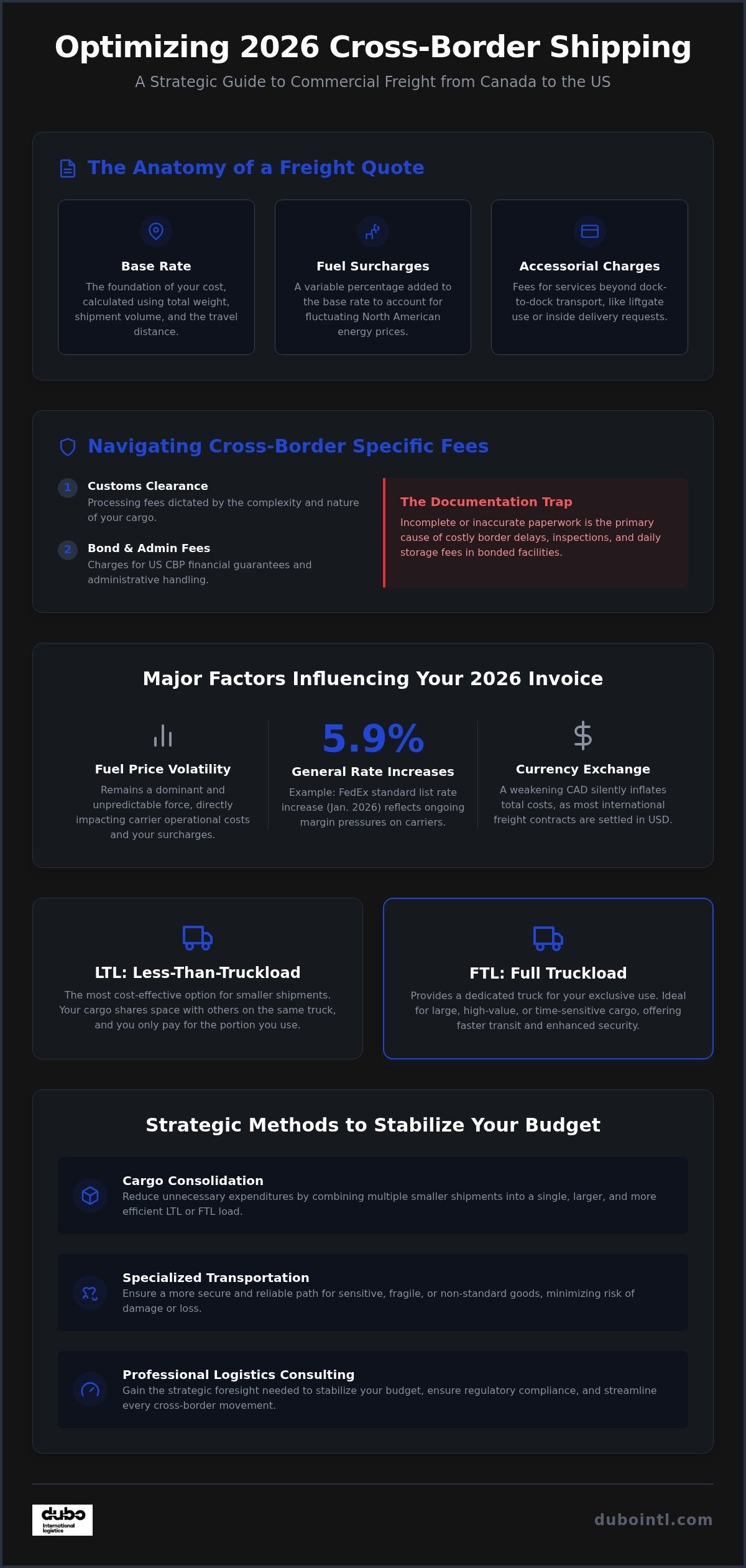
A professional freight quote begins with the base rate, which is calculated using a combination of total weight, shipment volume, and the distance between the origin and the final destination. When determining commercial shipping rates Canada to US, carriers also apply fuel surcharges as a percentage of the base rate to account for market volatility in North American energy prices. Beyond these standard costs, accessorial charges cover services that fall outside of dock-to-dock transport. These might include the use of a liftgate for locations without a loading bay or inside delivery requests. While these fees might seem small individually, they can significantly impact your total budget if they aren't accounted for during the initial planning phase.
Cross-Border Specific Fees
Moving goods across the border introduces a unique layer of administrative costs that don't exist in domestic transport. Customs clearance plays a primary role in the final rate, as the complexity of your cargo can dictate the level of scrutiny and processing required. You must also account for bond fees and administrative costs associated with US Customs and Border Protection (CBP). These charges ensure that the necessary financial guarantees are in place for the movement of commercial goods across international lines.
Proper documentation is the most effective way to prevent costly storage fees at the border; when paperwork is incomplete, cargo is often held in bonded facilities that charge daily rates while issues are resolved. By visiting www.dubointl.com, businesses can access the logistics consulting needed to ensure their documentation is precise and their border crossings remain seamless. Working with a dedicated partner like learn more ensures that every bond fee and CBP requirement is handled with strategic foresight, protecting you from the unpredictable fluctuations that often disrupt cross-border commerce.
Factors that Influence Cross-Border Freight Pricing in 2026
Stability in global trade is often an illusion; the reality is a shifting landscape of variables that dictate your final invoice. Fuel price volatility remains a dominant force in North American logistics, with carriers implementing general rate increases to offset energy costs. For instance, FedEx implemented a standard list rate increase of 5.9% in January 2026, reflecting the ongoing pressure on operational margins. These fluctuations mean that commercial shipping rates Canada to US are rarely static. Beyond fuel, the "colour" of the market is defined by the currency exchange between the Canadian Dollar (CAD) and the US Dollar (USD). Since most international freight contracts are settled in USD, a weakening CAD can silently inflate your total costs even if the base rate remains unchanged.
Effective carrier coordination is the primary tool for maintaining steady rates in this environment. Without a synchronized approach to scheduling and equipment positioning, businesses often find themselves at the mercy of daily market whims. A professional logistics architect can help you navigate these fluctuations by providing the strategic foresight needed to lock in reliable pricing before seasonal shifts occur.
Capacity and Market Demand
The balance of trade between Canada and the US dictates backhaul opportunities, which directly influences pricing. When southbound demand outstrips northbound capacity, carriers must charge more to cover the cost of returning empty trailers. Driver shortages and equipment availability continue to tighten the market, often pushing shippers toward the volatile spot market. Relying on the spot market for commercial shipping rates Canada to US is a risky strategy that leads to unpredictable budgets. Establishing long-term partnerships through learn more provides a buffer against these spikes, ensuring you have access to committed capacity when others are left waiting on the sidelines.
Regulatory Compliance and Security
Precision in regulatory compliance is a financial necessity rather than a mere administrative task. The cost of being "safe" is always lower than the price of a fine or a border delay. Accurate Harmonized System (HS) codes are essential for claiming duty-free entry under the CUSMA (formerly USMCA) agreement. Inaccurate filing can lead to the application of the 10% duty on Canadian-made goods that took effect in July 2026. Security certifications like CTPAT (Customs-Trade Partnership Against Terrorism) also play a role in cost management; certified shippers often experience fewer inspections and faster transit times. This efficiency reduces the likelihood of incurring non-compliance fees or storage charges, ultimately protecting your bottom line from the hidden costs of border friction.
Comparing Freight Modes: LTL, FTL, and Specialized Transportation
Selecting the right transportation mode is a pivotal decision that balances financial efficiency with operational speed. Commercial shipping rates Canada to US are structured differently across Less-than-Truckload (LTL), Full Truckload (FTL), and specialized services, each offering distinct advantages for specific cargo profiles. While small businesses often gravitate toward LTL for its cost-sharing properties, high-volume exporters realize better predictability through FTL. This choice fundamentally dictates your transit times and the level of handling your goods will experience at various consolidation hubs.
When to Choose Less-than-Truckload (LTL)
LTL is the most cost-effective option for businesses shipping between one and six pallets. By sharing trailer space with other shippers, you only pay for the portion of the truck your cargo occupies. Freight consolidation centres play a vital role here; they aggregate smaller shipments to optimize routes and reduce the base shipping rate. However, this mode carries a trade-off. Increased handling at multiple terminals can lead to a higher risk of damage, and transit times are generally longer as the carrier makes several stops along the route. It's a practical solution for growing companies that don't yet fill a whole trailer.
The Advantages of Full Truckload (FTL)
FTL remains the preferred choice for time-sensitive or high-volume shipments that require a direct route from your facility to the US destination. Because the truck is dedicated solely to your cargo, the risk of damage is minimized through reduced handling. You'll also find that FTL offers superior rates per unit when the trailer is fully utilized, making it a more efficient spend for bulk movements. It's a clean, direct process that eliminates the terminal delays inherent in the LTL model, providing a level of security that high-value cargo demands.
Handling Specialized and Oversized Cargo
Standard commercial shipping rates Canada to US simply don't apply when you're moving sensitive or non-standard goods. The logistics of specialized freight North America involves managing heavy-haul permits, escort vehicles, and bespoke equipment that standard carriers don't provide. At www.dubointl.com, we understand that these shipments require meticulous planning to avoid border delays. For time-critical specialized needs, partnering with a dedicated expert at learn more ensures your cargo moves under the watchful eye of a professional steward who understands the grand scale of global movement.
Strategic Methods to Reduce Your Commercial Shipping Costs
Reducing your logistics spend requires a shift from reactive price-shopping to proactive supply chain architecture. While many businesses focus solely on finding the lowest headline quote, the most sustainable way to lower commercial shipping rates Canada to US is through structural optimization. Cargo consolidation is a primary tactic in this regard; by aggregating smaller shipments into larger units, you maximize trailer utilization and effectively eliminate 'dead head' costs, which is the expensive inefficiency of moving empty or half-full trucks. Meticulous attention to packaging also ensures you aren't paying for air. Carriers increasingly rely on dimensional weight surcharges, so reducing box dimensions to match the actual product volume can lead to immediate savings.
Engaging in logistics consulting Canada offers a long-term return on investment that simple rate-comparison tools cannot match. This strategic approach identifies hidden inefficiencies in your current shipping lanes and provides a roadmap for end-to-end cargo movement. You can explore these bespoke solutions further at www.dubointl.com to see how professional oversight stabilizes your export budget. It's about building a framework that scales with your volume rather than struggling with unpredictable fluctuations.
Optimizing Supply Chain Efficiency
A thorough audit of your shipping history often reveals patterns that can be leveraged for volume discounts. By analyzing historical data, a logistics architect can identify consistent lanes where consolidated schedules can replace sporadic, high-cost shipments. Strategic warehouse placement also plays a vital role in reducing final-mile delivery costs, especially as North American transport networks become more congested. While 'just-in-time' delivery models offer inventory benefits, they require a sophisticated management system to ensure that the increased frequency of shipments doesn't erode your profit margins through higher aggregate commercial shipping rates Canada to US.
Leveraging Professional Expertise
A freight forwarder acts as a powerful advocate for your business by aggregating volume from multiple clients to negotiate preferential rates with carriers. This collective bargaining power allows smaller exporters to access pricing tiers usually reserved for multinational corporations. Outsourcing your freight management allows your team to focus on core business growth while a professional steward manages the minute details of border compliance and carrier performance. Choosing a reliable freight forwarder Canada is an investment in your company's longevity, providing the peace of mind that your logistics are both cost-effective and resilient. If you're ready to modernize your approach, consult with our team to uncover new efficiencies in your supply chain.
Dubo International Logistics stands as a dedicated steward of Canadian-to-US trade, offering more than just transport; we provide a stabilizing force in a volatile global economy. As a proud CIFFA member, we adhere to rigorous professional standards that ensure accountability and excellence in every shipment. This membership is a hallmark of our commitment to the industry's best practices, providing you with the assurance that your cargo is in the hands of a verified expert. By partnering with us, you gain access to the strategic foresight necessary to manage your commercial shipping rates Canada to US with absolute precision.End-to-End Cargo Coordination
Our methodology focuses on total integration. Dubo manages every critical touchpoint, from the initial pickup at a Canadian origin to the final delivery at a US destination, ensuring that no detail is overlooked. This level of end-to-end freight management is essential for reducing the transit stress that often accompanies cross-border movement. We act as your logistics architect, designing a path that bypasses common bottlenecks and minimizes the risk of regulatory delays. It's a process built on dependability and clear communication, allowing you to maintain a steady pace of business without the distraction of logistics hurdles.
Bespoke Solutions for Complex Logistics
Every manufacturer and exporter has unique requirements that standard, "one-size-fits-all" shipping tools simply cannot address. We specialize in tailoring freight solutions to the specific needs of your industry, whether you're moving sensitive machinery or high-volume consumer goods. This hands-on approach is what distinguishes our cross-border freight forwarding Canada USA expertise from the automated, impersonal services offered by larger retail carriers. We believe that a dedicated guide is essential for navigating the intricate layers of international trade, especially when your reputation depends on the timely arrival of your products. To realize your supply chain’s full potential and secure a tailored logistics assessment, we invite you to visit www.dubointl.com and request a professional consultation today.
Strategic Foresight for Your Cross-Border Success
Mastering the complexities of 2026 trade requires more than a reactive approach to fluctuating costs. You've learned that base rates are only the foundation; true savings come from strategic cargo consolidation and precise freight classification. By selecting the optimal transportation mode and ensuring documentation excellence, you protect your business from the unpredictable fluctuations that often disrupt cross-border commerce. It's about shifting your focus from simply finding a price to architecting a complete, integrated logistics solution.
Securing competitive commercial shipping rates Canada to US is a collaborative effort that benefits from seasoned expertise. As a CIFFA Certified Member with deep expertise in specialized transportation and national coverage across Canada, Dubo International Logistics provides the professional stewardship your cargo deserves. We're committed to helping you build a resilient supply chain that scales with your export volume. Visit www.dubointl.com today to see how our logistics consulting can stabilize your budget and provide the peace of mind you need. We invite you to optimize your cross-border strategy with Dubo International Logistics and move forward with quiet confidence.
Frequently Asked Questions
What is the average commercial shipping rate from Canada to the US?
Commercial shipping rates Canada to US are determined by a combination of freight class, total weight, and the distance between the origin and destination. There is no single average rate because every shipment is unique. A logistics architect at www.dubointl.com analyzes these variables to provide a precise quote. Factors like equipment type and the balance of trade lanes also play a role in the final cost you see on your invoice.
How do fuel surcharges affect my cross-border freight costs?
Fuel surcharges are calculated as a percentage of the base freight rate and fluctuate based on North American energy market indices. These charges allow carriers to recover the costs of fuel price volatility without constantly renegotiating base contracts. While they add to the total cost, they are a standard industry mechanism. Monitoring these trends helps you predict monthly budget variations in your cross-border logistics spend more accurately.
What documentation is required for commercial shipping to the US?
Essential documentation includes the commercial invoice, a bill of lading, and a certificate of origin for CUSMA compliance. You must also provide an accurate packing list and any specific permits required for regulated goods. Precise paperwork is the most effective way to prevent storage fees or delays at the border. Consulting with an expert at www.dubointl.com ensures your documentation package is complete and meets all current regulatory standards.
Is LTL or FTL more cost-effective for my business?
The most cost-effective choice depends entirely on your shipment volume and urgency. Less-than-Truckload (LTL) is typically the better financial option for shipments between one and six pallets because you share the trailer cost with other exporters. Full Truckload (FTL) becomes more economical for high-volume cargo that fills a trailer. FTL also offers faster transit times and reduced handling, which can lower the long-term cost of potential cargo damage.
How can a freight forwarder help me reduce my shipping rates?
A freight forwarder reduces your commercial shipping rates Canada to US by leveraging volume aggregation and strategic lane optimization. By combining shipments from multiple clients, forwarders negotiate preferential pricing with carriers that individual businesses often cannot access. Professional logistics consulting also uncovers hidden inefficiencies in your supply chain. This strategic approach transforms your shipping from a fixed expense into a variable cost that we can actively manage and reduce over time.
What are accessorial charges in commercial shipping?
Accessorial charges are fees for services that go beyond standard dock-to-dock transportation. Common examples include liftgate requirements, residential deliveries, and wait time fees if a driver is delayed at your facility. These charges cover the extra time and specialized equipment needed to complete a delivery safely. Identifying these requirements during the quoting process at www.dubointl.com prevents unexpected surcharges from appearing on your final freight bill.
How does the USMCA impact commercial shipping rates between Canada and the US?
The USMCA, known as CUSMA in Canada, allows for duty-free entry of goods that meet specific rules of origin. This agreement significantly lowers the total cost of shipping by eliminating tariffs on qualifying Canadian-made products. However, you must provide accurate certification to claim these benefits. Failure to comply with CUSMA regulations can result in the application of standard duties, which immediately inflates your total cross-border shipping expenditure.
Can specialized cargo be shipped across the border with standard rates?
Specialized cargo cannot be shipped using standard freight rates because it requires tailored equipment and meticulous handling. Oversized or sensitive goods often need flatbeds, climate-controlled trailers, or heavy-haul permits that fall outside of routine transport parameters. Standard rates are built for uniform pallets in dry vans. At www.dubointl.com, we provide bespoke quotes for specialized transportation services to ensure your unique cargo moves securely across the border with professional oversight.

