

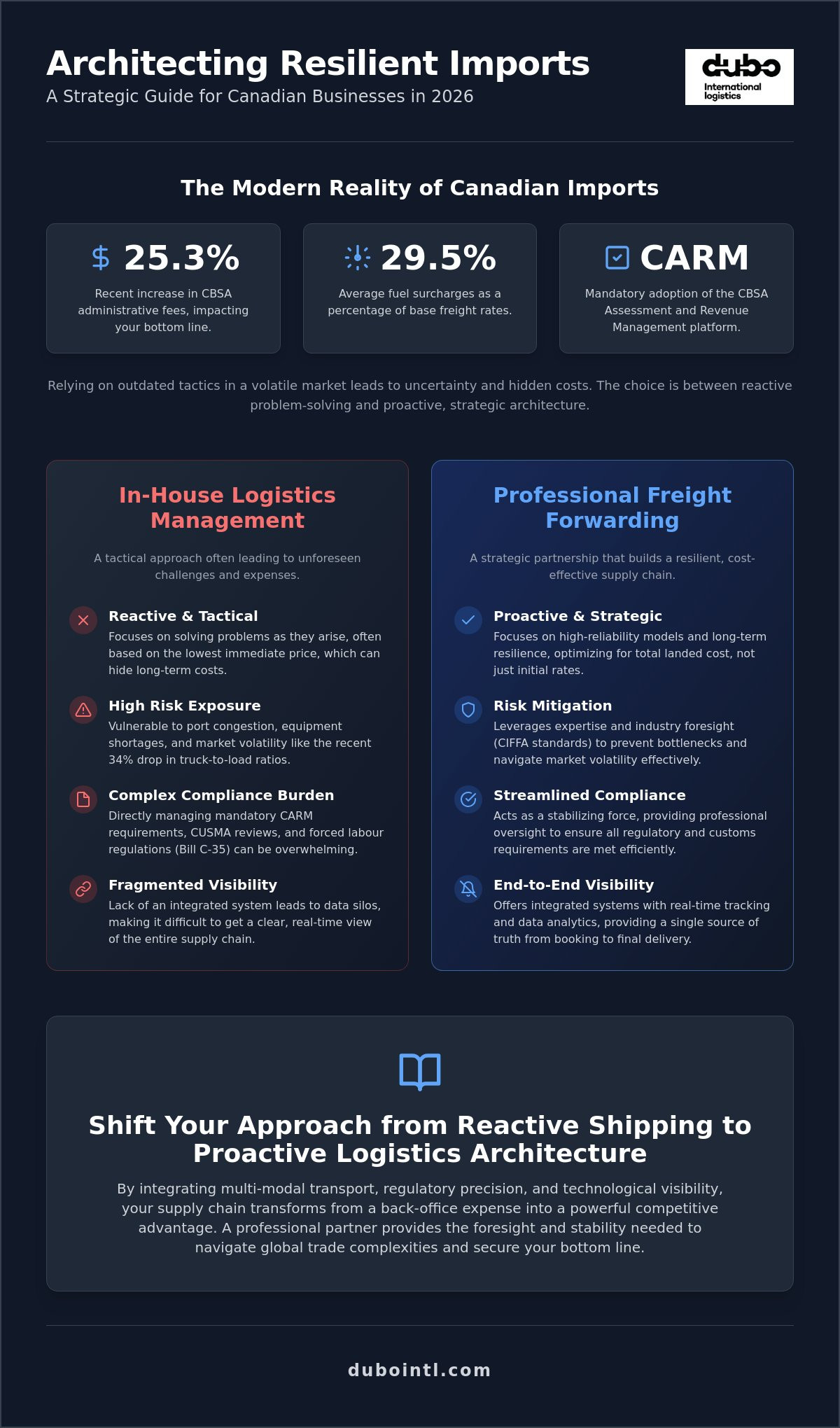
If your supply chain relies on the same tactics you used two years ago, you aren't just falling behind; you're likely overpaying for uncertainty. The reality of modern trade is that a single regulatory shift can disrupt months of planning. We understand that managing unpredictable transit times and hidden costs in fragmented logistics chains feels like a constant battle against volatility. It's a pressure felt by many businesses trying to find reliable freight solutions for importers Canada while navigating the mandatory CARM platform and the recent 25.3% increase in CBSA fees.
At www.dubointl.com, we believe that importing should be a seamless, end-to-end process rather than a series of fires to extinguish. This 2026 resource guide provides the blueprint to architect a resilient strategy that balances cost, speed, and compliance across North American trade lanes. We'll explore the impact of the July 2026 CUSMA review, the requirements of the new Bill C-35 regarding forced labour, and how strategic logistics consulting can offer the foresight needed to stabilize your bottom line.
Key Takeaways
- Gain a clear understanding of the 2026 market dynamics, including the impact of fuel fluctuations and infrastructure updates on your total landed costs.
- Discover how to architect comprehensive freight solutions for importers Canada that integrate ocean, air, and road transport into a single, resilient system.
- Uncover the hidden financial and operational risks of managing complex logistics in-house compared to the strategic advantages of professional freight forwarding.
- Learn to navigate the unique requirements of specialized or sensitive cargo while utilizing logistics consulting at www.dubointl.com to identify and eliminate supply chain inefficiencies.
- Shift your approach from reactive shipping to proactive logistics architecture, ensuring your business maintains a steady course through global trade complexities.
Understanding the Landscape of Freight Solutions for Importers in Canada
Effective freight solutions for importers Canada are no longer just about the physical journey of a container from one port to another. In the current 2026 trade environment, these solutions represent an integrated system that synchronizes the physical movement of goods with meticulous regulatory compliance and data-driven strategic planning. This holistic approach is essential as Canadian businesses face a landscape where fuel surcharges have climbed to an average of 29.50% of base rates, and CBSA administrative fees have recently surged by over 25% to account for years of inflation. Relying on fragmented logistics is a risk that few can afford to take when volatility is the new baseline.
Success in this climate requires a shift from reactive shipping to a model of end-to-end freight management. This transition ensures that visibility is maintained at every touchpoint, from the initial booking to the final mile of delivery. By treating logistics as a core pillar of business strategy rather than a back-office expense, importers can transform their supply chains into a competitive advantage. At www.dubointl.com, we act as a stabilizing force, providing the steady authority and professional oversight needed to protect your interests in a complex global market.
The Evolution of Canadian Import Logistics
The days of simple transport are over. Modern import journeys involve a sophisticated network of stakeholders, including ocean carriers, terminal operators, and the freight forwarder who orchestrates the entire movement. We define freight solutions as a comprehensive methodology that integrates the physical movement of cargo with regulatory foresight and supply chain architecture to ensure long-term resilience. This evolution reflects a broader trend where businesses prioritize "completeness" over individual service silos, seeking partners who understand the grand scale of global movement while managing the minute details of individual shipments.
Why Strategic Planning Outperforms Tactical Shipping
Choosing a logistics path based solely on the lowest immediate price often leads to the highest total cost. A tactical, price-first approach ignores the hidden expenses of port congestion, equipment shortages, and the 34% drop in spot market truck-to-load ratios seen earlier this year. Strategic planning, however, focuses on high-reliability models that prevent bottlenecks at Canadian ports of entry before they occur. By working with professionals who adhere to CIFFA standards, importers ensure their cargo is managed with the highest industry ethics and technical precision. This foresight allows businesses to realize significant savings through optimized routing and better equipment utilization, even when market conditions are tight.
Core Pillars of a Robust Import Logistics Strategy
Resilience in logistics is built on three foundational pillars: modal choice, regulatory precision, and technological visibility. A truly integrated strategy avoids treating these as silos; instead, it weaves them into a cohesive framework that supports business growth. This approach is vital for those seeking sustainable freight solutions for importers Canada, as it protects the bottom line against sudden market shifts and bureaucratic hurdles. When every component of the supply chain communicates effectively, the result is a reliable flow of goods that minimizes waste and maximizes predictability.
Seamless coordination between carriers and importers is the glue that holds these pillars together. In a year where Canadian freight rates have remained firmer than in 2025, supported by tighter equipment capacity and improved freight activity, the cost of a breakdown in communication is higher than ever. Real-time tracking and advanced data analytics have become non-negotiable tools for modern businesses. These technologies provide the foresight needed to manage inventory levels accurately and adjust to disruptions before they impact the final customer experience.
Multi-Modal Integration: Finding the Right Balance
Finding the right balance between transport modes requires a sophisticated understanding of your cargo's value and urgency. Ocean freight remains the primary engine for high-volume, cost-effective transport, but it requires longer lead times and careful planning. Conversely, air freight serves as a surgical tool for high-value or time-sensitive inventory where speed justifies the higher expenditure. In 2026, the "centre of gravity" concept is essential for national distribution; it involves positioning your primary hubs at the geographic heart of your Canadian market to minimize inland costs. Road freight provides the indispensable last mile, bridging the gap between major rail terminals or ports and your warehouse.
Compliance and Regulatory Stewardship
Documentation is the lifeblood of global trade. Missing a single form or misclassifying a product can lead to costly delays, administrative penalties, or even entry holds. Reviewing the official Import Requirements and Documentation is a necessary first step for any business looking to avoid these pitfalls. Beyond basic forms, importers must now navigate the mandatory CARM platform and prepare for the upcoming CUSMA review scheduled for July 1, 2026. Professional oversight ensures you leverage trade agreements like CETA or CUSMA effectively to optimize duty and tax obligations while remaining fully compliant with CBSA regulations. Ensuring these pillars are properly aligned requires a partner who understands the intricacies of the Canadian market; you can explore how a tailored approach can stabilize your operations at dubointl.com.
Professional Freight Forwarding vs. In-House Management
Deciding whether to manage logistics internally or partner with an expert is a pivotal moment for any growing business. While the idea of maintaining total control over every shipment is appealing, the hidden costs of in-house management often outweigh the perceived savings. Between the expense of specialized software and the constant need for staff training to keep pace with changing regulations, internal departments can quickly become overwhelmed. Opting for professional freight forwarding in North America isn't just an outsourcing of tasks; it's a strategic investment in professional accountability and peace of mind.
Many businesses initially view forwarders as an added expense, but this perspective overlooks the value of professional stewardship. A dedicated partner acts as a stabilizing force, absorbing the stress of fragmented logistics chains so your team can focus on core competencies like product development and sales. At www.dubointl.com, we believe that the right partnership provides more than just execution; it offers a protective layer of foresight that prevents minor issues from escalating into supply chain crises.
Evaluating Internal Resource Constraints
Assessing your organization's logistics maturity is essential before committing to an in-house model. Consider this checklist to determine if your current resources are sufficient for the complexities of 2026 trade:
- Does your team have the capacity to manage dozens of individual carrier relationships across different time zones?
- Are you utilizing the most recent Guide to importing commercial goods to ensure every shipment meets stringent entry requirements?
- Can your internal systems provide real-time visibility without significant capital investment in new technology?
- Do you have a plan for cargo recovery or damage claims that doesn't halt your daily operations?
Fragmented communication is one of the greatest risks of managing freight solutions for importers Canada internally. When you deal directly with multiple carriers, information often gets lost in translation, leading to delays that could have been avoided with a single, authoritative point of contact.
The Strategic Advantage of a Logistics Architect
A professional forwarder functions as a logistics architect, a persona that views your supply chain as a grand design rather than a series of isolated bookings. This expert doesn't just book a truck; they design the most efficient route, anticipate potential disruptions, and utilize volume-based negotiation power to secure space when capacity is tight. These relationships are vital in a market where equipment availability can shift overnight. Beyond simple transport, a logistics architect provides robust risk mitigation, ensuring that your cargo is protected through every stage of its journey. This level of meticulous execution is what separates a standard shipping service from a truly integrated partnership that values the longevity of your business.
Specialized Solutions for Complex and Sensitive Cargo
Standard freight solutions for importers Canada often meet their limit when cargo exceeds the dimensions of a 53 foot trailer or requires extraordinary handling. Specialized cargo, ranging from oversized industrial machinery to high-value sensitive electronics, demands a level of precision that goes beyond routine logistics. These non-standard shipments require a bespoke architectural plan where every variable is meticulously calculated. Managing the unique requirements of specialized freight in North America involves more than just booking a larger trailer; it requires a deep understanding of infrastructure constraints, bridge heights, and the specific border protocols that apply to project-based movements.
Because these challenges are unique, they necessitate tailored project fees that reflect the intensive coordination and specialized equipment required. At www.dubointl.com, we approach these complex movements with the quiet confidence of a seasoned partner. We ensure that the "smoothness" of the journey is prioritized, protecting both the physical integrity of the cargo and the financial interests of the importer. This commitment to detail is essential for maintaining effective freight solutions for importers Canada when the cargo is anything but standard.
Managing Oversized and Project Cargo
Transporting industrial equipment or heavy machinery across borders involves a rigorous planning phase that must begin weeks or months in advance. The process starts with a comprehensive route survey to identify potential obstructions and the procurement of necessary provincial or state permits. Coordination is especially critical for multi-vehicle project shipments, where the timing of arrivals must be synchronized to avoid site congestion or crane standby costs. Specialized cargo requires strategic foresight, not just a larger trailer. By managing the movement as a single, cohesive project, importers can avoid the delays that often plague uncoordinated shipments.
Handling Sensitive and High-Value Shipments
Maintaining the integrity of sensitive or high-value goods during transit requires strict adherence to specialized protocols. This includes the use of air-ride suspension to minimize vibration and climate-controlled environments for temperature-sensitive assets. Security is equally paramount, involving high-level insurance coverage and real-time monitoring to mitigate the risks of theft or loss. A dedicated partner understands that delicate cargo requires a gentle touch and a transparent chain of custody. If you are preparing for a complex shipment that requires professional oversight, you can request a consultation for specialized transportation services to ensure your assets are moved with the excellence they deserve.
Optimizing Your Supply Chain with Strategic Logistics Consulting
Excellence in global trade isn't achieved by simply moving cargo; it is realized through the continuous refinement of the processes that govern that movement. While many focus on the physical act of shipping, strategic logistics consulting addresses the underlying architecture of your supply chain. This consultative approach is a critical component of high-level freight solutions for importers Canada, as it transforms a cost centre into a lean, resilient engine for growth. By identifying inefficiencies before they manifest as delays, businesses move beyond tactical execution and toward a model of sustained operational excellence.
Choosing a partner that offers both execution and strategic guidance is essential for maintaining a competitive edge. It's not enough to book a shipment; you need a partner who understands how that shipment fits into your broader financial goals. At www.dubointl.com, we provide the professional oversight and industry literacy required to stabilize your operations in a volatile market. Our consulting services are designed to lower your stress by positioning your business as a stabilizing force within the global trade environment.
Identifying and Reducing Operational Costs
A comprehensive logistics audit serves as the diagnostic tool for finding "leaking" capital within your supply chain. We analyze every touchpoint to uncover where resources are being underutilized, whether through suboptimal container loading or inefficient routing that adds unnecessary mileage. Improved planning leads to more predictable and realized delivery timelines, which in turn reduces the need for costly expedited shipments. For example, optimizing container utilization ensures you aren't paying to ship empty space, while route efficiency planning accounts for the firmer freight rates and tighter equipment capacity seen throughout 2026. These refinements ensure that every dollar spent on freight solutions for importers Canada is an investment in precision rather than a reaction to poor planning.
Building a Resilient Partnership for 2026 and Beyond
Building a resilient partnership for the future requires a partner who acts as both a seasoned expert and a dedicated, hands-on guide. In an unpredictable global environment, having a steady, authoritative bridge between your local business and complex international systems provides a level of security that tactical shipping cannot match. A mature, established partner understands the grand scale of global movement but remains focused on the minute details of your specific needs. This relationship values longevity and consistency, presenting a narrative of end-to-end support that is both cohesive and well-planned. To ensure your cargo arrives with the precision and care it deserves, partner with a logistics architect who prioritizes your peace of mind and long-term success.
Architecting a Resilient Future for Your Canadian Imports
Transitioning from tactical shipping to a model of strategic logistics architecture is the only way to thrive in the 2026 trade environment. We've explored how integrating transport modes and prioritizing regulatory precision can protect your bottom line against rising CBSA fees and fuel surcharges. Relying on a partner that offers both execution and foresight ensures your supply chain remains a competitive asset rather than a source of volatility.
As a proud CIFFA member with decades of experience in specialized project cargo, we act as a stabilizing force for businesses managing North American cross-border trade. We're dedicated to providing comprehensive freight solutions for importers Canada that emphasize meticulous execution and long-term reliability. Our team at www.dubointl.com is ready to help you navigate the complexities of global movement with quiet confidence and professional stewardship.
Request a strategic consultation for your import needs at Dubo International Logistics to secure the expert guidance your business deserves. We look forward to building a seamless and successful path forward together.
Frequently Asked Questions
What are the main types of freight solutions available for Canadian importers?
The primary freight solutions for importers Canada include ocean freight for high-volume shipments, air freight for urgent inventory, and road transport for North American distribution. These categories are often integrated into a single supply chain strategy to balance cost and speed. Modern solutions also incorporate logistics consulting to identify inefficiencies. It's the best way to ensure that every movement aligns with current CBSA regulatory requirements and trade agreements.
How do I choose the right mode of transport for my specific cargo?
Selecting the appropriate mode depends on the specific balance between your budget and the required delivery timeline. Ocean freight is the standard for bulk goods due to its cost-efficiency; however, air freight is reserved for high-value or time-sensitive cargo. Road freight serves as the essential link for cross-border movements within North America, often acting as the final mile for goods arriving at major Canadian ports or rail terminals.
What documentation is essential for importing goods into Canada from the USA?
Importing goods from the USA requires a Canada Customs Invoice (CCI) or a commercial invoice that includes all necessary data elements. You'll also need a Bill of Lading to document the contract of carriage and a cargo manifest for the carrier. Ensuring these documents are precise prevents delays, especially with the mandatory CARM system and the CUSMA review scheduled for July 1, 2026, which may impact duty assessments.
Can a freight forwarder help reduce my overall logistics costs?
A freight forwarder reduces overall logistics costs by leveraging volume-based negotiation power with carriers and optimizing shipping routes. Beyond simple transport, they identify hidden expenses in your supply chain, such as unnecessary accessorial charges or inefficient container utilization. This professional oversight ensures you don't overpay for capacity. It's a key reason why many businesses seek comprehensive freight solutions for importers Canada to stabilize their bottom line.
What is the difference between a freight broker and a freight forwarder in Canada?
A freight broker typically acts as an intermediary that connects shippers with carriers for specific road transport needs. In contrast, a freight forwarder takes a more comprehensive role, managing the entire end-to-end movement of cargo across multiple modes and borders. Forwarders often provide additional services like logistics consulting and specialized transportation, acting as a single point of accountability for the entire international supply chain.
How does specialized transportation differ from standard freight services?
Specialized transportation differs from standard services by utilizing custom equipment and bespoke planning for cargo that is oversized, high-value, or environmentally sensitive. While standard freight follows established routes and dimensions, specialized projects require detailed route surveys and specific provincial permits. This ensures that delicate or industrial assets move with the "smoothness" and precision required to maintain their integrity throughout the journey.
What should I look for in a professional logistics consulting partner?
A professional logistics consulting partner should demonstrate deep industry literacy and a commitment to long-term supply chain resilience. Look for a partner who acts as a logistics architect, offering both strategic foresight and the ability to execute complex movements. They should be able to conduct thorough audits of your current processes to find "leaking" capital and provide a steady, authoritative bridge between your business and global systems.
How can I ensure my oversized cargo meets Canadian transport regulations?
Ensuring oversized cargo meets Canadian regulations involves securing the necessary provincial permits and conducting a rigorous route survey before the shipment departs. You must account for bridge heights, weight restrictions on specific corridors, and the requirement for pilot cars or police escorts in certain jurisdictions. Partnering with an expert at www.dubointl.com provides the professional oversight needed to navigate these complex legal requirements so it isn't a risk to your operations.

