

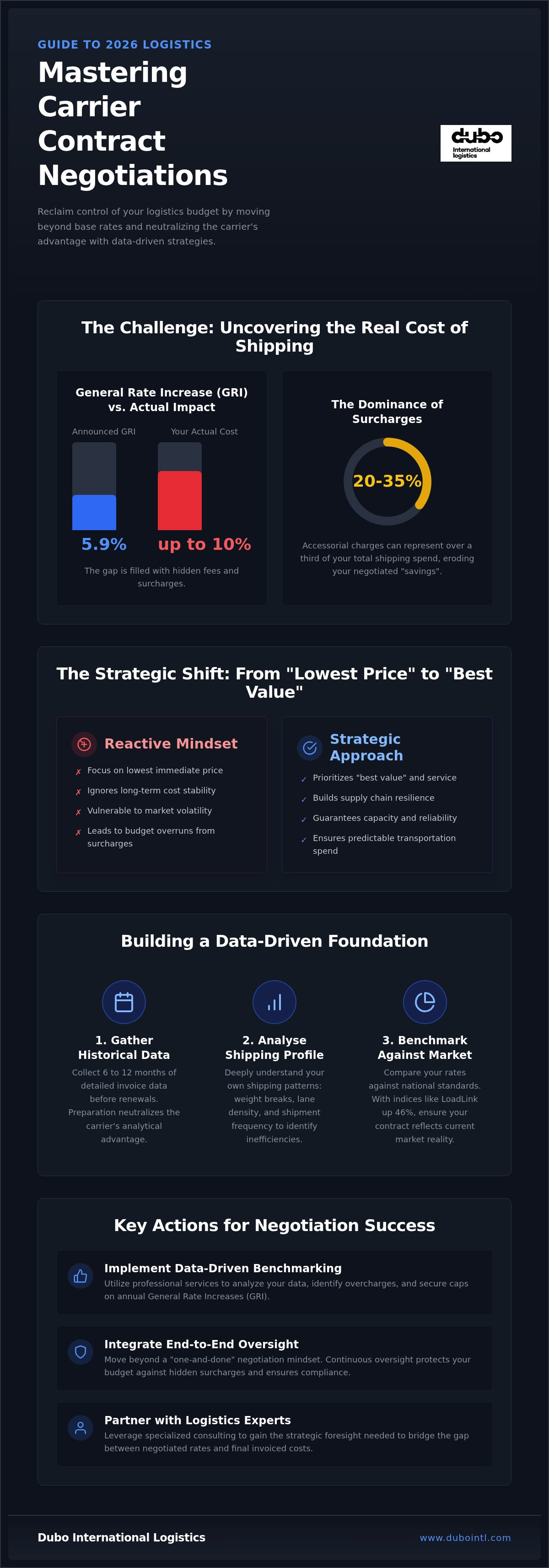
Did you realize that while major carriers announced a 5.9% general rate increase for 2026, the actual impact on your bottom line often climbs as high as 10% once surcharges are applied? For many Canadian shippers, the feeling of being outmatched by carrier pricing analysts during renewals is a stressful reality that leads to rising freight costs exceeding budget forecasts. It is difficult to maintain a sense of security when accessorial charges now represent 20% to 35% of your total shipping spend. Utilizing professional carrier contract negotiation services allows you to reclaim control over your logistics budget by applying data-driven strategies to every agreement.
You deserve a logistics partner that acts as a stabilizing force in this complex global environment. By mastering the intricacies of freight agreements, you can secure market-competitive rates and protect your business against arbitrary rate hikes. This guide examines how to bridge the execution gap between negotiated rates and final invoiced amounts, ensuring your transportation spend remains predictable. We will outline the methodology behind strategic partnerships that add long-term supply chain value, starting with the resources available at www.dubointl.com. You will learn how to transform your shipping contracts from a source of financial strain into a foundation for consistent growth.
Key Takeaways
- Shift focus from the "lowest price" to the "best value" to realize long-term supply chain stability in a volatile 2026 logistics environment.
- Utilize professional carrier contract negotiation services to implement data-driven benchmarking that identifies overcharges and secures caps on annual General Rate Increases (GRI).
- Prepare for renewals 6 to 12 months in advance by gathering detailed historical invoice data to neutralize the advantage held by carrier pricing analysts that often favour the carrier in rushed negotiations.
- Move beyond a "one-and-done" mindset by integrating end-to-end oversight that safeguards against hidden surcharges and protects your transportation budget.
- Visit www.dubointl.com to explore how specialized logistics consulting provides the strategic foresight that's needed to bridge the gap between negotiated rates and final invoiced costs.
What are Carrier Contract Negotiation Services?
Carrier contract negotiation services are professional consulting solutions that leverage market data and industry expertise to secure optimal terms between shippers and transportation providers. These services move beyond simple price haggling; they provide a comprehensive framework for managing the complex relationship between your business and its carriers. While traditional procurement often focuses on securing the lowest immediate price, the 2026 logistics environment necessitates a shift toward "best value." This approach prioritizes service reliability, capacity guarantees, and long-term cost stability over temporary discounts that often disappear when market conditions shift.
Adopting a "logistics architect" mindset allows you to build a shipping strategy that supports your broader business goals rather than just reacting to carrier demands. It involves looking at the grand scale of global movement while remaining focused on the minute details of your specific shipping profile. By integrating strategic oversight into your procurement process, you create a layer of supply chain resilience that protects your margins from the inherent volatility of the North American freight market.
The Information Asymmetry Challenge
Carriers employ sophisticated pricing analysts who use thousands of data points to design contracts that protect their margins, regardless of the discounts they offer on the surface. This creates a significant information gap where Canadian businesses often realize too late that their "savings" are being offset by complex surcharge structures. Applying proven negotiation principles is essential to balance the scales. Having an advocate who understands these pricing models from the inside ensures your interests are protected by a partner who speaks the carrier's language and understands their operational constraints.
Beyond the Base Rate
Effective carrier contract negotiation services cover a broad scope including parcel, LTL, FTL, and specialized transportation modes. It's rarely the base rate alone that causes budget overruns; instead, it's the proliferation of accessorial charges and fuel surcharges that inflate the final invoice. In 2026, these charges can represent up to 35% of total shipping spend, making them a primary focus for professional oversight. Contractual compliance serves as the essential foundation of logistics cost control. You can explore how these strategies integrate with broader supply chain goals at www.dubointl.com, where we focus on creating transparent and dependable cargo coordination.
The Data-Driven Foundation: Benchmarking and Profile Analysis
Data is your most potent asset. It transforms the conversation from subjective requests to objective requirements. Professional carrier contract negotiation services begin by aggregating 6 to 12 months of detailed invoice data to uncover the truth about your shipping patterns. You must look at weight breaks, lane density, and shipment frequency to understand how your freight fits into a carrier's network. Identifying hidden inefficiencies, such as poor trailer utilization or inconsistent scheduling, allows you to correct these issues before they become a liability during renewal discussions. Without this foundation, you're essentially walking into a boardroom with a blindfold on, while the carrier has a complete map of your vulnerabilities.
Benchmarking Against National Standards
It's hard to know if your volume-based discounts are actually market-competitive without a national baseline. With LoadLink's Freight Index seeing a 46% year-over-year increase in June 2026, the market is shifting rapidly. If your contract rates haven't been adjusted to reflect these broader trends, you're likely overpaying for capacity. Using logistics consulting Canada helps you interpret these complex data sets. It ensures that every carrier proposal is normalized, allowing for a true comparison of total cost rather than just looking at isolated discount percentages. This level of rigour mirrors federal contract negotiation techniques, where structured analysis and data symmetry prevent oversight during high-stakes agreements.
Creating a Shipper Profile That Carriers Want
Leverage isn't just about volume; it's about desirability. Carriers look for "good freight" that minimizes their dwell time and maximizes their equipment utilization. To gain the upper hand, you should present a profile that highlights consistent volume and predictable schedules. When you balance specialized needs with a carrier's operational strengths, you become a preferred partner. In a year where trucking insurance premiums are rising by 8% to 15%, being a "shipper of choice" is a strategic advantage. This positioning often leads to better service levels and more favourable terms that protect you from sudden capacity crunches. If you're unsure how your current profile appears to the market, the experts at www.dubointl.com can help you refine your data to attract the right transportation partners.
Evaluating Contractual Terms: A Comparison Framework
A high discount percentage on a base rate sheet is a common distraction that often masks the true total cost of ownership. Professional carrier contract negotiation services focus on the net cost after all variables are calculated, ensuring that a 70% discount doesn't result in a higher invoice than a 60% discount with better terms. It's essential to look past the headline numbers to understand how the pricing structure interacts with your specific shipment characteristics. This evaluation requires a steady authority to parse through the fine print where carriers often embed language that protects their margins at the shipper's expense.
General Rate Increases (GRIs) are another area where shippers lose ground if they don't negotiate specific caps or waivers. For 2026, FedEx and UPS announced a 5.9% GRI, yet most shippers will realize a total cost increase closer to 10% once surcharges are applied. You should strive for contracts that protect against these arbitrary hikes through tiered pricing or fixed-term agreements. Beyond the price, the "colour" of your contract matters; specific language regarding service level agreements (SLAs) ensures that the carrier is held accountable for delivery windows and equipment availability, transforming the document from a price list into a strategic partnership agreement.
Surcharges and Accessorials: The Profit Eroders
Accessorial charges now represent 20% to 35% of total shipping spend, making them a critical battleground in contract discussions. In the Canadian context, fuel surcharges, peak season premiums, and cross-border fees can quickly erode your margins. On October 1, 2026, the AQI transponder fee for U.S. border crossings rises to $870.60 USD, while the Gordie Howe International Bridge truck tolls sit at $12.00 CAD per axle. Leveraging cross-border freight forwarding Canada USA expertise is vital to identify and negotiate these fees. Negotiating fixed accessorial rates ensures price predictability and prevents your budget from being derailed by unexpected line items on the final invoice.
Liability and Insurance Terms
Protecting your specialized cargo requires ensuring that carrier liability limits align with the actual value of your goods. There's a significant difference between standard carrier liability and all-risk cargo insurance; the former often provides minimal coverage based on weight rather than value. As CIFFA members, we advocate for terms that provide a safer baseline for Canadian shippers. This professional oversight ensures that your claims process is streamlined and your financial exposure is minimized. To learn more about how we coordinate these complex agreements, visit www.dubointl.com for end-to-end support.
A Strategic 5-Step Roadmap to Successful Negotiation
Securing market-competitive rates is a methodical process that requires strategic foresight and a commitment to detail. It's recommended to begin renewal discussions 6 to 12 months in advance because rushed negotiations tend to favour the carrier. The first step involves gathering detailed invoice data to bridge the 5% to 15% execution gap often found between negotiated rates and final billed amounts. Once your data is organized, you must define your "must-haves," such as capacity guarantees or specific service levels, versus "nice-to-haves" like extended payment terms. Utilizing professional carrier contract negotiation services ensures that these business goals remain the focus throughout the procurement cycle.
The RFP Process for Specialized Freight
Drafting an RFP that captures the nuances of specialized freight North America requires industry-literate language that accounts for oversized cargo and specific handling requirements. You should invite a diverse but qualified mix of carriers rather than casting too wide a net. Inviting an excessive number of providers often dilutes your leverage and complicates the analysis phase by creating too much noise in the data. Setting clear timelines for responses ensures a disciplined selection process that respects both your schedule and the carrier's operational constraints.
The Art of the Counter-Offer
When you receive initial proposals, use market-level intelligence to push back on unreasonable rate hikes. For instance, if a carrier proposes an increase significantly higher than the 5.9% general rate increase announced by major players for 2026, your data serves as your primary defence. Negotiating for capacity guarantees during peak seasons is a vital component of long-term supply chain value, especially when LoadLink's Freight Index shows significant year-over-year growth. Professional advocacy reduces the hassle of back-and-forth communication. Finally, implementation and auditing ensure that new rates are correctly applied from day one, preventing the billing creep that often erodes expected savings. To secure a roadmap tailored to your unique shipping profile, connect with the consultants at www.dubointl.com for a comprehensive review of your logistics strategy.
Why Professional Oversight is the Logical Conclusion
The ink on a new agreement marks the beginning of a strategic partnership, not the end of your procurement efforts. Shippers who adopt a "one-and-done" mindset often find that the savings they meticulously negotiated begin to erode within the first quarter due to unmonitored surcharges or misapplied discounts. Securing market-competitive rates through carrier contract negotiation services provides the essential foundation, but maintaining those gains requires a professional logistics architecture that prioritizes long-term resilience. By integrating end-to-end freight management, you ensure that every shipment adheres to both the spirit and the letter of your agreement. This ongoing commitment to oversight transforms your supply chain from a cost centre into a stabilizing force that supports predictable business growth.
A stabilized logistics strategy offers a level of peace of mind that simple rate-shopping can never provide. It allows your internal teams to focus on core business functions while a dedicated steward protects your financial interests. This professional oversight acts as a protective barrier against the complexities of global trade, ensuring that your cargo coordination remains seamless and your budget remains intact. When your contracts are built on a foundation of data and professional advocacy, you gain the quiet confidence needed to scale your operations in a volatile North American market.
Continuous Monitoring and Auditing
Post-negotiation auditing is essential for recovering savings that would otherwise be lost to billing overages. It's common for carriers to misapply base rates or include accessorials that were specifically waived during the negotiation process. Using data visualization allows you to track carrier performance against contractual SLAs in real-time, providing the objective evidence needed for corrective conversations. You should start preparing for your next renewal cycle the very day your current contract is signed. This proactive stance ensures you're never caught off guard by shifting market dynamics or capacity constraints.
Partnering with Dubo International Logistics
Investing in specialized logistics consulting is an investment in the precision and smoothness of your entire operation. Our approach focuses on creating bespoke solutions that mirror the complexity of global trade while remaining grounded in the specific needs of Canadian shippers. When market volatility exceeds the protections of your standard agreements, you can leverage our expedited services to ensure your most urgent cargo reaches its destination without delay. We act as your dedicated logistics architect, bridging the gap between local operational needs and international systems. Visit www.dubointl.com to realize the full potential of a strategic partnership that values consistency and professional excellence.
Securing Your Supply Chain for 2026 and Beyond
Mastering the complexities of freight agreements requires more than just aggressive rate shopping; it demands a strategic alignment between your business goals and carrier capabilities. Successful shippers realize that their historical data is a primary asset for neutralizing the information advantage held by major carriers. By focusing on the total cost of ownership and implementing a disciplined roadmap, you can protect your margins from the hidden eroders of surcharges and arbitrary rate hikes. This structural alignment ensures that your logistics strategy remains a source of stability rather than a budget liability.
Professional carrier contract negotiation services provide the steady authority needed to navigate this complex global environment with confidence. Our team offers CIFFA certified expertise and acts as North American cross-border specialists to ensure your logistics architecture is both robust and market-competitive. We invite you to Request a Strategic Logistics Cost Review with Dubo International to explore how our bespoke logistics consulting can stabilize your transportation spend. Building a resilient supply chain is a continuous journey, and with the right partner, you can transform your logistics into a long-term value driver for your organization.
Frequently Asked Questions
What is the typical ROI for carrier contract negotiation services?
The return on investment for carrier contract negotiation services is often realized through the identification of billing errors and the implementation of caps on annual rate increases. By closing the 5% to 15% execution gap between negotiated and invoiced rates, businesses recover significant capital. These savings typically exceed the initial consulting fees, creating a self-funding model for supply chain optimization. Beyond direct costs, the long-term value includes improved service reliability and budget predictability for the entire fiscal year.
How often should a Canadian business renegotiate its freight contracts?
Most Canadian businesses should engage in a formal renegotiation every 12 to 24 months to ensure their terms remain market-competitive. However, the volatile nature of the 2026 logistics landscape suggests that quarterly performance reviews are essential for tracking surcharges and service levels. If your shipping profile changes or if market indices show significant shifts, an earlier assessment may be necessary. Preparing for these discussions 6 to 12 months in advance ensures you aren't forced into unfavourable terms during a capacity crunch.
Can I negotiate rates if I only ship specialized or oversized cargo?
Yes, specialized and oversized cargo shipping offers unique opportunities for negotiation based on lane density and equipment utilization. Carriers often value predictable, well-planned specialized moves because they maximize their technical assets. By presenting your cargo as "desirable freight" through detailed profiles, you can secure better project fees and capacity guarantees. Professional oversight helps you balance these unique requirements with standard carrier operational strengths to find the most reliable transportation partners across North America at www.dubointl.com.
What is the difference between a freight audit and contract negotiation?
A freight audit is a retrospective process that identifies overcharges and billing errors on past invoices to recover lost funds. In contrast, professional carrier contract negotiation services are a forward-looking strategic exercise designed to establish the rates and service levels that will govern future shipments. While an audit corrects past mistakes, negotiation prevents those costs from occurring. Both are essential components of a complete logistics architecture that ensures your actual spend aligns with your strategic business goals.
Will negotiating lower rates affect my service priority with carriers?
Negotiating competitive rates does not have to compromise your service priority if you focus on a partnership-based approach rather than purely transactional price-cutting. Professional negotiations include robust service level agreements (SLAs) that guarantee equipment availability and delivery windows. Carriers often prioritize shippers who provide consistent volume and predictable schedules, even at negotiated rates. By positioning your business as a "shipper of choice," you can secure both favourable pricing and high-level service reliability throughout the entire year.
How do cross-border regulations impact contract terms between Canada and the USA?
Cross-border regulations introduce specific cost variables like the AQI transponder fee and international bridge tolls that must be clearly defined in your contracts. In 2026, these fees are rising, making it essential to negotiate who bears the cost of these regulatory charges. Understanding the nuances of North American trade ensures that your agreements remain compliant while protecting you from unexpected border-related expenses. Strategic oversight helps you navigate these complexities, maintaining the smoothness of your cross-border operations without sacrificing margins.
What data do I need to provide to start a carrier contract assessment?
To begin a comprehensive assessment, you should provide 6 to 12 months of detailed invoice data and your current carrier agreements. This data must include shipment weights, lane origins and destinations, shipment frequency, and a breakdown of all accessorial charges. Having this information allows for an accurate benchmarking analysis against national standards. This level of detail is necessary to identify inefficiencies and build a strategy that empowers you during the RFP process and subsequent counter-proposals.
How does a CIFFA membership benefit the negotiation process?
CIFFA membership ensures that your logistics partner adheres to high professional standards and uses industry-literate language that carriers respect. This membership provides access to a network of expertise and standard terms that offer a safer baseline for Canadian shippers. During negotiations, this professional standing signals to carriers that your agreements are built on a foundation of reliability and ethical conduct. It adds a layer of trust to the process, ensuring that your contract terms are both sophisticated and enforceable.

