

A visible logistics problem is not yet a business case. Getting buy-in for a logistics consultant means showing decision-makers what is happening, how it affects operations, and where focused expertise could help.
Leaders may reasonably question external advice when the causes of delays, capacity pressures, or freight coordination issues aren’t clear. A strong proposal starts with a specific operational need, supported by evidence from day-to-day work, rather than a broad request for guidance. It also explains how a consultant could complement the team’s existing knowledge and capacity.
This guide will help you define the issue, connect it to business priorities, and set clear objectives, responsibilities, and measures of progress. You’ll also learn how to frame a practical consulting discussion around freight and transportation needs. Dubo International Logistics supports businesses across Canada and North America with logistics consulting, freight forwarding, and specialized transportation coordination. Learn more about Dubo at www.dubointl.com.
Key Takeaways
- Make getting buy-in for a logistics consultant easier by tying the request to a clearly defined operational challenge.
- Build your case from internal records and observations, then show how the issue affects operations without relying on unverified savings or benchmarks.
- Assess whether external support could add specialist expertise, capacity, neutrality, or a broader perspective to your team’s work.
- Shape your proposal around the decision each stakeholder needs to make, while keeping the evidence and objectives consistent.
- Use defined responsibilities and review measures to keep a consulting engagement focused and assess progress over time.
Why getting buy-in for a logistics consultant starts with a defined problem
A request for outside advice is easier to assess when it starts with a clear operational issue. “We need to improve logistics” could mean many things: recurring friction at handoffs, shipment plans that change without clear ownership, or freight decisions that are difficult to align with production and customer commitments. Each points to a different question and may call for a different response.
A logistics consultant is an external specialist who assesses operations and advises on practical changes. The consultant examines how work is done, helps clarify where a process is under pressure, and offers informed recommendations for consideration.
A logistics consultant assesses how freight and related processes work, then advises on practical changes that address a defined operational need.
That distinction matters when getting buy-in for a logistics consultant. The goal isn’t to present every inconvenience as a consulting mandate. It’s to show why a particular issue merits focused attention and whether an outside perspective could help the team examine it.
Which logistics problems justify an outside perspective?
External support can be useful when the internal team understands the context but lacks time to investigate a recurring issue, needs specialist insight, or would benefit from a neutral view of a familiar process. For example, repeated friction between the team planning freight and the team coordinating shipments may point to unclear handoffs. The cause should be examined before settling on a solution.
A business may also struggle to align freight decisions with changing operational priorities. That alone doesn’t mean consulting is required. First consider whether the team can address the issue with its available knowledge and capacity. Outside input is worth discussing when the question remains unresolved, spans several functions, or affects decisions beyond one team’s scope.
What decision-makers need to understand first
Before raising a proposal, state three things plainly: the operational issue, the teams affected, and why it deserves attention now. For instance, a planning team may be revisiting shipment arrangements late in the process. Identify which teams encounter the issue and whether it complicates coordination, customer commitments, or forward planning.
Separate what the team has observed from what it suspects. Shipment updates, planning documents, internal correspondence, and staff observations can help show where a process becomes difficult. These records may show that handoffs are repeatedly unclear, but they don’t automatically prove why the problem occurs or what a consultant’s advice would achieve.
This distinction builds trust. It shows decision-makers that the request is grounded in real work, while leaving room to investigate causes instead of presenting assumptions as facts. It also keeps the initial decision focused: does this issue merit a closer assessment, and what information would help determine the next step?
Build an evidence-led case for a logistics consultant
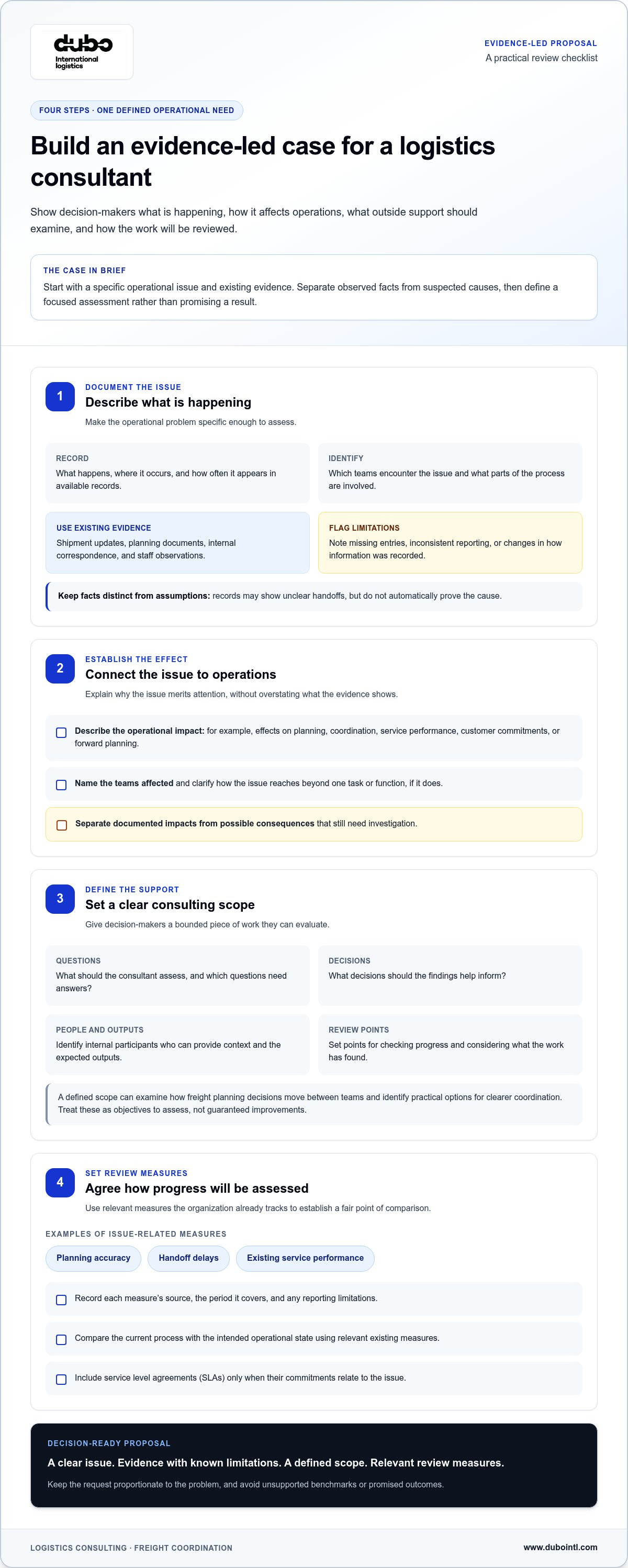
A focused proposal gives decision-makers something specific to assess: the issue, its operational effect, the support requested, and how the work will be reviewed. Keep the case proportionate to the problem. Existing records and observations can establish a useful starting point without relying on unsupported benchmarks or promised savings.
Use this four-step sequence to shape the case:
- Document the issue. Describe what happens, where it occurs, and how often it appears in the records available. Note gaps or inconsistent reporting rather than presenting incomplete data as definitive.
- Establish the operational effect. Explain how the issue affects planning, coordination, service performance, or another relevant part of the operation. Distinguish documented impacts from potential consequences that still need investigation.
- Define the support needed. State what you want the consultant to assess, which questions need answers, and what decisions the findings should inform.
- Set review measures. Agree on how the team will assess the work, when progress will be reviewed, and what evidence will be considered.
Baseline measures make a consulting proposal easier to assess because they show the current process and give the team a fair point of comparison.
Choose evidence leaders can evaluate
Select measures that connect directly to the issue, such as planning accuracy, handoff delays, or existing service performance. For each measure, record its source, the period it covers, and any limitations, such as missing entries or changes in how information was recorded. Compare the current process with the intended operational state using measures the organization already tracks. If existing service level agreements (SLAs) relate to the issue, include the relevant commitments. Don’t treat unrelated targets as proof of a problem.
Define a bounded consulting engagement
Keep the proposed work clear enough that decision-makers can see where it starts and what it should inform. Specify the questions to investigate, the expected outputs, the internal participants who can provide operational context, and the review points for checking progress. For example, the work might assess how freight planning decisions move between teams and identify practical options for clearer coordination. Present these as objectives to evaluate, not guaranteed improvements. A defined scope gives stakeholders clear boundaries while allowing findings to guide the next decision.
For organizations assessing logistics consulting alongside freight coordination needs, Dubo’s logistics expertise can inform the discussion. Visit www.dubointl.com to explore how a logistics partner can contribute practical freight and transportation knowledge to operational planning.
Address the main objection: can the internal team solve this alone?
It’s a fair question. Internal staff know the organization’s operating context, customer expectations, systems, and established working relationships. Any review should draw on that knowledge, not set it aside. The decision is whether the team can resolve the issue with its current expertise and capacity, or whether focused external support could help clarify the way forward.
An outside perspective can help when a problem exceeds available time or specialist insight, while internal expertise remains essential to understanding and assessing practical recommendations.
To weigh the options, consider four factors:
- Expertise: Internal staff bring company and process knowledge; an external specialist may add relevant logistics insight to a question the team hasn’t had the opportunity to examine in depth.
- Capacity: A capable team may still be committed to daily operational responsibilities. Consider whether it can investigate the issue without leaving other priorities unattended.
- Neutrality: People close to a long-standing process may hold different views about where a problem begins. An external review can organize those observations without asking one internal group to judge another.
- Decision scope: A contained process change may sit within one manager’s authority. An issue spanning teams, freight modes, or broader operational priorities may need a wider assessment.
When an internal-only approach may be sufficient
An internal response may be appropriate when the issue is contained, its cause is understood, an accountable owner is in place, and the team has capacity to act. For example, if a handoff step is clearly missing from an established process and the responsible teams agree on the remedy, staff may be able to address it directly. Set out the action, owner, and review point, then assess whether the change resolves the issue before proposing outside support.
When external logistics expertise may be useful
Consider external input when the same concern recurs across teams, modes, or carriers, or when complex freight requirements make it difficult to see how decisions affect one another. A neutral review can organize competing observations into questions, dependencies, and priorities for leadership to consider. The consultant should not be treated as the sole authority on the operation.
Internal staff should explain how work happens in practice, identify constraints that may not appear in records, and assess whether recommendations can be carried out. This shared approach helps distinguish a useful outside observation from a proposal that doesn’t fit the organization’s operating realities.
Before requesting approval, describe what the internal team has already tried, what remains unresolved, and what expertise or capacity is missing. This frames consulting as a complement to staff, not a replacement for their operational knowledge. It also gives decision-makers a sound basis for deciding whether to proceed with internal action, seek external support, or revisit the question later.
Presenting Logistics Proposals to Stakeholders
A sound proposal can lose momentum if stakeholders can’t see what they’re being asked to approve. Keep the presentation focused on the decision, not a broad account of every logistics concern. Use a clear sequence: describe the issue, summarize the evidence, define the proposed scope, assign roles, set review measures, and state the decision you need.
For getting buy-in for a logistics consultant, make the request specific. You might ask leaders to approve an initial assessment of a defined process, with a review point before any broader work is considered. This gives decision-makers a clear boundary and lets them evaluate the findings before deciding what comes next.
Tailor the case to each stakeholder
Adapt the emphasis to each audience, but keep the underlying evidence consistent. Operational leaders need to understand workflow impacts and how staff will contribute. Finance stakeholders need a transparent measurement approach, including what will be assessed and what information is available, without unsupported financial claims. Executives need to see how the issue relates to continuity, strategic priorities, and accountable decision-making.
Prepare concise answers to practical questions before the meeting. Will the assessment interrupt daily work? Who is accountable for decisions? What information will the consultant need, and who will coordinate access? How will recommendations be reviewed? If the work begins with an assessment, explain what it will cover and identify the decision point before broader work proceeds.
Turn approval into clear next steps
Approval should establish a workable process, not leave responsibilities open to interpretation. Identify the decision-maker, internal sponsor, staff contributors, and information needed to begin. Agree on scope boundaries, a suitable communication cadence, and who will review progress and findings. These details keep the work connected to operational realities and make it easier for participants to raise concerns early.
Where appropriate, propose an initial assessment with defined questions and outputs, then set a review meeting to decide whether further consulting is warranted. Consider what the assessment found, which recommendations are practical, and what additional work, if any, should be authorized. Keep review measures tied to the original issue instead of adding new goals without agreement.
A strategic logistics consulting discussion can also help frame how operational choices relate to longer-term priorities. In the presentation, be precise about what is known, what remains to be assessed, and which decision is required now. That clarity helps stakeholders evaluate the proposal on its merits while keeping the internal team involved.
To discuss your logistics priorities and shape a focused consulting conversation, connect with Dubo International Logistics.
How Dubo supports logistics consulting decisions and next steps
Logistics consulting is most useful when it stays connected to the decisions and freight activity it is intended to inform. Dubo International Logistics provides logistics consulting alongside freight forwarding and specialized transportation. Its work coordinating freight and complex cargo requirements brings practical context to discussions about operational planning, shipment coordination, and specialized cargo movement across Canada and North America.
This perspective can help a business frame a consulting question in relation to real freight operations. For example, a planning concern may involve how shipment requirements affect coordination between teams, or how a complex cargo movement fits into broader operational priorities. The purpose is to examine the question and inform decisions, not to assume a particular outcome in advance.
Dubo International Logistics is a member of the Canadian International Freight Forwarders Association (CIFFA), an industry association relevant to freight forwarding. This membership provides professional context when considering a logistics partner for a consulting discussion.
What a first consulting discussion should establish
Come prepared to describe the operational issue, the processes it touches, and the priorities that make it relevant now. Identify which teams understand the work, what information is available, and what decision the business needs to make. These details give the discussion a practical starting point.
From there, clarify the question to be addressed, the expertise that may be relevant, and the scope of any proposed assessment. A focused conversation can distinguish the immediate operational concern from wider planning questions, then identify what the team needs to evaluate before deciding on next steps. Don’t assume a particular result before assessing the issue and its context.
Connect consulting priorities with freight operations
A defined consulting question may relate directly to freight forwarding or specialized transportation planning. A business coordinating complex cargo, for instance, may need to understand how freight requirements affect operational decisions across teams. For cross-border movements between Canada and the United States, the discussion can also consider how the movement fits into the organization’s broader planning needs. Keep the focus on the specific question, relevant processes, and decisions the work should support.
As you prepare, bring together your internal team’s operational perspective and the freight coordination context relevant to the issue. This helps keep recommendations grounded in how the work is carried out and gives decision-makers a clear basis for considering the next step.
If your organization is getting buy-in for a logistics consultant, a focused discussion about the operational issue and freight priorities can establish a practical starting point. Visit www.dubointl.com to discuss your logistics priorities with Dubo.
Move your logistics priorities forward
Approval is not the finish line. It creates an opportunity to turn an unresolved logistics question into a considered next step, with the right people involved and a clear understanding of what the business needs to learn. Keep the focus on decisions that support dependable operations, and let the evidence gathered through the work guide what happens next.
For leaders, consulting is a practical part of operational planning, not an open-ended commitment. A well-framed discussion can clarify where external expertise fits, how it relates to freight activity, and what the organization should consider before proceeding. The internal team remains central to applying its knowledge and shaping actions that reflect the realities of the business.
Getting buy-in for a logistics consultant begins with a purposeful conversation about priorities. Dubo International Logistics provides freight forwarding, logistics consulting, and specialized transportation support, and is a member of the Canadian International Freight Forwarders Association. Take the next step by discussing your logistics priorities with Dubo International Logistics. A clear starting point can help your team move ahead with greater confidence.
Frequently Asked Questions
What does a logistics consultant do for a business?
A logistics consultant examines how freight and related operational activities fit together, then provides advice to support business decisions. Depending on the assignment, this may include mapping where information or responsibility passes between teams, identifying planning dependencies, or assessing options for a defined process. The result is a clearer view of the decisions involved, so leaders can determine which changes are practical and who should own them.
How do I convince leadership to hire a logistics consultant?
Make the request a decision leaders can assess, not a general endorsement of consulting. Explain what you need permission to examine, who will participate, and what the organization will receive for review. Getting buy-in for a logistics consultant is easier when leadership can see what remains undecided after the assessment and who will decide whether to proceed. Present proposed benefits as questions to evaluate, not promised results.
Can a logistics consultant work alongside an in-house team?
Yes. Internal staff can act as operational counterparts, explaining how work differs across shifts, shipment types, or customer requirements. They can also test whether a proposed process reflects actual responsibilities and constraints. For example, a planner might clarify why a shipment sequence changes, while the consultant helps examine the handoffs involved. Agreeing on a staff contact and review process helps keep findings grounded in day-to-day practice.
When should a business bring in an external logistics consultant?
Consider external advice when a decision has implications beyond one team’s remit, or when a business change creates new logistics questions. A new product with distinct handling needs, a shift in freight patterns, or repeated exceptions across shipment types may prompt a closer review. The trigger is not complexity alone; it’s whether the organization needs another perspective to assess options before committing to an operational change.
What information should I prepare before meeting a logistics consultant?
Bring a small, representative sample of the work rather than every available file. Useful context can include shipment profiles, planning documents, process instructions, examples of exceptions, and notes on earlier actions. Identify any customer commitments or cargo characteristics that constrain decisions, along with the teams involved. If information comes from different systems or uses inconsistent terms, flag that at the outset so the discussion can account for those limits.
How can a business measure whether logistics consulting is helping?
Choose measures that reflect the decision the consulting work is meant to inform. Alongside operational indicators, consider whether the team has clearer ownership, fewer unresolved planning questions, or more consistent use of an agreed process. Keep definitions stable during review so changes in reporting aren’t mistaken for changes in performance. Also consider whether an adjustment creates new complications elsewhere, such as extra coordination for another team.
Is logistics consulting suitable for a business with complex freight requirements?
It can be, particularly when cargo characteristics create planning dependencies that standard processes don’t address. Oversized machinery, fragile equipment, or temperature-sensitive products may require teams to consider handling and transportation needs together. A defined consulting question can help clarify which requirements shape the plan, where coordination decisions sit, and what information stakeholders need. The assessment should reflect the specific cargo and operating context rather than assume one approach fits every shipment.
