
A single centimetre of overhang or a missed provincial permit can ground a multi-million dollar project before it even leaves the yard. Managing oversized cargo transport across North America isn't just about hauling weight; it's a high-stakes orchestration of physics and shifting regulations. You likely already recognize that the patchwork of state and provincial rules is becoming more intricate as we move through 2026, often leading to unexpected delays or hidden costs from pilot cars and route surveys. At www.dubointl.com, we understand that these complexities require more than just equipment; they demand strategic foresight and a methodical approach to risk management.
This guide will help you master these logistics challenges by providing a comprehensive roadmap for planning, permitting, and executing heavy-haul shipments with absolute precision. We'll examine the critical differences between standard and specialized freight, explain the impact of new 2026 customs reforms, and show you how to select a logistics partner that acts as a stabilizing force for your supply chain. By the end of this article, you'll have the clarity needed to move your most challenging loads across borders without the stress of legal delays or cargo damage.
Key Takeaways
- Establish a foundation for success by conducting a comprehensive cargo dimension audit to identify physical bottlenecks before transit begins.
- Understand the strategic methodology required to manage the evolving permit regulations that govern oversized cargo transport across North America.
- Learn to select the appropriate specialized equipment, such as Removable Gooseneck trailers, while implementing rigorous lashing and bracing protocols for maximum safety.
- Evaluate the importance of professional credentials, including CIFFA membership, when choosing a partner to handle your most complex heavy-haul projects.
- Discover how to integrate these strategic insights into your operations and find additional resources for global movement at www.dubointl.com.
What Defines Oversized Cargo Transport in 2026?
Defining oversized cargo transport requires a shift from simple freight movement to a specialized engineering mindset. In the Canadian and broader North American context, cargo is classified as oversized when its dimensions or weight exceed the standard legal limits for road travel. While standard trailers accommodate loads within a predictable envelope, specialized freight requires a bespoke strategy to account for physical infrastructure limitations like bridge heights and lane widths. Understanding What Defines Oversized Cargo is the first step in ensuring a shipment remains compliant and safe throughout its journey.
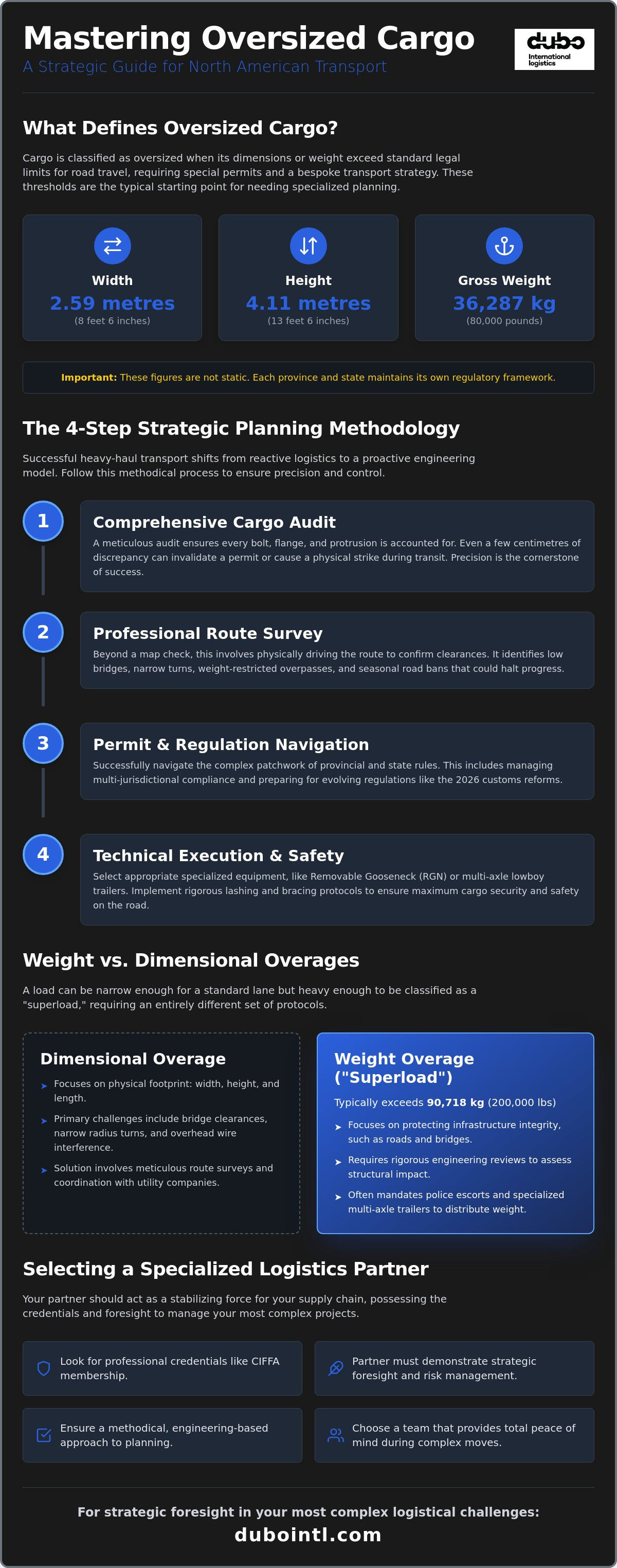
Standard North American thresholds typically trigger the need for permits when a load exceeds 2.59 metres (8 feet 6 inches) in width or 4.11 metres (13 feet 6 inches) in height. Weight limits often hover around 36,287 kilograms (80,000 pounds) gross vehicle weight. However, these figures are not static. Each province and state maintains its own regulatory framework; this makes the movement of large-scale assets a complex exercise in multi-jurisdictional compliance. For sectors like manufacturing and energy, this transportation mode is the lifeblood of project success, enabling the delivery of massive components that cannot be broken down into smaller pieces.
Common Examples of Specialized Cargo
The demand for specialized transportation often stems from industries that build on a grand scale. You'll frequently see oversized cargo transport utilized for:
- Industrial machinery and pre-fabricated construction modules that arrive ready for installation.
- Energy infrastructure components, specifically wind turbine blades and heavy-duty transformers.
- Aerospace assemblies and large-scale agricultural equipment like combines and seeders.
Legal Weight vs. Dimensional Overages
Distinguishing between dimensional overages and weight-based challenges is vital for successful execution. While a load might be narrow enough for a standard lane, its weight may classify it as a "superload" if it exceeds 90,718 kilograms (200,000 pounds) in many jurisdictions. These shipments require rigorous engineering reviews and often involve police escorts. Managing the footprint of such cargo relies on specialized trailers, such as multi-axle lowboys, which distribute weight effectively to protect road integrity and ensure safety. At www.dubointl.com, we prioritize this level of meticulous planning to provide our clients with total peace of mind during complex moves.
How to Plan Your Oversized Shipment: A Strategic Methodology
Precision is the cornerstone of every successful heavy-haul project. Managing oversized cargo transport requires a transition from reactive logistics to a proactive engineering model. The process begins with a meticulous cargo dimension audit; this ensures that every bolt, flange, and protrusion is accounted for before a trailer is even selected. Even a few centimetres of discrepancy can invalidate a permit or cause a physical strike during transit. By integrating logistics consulting Canada early in the design phase, shippers can often identify modifications that simplify the transport profile and reduce overall costs.
Once the dimensions are verified, the focus shifts to the path of travel. A preliminary route assessment identifies obvious hurdles, but truly massive loads require a professional route survey. This involves physically driving the route to confirm that theoretical clearances match reality. When Navigating Permits and Cross-Border Regulations, you'll find that many jurisdictions mandate these surveys for loads exceeding specific height or width thresholds. This methodical preparation transforms oversized cargo transport from a high-risk gamble into a controlled, predictable operation.
Conducting a Thorough Route Survey
A survey is much more than a map check. It's a granular investigation into low-clearance bridges, narrow radius turns, and weight-restricted overpasses that could halt progress. In Canada, seasonal road bans during the spring thaw significantly limit axle weights on secondary highways; this requires strategic rerouting or timing adjustments. Coordination with utility companies is also essential for managing overhead wire interference, as raising lines often requires multi-week lead times and specialized crews.
Scheduling and Timing Considerations
Timing in 2026 is influenced by both regulatory "blackout periods" and increasingly volatile weather patterns. Many provinces and states prohibit oversized moves during major holidays or peak traffic hours to ensure public safety. Winter conditions in the Rockies or the Canadian Prairies can introduce sudden delays that ripple through the entire schedule. Effective coordination with project cargo logistics Canada ensures that multi-stage deliveries remain synchronized despite these external variables. For those seeking a partner to architect these complex movements, the experts at www.dubointl.com provide the steady hand needed to maintain project momentum.
Navigating Permits and Cross-Border Regulations
Regulatory compliance is the invisible architecture that supports every successful heavy-haul move. While the physical transport is the most visible aspect, the administrative work behind oversized cargo transport often dictates the project's ultimate timeline and budget. In 2026, the complexity of multi-jurisdictional permitting has intensified, requiring a synchronized approach to secure approvals from every province and state along the route. Failing to align these permits perfectly can lead to costly border impounds or legal delays that ripple through an entire construction or energy project schedule.
A reliable Specialized Logistics Partner will manage the deployment of pilot cars and escort vehicles, which are mandatory for ensuring public safety during transit. These escorts act as a protective buffer between non-standard loads and civilian traffic, navigating tight turns and height-restricted zones with precision. Beyond basic safety, carriers must now adhere to the latest 2026 environmental regulations and safety standards, which govern everything from engine emissions to the specific lashing points used on specialized trailers. At www.dubointl.com, we treat this regulatory burden as a strategic priority, ensuring every shipment moves with full legal authorization and peace of mind.
Permit Requirements by Jurisdiction
Permit structures in Canada differ significantly from federal guidelines in the United States. While Transport Canada sets broad safety frameworks, provincial authorities in places like Ontario or British Columbia manage specific road weight and dimension thresholds. For instance, during the Victoria Day weekend in 2026, travel is prohibited for loads exceeding certain dimensions in British Columbia and Saskatchewan, requiring careful scheduling. Navigating the "superload" category adds another layer of scrutiny; these loads often require bridge stress analysis and engineering sign-offs from state or provincial departments of transportation before a single wheel turns.
Cross-Border Compliance and Documentation
Successfully shipping specialized cargo across border points requires more than just a permit. It demands deep customs expertise to manage accurate Harmonized Tariff Schedule (HTS) codes and valuation for complex industrial machinery. When handling cross-border freight forwarding Canada USA, documentation must be flawless to avoid secondary inspections that cause cascading delays. CIFFA-certified forwarders provide a crucial layer of regulatory credibility, acting as a stabilizing force between local manufacturers and complex international trade laws. This meticulous attention to detail ensures that your cargo crosses the border as smoothly as it travels the open highway.
Technical Execution: Equipment and Safety Protocols
Executing a heavy-haul move requires more than just raw power; it demands a sophisticated understanding of mechanical limits and safety engineering. The success of oversized cargo transport depends on selecting a trailer configuration that perfectly matches the cargo's centre of gravity and physical footprint. While standard flatbeds are versatile, they are often insufficient for specialized loads. Removable Goosenecks (RGN) are the industry standard for heavy self-propelled machinery because they allow for ground-level loading, while step-decks provide the necessary clearance for taller freight that would otherwise strike overhead obstacles. Every choice is a calculated balance between stability and road clearance.
Securement is a rigorous science rather than a simple checklist. It involves a methodical application of lashing, blocking, and bracing designed to counteract the immense kinetic forces generated during transit. In 2026, the integration of real-time tracking and monitoring technologies has become a standard expectation for high-value assets. Advanced telematics provide continuous data on load stability and vehicle health; this allows the team to realize and address even the slightest shift in the cargo before it becomes a safety risk. This level of technical oversight transforms a complex move into a predictable, manageable process.
Advanced Trailer Configurations
Weight distribution is the primary challenge when moving massive industrial components. Utilizing multi-axle trailers, such as 13-axle or 19-axle setups, allows carriers to spread the load across a larger surface area to comply with strict provincial and state axle-weight regulations. For extremely wide or tall loads, perimeter beams and dual-lane trailers offer a lower centre of gravity and enhanced stability. Ensuring all equipment is maintained to 2026 safety specifications is a non-negotiable requirement for maintaining the integrity of the supply chain and protecting the client's investment.
On-Site Safety and Risk Mitigation
Safety on the road is maintained through disciplined communication and clear protocols. Drivers and pilot car operators utilize dedicated radio frequencies to coordinate movements through tight turns and high-traffic corridors. Comprehensive cargo insurance is a vital component of risk mitigation, providing a final layer of security for specialized moves. Managing public relations is also essential; daylight moves with significant traffic impact require a professional approach to ensure the community remains informed and safe. Ensure your next heavy-haul project is supported by the highest technical standards by partnering with the experts in specialized transportation at www.dubointl.com.
Choosing a Specialized Logistics Partner
Selecting a partner for oversized cargo transport is a high-stakes decision that extends far beyond simply hiring a carrier. In the complex trade environment of 2026, you need a "Logistics Architect" who can design a bespoke solution for your specific cargo category. A standard carrier relationship often lacks the strategic depth required to manage the thousands of variables involved in moving industrial or energy assets across North America. Instead, prioritize partners who offer strategic consulting and can demonstrate a history of success with similar high-value projects. This ensures that your logistics provider acts as a stabilizing force rather than just a service vendor.
Professional certifications provide a baseline for reliability and regulatory credibility. CIFFA membership, for example, signals that a forwarder adheres to high professional standards and possesses the industry-literate expertise needed to navigate shifting international laws. When you request specialized transportation project fees, look for transparency in the methodology rather than just a bottom-line number. A comprehensive quote should account for the precision of route surveys, the cost of multi-jurisdictional permits, and the deployment of specialized rigging. This methodical approach ensures there are no hidden costs or legal surprises during the execution phase.
The Strategic Advantage of Professional Management
Entrusting your shipment to a professional team offers a significant strategic advantage by reducing internal administrative strain. By utilizing end-to-end freight management, businesses can focus on their core operations while experts handle the minute details of compliance and equipment coordination. Specialized consulting during the early stages of a project often identifies opportunities to reduce overall costs through better route selection or equipment optimization. This partnership model fosters longevity and consistency, providing a stabilizing force for your recurring oversized cargo transport needs.
Why Dubo International Logistics is the Trusted Choice
Dubo International Logistics positions itself as a dedicated, hands-on guide for businesses navigating the complexities of global movement. Our commitment to precision and strategic foresight ensures that every move is executed with seamlessness and excellence. We act as a protective steward of our clients' interests, delivering peace of mind through a methodical and highly organized approach to logistics. Visit www.dubointl.com to start your specialized cargo consultation and realize the benefits of a truly reliable logistics partnership.
Architecting Success for Your 2026 Heavy-Haul Projects
Managing large-scale assets across North America requires more than just transport; it demands a commitment to precision and strategic foresight. Success rests on a meticulous foundation of dimension audits and physical route surveys that eliminate guesswork before the trailer ever leaves the yard. Equally vital is the ability to navigate the shifting regulatory landscape of 2026, ensuring that permits and customs documentation are perfectly synchronized to prevent costly border delays. Mastering oversized cargo transport is about transforming a complex series of variables into a smooth, predictable operation that safeguards your investment.
As a CIFFA Certified Member and specialists in North American cross-border logistics, Dubo International Logistics provides the steady hand needed to protect your interests in a volatile global environment. Our team offers the bespoke strategic consulting required to solve the unique challenges of your most complex projects. You can Consult with a Logistics Architect at Dubo International to begin planning your next move with total clarity. With the right methodology and a dedicated partner by your side, you can move your heaviest loads with absolute confidence and peace of mind.
Frequently Asked Questions
How is oversized cargo defined in Canada for 2026?
Oversized cargo is generally defined as any load exceeding 2.59 metres in width or 4.11 metres in height. For 2026, specific municipal thresholds, such as those in Toronto, trigger the need for single-trip permits when a vehicle exceeds 4.15 metres in height or 50,000 kilograms in weight. These parameters require specialized transportation services to ensure the move remains compliant with provincial road safety standards.
What is the average lead time for securing oversized permits?
Lead times for securing permits typically range from five business days to several weeks, depending on the complexity of the route and the load's dimensions. Superloads or shipments requiring engineering reviews for bridge stress analysis often require at least 30 days of lead time. Strategic planning at www.dubointl.com helps minimize these administrative delays through early submission and methodical follow-up with provincial and state authorities.
Do I need a pilot car for every oversized shipment?
Pilot cars are not required for every shipment; they become mandatory only when a load exceeds specific width or height thresholds defined by each jurisdiction. Generally, shipments wider than 3.05 to 3.65 metres require at least one escort vehicle to manage traffic and ensure public safety. For extreme dimensions, multiple pilot cars and police escorts may be necessary to navigate narrow turns or bridge crossings safely.
How do cross-border regulations differ for specialized freight?
Cross-border regulations for specialized freight differ primarily in the complexity of customs documentation and the lack of uniformity between state and provincial permit rules. In 2026, shipments entering Mexico face heightened scrutiny under new customs reforms, requiring precise HTS codes and enhanced digital monitoring. Navigating oversized cargo transport across these borders requires a partner who understands the specific physical and legal requirements of each national authority.
Can oversized cargo be transported by rail or sea as well?
Oversized cargo can be transported by rail or sea, and these modes are often more cost-effective for extremely long distances or international movements. Sea freight is currently the fastest-growing segment for heavy-haul logistics, with a projected growth rate of 8.39% through 2031. These multi-modal solutions require specialized rigging and cranes at port or rail terminals to manage the transition between different types of trailers and vessels.
What are the main risks associated with heavy-haul transport?
The primary risks associated with heavy-haul transport include structural damage to cargo, infrastructure strikes, and significant legal delays at border crossings. Physical risks are often mitigated through rigorous route surveys and the use of specialized trailers like Removable Goosenecks. Administrative risks, such as permit invalidation due to minor dimension errors, are best managed through a methodical project audit and professional logistics consulting.
How much does oversized cargo transport cost on average?
The cost of transporting oversized cargo depends on a combination of permit fees, specialized equipment requirements, and the need for escort vehicles. For example, state-level permit fees in 2026 range from approximately $16 in California to over $445 for heavy overweight loads in Texas. Total project costs are also influenced by pilot car rates and the complexity of the route survey, making bespoke quotes essential for accurate budgeting.
What insurance coverage is necessary for specialized cargo?
Specialized cargo requires comprehensive "all-risk" cargo insurance that specifically covers the unique perils of heavy-haul movement. Standard carrier liability is often insufficient for the high valuations of industrial machinery or energy infrastructure. It's essential to verify that your insurance policy includes coverage for loading and off-loading operations, as well as any potential environmental liabilities that could arise during a complex move.

