

A single clerical error in your digital commercial accounting declaration can now trigger daily compounded interest and immediate financial penalties. For many businesses, logistics has become a source of persistent anxiety rather than a routine operational task. You likely realize that selecting a partner based solely on the lowest quote often leads to hidden fees, specialized equipment shortages, and frustratingly opaque communication. Knowing how to choose a freight forwarder Canada requires a shift in perspective; you aren't just looking for a vendor, but a strategic logistics architect who can navigate the complexities of the 2026 trade environment.
This article provides a comprehensive framework to help you identify a partner who prioritizes precision and compliance over mere volume. We'll examine the essential criteria for vetting providers, from their integration with the CARM Client Portal to their mastery of shifting CUSMA regulations. By following this strategic checklist, you can establish a reliable partnership that ensures predictable shipping timelines and total peace of mind for your Canadian business operations.
Key Takeaways
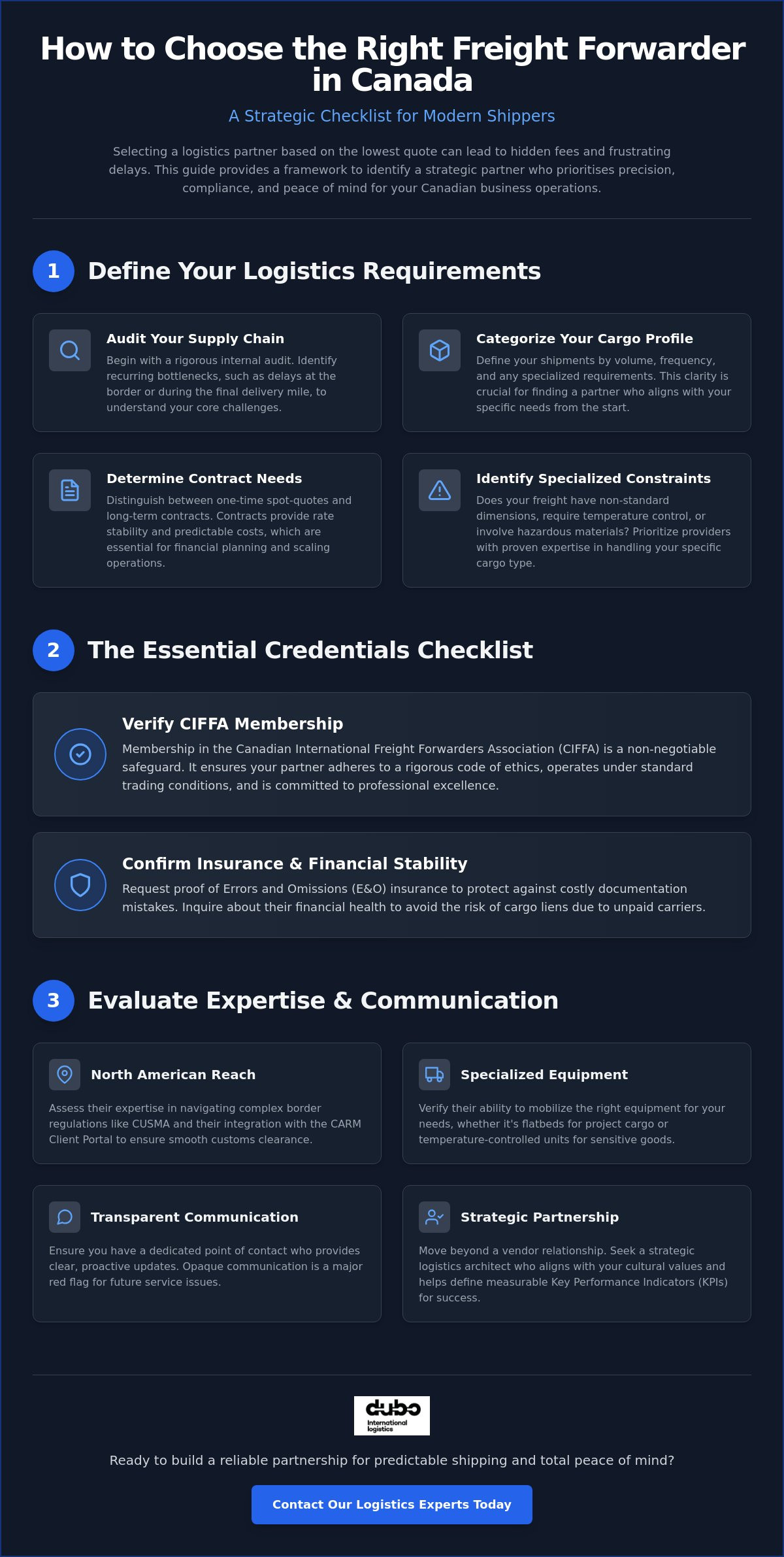
- Conduct a thorough audit of your internal supply chain to identify recurring bottlenecks and define your specific cargo profile before beginning your search.
- Learn how to choose a freight forwarder Canada by vetting for CIFFA membership and verifying that their liability insurance provides comprehensive coverage for your industry’s unique requirements.
- Assess a provider’s specialized expertise in navigating complex North American border regulations and their ability to mobilize equipment for non-standard or project cargo.
- Evaluate communication responsiveness and transparency to ensure you have a dedicated point of contact who provides clear updates throughout the shipping lifecycle.
- Establish a foundation for a long-term strategic partnership by aligning cultural values and defining measurable Key Performance Indicators that track logistics efficiency.
Defining Your Logistics Requirements and Cargo Profile
A successful logistics strategy begins with a rigorous internal audit rather than a search for the lowest rate. Before you can determine how to choose a freight forwarder Canada, you must first identify the recurring bottlenecks that currently hinder your supply chain. These pain points often reveal whether you require a simple transactional service or a more integrated partnership. To gain a clearer perspective on the industry's foundational role, it's useful to review What is a Freight Forwarder? and how they bridge the gap between shippers and carriers. Identify where your delays occur. Is it at the border, or during the final delivery mile?
Categorizing your cargo by volume, frequency, and specialized requirements is a prerequisite for any meaningful consultation. You should decide if your business has the internal capacity to manage complex documentation or if your growth requires a provider capable of full end-to-end freight management. A generalist might suffice for standard palletized goods, but specialized transportation experts are necessary for cargo that defies conventional dimensions. When you understand how to choose a freight forwarder Canada, you realize that the most effective partners are those who align with your specific cargo profile from the outset.
Understanding Your Shipping Volume and Frequency
Distinguishing between spot-quote requirements and long-term contract needs is vital for maintaining rate stability. While spot-quotes offer flexibility for occasional shipments, they leave you vulnerable to market volatility. Conversely, long-term contracts provide a predictable cost structure that simplifies your financial planning. You must also identify seasonal peaks within your specific industry. A reliable partner should possess a scalable carrier network that can accommodate sudden surges in volume without compromising on service quality. Evaluate if your business requires deep North American regional expertise or a broader global reach to support your expansion goals.
Identifying Specialized Cargo Constraints
Non-standard freight requires a higher level of strategic foresight and technical expertise. You need to define the exact dimensions and weight restrictions of your cargo to ensure your forwarder has access to the correct specialized equipment. This might include flatbeds for oversized machinery or temperature-controlled units for sensitive goods. High-value shipments also demand enhanced security protocols. If your cargo profile includes project cargo or hazardous materials, your selection process must prioritize providers who demonstrate a proven track record in handling these specific constraints with precision and care.
The Essential Credentials Checklist for Canadian Forwarders
Credentials serve as the bedrock of a secure logistics partnership. When determining how to choose a freight forwarder Canada, you shouldn't view certifications as optional accolades, but as non-negotiable safeguards for your commercial interests. A provider's professional affiliations and insurance policies tell the story of their commitment to excellence and their ability to protect your assets in a volatile trade environment. By verifying these credentials early, you eliminate the risk of partnering with an unqualified entity that could jeopardize your supply chain.
The Value of CIFFA Membership
Verify membership in the Canadian International Freight Forwarders Association (CIFFA). This isn't merely about industry prestige. CIFFA members must adhere to a rigorous code of ethics and professional conduct that protects the shipper. These firms operate under standardized trading conditions, which clarify the responsibilities and liabilities of all parties involved in a shipment. If you want to dive deeper into why this matters, read our guide on understanding the value of a CIFFA certified forwarder. This membership ensures that your partner is committed to a high-professional register and ethical transparency.
Insurance and Financial Stability
Liability insurance provides a vital layer of security. Always request proof of Errors and Omissions (E&O) insurance to protect your business against documentation mistakes. These errors often lead to costly delays at the border or administrative penalties. You should also inquire about the forwarder's financial health. An unstable provider may fail to pay carriers, which could lead to cargo liens being placed on your goods even after you've settled your invoice. Analyze the smoothness of their claims process. A reliable partner should have clear protocols for handling cargo damage or loss, ensuring that you aren't left stranded during a crisis.
Compliance with the Canada Border Services Agency (CBSA) remains the final, critical hurdle. With the full implementation of CARM on January 1, 2026, the importer of record bears legal responsibility for all duties and taxes. Your forwarder must demonstrate a proven track record of navigating the CARM Client Portal and the digital Commercial Accounting Declaration (CAD). If you're unsure about your current level of compliance, seeking logistics consulting can provide the clarity needed to avoid Administrative Monetary Penalty System (AMPS) fines. Knowing how to choose a freight forwarder Canada involves finding an expert who acts as a protective steward of your regulatory standing and financial peace of mind.
Evaluating Specialized Expertise and North American Reach
While credentials establish a baseline of trust, the true measure of a partner is their ability to execute in the field. When you're determining how to choose a freight forwarder Canada, you must look beyond their office walls to their physical network and regional mastery. North American logistics is uniquely demanding. It requires a partner who understands the nuances of regional infrastructure and the shifting tides of transborder trade. A forwarder with a robust, vetted carrier network can secure capacity even during market fluctuations, ensuring your goods don't sit idle when demand spikes or equipment becomes scarce.
Navigating the Canada-USA Border
Crossing the border is often the most vulnerable stage of a shipment's journey. You need a partner with deep expertise in CUSMA regulations to ensure your goods qualify for duty-free status whenever possible. This is particularly vital given the scheduled CUSMA review in July 2026, which may introduce new complexities to trade flows between Canada, the US, and Mexico. Effective cross-border freight forwarding involves more than just filing paperwork; it requires proactive coordination to prevent costly border holds. Your chosen partner should have a refined process for validating documentation before the truck ever reaches the lane, ensuring a seamless transition across the 49th parallel.
Managing Complex and Oversized Shipments
Strategic consulting plays a pivotal role in this selection process. A forwarder shouldn't just book a truck; they should optimize the entire route to reduce transit times and mitigate risks. This level of foresight is a hallmark of a mature partner. They'll pre-plan routes to avoid construction delays or height restrictions that could derail a specialized project. When considering how to choose a freight forwarder Canada, prioritize those who offer this level of meticulous execution. It's the difference between a shipment that simply arrives and one that arrives exactly as planned, without the stress of unforeseen complications or hidden transit costs.
Vetting for Transparency and Strategic Communication
Communication serves as the pulse of any successful logistics operation. If you find yourself chasing a provider for updates while your shipment is mid-transit, the partnership has already failed a fundamental test. When you're evaluating how to choose a freight forwarder Canada, the responsiveness of a team during the initial quoting phase often mirrors their performance during a crisis. A reliable partner doesn't just provide a portal; they provide a dedicated point of contact who understands the nuances of your cargo and the specific requirements of your industry. You need a partner who values clarity as much as you value your cargo's security.
The "Logistics Architect" Approach to Communication
A true logistics architect operates with a proactive mindset rather than a reactive one. You should look for a partner who identifies potential disruptions, such as port congestion or seasonal weather patterns, before they impact your timeline. This level of strategic foresight allows for the adjustment of routes or schedules in real time, mitigating risks that would otherwise lead to costly delays. Successful end-to-end freight management depends on this seamless flow of data and human expertise. Ask potential partners about their problem-solving methodology. How do they communicate a delay, and what specific steps do they take to recover the schedule?
Decoding the Quote: Avoiding Hidden Costs
Transparency in pricing is the cornerstone of long-term professional trust. You must request a comprehensive breakdown of all potential charges to avoid the frustration of unexpected surcharges or administrative fees. A quote that appears lower at first glance may actually be more expensive once you factor in documentation fees, fuel surcharges, and local handling costs. You should always compare providers based on the "total cost of ownership" rather than just the initial freight rate. This approach ensures that your logistics budget remains predictable and that you aren't penalized for a provider's lack of clarity during the bidding process.
A sophisticated partner will take the time to explain every line item, ensuring you realize exactly what you're paying for and why. This level of openness eliminates the stress of hidden costs and allows you to focus on your core business growth. If you're tired of navigating opaque quotes and inconsistent updates, it's time to work with a team that prioritizes your peace of mind. Request a transparent logistics consultation today to experience a partnership built on precision and strategic communication. Mastering how to choose a freight forwarder Canada means selecting a guide who is as committed to your success as you are.
Moving Toward a Strategic Logistics Partnership
The final step in your selection process should involve a consultation focused on cultural alignment and shared business goals. While technical proficiency is essential, the long-term success of your supply chain depends on a partner who shares your commitment to excellence and reliability. When you realize that your logistics provider acts as a direct extension of your brand, the importance of this cultural fit becomes clear. You aren't just hiring a vendor to move freight; you're engaging a partner who will protect your interests at every border crossing and transit point. This final meeting allows you to assess their dedication to meticulous execution before signing a contract.
Transitioning from a transactional mindset to a collaborative model is the only way to build true supply chain resilience. In a volatile global market, a stable partner provides a level of security that a budget-focused provider simply cannot match. By choosing a partner who prioritizes strategic foresight, you ensure that your business is prepared for the regulatory shifts and market fluctuations typical of the Canadian trade environment. This shift in perspective is the most critical element of knowing how to choose a freight forwarder Canada that can support your growth for years to come.
Setting Success Metrics for Your Forwarder
Establishing clear Key Performance Indicators (KPIs) ensures that both parties remain accountable and aligned. These metrics should be concrete and measurable, including on-time delivery percentages, billing accuracy, and response times to inquiries. You should establish a regular review cadence to discuss these results and explore new strategies for efficiency. Integrating supply chain optimization consulting into these reviews allows you to move beyond daily operations and focus on long-term cost reduction. A structured approach to performance management transforms the relationship from a simple service into a powerful driver of business growth.
The Final Selection: Trust and Reliability
A "stable partner" is always more valuable than a "cheap provider" when cargo is at stake. Reliability is the currency of international trade. You need a partner who acts as a protective steward of your interests, someone who understands the grand scale of global movement but remains focused on the minute details of your specific needs. Dubo International Logistics positions itself as this stabilizing force, offering the quiet confidence that comes from professional management and industry-literate expertise. We invite you to experience a partnership where precision is the standard and your peace of mind is the ultimate goal.
Selecting the right partner is the most important logistics decision you'll make this year. By following this strategic checklist, you've learned how to choose a freight forwarder Canada based on credentials, expertise, and transparency. Now is the time to finalize your choice and move toward a more resilient, organized, and predictable supply chain. Your business deserves a partner who values longevity and consistency as much as you do.
Strengthening Your Logistics Foundation
Mastering the selection process requires moving beyond a simple rate comparison to find a partner who acts as a dedicated steward of your commercial interests. You've now seen that knowing how to choose a freight forwarder Canada involves a rigorous audit of your cargo profile, a verification of ethical CIFFA standards, and a demand for absolute pricing transparency. These strategic steps ensure that your business remains compliant with shifting 2026 regulations while maintaining the predictable timelines necessary for sustainable growth. A well-vetted partnership reduces operational stress and transforms your supply chain into a competitive advantage.
As an independent CIFFA member specializing in North American cross-border logistics and specialized, oversized cargo transportation, Dubo International Logistics provides the strategic foresight your business requires. We invite you to Partner with Dubo International Logistics for seamless North American freight management. Our team is ready to act as your logistics architect; we focus on the minute details so you can lead your industry with quiet confidence. Your path to a resilient and professionally managed supply chain starts with a single, professional conversation.
Frequently Asked Questions
What is the difference between a freight forwarder and a customs broker in Canada?
A freight forwarder organizes the physical transportation of goods across the global supply chain. A customs broker focuses on the regulatory requirements for clearing those goods through the Canada Border Services Agency. While forwarders manage the logistics and carrier networks, brokers handle the specific duties and taxes. Many businesses utilize both services to ensure a seamless flow from the point of origin to the final destination.
Do I need a freight forwarder for domestic shipments within Canada?
How much does it cost to hire a freight forwarder in Canada?
Pricing is determined by several factors, including the weight and dimensions of the cargo, the distance travelled, and the mode of transport. Some providers charge per shipment, while others offer contract rates for high-frequency shippers. You should request a transparent breakdown of all potential surcharges to understand the total investment required for your specific cargo profile.
Is CIFFA membership mandatory for freight forwarders in Canada?
CIFFA membership is voluntary, yet it remains a hallmark of a reliable logistics partner. It signals that a firm adheres to a professional code of conduct and utilizes industry-recognized trading conditions. When you learn how to choose a freight forwarder Canada, you'll find that these credentials provide a layer of security and accountability that non-member firms may lack.
Can a freight forwarder help me ship oversized or specialized cargo to the USA?
Specialized forwarders excel at managing oversized or project cargo that requires non-standard equipment. They navigate the varying provincial and state regulations for height, weight, and escort requirements. Their role is to ensure that your specialized freight moves without interruption across the Canada-USA border, utilizing the correct permits and trailers for the specific job.
What happens if my cargo is damaged while being managed by a forwarder?
Your forwarder acts as an intermediary to help facilitate the claims process with the carrier's insurance provider. They document the condition of the goods at various transit points and provide the necessary evidence to support your claim. It's essential to confirm that your partner maintains robust liability insurance to protect your interests in the event of an unforeseen incident.
How do I know if I am getting a competitive shipping rate?
You can identify a competitive rate by comparing the level of service and reliability alongside the final dollar amount. A low rate that results in frequent delays or hidden surcharges is not truly competitive. Focus on providers who offer strategic consulting and transparent communication, as these factors lead to better long-term value for your business.
What documents do I need to provide to my freight forwarder for a cross-border shipment?
The primary requirements include a commercial invoice, a detailed packing list, and a bill of lading. Since the full implementation of CARM on January 1, 2026, importers must also be registered in the CARM Client Portal to manage their financial security and accounting declarations. Providing these documents accurately is a vital part of how to choose a freight forwarder Canada who can guarantee a smooth border crossing.

