

The perceived safety of managing your own shipping might actually be the very thing increasing your operational risk in 2026. Most Canadian business leaders feel that keeping everything under one roof provides better control, yet the reality of rising overhead and the complexity of modern trade often tells a different story. You're likely feeling the weight of managing cross-border compliance, especially since the U.S. de minimis exemption was permanently suspended on June 24, 2026. Every commercial shipment now requires formal entry, adding a layer of administrative burden that can quickly overwhelm an internal department.
This strategic comparison of freight forwarding vs in-house logistics will help you determine which model provides the predictable costs and seamless movement your Canadian business requires. At Dubo International (www.dubointl.com), we believe that true control comes from strategic foresight rather than just proximity. We'll examine how the 2026 regulatory environment, including the new Consolidated Administration and Processing of Entries (CAPE) platform for IEEPA tariff refunds, impacts your organizational choice. This guide provides a clear look at how to stabilize your supply chain and protect your bottom line against the volatility of today's global market.
Key Takeaways
- Realize the financial benefits of shifting from fixed internal overhead to a variable cost model that scales directly with your actual shipping volume.
- Navigate the intensified 2026 regulatory landscape with precision, ensuring your cross-border documentation meets the latest U.S. and EU entry requirements.
- Evaluate the strategic trade-offs of freight forwarding vs in-house logistics to determine which model offers the highest degree of operational agility for your cargo.
- Discover how strategic consulting can help you identify and eliminate hidden inefficiencies within your current North American supply chain.
- Learn how a seasoned partner at www.dubointl.com can provide the end-to-end coordination required to transform your logistics into a stabilizing force for your business.
Defining the Landscape: Freight Forwarding and In-House Logistics
Selecting the right framework for your supply chain determines the structural integrity of your entire operation. The debate between freight forwarding vs in-house logistics isn't merely a choice of service; it's a choice between building an internal department or partnering with an external orchestrator. For Canadian firms, this decision carries significant weight. You face vast geographies and a complex border where regulations shifted fundamentally in mid-2026. A high-performing supply chain requires a "logistics architect" who views the movement of goods as a strategic asset rather than a back-office expense. This specialized perspective ensures that your chosen model supports long-term growth instead of creating bottlenecks as you attempt to scale.
The Architecture of In-House Logistics
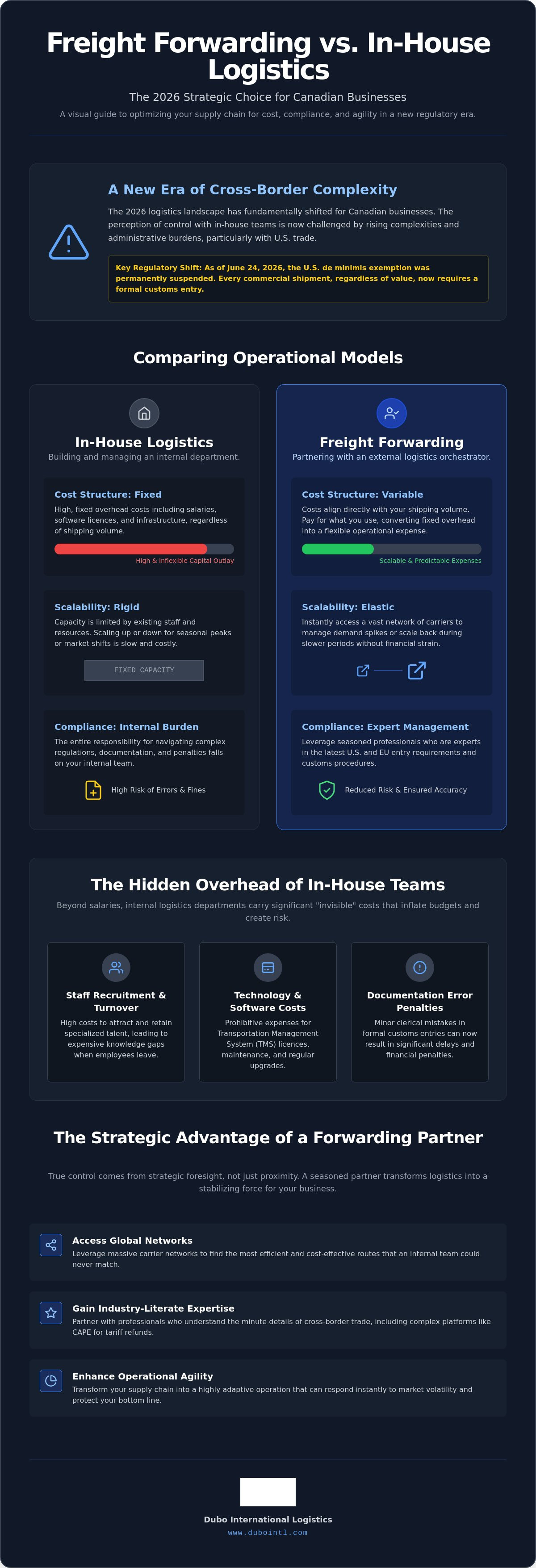
Maintaining an internal logistics team demands a substantial investment in specialized staff, transport management software, and direct carrier contracts. Many businesses prefer this model because it offers immediate, hands-on oversight. You can walk down the hall to check on a shipment or pivot priorities instantly. However, this proximity often masks hidden rigidities. Internal teams frequently struggle during seasonal peaks or sudden market shifts, as their capacity is limited by fixed headcount and existing software capabilities. These fixed costs remain even when shipping volumes dip, creating financial strain during slower quarters. It's a model built on control, yet it often lacks the elasticity required to thrive in a volatile North American market.
The Strategic Role of a Freight Forwarder
A professional freight forwarder functions as a sophisticated bridge between your business and global transport systems. If you're seeking a foundational definition of What is a Freight Forwarder?, consider them an orchestrator who manages the movement of cargo without necessarily owning the physical assets. They leverage massive carrier networks to find the most efficient routes and rates, providing a level of agility that internal teams rarely match. This model offers a comprehensive range of professional freight forwarding services that adapt to your specific needs, from standard truckloads to specialized cargo. By partnering with the seasoned experts at www.dubointl.com, you gain access to industry-literate professionals who understand the minute details of cross-border trade. This partnership transforms logistics from a source of daily stress into a seamless, well-planned operation that protects your interests at every turn.
Evaluating the Financial Impact: Fixed vs. Variable Cost Models
Financial transparency is the cornerstone of a resilient supply chain. When comparing freight forwarding vs in-house logistics, the most significant differentiator is the transition from rigid fixed costs to a flexible variable model. Maintaining an internal department requires a constant capital outlay regardless of market conditions or shipping volume. In contrast, a partnership with a forwarder allows you to align your expenses directly with your operational output. Total cost of ownership in 2026 logistics represents the sum of all direct and indirect expenses, including procurement, regulatory compliance, and the capital risk associated with supply chain volatility.
The Hidden Overhead of Internal Teams
Building an internal team involves far more than just salary. Recruitment and retention of specialized logistics professionals in Canada has become increasingly expensive, with turnover often leading to costly knowledge gaps and lost labour hours. Beyond payroll, the expense of maintaining a modern Transportation Management System (TMS) can be prohibitive for small to medium-sized firms. There's also the financial risk of documentation errors. With the June 24, 2026, permanent suspension of the U.S. de minimis exemption, even minor clerical mistakes in formal customs entries can lead to significant penalties and delays. These "invisible" costs often inflate the internal budget far beyond the initial projections, making the freight forwarding vs in-house logistics debate a matter of long-term solvency.
Scalability and Variable Pricing in Forwarding
A professional forwarder offers an elastic solution that grows alongside your business goals. You don't need to hire more staff when your volume spikes; you simply utilize more of your partner's capacity. Forwarders also provide access to superior buying power. While an individual company might struggle with spot rates that increased by 120% for transpacific routes in mid-2026, forwarders leverage their aggregate volume to negotiate more stable pricing with international carriers. Utilizing logistics consulting can further refine this approach by identifying specific areas where your supply chain is leaking capital. This strategic oversight ensures you aren't just moving goods, but doing so with maximum financial efficiency. If you're ready to stabilize your overhead, consider how a partnership with Dubo International could transform your cost structure from a liability into a competitive advantage.
Complexity and Compliance: Navigating Regulatory Hurdles
Compliance is the silent engine of a successful supply chain. When businesses weigh freight forwarding vs in-house logistics, they often overlook the sheer volume of regulatory shifts that can halt an operation overnight. In 2026, the complexity of cross-border trade between Canada and the USA reached a new peak. Precision in documentation is no longer just a best practice; it's a mandatory requirement for border fluidity. Independent cargo management carries significant legal and financial liabilities that many internal teams aren't equipped to handle. A professional forwarder acts as a protective steward of your regulatory standing, ensuring your business remains in good favour with customs authorities while avoiding the heavy fines associated with non-compliance.
Managing Cross-Border Compliance
The movement of goods across the 49th parallel requires a nuanced understanding of evolving trade policies. As of June 24, 2026, the U.S. de minimis exemption for shipments valued under $800 was permanently suspended. This means every commercial shipment, regardless of its value, now requires formal customs entry and full duty payment. An internal team might struggle to manage this sudden administrative surge, whereas a partner specializing in cross-border freight forwarding possesses the systems to automate these entries. They also navigate the new Consolidated Administration and Processing of Entries (CAPE) platform, which launched on April 20, 2026, to manage IEEPA tariff refunds. This level of specialized focus mitigates the risk of border seizures and ensures your goods move without friction.
The Value of Professional Certification
Trust is built on verified standards. Choosing a CIFFA certified freight forwarder provides a benchmark for reliability that internal departments simply cannot replicate. Membership in the Canadian International Freight Forwarders Association (CIFFA) requires adherence to strict ethical and professional standards, serving as a milestone for security in your supply chain. This certification offers business owners peace of mind, knowing that their "logistics architect" is held accountable by a national governing body. By partnering with the experts at www.dubointl.com, you ensure that your logistics model is anchored by industry-literate professionals who prioritize the integrity of your cargo.
- Precision: Automated compliance checks reduce human error in formal entries.
- Expertise: Deep knowledge of Section 232 tariffs and pharmaceutical trade regulations.
- Resilience: Immediate adaptation to Supreme Court rulings affecting tariff collections.
- Reliability: CIFFA membership as a guarantee of professional conduct and cargo safety.
This commitment to excellence transforms the freight forwarding vs in-house logistics decision from a simple cost comparison into a strategic risk-mitigation exercise. Protecting your business from the volatility of international trade requires more than just a dedicated staff; it requires a partner with the foresight to anticipate regulatory changes before they impact your bottom line.
Operational Agility: Scaling Your Supply Chain for Growth
Adapting to Market Fluctuations
Market volatility in 2026 requires a high degree of elasticity that few internal departments can sustain. While a small internal team is limited by its specific carrier contracts and local knowledge, a global forwarding network offers immediate access to alternative routes and diverse modes of transport. This flexibility is vital as truckload and parcel shipping costs remain elevated through the third quarter of 2026 due to high fuel prices and tight carrier capacity. Rapid growth often exposes gaps in internal processes. By avoiding common freight forwarding mistakes, such as failing to secure space in advance during peak surges, you protect your supply chain from the delays that plague less prepared competitors. This shift toward a "buffered" logistics model allows you to maintain consistency even when the broader market is in flux.
Handling Specialized and Oversized Cargo
Non-standard cargo presents technical challenges that often exceed the capabilities of general internal logistics departments. Transporting heavy machinery, sensitive electronics, or oversized industrial components requires a deep understanding of specialized freight North America regulations and equipment requirements. These projects demand meticulous planning, from conducting route surveys to securing specialized permits across multiple jurisdictions. While some businesses hesitate at the associated project fees, these should be viewed as a strategic investment in cargo safety and risk mitigation. An internal team simply doesn't have the daily exposure to these complexities to manage them with the necessary precision. If your cargo requires a bespoke approach that standard carriers can't provide, the seasoned experts at Dubo International can architect a specialized transportation plan that ensures your most valuable assets arrive safely and on schedule.
Choosing a model that prioritizes operational agility allows your business to move from a reactive stance to a proactive one. This transition is essential for Canadian companies looking to expand their footprint across North America. By leveraging external expertise, you ensure that your logistics framework is a catalyst for growth rather than a limitation. The "logistics architect" approach focuses on the minute details of your individual needs while maintaining a view of the grand scale of global movement, creating a seamless experience for both you and your customers.
Making the Strategic Decision for Your Business
Strategic decision-making in 2026 demands a shift from reactive problem-solving to proactive supply chain architecture. The choice of freight forwarding vs in-house logistics isn't necessarily an all-or-nothing proposition; many successful Canadian firms now adopt a hybrid model to maximize their resilience. Your framework for evaluation should prioritize three core pillars: financial predictability, regulatory safety, and the ability to scale without friction. Optimization, rather than simple movement, is the ultimate objective for any modern business looking to secure its place in the North American market. A proactive transition now ensures your operation isn't left vulnerable to the infrastructure pressures and rate volatility that defined the first half of this year.
- Capacity Audit: Does your team have the bandwidth to handle the projected record of 2.47 million TEUs entering North American ports this July?
- Compliance Check: Can your internal staff manage the formal customs entry requirements and IEEPA refund requests established in early 2026?
- Cost Analysis: Are your fixed payroll and software expenses becoming a liability during seasonal dips in shipping volume?
When to Keep Logistics In-House
Internal management remains the most efficient option for businesses with extremely high, predictable volumes on fixed domestic routes. If your shipping lanes rarely change and your demand is steady enough to justify the full-time labour of a dedicated team, keeping certain functions internal can offer a sense of direct control. However, internal "logistics literacy" remains essential even when you decide to outsource. Your team needs to understand the fundamentals of global trade to collaborate effectively with an external partner, ensuring that your strategic goals are clearly communicated and executed. Without this internal baseline, you risk losing the strategic oversight required to manage a modern supply chain.
Integrating a Freight Forwarding Partner
Transitioning from a DIY model to a professional partnership requires a commitment to transparency and data integration. The first step involves a comprehensive audit of your current inefficiencies, followed by the selection of a partner who acts as a dedicated extension of your business. Sharing real-time inventory data and sales forecasts allows your forwarder to architect a bespoke plan that anticipates market shifts before they impact your bottom line. We invite you to visit www.dubointl.com to explore how our strategic consulting and specialized transportation services can help you realize a more resilient and optimized supply chain. This proactive shift ensures that your Canadian business is prepared for the complexities of 2026 and beyond, turning your logistics framework into a powerful catalyst for growth.
Building a Resilient Framework for North American Trade
Choosing the right path for your supply chain determines your ability to thrive in a volatile market. We've explored how transitioning from fixed internal overhead to a variable cost model provides the financial elasticity required to scale. You've also seen how the permanent suspension of the U.S. de minimis exemption on June 24, 2026, has made professional regulatory oversight a necessity rather than a luxury. The strategic choice of freight forwarding vs in-house logistics ultimately centres on whether you want to manage an internal department or optimize a strategic asset that drives growth.
As specialized North American transportation experts and a CIFFA certified member, we provide the steady authority needed to navigate these complexities. Our strategic logistics consulting identifies inefficiencies before they impact your bottom line, ensuring your goods move with precision and peace of mind. Experience the precision of professional cargo coordination; visit Dubo International Logistics today. We're here to act as your dedicated logistics architect, providing the stability your business deserves as you expand your reach across the continent.
Frequently Asked Questions
What is the primary difference between freight forwarding and in-house logistics?
The primary difference lies in the ownership of the process versus the ownership of the result. In-house logistics relies on your internal staff and fixed software assets to manage shipments. Conversely, freight forwarding involves partnering with an external orchestrator who utilizes a global network to move goods. This distinction is crucial when evaluating freight forwarding vs in-house logistics, as forwarding provides a flexible framework that adapts to market shifts without increasing your permanent headcount.
Is it more cost-effective for a Canadian business to outsource freight management?
Outsourcing is often more cost-effective for Canadian businesses because it converts fixed salary and overhead expenses into variable costs. You only pay for the services you use, which is essential during periods of fluctuating demand. Freight forwarders also leverage aggregate volume to negotiate better rates with international carriers. This buying power, combined with strategic consulting from experts at www.dubointl.com, helps identify and eliminate hidden inefficiencies within your existing supply chain.
How does a freight forwarder help with cross-border compliance between Canada and the USA?
A freight forwarder acts as a sophisticated guide through the shifting landscape of North American trade regulations. They manage the minute details of formal customs entries, which became mandatory for all commercial shipments following the 2026 de minimis suspension. By staying updated on Supreme Court rulings and tariff refunds, forwarders ensure your documentation is precise. This proactive approach prevents border seizures and avoids the heavy fines that often catch internal departments off guard.
Can a freight forwarder handle specialized or oversized cargo better than an internal team?
Professional forwarders are better equipped to handle non-standard cargo because they maintain relationships with specialized carriers and equipment providers. Transporting oversized or sensitive goods requires technical route surveys and specific permits across various jurisdictions. Internal teams rarely have the daily exposure to these complexities required to manage them safely. Forwarders provide the strategic foresight needed to architect a specialized movement plan that protects your most valuable assets throughout their journey.
What are the risks of managing logistics entirely in-house?
The risks of managing logistics entirely in-house include financial rigidity and increased regulatory liability. If your internal team makes an error in documentation, your business is directly responsible for the resulting penalties and delays. Internal departments often lack the agility to respond to sudden infrastructure pressures or port congestion. This lack of scalability can create significant bottlenecks that hinder your ability to meet customer expectations during peak growth periods.
How do I know if my business is ready to switch to a professional freight forwarder?
Your business is likely ready to switch when the administrative burden of shipping starts to detract from your core operations. If you're experiencing frequent border delays or finding it difficult to manage rising fuel surcharges, it is time to consult a professional. You can explore bespoke solutions at www.dubointl.com to see how an external partner can streamline your movement. A switch is often the most strategic move for businesses looking to professionalize their supply chain.
Does a freight forwarder provide insurance for my cargo?
While freight forwarders are not insurance companies, they play a critical role in facilitating comprehensive cargo protection for their clients. They ensure that your goods are covered by appropriate liability policies and can arrange for additional "all-risk" insurance through trusted partners. This provides a layer of security that internal teams might overlook. Having a forwarder manage these details ensures that your financial interests are protected in the event of unforeseen transit disruptions.
What role does CIFFA certification play in choosing a logistics partner?
CIFFA certification serves as a milestone of reliability and professional excellence in the Canadian logistics industry. Membership requires adherence to strict ethical standards and a demonstrated level of industry literacy. When you choose a CIFFA-certified partner, you're working with an expert who is held accountable by a national governing body. This certification provides business owners with peace of mind, knowing their cargo is in the hands of a dedicated and trustworthy steward.

