

Relying on reactive freight booking is the fastest way to derail a North American supply chain. For Canadian shippers managing strict production schedules, strategic cross-border logistics consulting transforms fragmented shipping routes into predictable, resilient commercial corridors. When trade paperwork discrepancies, unexpected carrier capacity swings, and border congestion stall cargo, the underlying issue isn't bad luck on the road. It's an absence of structured lane architecture.
You already know the frustration of watching shipments sit idle due to incomplete trade filings, carrier detention, or mismatched documentation. In this article, you'll discover how strategic cross-border logistics consulting resolves corridor friction, aligns regulatory documentation, and protects freight reliability across North America. We'll examine how disciplined carrier vetting and proactive routing eliminate transit bottlenecks, reduce systemic shipping costs, and safeguard complex manufacturing cargo. Backed by the specialized advisory expertise at Dubo International Logistics (www.dubointl.com), you'll gain practical clarity on building an end-to-end framework that keeps cross-border freight moving with absolute certainty.
Key Takeaways
- Understand how strategic cross-border logistics consulting transitions operations from reactive dispatching to structured lane architecture, eliminating corridor friction and border delays.
- Examine the critical carrier vetting process required to uphold strict service level agreements (SLAs) and safeguard complex industrial freight across international routes.
- Identify operational blind spots within internal shipping departments to curb unexpected carrier detention fees and eliminate empty miles.
- Follow a structured four-stage framework to align equipment profiles, transit corridors, and trade compliance for dependable North American cargo movement.
- Evaluate potential logistics advisory partners using verified industry benchmarks, including CIFFA certification, to guarantee professional accountability and cargo security.
What Is Cross-Border Logistics Consulting for North American Shippers?
Moving freight across international boundaries requires far more than finding an available trailer. For Canadian commercial enterprises, professional cross-border logistics consulting provides dedicated lane architecture, carrier governance, and regulatory alignment. Rather than simply tendering loads to the lowest spot bidder, consultative advisory treats transportation as an integrated system. It establishes structured operating procedures that balance transit speed, vehicle capacity, and border compliance to protect enterprise continuity.
Modern global trade demands rigorous operational design. Within the broader discipline of supply chain management, cross-border consulting functions as an architectural blueprint for commercial transport. Experienced advisors act as protective stewards of your inventory, designing routes that absorb regulatory shifts and protect manufacturing schedules from disruptive international supply bottlenecks.
Strategic Advisory vs Transactional Freight Dispatching
Transactional freight dispatching addresses immediate capacity needs. It secures equipment on the open market when orders appear, leaving businesses exposed to volatile spot pricing, inconsistent transit times, and unpredictable driver qualifications. This reactive pattern often leads to expensive accessorial fees and carrier detention.
Strategic logistics advisory restructures continuous commercial corridors for long-term operational resilience. It involves:
- Lane predictability analysis: Assessing historical transit variances to establish dependable transit schedules.
- Freight classification alignment: Reviewing precise freight dimensions, crating methods, and packaging integrity before loading.
- Capacity reservation: Securing dedicated trailer space across major trade lanes to avoid seasonal equipment deficits.
- Risk mitigation: Evaluating carrier safety histories to replace open-market spot risks with established service level agreements (SLAs).
This consultative methodology shifts focus from transactional booking to permanent risk reduction across your North American corridors.
Navigating North American Trade Regulations in 2026
Regulatory scrutiny at international checkpoints has intensified. Importers and exporters face shifting trade policies, including annual review cycles under the Canada-United States-Mexico Agreement that demand sustained compliance diligence. Navigating tariff assessments and documentation mandates requires structured oversight.
A central pillar of cross-border logistics consulting is ensuring origin documentation aligns with current trade requirements. Valid CUSMA certification is required to support preferential duty treatment; missing or flawed records result in unexpected duty liabilities and border holding fees. Furthermore, Canadian shippers managing regulated materials must observe strict cross-border protocols under the Règlement sur le transport des marchandises dangereuses, aligning packaging markings and documentation with matching United States standards. Through companies like Dubo International Logistics (www.dubointl.com), Canadian shippers access structured advisory frameworks that streamline cross-border lanes, prevent expensive customs redelivery loops, and maintain fluid commercial distribution.
Architectural Freight Planning Across North American Corridors
Connecting industrial production facilities in Canada with commercial distribution centres across the United States requires disciplined corridor engineering. Under the trade terms established by the United States-Mexico-Canada Agreement (USMCA), ground freight moves across shared border crossings daily. Maintaining reliable delivery cycles across these lanes demands detailed planning. Effective cross-border logistics consulting identifies dependable highway routes, creates operational contingencies for border bottlenecks, and structures schedules around legal driving limits.
Rigorous Carrier Vetting and Equipment Matching
Protecting specialized industrial cargo starts with a structured carrier vetting process. Rather than relying on unverified load boards, strategic logistics management screens carriers against verified safety records, active operating authorities, and commercial insurance coverage.
Specialized shipments present distinct mechanical demands that standard dry van equipment cannot satisfy:
- Out-of-gauge machinery: Coordinating step-deck configurations or a lowbed trailer guarantees legal overhead clearances under bridges across varying provincial and state jurisdictions.
- Sensitive components: Implementing engineered customized crating cushions delicate equipment against transit vibration and cargo shifts along rough highway segments.
- Severe weather preparedness: Auditing carrier maintenance programs and driver winter safety training prevents breakdowns during harsh Canadian winter storms.
Mitigating Route Inefficiencies and Reducing Empty Miles
Corridor architecture also controls systemic transportation expenses by eliminating carrier empty miles. When transport providers return with unladen trailers, shippers absorb those deadhead movements through inflated contract rates. Consultative route planning balances bidirectional freight flows, pairing outbound shipments with steady return freight to maximize trailer space.
Consultants also review warehouse appointment windows to curb driver detention and temps d'attente penalties at shipping docks. Whenever order volumes permit, grouping individual LTL freight shipping orders into scheduled multi-stop truckloads reduces cargo handling and lowers transit variance. Shippers looking to design more reliable international freight routes can review lane strategies with Dubo International Logistics to establish resilient commercial corridors across North America.
In-House Freight Management vs Strategic Logistics Advisory
Managing international freight internally gives companies direct administrative control over day-to-day operations. However, internal traffic teams often become overwhelmed by tactical tasks, spending hours checking shipment locations, handling customs documentation discrepancies, and disputing surprise carrier accessorial charges. Engaging specialized cross-border logistics consulting provides external strategic expertise without inflating full-time internal enterprise headcount. This advisory approach shifts your focus from reactive troubleshooting to structured carrier governance.
Official trade metrics highlight the sheer scale of these bilateral freight operations. Figures from the North American Transborder Freight Data show that freight moved across borders by trucks accounted for over one hundred billion dollars in freight activity during July 2026 alone. Navigating commercial corridors of this magnitude requires dedicated lane design, continuous monitoring, and structured accountability.
Identifying Internal Operational Blind Spots and Overhead
Internal departments naturally develop blind spots when managing repetitive routes. Busy shipping teams often accept creeping carrier rate hikes and recurring accessorial charges as normal costs of international distribution. These hidden operational leaks compound over time.
Common systemic vulnerabilities in internal management include:
- Disproportionate administrative overhead: Spending extensive internal labor hours calling dispatchers and expediting paperwork rather than refining distribution operations.
- Regulatory oversight: Missing periodic revisions to documentation protocols, leading to unexpected secondary border inspections and carrier layover costs.
- Limited capacity leverage: Lacking broad market volume, which leaves internal shippers vulnerable during localized truck shortages.
Partnering with external specialists connects routine shipping operations directly to high-level supply chain optimization consulting, uncovering hidden inefficiencies across established lanes.
Establishing Enforceable Service Level Agreements
Spot-market load bookings rarely provide real operational accountability. When delivery schedules slip, transactional brokers offer few contractual protections to insulate your business against facility downtime.
Consultative logistics management addresses this risk through binding service level agreements (SLAs). Key SLA provisions established by advisors include:
- Firm pickup and delivery windows: Enforcing strict schedule windows aligned with industrial receiving docks to avoid manufacturing downtime.
- Mandatory tracking communication: Establishing structured update intervals to ensure full shipment visibility across international border checkpoints.
- Defined detention accountability: Establishing clear, fair terms that limit non-compliance fees and protect shippers from unverified carrier claims.
By defining explicit operational parameters across every route, cross-border logistics consulting transforms unpredictable carrier relationships into dependable commercial partnerships.
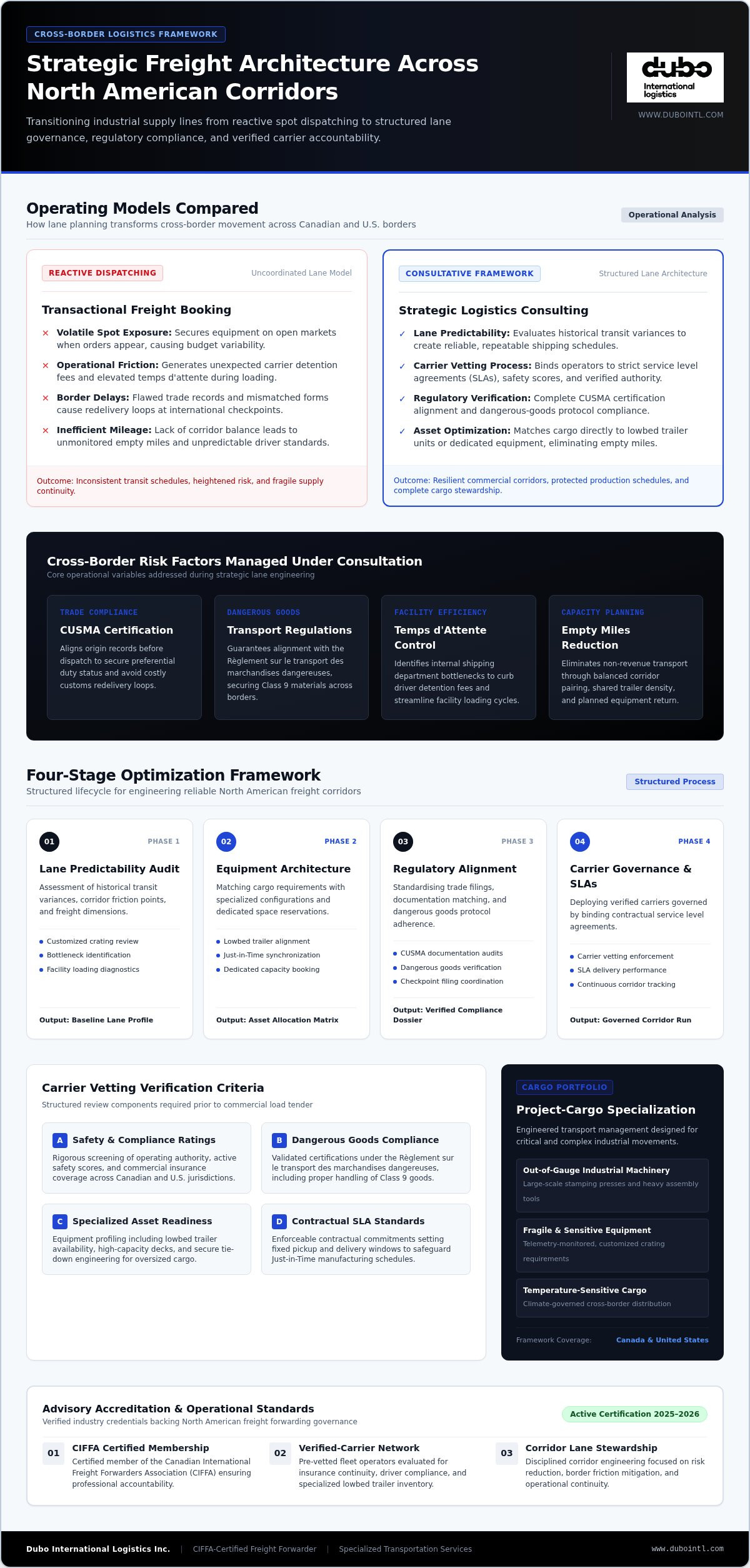
Four-Stage Framework for Cross-Border Logistics Optimization
Establishing dependable international freight corridors requires a methodical roadmap. When Canadian manufacturers encounter repeated transit friction, deploying a structured optimization model pinpoints operational vulnerabilities and restores lane stability. Through dedicated cross-border logistics consulting, shippers replace trial-and-error scheduling with an architectural blueprint that balances compliance rigor, transit predictability, and cost control across every boundary crossing.
Stage 1 and 2: Diagnostic Lane Auditing and Corridor Engineering
Optimization starts with an empirical audit of historical transport records. Consultants review past bills of lading, accessorial charge histories, and border dwell metrics to uncover where transit variances originate. Many shipping bottlenecks stem from documentation inaccuracies or suboptimal crossing point selections that route freight directly into heavily congested port-of-entry corridors.
Corridor engineering takes these audit findings to reconstruct the physical routing profile:
- Crossing selection: Selecting strategic border crossings based on real-time processing volumes and specialized inspection facility capabilities rather than default GPS routes.
- Production alignment: Synchronizing dispatch timetables with customer Just-in-Time systems to ensure components arrive exactly when production lines require them.
- Regulatory pre-clearance: Establishing standardized paperwork protocols to ensure import declarations match invoice data before drivers reach the primary inspection booth.
Stage 3 and 4: Carrier Procurement and Performance Governance
The second half of the framework establishes operational execution and active oversight. During the procurement phase, advisors align cargo freight dimensions with dedicated carrier capabilities, vetting equipment condition, driver certifications, and safety records. For temperature-sensitive or fragile industrial cargo, fleets deploy calibrated enregistreurs de données to track internal trailer conditions and movement shock throughout transit.
The final stage focuses on continuous performance governance. Integrating carrier performance tracking with your internal ERP system creates operational visibility across all transborder lanes. Regular audits evaluate carrier adherence to agreed service milestones, transit times, and billing accuracy. These diagnostic findings flow seamlessly into ongoing cross-border freight forwarding execution, turning corridor diagnostics into measurable operating efficiency.
If your team is ready to eliminate transport variances and secure international routes, you can schedule a freight consultation with Dubo International Logistics to engineer a dependable corridor strategy tailored to your cargo.
Selecting a Strategic Logistics Partner for Complex North American Freight
Selecting an external advisory partner requires looking beyond surface-level rate sheets. Shippers need a true logistics architect capable of managing regulatory demands, carrier networks, and continuous corridor performance. The right cross-border logistics consulting firm acts as an accountable steward of your commercial interests, ensuring every shipment complies with international standards while meeting tight factory schedules.
The Value of CIFFA Certified Industry Governance
When vetting Canadian advisory specialists, industry accreditations offer tangible proof of operational discipline. Membership in the Canadian International Freight Forwarders Association (CIFFA), particularly holding CIFFA-certified membership for 2025-2026, confirms strict adherence to recognized ethical guidelines, standard trading conditions, and financial stability benchmarks.
CIFFA governance ensures forwarders maintain ongoing training in cross-border transport regulations, commercial contracts, and liability protection. Working with an accredited specialist eliminates the risks of unverified intermediaries who lack professional accountability. You can explore these foundational standards within broader frameworks for strategic logistics consulting in Canada.
Managing Complex and Specialized Industrial Cargo
Industrial supply chains rarely rely solely on standard palletized dry freight. Moving heavy assembly tooling, large-scale stamping presses, and delicate manufacturing equipment demands precise engineering rather than basic brokerage. A specialized consulting partner designs customized transport configurations that protect cargo integrity from initial loading through final placement.
Critical capabilities for complex cross-border cargo include:
- Out-of-gauge freight planning: Assessing bridge weight allowances, overhead wire clearances, and specialized trailer configurations before dispatch.
- Industrial project strategies: Applying practical methodologies outlined in specialized freight North America resources to coordinate multi-unit manufacturing plant relocations.
- Dedicated expedited transport: Deploying dedicated sprinters or straight trucks under an expédition accélérée premium framework to rush urgent components directly to assembly lines and prevent plant shutdowns.
By blending regulatory rigor with project-cargo capabilities, strategic advisory removes friction from complex commercial trade lanes. Canadian enterprises ready to upgrade their corridor architecture and safeguard delicate cargo can connect directly with Dubo International Logistics (www.dubointl.com) to initiate a structured freight evaluation.
Strengthen Your North American Corridors with Strategic Freight Architecture
Transitioning from reactive spot tendering to structured lane governance protects your business from unpredictable transport disruptions. When you engineer commercial corridors, harmonize international trade documentation, and enforce strict performance metrics, your operations eliminate costly transit variances. Methodical planning turns complex border crossings into dependable distribution pathways, ensuring your manufacturing cargo arrives safely and on schedule.
Engaging specialized cross-border logistics consulting delivers the hands-on oversight needed to navigate North American trade networks with complete confidence. Backed by CIFFA-certified membership for 2025-2026, proven project-cargo coordination capabilities across Canada and the United States, and an exhaustive carrier vetting process prioritizing safety, reliability, and cargo security, our consultative advisory safeguards your freight at every stage of its journey.
Take command of your international freight operations today. Partner with the logistics specialists at Dubo International Logistics (www.dubointl.com) to audit your lanes, eliminate border friction, and build an enduring freight framework designed for complete operational peace of mind.
Frequently Asked Questions
How does cross-border logistics consulting differ from freight forwarding?
Freight forwarding focuses on the physical coordination and execution of shipping cargo from origin to destination. In contrast, cross-border logistics consulting provides higher-level strategic advisory. It analyzes your complete lane network, carrier contracts, and trade compliance protocols to eliminate systemic inefficiencies. While forwarding moves your daily freight, consulting designs the overarching operating frameworks that make those transport corridors reliable and cost-effective over the long term.
Can logistics consulting help resolve recurring border customs delays?
Yes, strategic consulting identifies root causes behind clearance holds. Advisors audit your commercial invoices, Harmonized System tariff classifications, and trade filings to resolve discrepancies before freight approaches the border. While consultants do not act as customs brokers, they align operational processes between your internal documentation teams, contracted customs brokers, and transport carriers. This proactive coordination prevents repetitive inspections, secondary border holds, and costly vehicle detention fees.
What industries benefit most from North American cross-border advisory?
Industrial manufacturing, automotive, heavy machinery, aerospace, and energy sectors gain the greatest advantage from strategic advisory. These industries regularly move high-value assemblies, regulated materials, or out-of-gauge equipment across international borders under rigid delivery timelines. Consulting helps these shippers eliminate supply-chain friction, align specialized transport equipment to specific cargo requirements, and protect complex production schedules from expensive border bottlenecks and plant downtime.
How does CUSMA certification impact cross-border freight planning?
A valid CUSMA certification determines whether your goods qualify for preferential duty-free treatment across North American trade lanes. Flawed origin records or missing certifications automatically trigger standard tariff rates and border processing delays. Logistics consulting helps Canadian shippers establish rigorous documentation protocols, ensuring every commercial load includes verified origin data and conforming trade records before equipment dispatch to prevent unexpected duty liabilities.
What role does carrier vetting play in logistics risk management?
Rigorous carrier vetting forms the defensive backbone of cross-border risk management. Rather than tendering loads across open spot boards, consultants screen transport providers for operating safety scores, insurance coverage levels, and cross-border security compliance. This verification process ensures every contracted fleet upholds agreed service level agreements (SLAs), protects specialized industrial cargo from transit damage, and minimizes the financial risks of carrier breakdown or non-performance.
How do consultants address transport for oversized or sensitive machinery?
Advisors develop customized project-cargo blueprints tailored to exact physical freight dimensions and tolerances. For oversized equipment, consultants coordinate specialized assets such as a lowbed trailer or step-deck while planning transit routes that comply with jurisdictional height and weight regulations. For fragile machinery, strategies include customized crating recommendations, secure blocking protocols, and real-time environmental monitoring to maintain cargo integrity throughout international travel.
Can cross-border freight strategies support Just-in-Time production schedules?
Yes, structured cross-border logistics consulting stabilizes transit times to meet tight Just-in-Time delivery windows. Advisors eliminate route variance by pre-clearing trade documentation, selecting uncongested border crossings, and establishing binding carrier SLAs. By structuring predictable dispatch cycles and deploying dedicated expedited transport when necessary, strategic frameworks ensure assembly plants receive essential manufacturing inputs exactly when needed without maintaining bloated safety stocks.
