

According to research from Descartes in 2026, nearly half of all North American shippers now deploy dedicated fleets just to protect baseline capacity and service levels. When unpredictable carrier delays stall key freight corridors and specialized machinery competes for space alongside standard less-than-truckload shipments, maintaining control feels like an uphill battle. Developing a logistics strategy that directly addresses these vulnerabilities isn't about chasing spot rates; it's about building operational resilience from the ground up.
You already know that friction between daily transportation execution and broader corporate expansion can quietly erode customer trust. You need dependable transit consistency across Canadian and cross-border lanes without second-guessing carrier performance. In this guide, you'll learn how to design, execute, and refine an agile freight transportation strategy tailored for Canadian and North American supply chains. We outline a clear roadmap to audit your existing shipping network, formalize service level agreements (SLAs), and manage route risks across every freight corridor.
Key Takeaways
- Strategic alignment connects long-term corporate expansion goals directly to freight routing, preventing unexpected carrier disruptions from derailing commercial milestones.
- Conducting an operational shipping audit establishes the factual foundation for developing a logistics strategy that balances equipment selection with schedule dependability.
- Documented service level agreements (SLAs) and proactive corridor risk assessments safeguard cargo continuity against regulatory updates and cross-border bottlenecks.
- Combining internal management with freight forwarding consulting enables industrial shippers to move specialized machinery alongside standard freight without heavy administrative overhead.
- Actionable execution roadmaps translate theoretical transportation planning into consistent transit performance across Canadian and continental lanes, with guidance accessible through www.dubointl.com.
Core Foundations for Developing a Logistics Strategy in 2026
Every commercial distribution network depends on continuous physical execution. At its core, logistics coordinates equipment, labour, and lane planning to move commercial goods predictably through the supply chain. When developing a logistics strategy, Canadian enterprises must look beyond isolated lane pricing. Senior leaders often decide whether priority rests on rapid transit times, absolute schedule reliability, or controlled operating margins. Forward-looking companies treat freight operations as an active strategic asset rather than an unmanaged operational burden, structuring resilient transport systems that balance steady day-to-day freight alongside sudden market disruptions.
Aligning Freight Operations with Corporate Business Objectives
Transportation choices directly impact balance sheets. Reviewing annual sales projections helps shippers plan equipment demand well ahead of seasonal cargo surges, avoiding expensive last-minute scrambles for linehaul capacity. Before committing to specific transport corridors, teams should define clear delivery expectations for their end customers. Balancing expedited transit against fluctuating fuel surcharges keeps margins intact without compromising service commitments, ensuring daily transport decisions actively reinforce broad corporate growth targets.
Identifying Operational Vulnerabilities and Transit Risks
A resilient network requires an honest assessment of structural friction. Analyzing past delivery delays across primary Canadian corridors reveals persistent bottlenecks before they interrupt customer commitments. In developing a logistics strategy that endures, identifying these friction points early is essential. Shippers should evaluate operational vulnerabilities across three distinct operational areas:
- Corridor congestion patterns: Document recurring transit slowdowns caused by regional infrastructure backlogs or severe seasonal weather across east-west routes.
- Capacity crunches: Examine past distribution schedules to see how sudden volume spikes exposed dry van and flatbed equipment shortages.
- Carrier concentration risks: Pinpoint single points of failure where over-reliance on a solitary motor carrier leaves production schedules exposed to unexpected fleet groundings.
Addressing these carrier dependencies early gives logistics managers the operational agility required to protect distribution schedules throughout the year.
Auditing Supply Chain Operations Before Developing a Logistics Strategy
Accurate baseline data prevents costly miscalculations during logistics restructuring. Rather than guessing corridor performance, a thorough diagnostic audit evaluates freight spend distribution across full truckload movements and LTL freight shipping. Research from the MIT Center for Transportation & Logistics emphasizes that analyzing historical delivery reliability alongside cargo claims incidence reveals structural weaknesses that daily dispatch reports miss. Before altering linehaul arrangements, shippers must quantify real network performance. For a step-by-step diagnostic framework, review our guide to strategic logistics consulting in Canada.
Mapping North American Freight Flows and Lane Density
Systematic lane analysis reveals hidden imbalances that siphon transport budgets. Plotting inbound and outbound cargo density across nationwide corridors exposes empty miles and backhaul inefficiencies that generate unnecessary shipping costs. Shippers must also track quarterly volume variations, ensuring equipment access remains predictable when seasonal industrial surges tighten commercial trailer capacity.
Measuring Performance with Service Level Agreements (SLAs)
Reliable freight execution demands clear carrier accountability. When developing a logistics strategy, formalizing service level agreements (SLAs) protects baseline operations across three essential areas:
- Punctuality compliance: Track on-time pickup and on-time delivery percentages against strict facility appointment windows.
- Facility turnaround: Standardize facility detention thresholds to minimize unnecessary temps d'attente charges that erode freight margins.
- Corrective clauses: Document contractual remedies and backup capacity triggers for recurring corridor failures.
Evaluating Enterprise Software and ERP Data Integration
Digital visibility must align directly with physical trailer movements. Auditing how ERP systems share shipment milestones between dispatch teams, floor managers, and freight analysts prevents operational blind spots. When dispatch records fail to reconcile with physical inventory tallies, production schedules stall. Industrial shippers seeking experienced guidance to audit their lane performance can connect with advisory specialists through www.dubointl.com.
Strategic Frameworks: In-House Management versus Freight Forwarding Partnerships
Every commercial shipper eventually faces an operational crossroads: retain direct carrier agreements internally or delegate transportation coordination to specialized partners. Managing freight in-house provides direct operational oversight, but it requires significant administrative resources, constant lane surveillance, and continuous back-office tracing. In contrast, working with established freight forwarding specialists connects businesses to vetted carrier networks and dynamic equipment access without expanding internal headcount. For many mid-market enterprises, developing a logistics strategy built on a hybrid model provides the optimal balance, keeping core manufacturing priorities central while trusted freight professionals handle lane procurement.
Balancing Dedicated Transport Resources with Variable Carrier Capacity
Dedicated fleets offer predictability, but internal equipment leases carry rigid balance-sheet overhead. Committing solely to spot markets leaves cargo exposed to regional capacity shortages whenever demand spikes. A coordinated approach to end-to-end freight management resolves this dilemma. External logistics consulting allows organizations to lock in dependable contracted capacity for primary lanes while scaling variable carrier space for irregular seasonal surges.
Risk Management across Cross-Border Freight Corridors
Cross-border distribution demands strict regulatory discipline. Since trade under CUSMA expanded by nearly 39 percent between 2020 and 2026, bilateral movement has grown increasingly complex. Moving commercial freight smoothly across borders involves several non-negotiable compliance checkpoints:
- Pre-dispatch documentation: Verify accurate commercial manifests and load manifests before shipments depart physical loading docks.
- CUSMA certification: Ensure compliant CUSMA certification to support preferential tariff claims and prevent border inspections from delaying transit schedules.
- Carrier safety vetting: Monitor driver safety scores, insurance certifications, and cross-border security compliance to eliminate transit risks.
Balancing Cost Efficiency with Just-in-Time Demands
Modern manufacturing facilities operate on tight margins where assembly schedules depend on predictable deliveries. Designing freight schedules to support Just-in-Time systems requires building strategic buffer windows into transit planning, preventing unexpected border queues from causing costly production shutdowns. When developing a logistics strategy, savvy transportation planners evaluate total landed transport expense rather than hunting for superficial base rates. Evaluating total delivery costs ensures equipment availability, transit reliability, and inventory continuity remain synchronized.
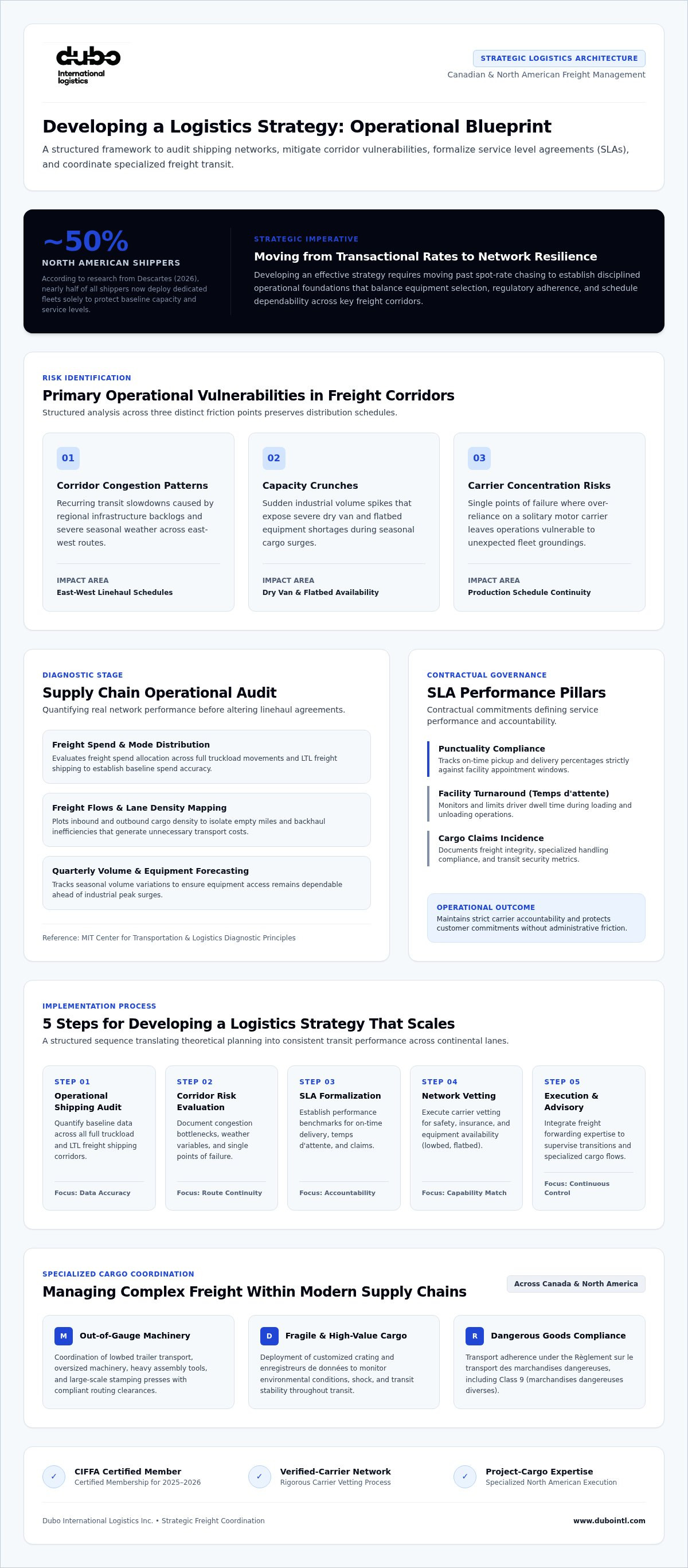
Five Steps for Developing a Logistics Strategy That Scales
Translating corporate growth targets into daily transportation excellence requires a structured execution framework. Developing a logistics strategy that scales means replacing reactive expediting with repeatable, documented operational habits. Industrial manufacturers and distributors navigate variable carrier capacity by executing five foundational stages:
- Define baseline standards: Establish uncompromised transit parameters, loading protocols, and client communication criteria.
- Isolate lane inefficiencies: Aggregate historical transport data across internal departments to spot recurring schedule leaks.
- Implement carrier qualification gates: Enforce rigorous insurance, safety, and operational criteria across all primary routes.
- Structure route contingencies: Formalize secondary transit lanes and alternate modes before corridor bottlenecks occur.
- Execute continuous performance reviews: Evaluate quarterly SLA scorecards to refine equipment allocations systematically.
Establishing a Rigorous Carrier Vetting Process and Standards
A structured carrier vetting process protects industrial cargo from roadside delays and legal liabilities. Shippers should systematically verify commercial general liability insurance, motor cargo policy endorsements, and active safety fitness certificates directly with transport regulators. Prior to assigning out-of-gauge shipments or high-value freight, confirm valid equipment inspection records and verify that transport operators comply with federal réglementations sur les heures de service.
Mitigating Transit Bottlenecks and Reducing Empty Miles
Consolidating cargo flows lowers distribution expenses while securing equipment availability. Blending partial shipments into scheduled LTL freight shipping programs improves trailer utilization and removes unbilled empty miles across major transport corridors. When emergency machinery replacements or high-value industrial assemblies face strict installation windows, dispatching dedicated dubo expedited solutions bypasses transfer terminals to preserve schedule integrity.
Formulating Contingency Protocols for Supply Chain Disruptions
Every reliable supply chain needs pre-planned recovery routes. Bill C-39 introduced legislative proposals to modernize strategic trade corridors, yet sudden severe weather or regional infrastructure bottlenecks still interrupt physical freight. Designing operational contingencies involves three proactive steps:
- Secondary lane mapping: Map redundant highway routing and intermodal transfer options around standard bottlenecks.
- Surge capacity agreements: Pre-qualify vetted auxiliary carriers possessing available fleet equipment to absorb seasonal volume surges.
- Escalation protocols: Maintain documented communication workflows so dispatchers and facility managers resolve delays instantly.
To establish resilient freight networks across North American shipping lanes, consult with the freight management specialists at Dubo International.
Executing Your Logistics Strategy with Professional Freight Advisory
Transitioning from high-level planning to daily operational execution demands proven freight expertise. A theoretical routing model looks immaculate on a spreadsheet, yet sudden road closures, regional carrier shortages, and specialized machinery requirements quickly test real-world resilience. In developing a logistics strategy, partnering with seasoned freight forwarding specialists bridges the gap between design and physical delivery. Collaborative planning lifts heavy administrative burdens from internal personnel while securing transit predictability across Canadian transport corridors. To review how structured advisory services enhance distribution reliability, visit Dubo International.
Selecting a CIFFA-Certified Partner for Strategic Advisory
Not every freight intermediary possesses the operational depth needed for complex industrial freight. Forwarding partners maintaining CIFFA-certified membership for 2025–2026 adhere to strict professional governance standards established by the Canadian International Freight Forwarders Association. Working alongside a certified forwarder grants direct access to a thoroughly vetted carrier network, shielding shippers from safety and regulatory non-compliance. Their practical background coordinating heavy assembly tools and out-of-gauge machinery turns complex industrial shipping into an orderly, dependable process.
Managing Specialized Transportation for Non-Standard Freight
Standard freight networks often falter when handling irregular or fragile shipments alongside standard commodities. Integrating specialized transportation services into your distribution network protects non-standard assets from handling errors and corridor bottlenecks. When developing a logistics strategy that includes heavy machinery or fragile equipment, shippers should incorporate four core safeguards:
- Equipment matching: Select lowbed trailer configurations to maintain legal overhead bridge clearances during oversized cargo transport.
- Specialized protection: Commission customized crating and precision blocking systems to secure sensitive components against transit stress.
- Environmental tracking: Deploy calibrated enregistreurs de données to verify continuous temperature stability and monitor physical shock.
- Experienced operators: Restrict project-cargo dispatch to carriers proven in transporting delicate industrial machinery.
Building Freight Resilience for Long-Term Growth
Establishing transit certainty requires moving beyond reactive troubleshooting. Developing a logistics strategy built on rigorous lane audits, enforceable service level agreements, and disciplined carrier vetting protects your distribution network against unexpected corridor delays. When standard freight and specialized shipments operate under unified operational standards, your supply chain remains dependable regardless of external market friction.
Achieving that standard of consistency is far easier with a dedicated guide. As a CIFFA-certified freight forwarder, Dubo International delivers nationwide North American cargo coordination alongside specialized handling for delicate equipment and heavy machinery. Our team works as a direct extension of your business, aligning transportation execution with broader corporate goals while mitigating transit risks at every stage.
Take control of your transport operations today. You can partner with Dubo International at www.dubointl.com to design an efficient, resilient freight framework that keeps your cargo moving safely and on schedule.
Frequently Asked Questions
What is the primary objective when developing a logistics strategy?
The primary objective when developing a logistics strategy is establishing predictable, repeatable freight movement that directly aligns with corporate growth targets. Rather than simply procuring spot trailer capacity, a mature strategy structures carrier accountability, manages route risks, and protects profit margins against unexpected transit disruptions. It transforms everyday transportation from a reactive overhead expense into an organized, competitive business advantage.
How does a logistics strategy differ from standard supply chain management?
Supply chain management oversees the entire end-to-end flow of raw materials and finished goods, spanning procurement, production planning, and vendor collaboration. A logistics strategy focuses specifically on the physical transport and strategic routing required to move those goods efficiently between facilities. It handles carrier qualification, mode selection, transit scheduling, and corridor risk management to ensure physical execution meets overarching supply chain milestones.
What performance metrics should be tracked in a freight logistics strategy?
Core metrics must evaluate schedule dependability, equipment capacity, and carrier compliance across active lanes. Shippers should rigorously track on-time pickup and delivery percentages, claims-free delivery ratios, and dock dwell times. Monitoring facility detention hours, tender acceptance rates, and total landed transport costs provides actionable visibility into operational friction, helping internal teams correct service bottlenecks before customer relationships suffer.
How frequently should a business review and update its logistics strategy?
Enterprises should audit operational performance quarterly while conducting a formal strategic review annually. In developing a logistics strategy, regular quarterly assessments allow logistics teams to review carrier scorecards, analyze seasonal lane volume shifts, and adapt to regulatory updates like Hours of Service amendments. Annual audits let leadership re-evaluate corporate expansion goals, verify network lane density, and adjust dedicated freight contracts accordingly.
What role do service level agreements play in carrier management?
Service level agreements (SLAs) establish enforceable contractual benchmarks that govern motor carrier performance. They clearly define required transit windows, appointment loading times, equipment standards, and formal communication protocols during transport delays. By setting explicit thresholds for facility temps d'attente and non-performance penalties, SLAs remove ambiguity, incentivize dependable carrier dispatch, and ensure consistent service quality across all distribution lanes.
How can a company reduce empty miles across domestic freight routes?
Companies reduce empty miles by auditing corridor cargo density and coordinating scheduled backhaul freight programs. Combining partial loads into structured LTL freight shipping networks eliminates deadhead mileage between facilities. Working with freight forwarding specialists also helps shippers identify compatible return-trip cargo opportunities, maximizing trailer capacity, lowering fuel burn, and keeping transport assets continuously productive across Canadian corridors.
Why is CIFFA membership relevant when choosing a logistics partner in Canada?
Membership in the Canadian International Freight Forwarders Association (CIFFA) certifies that a freight intermediary maintains the highest industry standards for professional competency, ethical conduct, and financial stability. CIFFA-certified providers adhere to standardized trading conditions and employ rigorous carrier vetting procedures. This certification provides shippers with peace of mind, knowing their project cargo and regular freight are handled by proven logistics professionals.
