
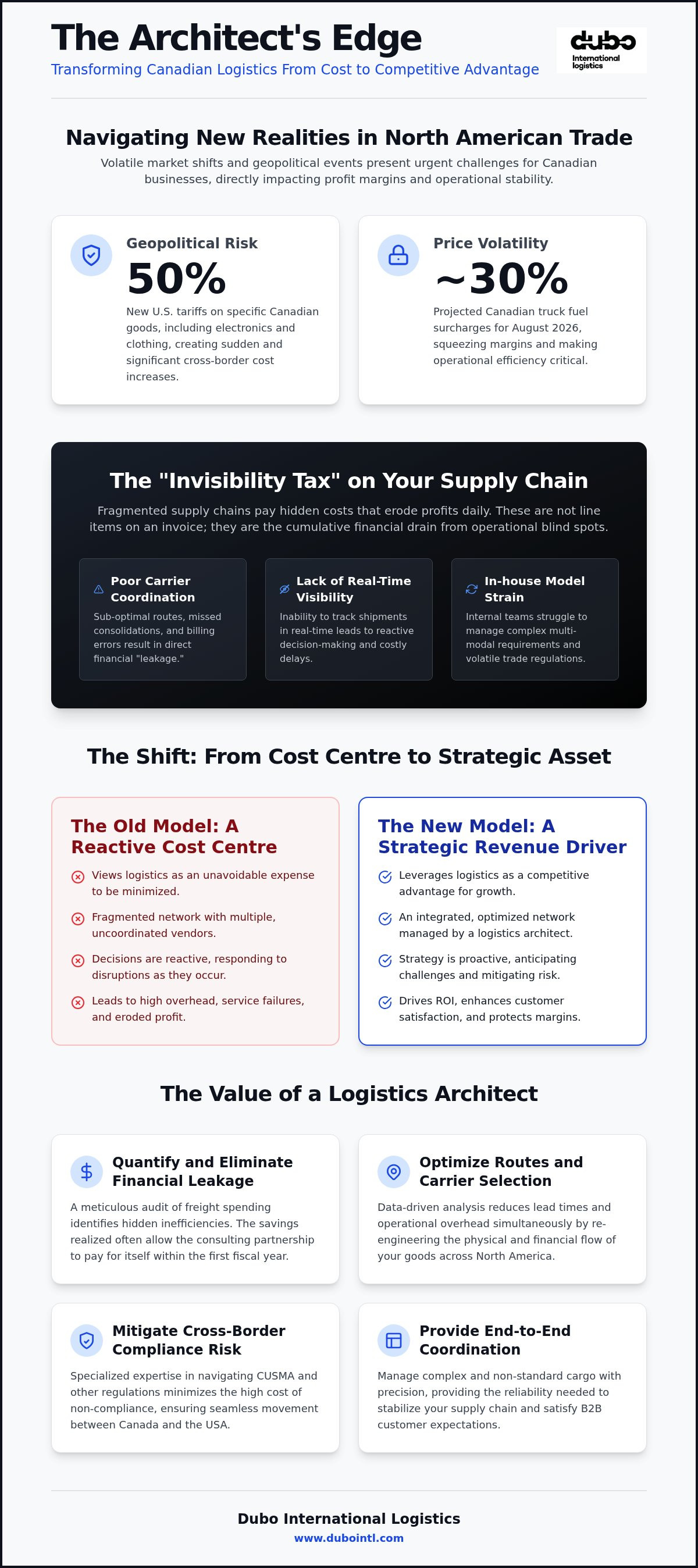
Many Canadian executives view their supply chain as an unavoidable expense, yet the most resilient firms realize that a well-tuned network is actually their strongest revenue driver. With new 50% tariffs on specific Canadian goods entering the U.S. and fuel surcharges for August 2026 hovering near 30%, the business case for logistics consulting has never been more urgent. At Dubo International Logistics (www.dubointl.com), we understand that navigating these complexities requires more than just moving freight; it demands a strategic architecture that protects your margins from volatile market shifts. You likely feel the mounting pressure of rising cross-border costs and the anxiety of maintaining regulatory compliance in an increasingly unpredictable trade environment.
We recognize that these challenges can feel overwhelming, but they also present a unique opportunity to refine your operational model for better precision. This article will demonstrate how professional guidance shifts your logistics from a reactive cost centre to a scalable competitive advantage that supports long-term growth. We will explore the methodology behind optimizing carrier coordination and closing visibility gaps to improve your bottom line while ensuring your Canadian business achieves higher customer satisfaction across North America.
Key Takeaways
- Learn how to transition your logistics from a back-office cost centre into a strategic asset that protects margins against fuel price volatility and geopolitical shifts.
- Build a robust business case for logistics consulting by identifying hidden "leakages" in freight spending and optimizing carrier routes to realize immediate ROI.
- Discover how specialized expertise in cross-border regulations and risk diversification minimizes the high cost of non-compliance for seamless movement between Canada and the USA.
- Identify the critical criteria for selecting a "logistics architect" capable of managing complex cargo and providing end-to-end coordination across North America.
- Explore how a partnership with Dubo International Logistics (www.dubointl.com) provides the precision and reliability needed to stabilize your global supply chain.
The Shifting Landscape of North American Supply Chains
The role of Logistics has moved far beyond the warehouse floor. It's no longer a quiet back-office function; it's a primary strategic asset that determines whether a Canadian company thrives or merely survives. When supply chains are fragmented, businesses pay what we call an "Invisibility Tax." These are the hidden costs of poor carrier coordination, lack of real-time visibility, and reactive decision-making that slowly erode profit margins. Relying on traditional in-house models often leaves teams struggling to manage modern multi-modal requirements, especially as global trade becomes more volatile. This volatility is exactly why the business case for logistics consulting is becoming a central pillar of corporate strategy. With Canadian truck fuel surcharges reaching 30.28% in August 2026, the margin for error has effectively vanished.
Geopolitical shifts and fuel price volatility aren't just headlines; they're direct threats to your bottom line. At Dubo International Logistics (www.dubointl.com), we've seen how quickly a trade surplus can be offset by rising operational overhead. Professional oversight provides the stabilizing force needed to turn these challenges into opportunities for optimization. By moving away from a purely transactional mindset, businesses can begin to view their supply chain as a source of competitive advantage rather than a recurring headache.
The Complexity of Modern Cargo Movement
Moving goods in 2026 isn't just about distance. It's about specialized requirements. We see a significant rise in non-standard cargo that demands precise handling and specialized transportation services to ensure safe delivery. B2B clients now expect e-commerce levels of speed and transparency, putting immense pressure on traditional logistics timelines. In this environment, "good enough" logistics becomes a heavy liability. A single delay or a compliance oversight can disrupt an entire production cycle, making professional oversight a necessity rather than a luxury.
The Canadian Context: A Unique Set of Challenges
Canada presents a geographic puzzle that few other nations face. Our trade corridors are vast, and the density of North American traffic requires a sophisticated approach to route planning. Recent geopolitical shifts have added layers of difficulty. As of August 19, 2026, the U.S. has imposed 50% tariffs on various Canadian goods, including electronics and clothing, regardless of CUSMA status. These sudden changes demand the strategic foresight of a "logistics architect" to pivot operations and mitigate risk. In 2026, Canadian logistics infrastructure remains a complex network of high-volume corridors and remote access points that requires meticulous, data-driven coordination to remain resilient.
Building the Quantitative Business Case for Logistics Consulting
Financial performance in the supply chain is often a game of inches. Every sub-optimal route, billing error, or missed consolidation opportunity represents "leakage" that quietly drains your annual budget. Building a robust business case for logistics consulting starts with quantifying these inefficiencies and recognizing that professional fees are an investment, not a sunk cost. In many instances, the savings identified through a comprehensive audit allow the consulting partnership to pay for itself within the first fiscal year. By shifting from a reactive stance to a data-driven strategy, Canadian firms can build a logistics framework that scales seamlessly without requiring a proportional increase in headcount.
Consultants don't simply move cargo; they re-engineer the financial flow of your goods. This involves a meticulous analysis of your current freight spending to identify where money is being left on the table. Whether it's through better carrier selection or more precise route planning, the goal is to reduce lead times and operational overhead simultaneously. For those managing complex requirements, leveraging specialized transportation services ensures that high-value or oversized loads don't become the source of unexpected financial "surprises."
Analyzing Cost Structure and Savings
Maintaining a full-scale, in-house logistics department is a significant fixed expense that many mid-sized businesses struggle to justify. A strategic consulting partnership offers a more flexible alternative, providing access to high-level expertise without the long-term burden of additional salaries and benefits. These experts use industry-wide data to negotiate carrier rates that are typically unavailable to individual shippers. Precision in documentation is another critical factor. Even minor clerical errors in cross-border paperwork can lead to costly storage fees or delivery delays that ripple through your entire production schedule.
The Impact on Bottom-Line Profitability
Optimizing your supply chain has a direct, measurable impact on your company's Net Present Value (NPV) and overall EBITDA. Consider the "Case Study Logic" of the industry: for a business with a 10% profit margin, a 5% reduction in logistics costs can have the same impact on the bottom line as a significant increase in total sales. Staying informed on global shipping and logistics trends allows consultants to anticipate market shifts before they affect your balance sheet. This proactive approach creates a self-funding model where the savings from one quarter fund the improvements of the next. If you're ready to uncover the hidden ROI in your operations, the seasoned experts at Dubo International Logistics (www.dubointl.com) can help you refine your financial strategy for a more resilient future.
Mitigating Strategic Risk and Enhancing Cross-Border Resilience
Beyond the immediate financial savings, the business case for logistics consulting is anchored in the preservation of your corporate reputation. A single compliance error or a delayed shipment of oversized equipment doesn't just cost money; it erodes the trust your partners place in your brand. In a trade environment where U.S. tariffs on Canadian goods are shifting rapidly, having a dedicated "logistics architect" ensures your business remains agile and protected. At Dubo International Logistics (www.dubointl.com), we prioritize this role as a protective steward of our clients' interests. Our commitment to CIFFA standards ensures that every shipment is handled with the highest level of professional ethics and precision. This certification isn't merely a badge; it's a guarantee that your cargo coordination follows recognized industry best practices.
Reliability builds trust. When a shipment arrives exactly when promised, it reinforces your brand's commitment to excellence and ensures that your partners can maintain their own operational rhythms without interruption. We don't just move freight; we provide the steady authority needed to lower your stress by positioning your business as a stabilizing force in a complex global environment. This proactive approach to risk management is what separates market leaders from those who are constantly reacting to the next supply chain crisis.
Navigating the Canada-USA Border
Maintaining a seamless flow of goods across the 49th parallel is essential for the health of international trade relationships. Border delays often stem from minor clerical oversights or a lack of strategic foresight regarding changing regulations. For a deeper look at these specific challenges, you can explore our detailed guide on Cross-Border Freight Forwarding: Navigating Canada-USA Logistics in 2026. By identifying regulatory pitfalls early, consultants act as a sophisticated bridge between your local operations and complex international systems, preventing costly friction before it occurs.
Managing Specialized and Sensitive Cargo
Moving non-standard or sensitive equipment requires a level of project management that standard freight models simply don't provide. There is a clear business case for logistics consulting when it comes to specialized transportation project management, as the cost of a single damaged asset can dwarf the fees of professional oversight. Utilizing tailored specialized transportation services reduces the probability of loss by matching the unique requirements of the cargo with the right carrier and equipment. Expert cargo coordination functions as a sophisticated barrier between your high-value assets and the inherent unpredictability of international transit.
The Strategic Roadmap: How to Evaluate a Logistics Consultant
Selecting a logistics consultant requires a significant shift in perspective. It's not merely about hiring a service; it's about choosing a strategic partner who can navigate the 322.8 billion dollars in trade that moved between Canada and the U.S. in the first quarter of 2026. A methodical evaluation process ensures that the business case for logistics consulting translates into tangible operational gains. You need to look beyond surface-level promises to find a partner who understands the minute details of your specific industry. This includes verifying professional credentials, such as membership in the Canadian International Freight Forwarders Association (CIFFA), which signals a commitment to ethical standards and industry best practices. At Dubo International Logistics (www.dubointl.com), we believe that precision and strategic foresight are the foundations of any successful supply chain partnership.
Technological integration is equally vital in a modern environment. A consultant should provide real-time visibility tools that allow you to track shipments and anticipate disruptions before they impact your customers. This level of transparency is essential for maintaining the smoothness of global movement. A robust carrier network and a deep North American reach are also non-negotiable, as they provide the flexibility needed to pivot when trade patterns shift or tariffs change.
The Selection Framework for Canadian Businesses
A structured approach to selection eliminates the uncertainty often associated with professional services. We recommend a three-step framework to ensure a proper fit:
- Step 1: Define the scope of your supply chain inefficiencies. Start by identifying where your current model is failing, whether it's rising cross-border costs or poor visibility.
- Step 2: Audit the consultant’s track record with similar specialized projects. If you move oversized equipment, ensure they have documented experience in specialized transportation services.
- Step 3: Evaluate the "Logistics Architect" approach vs. a generic service provider. A generic provider offers one-size-fits-all solutions, whereas a logistics architect builds a bespoke framework tailored to your unique needs.
Ensuring Long-Term Strategic Alignment
A successful partnership depends on shared values and a deep understanding of the "Made in Canada" brand commitment. Your consultant should act as an extension of your own team, prioritizing your reputation as much as your bottom line. This alignment ensures maximum transparency and accountability throughout the engagement. To learn more about this process, read our Strategic Logistics Consulting in Canada: A 2026 Guide to Supply Chain Excellence. Establishing this foundation early allows for a scalable strategy that grows with your business. If you're ready to see how a bespoke strategy can transform your operations, you can schedule a comprehensive audit with the seasoned experts at Dubo International Logistics today.
Navigating the Future with Dubo International Logistics
In an era defined by shifting trade volumes and complex regulatory hurdles, having a reliable partner is the ultimate hedge against uncertainty. Dubo International Logistics serves as a stabilizing force for Canadian businesses, providing the steady authority required to manage global trade with confidence. We recognize that the business case for logistics consulting is ultimately about peace of mind. Our approach prioritizes your long-term interests, ensuring that every shipment is treated with the meticulous care it deserves. By choosing a partner dedicated to end-to-end cargo management, you lower your operational stress and allow your team to focus on core growth while we act as the protective steward of your interests.
Precision and reliability aren't just goals; they're the standards by which we measure every successful delivery. We understand that your supply chain is the lifeblood of your organization, and any disruption can have significant ripple effects. By integrating strategic foresight with a hands-on commitment to execution, we ensure that your goods move through North American corridors with maximum efficiency. Contacting our team is the first step toward realizing your supply chain's full potential and securing a framework that supports your long-term ambitions.
Bespoke Solutions for Unique Cargo Needs
Standard logistics models often fail when faced with non-standard requirements. We specialize in specialized transportation services across North America, ensuring that even the most complex oversized or sensitive loads reach their destination safely. The Dubo methodology integrates high-level strategy with a meticulous focus on individual client needs, allowing us to anticipate problems before they manifest as delays. This integration of planning and performance is what defines us as a "logistics architect." You can visit www.dubointl.com to explore how our full range of services can be tailored to your specific operational requirements.
Your Partner in North American Growth
Security and compliance are the bedrock of any successful international expansion. Our status as a CIFFA member is a significant milestone for your security, as it guarantees that our processes align with the highest ethical and professional standards in the industry. This commitment to excellence ensures that your supply chain remains resilient, even as market dynamics continue to evolve. The business case for logistics consulting is clear: it is a self-funding investment in your brand's future and its reputation for dependability. As a seasoned, hands-on guide, we are ready to help you navigate the complexities of global movement with precision. Optimize your supply chain today by partnering with a team that values your longevity as much as you do.
Securing Your Supply Chain’s Competitive Future
Transforming your logistics from a reactive operational burden into a streamlined strategic asset is the most reliable way to protect your margins in a volatile trade environment. We've explored how identifying freight spending "leakage" and implementing professional oversight creates a definitive business case for logistics consulting that often pays for itself within a single fiscal year. By prioritizing precision in cross-border coordination and leveraging specialized project expertise, Canadian businesses can navigate shifting tariffs and fuel surcharges with quiet confidence. As a CIFFA Certified Member, Dubo International Logistics (www.dubointl.com) provides the end-to-end cargo coordination and North American coverage needed to stabilize your global movement. We act as your dedicated logistics architect, ensuring that every detail of your supply chain is meticulously executed to support your long-term growth.
Don't let operational friction hold back your enterprise. You're invited to Partner with Dubo International for Strategic Logistics Success and experience the peace of mind that comes from seasoned expertise. We look forward to helping you build a more resilient and profitable future.
Frequently Asked Questions
What exactly does a logistics consultant do for a Canadian business?
A logistics consultant acts as a strategic architect, designing bespoke frameworks that optimize the movement of goods while reducing operational overhead. They conduct deep audits of existing supply chains to identify hidden inefficiencies, negotiate more favourable carrier rates, and ensure total compliance with shifting North American trade regulations. This professional oversight ensures that cargo coordination remains seamless across vast geographic distances while protecting your profit margins.
How does logistics consulting differ from standard freight forwarding?
While freight forwarding focuses on the tactical execution of moving cargo from point A to point B, logistics consulting focuses on the overarching strategy and financial optimization of those movements. Forwarding is primarily transactional; however, consulting is architectural. A consultant analyzes your entire network to find long-term savings and structural improvements that a standard forwarding service might overlook during daily operations.
Can a logistics consultant help reduce our cross-border shipping delays?
Yes, consultants provide expert foresight into regulatory requirements and documentation precision to prevent friction at the Canada-USA border. They identify potential pitfalls before they become delays, managing the complexities of CUSMA and new 2026 tariffs with meticulous detail. This proactive approach ensures international trade relationships remain strong by maintaining on-time delivery schedules for even the most specialized or sensitive cargo.
What is the typical ROI for a logistics consulting engagement?
Most businesses find that a well-executed business case for logistics consulting allows the engagement to pay for itself within the first fiscal year through direct cost reductions. By eliminating "leakage" in freight spending and optimizing carrier selection, companies often see a measurable improvement in their EBITDA. The ROI is realized not just in dollars saved, but in increased scalability and higher customer satisfaction.
Does my business need to be a certain size to benefit from logistics consulting?
No, businesses of all sizes benefit from professional oversight, though the specific needs vary depending on volume and cargo complexity. Mid-sized Canadian firms often find the most value, as they require sophisticated expertise without the fixed overhead of a large in-house department. Consulting provides a flexible, scalable model that grows alongside your business, ensuring your logistics strategy remains a competitive advantage as you expand.
How do I know if our in-house logistics team needs external consulting support?
If your team is struggling with rising cross-border freight costs or persistent visibility gaps, it is likely time for external strategic support. In-house teams are often consumed by daily execution and may lack the industry-wide data needed for high-level negotiation or complex risk mitigation. A consultant provides the specialized perspective required to stabilize operations during periods of market volatility or rapid growth.
What role does technology play in modern logistics consulting?
Technology provides the real-time visibility and data analytics necessary for making informed, strategic decisions about your supply chain. Modern consultants integrate advanced tools to track shipments, forecast demand, and identify route optimizations that reduce lead times. At Dubo International Logistics (www.dubointl.com), we use these insights to ensure the smoothness and completeness of our work, providing clients with the transparency they need for peace of mind.
How do I calculate the business case for outsourcing my logistics strategy?
To calculate the business case for logistics consulting, compare your current operational overhead and freight spend against the projected savings from optimized carrier routes and reduced compliance risks. Factor in the value of your team's time and the potential for increased revenue through higher customer satisfaction. This comprehensive audit reveals the true ROI of shifting from a reactive model to a professionally managed strategy.

