

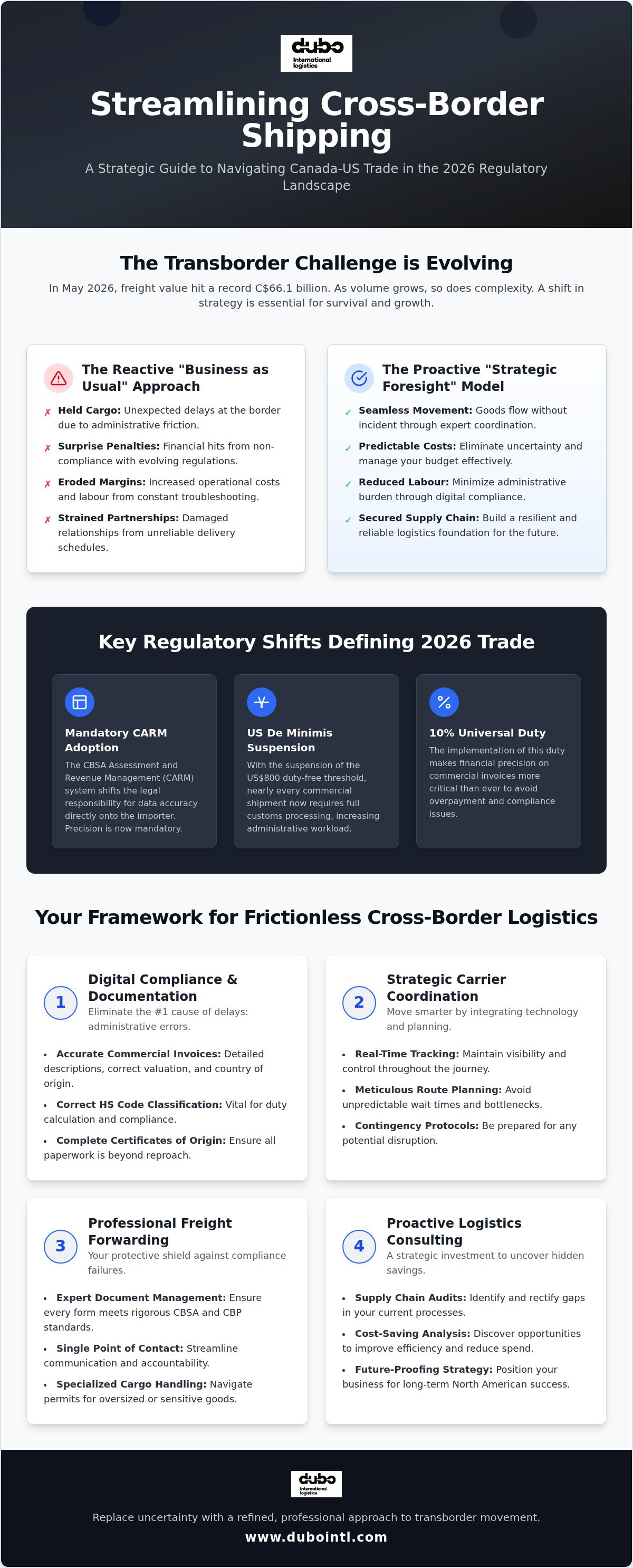
In May 2026, the value of freight moving across our southern border reached a record C$66.1 billion, yet many Canadian businesses still struggle with the administrative friction that stalls growth. The recent suspension of the US de minimis threshold and the mandatory adoption of the CARM system mean that "business as usual" is no longer a viable strategy. You're likely tired of navigating complex regulatory hurdles that result in held cargo or surprise penalties. Truly streamlining cross-border shipping Canada US requires a shift from reactive troubleshooting to a model of proactive, strategic foresight.
It's reasonable to expect a logistics process that feels invisible, where goods move without incident and costs remain predictable. This strategic guide promises to show you how to eliminate delays and reduce administrative labour through expert coordination. We'll examine the operational impact of enhanced cross-border infrastructure and provide a clear framework for managing the 2026 duty environment. With the support of Dubo International Logistics at www.dubointl.com, you can replace uncertainty with a refined, professional approach to transborder movement that secures your supply chain for the years ahead.
Key Takeaways
- Discover the essential methodologies for streamlining cross-border shipping Canada US by integrating digital compliance tools with strategic carrier coordination.
- Learn how professional freight forwarding eliminates administrative friction by ensuring all documentation meets the rigorous 2026 standards of both CBSA and CBP.
- Understand how logistics consulting serves as a strategic investment to audit your supply chain and identify hidden cost-saving opportunities.
- Gain confidence in moving sensitive or oversized cargo by navigating the specific permit requirements and routing complexities of specialized transportation.
- Establish a seamless, end-to-end management approach that positions your business for longevity in the North American market through the expertise found at www.dubointl.com.
Understanding the Dynamics of Cross-Border Shipping Streamlining
True efficiency in global trade isn't found in simply moving faster; it's found in moving smarter. In a professional logistics context, streamlining involves the meticulous integration of digital compliance, real-time tracking technology, and precise carrier coordination. A standard shipping approach often fails at the border because it treats the crossing as a mere checkpoint rather than a complex regulatory gateway. Understanding the broader Canada-U.S. trade dynamics is essential for any business looking to maintain a competitive edge. When friction-heavy supply chains become the norm, Canadian businesses suffer from eroded profit margins and strained partner relationships.
Success depends on the role of a "logistics architect." This professional doesn't just book trucks; they design the entire movement of goods before the first pallet is even loaded. By planning for every contingency, they ensure that streamlining cross-border shipping Canada US becomes a repeatable process rather than a series of lucky breaks. This level of strategic foresight is what separates a reliable supply chain from one that's constantly in crisis mode.
The Evolution of the Canada-US Trade Corridor
The regulatory landscape of 2026 has brought significant changes to how cargo flows across North America. With the full implementation of the CBSA Assessment and Revenue Management (CARM) system, the responsibility for data accuracy has shifted directly to the importer. Modern trade agreements now require a higher degree of precision, especially for "just-in-time" manufacturing cycles where a four-hour delay can halt an entire production line. Precision in documentation isn't just a requirement; it's the foundation of a seamless border experience.
Identifying Common Friction Points in Transborder Freight
Administrative errors remain the leading cause of cargo being held at the border. A simple mismatch in a Harmonized System (HS) code or an incomplete commercial invoice can trigger an audit that lasts days. Beyond paperwork, businesses often struggle with mismatched carrier schedules and unpredictable border wait times. These "invisible" delays compound throughout the supply chain, leading to increased operational costs and missed delivery windows. At www.dubointl.com, we focus on identifying these bottlenecks early to ensure your specialized freight moves without hesitation. By auditing your existing processes, we help you avoid the labour-intensive task of correcting errors after the cargo has already reached the crossing.
Essential Documentation and Regulatory Compliance Strategies
Compliance is the bedrock of any efficient supply chain. Without a rigorous approach to documentation, even the most sophisticated logistics plans will fail at the first inspection point. The landscape of 2026 is particularly demanding, as the February 2026 implementation of a 10% universal duty under the Trade Act of 1974 has made financial precision more critical than ever. Effective streamlining cross-border shipping Canada US relies on the ability to anticipate these regulatory shifts before they impact your bottom line. Professional freight forwarding acts as a protective shield, ensuring that every commercial invoice and certificate of origin is beyond reproach.
Accuracy in real-time data is no longer optional; it's a requirement for avoiding the increased frequency of CBSA and CBP audits. As U.S. trade policy with Canada continues to evolve ahead of the CUSMA joint review, businesses must maintain a state of constant readiness. Strategic consulting through www.dubointl.com helps identify gaps in your current protocols, allowing you to rectify errors before they lead to cargo holds or financial penalties. You might consider a logistics compliance audit to ensure your internal processes align with the latest North American standards.
A Step-by-Step Approach to Document Readiness
Precision begins with the Commercial Invoice. Every line item must include a detailed description, the correct country of origin, and an accurate valuation in C$. Correct HS Code classification is vital; with the suspension of the US$800 de minimis threshold in 2025, every commercial shipment now requires full customs processing regardless of value. Shippers must also ensure that PARS (Pre-Arrival Review System) for Canada-bound goods and PAPS (Pre-Arrival Processing System) for US-bound freight are utilized correctly to allow for pre-clearance while the truck is still in transit.
Navigating Modern Digital Customs Initiatives
The transition to fully paperless border crossings is nearly complete in 2026. Electronic manifests (e-manifests) are now the mandatory standard for all North American cargo, requiring carriers to submit data hours before reaching the gate. The CARM system is fully operational, shifting the legal responsibility for duties directly to Canadian importers. High-volume shippers can find significant relief through pre-clearance programs, which reduce physical inspections and keep goods moving at the speed of modern commerce. Embracing these digital tools is the only way to ensure your cargo doesn't become a statistic in the growing list of "invisible" delays.
Leveraging Logistics Consulting to Optimize Supply Chain Flow
Logistics consulting is the blueprint upon which a resilient supply chain is built. It's often misunderstood as an optional expense; yet for businesses moving goods across the 49th parallel, it's a primary driver of long-term savings. Achieving true success in streamlining cross-border shipping Canada US requires moving beyond basic freight booking toward a model of comprehensive supply chain architecture. By evaluating the broader context of U.S. and Canada Trade Relations, consultants provide the strategic foresight needed to predict border surges and mitigate the impact of rising operational costs. Bespoke solutions replace rigid, one-size-fits-all models, ensuring that your specific cargo requirements are met with precision and care.
Auditing for Efficiency and Cost Reduction
The audit process begins by dissecting every touchpoint in your current cargo coordination cycle to identify redundant administrative steps. In 2026, surcharges for fuel and remote deliveries account for approximately 33% of the average package cost, making route optimization a financial necessity. With US diesel averages reaching the equivalent of approximately C$7.17 per gallon in July 2026, even minor inefficiencies in lane selection lead to significant budgetary leaks. Shippers are also facing a 16% to 17% increase in truckload costs as of the second quarter of 2026. This strategic focus on streamlining cross-border shipping Canada US through data analysis allows for a more sophisticated carrier selection process, prioritizing those with proven performance records during peak border congestion.
Strategic Planning for Business Growth
Scaling your operations shouldn't mean a linear increase in your administrative overhead. Through Collaborative Planning, Forecasting, and Replenishment (CPFR), businesses can align their production schedules with logistics capacity to ensure a steady flow of goods. This methodology reduces the need for emergency expedited services, which often carry premium price tags. It's about creating a predictive model where your freight forwarder understands your demand cycles as well as you do. For a deeper look into these methodologies, explore our guide on Strategic Logistics Consulting in Canada. By integrating these practices, you transform your supply chain from a cost centre into a competitive advantage. Visit www.dubointl.com to learn how a tailored consulting approach can stabilize your North American operations.
Managing Specialized and Non-Standard Freight Across the Border
Specialized transportation represents the most complex tier of logistics, encompassing the movement of sensitive, oversized, or exceptionally high-value goods. Many shippers assume that streamlining cross-border shipping Canada US is impossible for non-standard freight due to the layers of bureaucracy and physical constraints involved. However, complexity shouldn't lead to inevitable delays. By treating specialized cargo as a structured project rather than a simple transaction, we can eliminate the friction that often plagues these shipments. It requires a higher level of end-to-end coordination where the physical dimensions of the cargo are matched with the specific regulatory requirements of every jurisdiction it touches.
A "logistics architect" views specialized freight as a puzzle to be solved through precision and planning. While standard freight follows a well-worn path, non-standard shipments require a bespoke route and a dedicated support system. At www.dubointl.com, we prioritize the "completeness" of the plan to ensure that even the most challenging cargo moves with the same smoothness as a standard pallet. This proactive approach lowers your stress and positions your business as a reliable partner in the global trade environment.
The Logistics of Oversized and Project Cargo
Moving "super-loads" across the border demands a level of planning that begins long before the truck arrives at the loading dock. You must secure unique permits for every province and state the vehicle traverses, as regulations regarding weight and dimensions vary significantly across North American jurisdictions. This often involves commissioning professional route surveys to identify low bridges or tight turns and arranging for escort vehicles to ensure public safety. Utilizing the right equipment, such as flatbeds, step-decks, or double-drops, is non-negotiable for maintaining cargo integrity. For a comprehensive look at these requirements, see our guide on Specialized Freight North America. With the opening of the Gordie Howe International Bridge in July 2026, new capacity has been added to a critical corridor, but navigating the specific lane restrictions for oversized cargo remains a task for a seasoned expert.
Handling Sensitive and High-Value Shipments
Security and precision are the primary concerns for sensitive or high-value cargo moving through major trade hubs. The launch of FedEx Authenticated Delivery in August 2026 highlights the industry's shift toward enhanced security, but true risk management involves a deeper level of oversight. It requires specialized insurance coverages and meticulous handling procedures that reduce the likelihood of damage-related delays. Precision handling isn't just about safety; it's about maintaining the "invisible" border experience where goods aren't held for inspection due to poor packaging or inadequate security documentation. If you're moving critical assets, you can request a specialized transportation consultation today to ensure your cargo arrives without incident.
Partnering for Seamless North American Cargo Coordination
A consolidated, end-to-end management approach is the final piece of the logistics puzzle. When you transition from managing individual shipments to a holistic partnership, you move away from reactive troubleshooting and toward a model of steady, predictable growth. Trust is the currency of global trade. By positioning ourselves as a protective steward of your interests, we ensure that every decision made, from carrier selection to final delivery, aligns with your long-term business goals. The ultimate goal of streamlining cross-border shipping Canada US is to create a supply chain that requires less of your time and more of our expertise, allowing you to focus on your core operations while we handle the complexities of the border.
This partnership model provides a stabilizing force in a trade environment that's often characterized by volatility. Whether you're navigating the sustained high fuel prices of 2026 or the shifting truckload capacity resulting from recent regulatory crackdowns, a dedicated partner offers the strategic foresight needed to maintain continuity. It's about building a narrative of support that feels cohesive and well-planned, ensuring that your cargo is always in capable hands.
The Advantage of a CIFFA Certified Partner
In the Canadian market, CIFFA (Canadian International Freight Forwarders Association) membership is the hallmark of professional excellence. This certification requires adherence to rigorous standards of industry literacy, ethical conduct, and professional liability insurance. For the shipper, this translates to a higher level of compliance and reliability. A CIFFA-certified partner understands the minute details of the 2026 trade landscape, from the intricacies of the CARM system to the specific documentation required under the latest CUSMA reviews. To understand how these standards apply to your specific needs, explore our insights on Cross-Border Freight Forwarding: Canada-USA Logistics. Working with a certified expert ensures that your supply chain is managed with the precision that modern commerce demands.
Realizing a Frictionless Border Experience
The future of your transborder operations should be one of "invisible" borders and reduced administrative labour. By integrating the strategies outlined in this guide, you can achieve a level of operational excellence that lowers costs and builds confidence. We invite you to visit www.dubointl.com to consult with a logistics architect who can design a bespoke flow for your goods. For those moving sensitive or non-standard cargo, we encourage you to explore our specialized solutions at Dubo Expedited. Together, we can realize a more efficient, secure, and profitable future for your North American supply chain, backed by the peace of mind that only professional freight management can provide.
Securing Your Supply Chain for the Future of North American Trade
The landscape of 2026 demands a shift from reactive logistics to a model of precision and foresight. Navigating the suspension of the US de minimis threshold and the full implementation of the CARM system requires more than just standard effort; it requires a dedicated partner. By prioritizing digital accuracy and specialized equipment, you ensure that streamlining cross-border shipping Canada US becomes a sustainable reality for your business. This commitment to excellence reduces administrative friction and protects your bottom line against the volatility of the global market.
As a CIFFA Certified Member, Dubo International Logistics provides the stability and industry literacy needed to manage your most complex freight. We specialize in North American specialized transportation and provide bespoke logistics consulting for complex supply chains, acting as a protective steward of your interests. It's time to realize a more efficient future for your operations. We invite you to Consult with a Logistics Architect at www.dubointl.com to begin designing a more resilient flow. With the right coordination, your goods will move with the confidence and reliability your customers expect.
Frequently Asked Questions
How can I reduce border delays for my shipments to the USA?
Reducing delays starts with ensuring 100% accuracy in your digital documentation before the truck leaves the dock. The suspension of the US$800 de minimis threshold in 2025 means every commercial shipment now requires full processing. By utilizing pre-clearance programs and verifying HS codes with precision, you eliminate the primary causes of holds. Partnering with a logistics architect at www.dubointl.com ensures your paperwork is audited for accuracy, keeping your cargo moving without incident.
What is the role of a freight forwarder in streamlining cross-border shipping?
A freight forwarder acts as the central coordinator for your entire transborder supply chain. They manage carrier selection, documentation, and real-time tracking to ensure a seamless flow of goods between countries. By streamlining cross-border shipping Canada US, they remove the administrative burden from your internal team. This professional oversight prevents mismatched schedules and ensures that specialized or high-value freight is handled with the strategic foresight required for modern North American trade.
Do I need a customs broker if I use a freight forwarding service?
Yes, you generally still require a customs broker to legally clear goods through CBSA or CBP. While a freight forwarder coordinates the physical movement and documentation, the broker focuses on the legal entry and duty payment. However, a forwarder like Dubo International Logistics works in close partnership with brokers to ensure the data provided is accurate. This integration is essential for maintaining a frictionless border experience and avoiding the risk of costly audits.
What documentation is mandatory for shipping oversized cargo from Canada to the US?
Oversized cargo requires a Commercial Invoice, a Bill of Lading, and specific provincial or state permits for every jurisdiction on the route. You'll also need a detailed route survey for "super-loads" to ensure the cargo can physically pass under bridges or through tight turns. Precision in these documents is vital for safety and compliance. At www.dubointl.com, we ensure all specialized transportation requirements are met before the journey begins to prevent physical or regulatory delays.
How does logistics consulting help in reducing transborder shipping costs?
Logistics consulting identifies hidden inefficiencies like redundant administrative steps or suboptimal lane choices. With surcharges now accounting for roughly 33% of package costs in 2026, auditing your supply chain is a financial necessity. Consultants analyze data to reduce fuel surcharges and improve carrier performance. This bespoke approach ensures you aren't overpaying for "one-size-fits-all" solutions, ultimately realizing significant long-term savings and improved profit margins for your North American operations.
What are PARS and PAPS numbers, and why are they critical for streamlining?
PARS (Canada-bound) and PAPS (US-bound) are barcode systems that allow customs agencies to review shipment data before the truck arrives at the gate. These numbers are the foundation of streamlining cross-border shipping Canada US because they enable pre-clearance while the goods are in transit. Without them, drivers must wait for manual processing, leading to significant congestion. Correctly utilizing these digital identifiers ensures your cargo moves through the crossing as part of a modern, paperless flow.
Can specialized cargo be shipped as quickly as standard freight?
While specialized cargo requires more lead time for permits and route planning, the actual transit can be just as efficient with proper coordination. Delays usually stem from poor planning rather than the nature of the goods themselves. By designing the logistics flow in advance, we ensure that escorts and specialized equipment are ready when needed. This methodical approach at www.dubointl.com removes the physical and administrative friction that typically slows down non-standard shipments.
Why is CIFFA certification important for Canadian businesses shipping internationally?
CIFFA certification ensures your logistics partner adheres to the highest standards of industry literacy and ethical conduct in Canada. It provides peace of mind that your freight forwarder has the professional liability insurance and technical expertise to manage complex global trade. This certification is a mark of excellence that separates seasoned experts from uncertified providers. It guarantees that your supply chain is managed by a dedicated steward of your business interests.

