

A single oversight in your permit architecture can stall a multi-million dollar shipment faster than any mechanical failure ever could. Moving heavy-haul machinery across the border often feels like trying to solve a puzzle where the pieces change shape at every state and provincial line. You've likely felt the frustration of unexpected border delays or the stress of managing the patchwork of local laws that govern oversized freight shipping challenges Canada to US routes. In a year where the rigour of a universal 10% duty applies to the declared customs value of goods and the de minimis exemption remains suspended, the margin for error has never been thinner.
We understand that you need more than just a carrier; you need a partner who acts as a stabilizing force in this complex global environment. This guide provides the strategic foresight required to master permits, regulations, and specialized logistics coordination. We'll examine how to manage the July 2026 CPSC eFiling requirements and the nuances of provincial travel restrictions during holiday weekends. By the end of this article, you'll have the tools to ensure predictable delivery timelines and a seamless cross-border journey. Expert resources and coordination strategies are available at www.dubointl.com to help you secure your cargo's future.
Key Takeaways
- Define the precise dimensional limits for over-dimensional cargo across various jurisdictions to ensure your heavy-haul equipment meets both Canadian and American legal standards.
- Master oversized freight shipping challenges Canada to US by synchronizing provincial and state-specific permit applications into a single, cohesive movement plan.
- Execute professional route surveys and pilot car coordination to identify physical obstructions and maintain predictable delivery timelines for project-critical machinery.
- Align your customs documentation with specialized travel permits to manage the 2026 universal duty requirements while avoiding costly border holds or documentation errors.
- Partner with a dedicated logistics architect at www.dubointl.com to transition from high-stress tactical shipping to a dependable, strategically managed cross-border logistics model.
Understanding the Scope of Oversized Freight Shipping
Precision is the foundation of every successful heavy-haul movement. When cargo exceeds standard trailer dimensions, it transitions into a specialized category that requires a meticulous level of planning and oversight. Understanding what is an oversize load involves recognizing the specific legal thresholds where a shipment moves from routine to regulated. These oversized freight shipping challenges Canada to US arise because the definition of "oversized" isn't universal; it shifts as soon as your driver crosses the border.
Common examples of this specialized cargo include massive industrial boilers, pre-fabricated construction modules, and components for the renewable energy sector, such as wind turbine blades. Standard freight forwarders often struggle with these requirements because they rely on automated systems built for palletized goods. Specialized transportation services, however, act as logistics architects. They manage the minute details of non-standard goods, ensuring that every centimetre of width or kilogram of weight is accounted for before the wheels turn. It's also vital to distinguish between oversized (over-dimensional) and overweight loads, as each triggers different permit requirements and equipment needs.
Legal Dimensions and Weight Thresholds
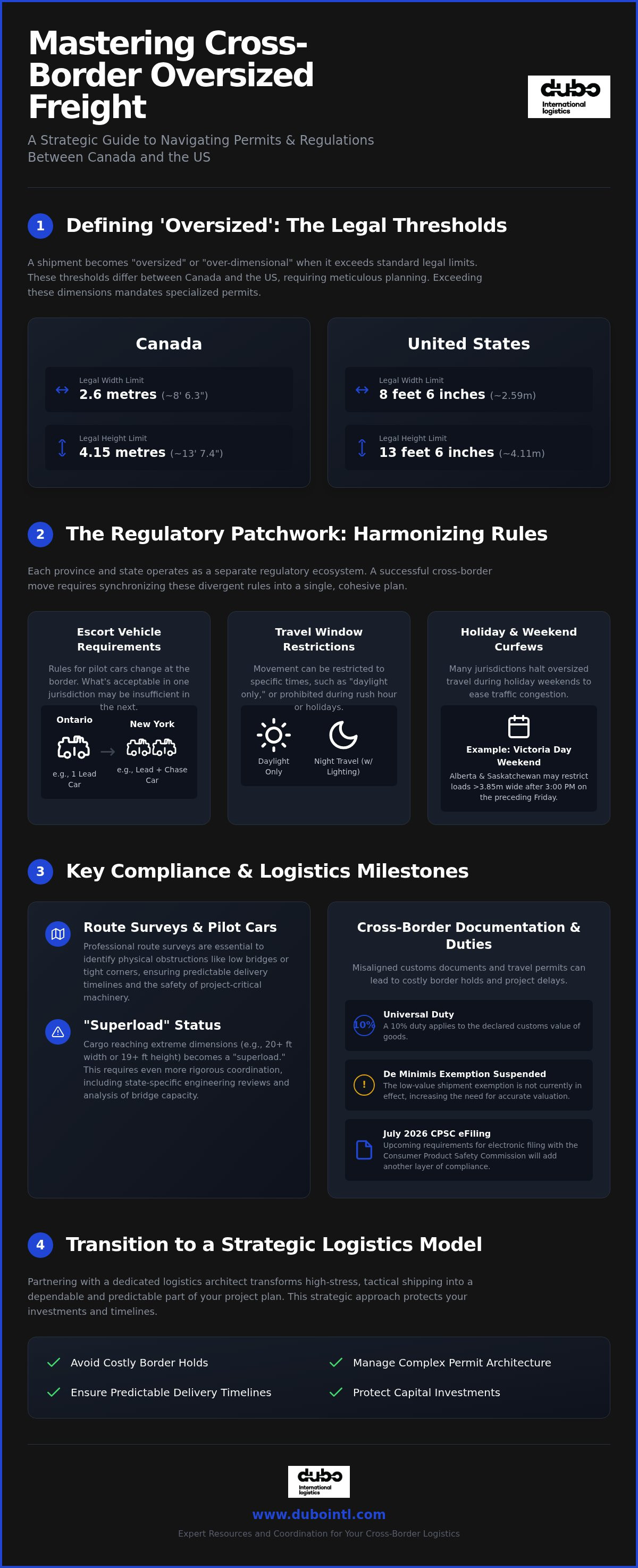
In the United States, the typical legal limits for a standard load are 8 feet 6 inches in width, 13 feet 6 inches in height, and a 53-foot trailer length. In Canada, these thresholds are generally 2.6 metres in width and 4.15 metres in height. Once these limits are exceeded, specialized permits become mandatory. If a load reaches extreme proportions, such as 20 feet in width or 19 feet in height, it enters "superload" status. This designation requires even more rigorous coordination and often involves state-specific engineering reviews. Accurate measurements are the only way to avoid permit violations and ensure you receive a reliable quote from providers like those found at www.dubointl.com.
The Economic Impact of Specialized Cargo
Specialized shipping is the backbone of national infrastructure and large-scale energy projects. When a critical component for a power plant or a bridge is delayed due to poor planning, the financial consequences ripple through the entire project timeline. Precision in logistics is a financial necessity, as unexpected border holds can lead to mounting storage fees and idle labour costs at the destination site. Specialized transportation is a strategic business asset that protects your capital investments through expert cargo coordination. By prioritizing strategic foresight, businesses can maintain predictable delivery timelines despite the inherent oversized freight shipping challenges Canada to US.
The Patchwork of Jurisdictions: Permits and Regulations
Crossing the border isn't just a change in currency; it's a transition into an entirely different regulatory ecosystem. While Canadian provinces have their own specific over-dimensional thresholds, the United States introduces a complex layer of state-level autonomy. These oversized freight shipping challenges Canada to US require a logistics architect who can synchronize multiple permit applications across every jurisdiction on the route. Success depends on the ability to harmonize these conflicting rules into a single, cohesive movement plan.
State vs. Provincial Permit Divergence
Escort vehicle requirements vary significantly between jurisdictions. For instance, a load that requires one lead car in Ontario might require both a lead and a chase car once it enters New York. Travel windows also differ; some states enforce strict "daylight only" movement, while others allow night travel with specific lighting. Understanding Federal commercial vehicle standards is a necessary starting point, but local state laws often impose stricter curfews during rush hours or holiday weekends. For the Victoria Day weekend in 2026, Alberta and Saskatchewan have already confirmed travel restrictions for loads over 3.85 metres wide starting after 3:00 PM on May 15. Managing these "travel windows" requires steady authority to ensure the driver doesn't reach a border or state line only to be grounded by a local curfew.
- Bridge Analysis: Engineering reviews are often mandatory for superloads to ensure weight-bearing capacity.
- Pilot Car Specs: Requirements for height poles or specific signage change at the border.
- Route-Specific Permits: Most oversized moves are bound to a literal turn-by-turn path that cannot be altered.
The Application Process and Lead Times
Precision is mandatory during the application phase. The process demands an exhaustive level of detail, ranging from axle weight distributions to exact route turn-by-turn directions. In 2026, permit lead times for major transit states like Texas or Illinois require earlier project initiation than in previous years to account for increased administrative scrutiny. There's also a significant risk of permit expiration during border customs delays. If a shipment is held due to a minor documentation error, the validity window for your state permits might close. This creates a domino effect of costs and delays that only logistics consulting can effectively mitigate. By aligning permit timelines with customs clearance, you create a stabilizing force that protects your delivery schedule. For a detailed review of your specific route requirements, the team at www.dubointl.com provides the strategic foresight needed to keep your cargo moving without interruption.
Physical Challenges: Routing, Equipment, and Escorts
The transition from digital permit planning to physical execution is where the most tangible risks emerge. Successfully managing the physical oversized freight shipping challenges Canada to US requires a deep understanding of both infrastructure and physics. It isn't enough to have a permit in hand; the equipment must be perfectly matched to the cargo's dimensions and weight distribution to ensure a stable, safe journey across varied terrain. This level of precision is what separates a successful delivery from a costly roadside delay.
The Necessity of Route Surveys
A professional route survey is a mandatory prerequisite for any over-dimensional movement. This process involves a physical scout of the entire path to identify low-hanging utility wires, narrow bridges, and tight turn radii that could ground a shipment. Construction zones are particularly volatile; a project that wasn't present during the permit application phase can instantly invalidate a pre-approved route. Modern logistics consulting firms use simulation technology to model how a specific multi-axle trailer will navigate a particular intersection, providing an extra layer of security before the first kilometre is driven. This proactive approach lowers the stress of the journey by identifying obstacles long before they become emergencies.
Specialized Trailer Selection
Choosing the right trailer is a matter of technical precision rather than convenience. While standard flatbeds suffice for some loads, more complex cargo requires specialized configurations. Step-decks and double-drops are essential for taller items to clear bridge heights, while Removable Gooseneck (RGN) trailers are the industry standard for self-propelled construction or agricultural machinery. For extreme weight, multi-axle configurations are necessary to distribute the load and meet both Canadian and US axle-weight safety standards. Every piece of equipment must be vetted for compliance to avoid delays during cross-border freight challenges where equipment inspections are frequent and rigorous.
Beyond the trailer, the role of pilot cars and police escorts is critical for maintaining safety in both urban and rural areas. A pole car, equipped with a height sensor, acts as a final safeguard against overhead obstructions that may have changed since the last survey. Securing non-standard cargo also requires an expert understanding of the centre of gravity and aerodynamic considerations; an improperly balanced load can become a safety hazard under high wind conditions or during sudden stops. This level of end-to-end coordination is a hallmark of the specialized transportation services that protect your capital investments. By focusing on these minute physical details, the team at www.dubointl.com ensures that your project-critical machinery arrives safely and on schedule.
Cross-Border Compliance and Documentation
Documentation serves as the invisible infrastructure of every successful heavy-haul movement. While physical obstacles are visible to the naked eye, the most persistent oversized freight shipping challenges Canada to US often reside within the paperwork. Precision in this area is a non-negotiable requirement for maintaining a predictable delivery timeline. If the dimensions on your Bill of Lading don't align perfectly with your state-issued travel permits, your shipment will remain stationary at the border while costs accumulate. This synchronization between customs data and permit specifications is the hallmark of a professional logistics strategy.
Essential documentation for 2026 includes the Bill of Lading, a detailed Commercial Invoice, and relevant CUSMA certificates to ensure preferential treatment under current trade agreements. In an environment where the universal 10% duty applies and the de minimis exemption has been suspended, even minor errors in declared customs value can trigger audits. Digital compliance systems, specifically Advance Commercial Information (ACI) for Canadian exports and the Pre-Arrival Processing System (PAPS) for US imports, must be managed with strategic foresight. These systems act as the digital gates for your cargo; they require accurate data long before the driver reaches the booth.
Customs Brokerage Coordination
Oversized loads require a bespoke approach to customs that standard shipments simply don't demand. For instance, cargo transiting through the US to reach a third destination may require in-bond filing to defer duties and taxes. Border inspections for non-standard containers or open-deck machinery are more frequent and time-consuming than for standard dry vans. A dedicated logistics architect ensures that all technical specifications are shared with the broker well in advance, reducing the likelihood of a physical secondary inspection that could jeopardize your permit windows. You can access expert logistics consulting to verify that your specific cargo meets all current 2026 regulatory standards.
Immigration and Driver Compliance
The human element of cross-border haulage is just as regulated as the cargo itself. Drivers must possess the correct visas and specialized certifications required for heavy-haul operations in multiple jurisdictions. Furthermore, the impact of Electronic Logging Device (ELD) mandates cannot be overlooked; a driver who runs out of legal hours while waiting for a pilot car or a border clearance creates a cascading delay. Managing these overlapping schedules is a core component of end-to-end coordination. To deepen your understanding of these complexities, you can learn more about cross-border freight forwarding and how it integrates with specialized transport. For immediate assistance with your next project, the team at www.dubointl.com provides the authoritative management required to navigate these intricate systems with confidence.
Strategic Partnership: Why Expert Management Matters
Success in North American trade depends on the transition from tactical shipping to strategic logistics consulting. While many providers focus solely on the movement of goods, a dedicated partner views your supply chain as a cohesive architecture that requires constant refinement. These oversized freight shipping challenges Canada to US are best managed through a professional relationship built on longevity and consistency. By integrating expert foresight into your project planning, you transform logistics from a variable cost into a predictable competitive advantage that supports your long-term growth.
Trust is the most valuable currency in the heavy-haul sector. As a CIFFA member, Dubo International Logistics adheres to the highest international standards, providing a layer of security that protects your interests in a complex global environment. This membership isn't just a badge; it's a commitment to professional excellence and ethical conduct that ensures every movement is executed with precision. End-to-end cargo coordination reduces the administrative burden on your team, allowing you to focus on your core operations while we stabilize the moving parts of your cross-border journey.
The Role of a Logistics Architect
A logistics architect understands the grand scale of global movement while remaining focused on the minute details of individual client needs. This consultative approach identifies supply chain savings long before the cargo is loaded. By analyzing route data and permit requirements early, we can suggest bespoke solutions for sensitive or high-value oversized cargo that standard forwarders might overlook. You can explore our specialized freight services to see how this strategic methodology applies to your specific industry requirements. Specialized project fees cover these tailored solutions, ensuring that the complexity of non-standard goods is managed with a high-professional register and meticulous execution.
Securing Peace of Mind in 2026
Commitment and dependability are the stabilizing forces your business needs to navigate the shifting regulations of the coming year. In a market where digital compliance and universal duties have increased the stakes, having a seasoned expert as a guide provides essential peace of mind. We act as a sophisticated bridge between your business and the intricate international systems that govern North American trade. This steady authority ensures that your project-critical machinery moves without the friction of permit violations or border delays. You're invited to visit www.dubointl.com to realize your next specialized transport project with a partner who prioritizes your security and success above all else.
Securing Your Cross-Border Heavy-Haul Success
Mastering the complexities of oversized freight shipping challenges Canada to US requires more than just a truck and a trailer; it demands a meticulous integration of permit synchronization, physical route surveys, and rigorous customs compliance. By addressing these variables with strategic foresight, you ensure your project-critical machinery moves without the friction of documentation errors or border delays. Our national North American coverage provides the stabilizing force your business needs to maintain predictable delivery timelines in a shifting 2026 regulatory environment.
Choosing a partner with CIFFA certified reliability means your cargo is managed by dedicated experts who understand the minute details of specialized project coordination. This authoritative management lowers your stress and protects your capital investments from the risks of a fragmented jurisdictional landscape. We invite you to partner with the logistics architects at Dubo International for your next oversized shipment. Visit www.dubointl.com to realize a seamless journey for your most challenging cargo. We look forward to helping you build a more resilient and efficient supply chain.
Frequently Asked Questions
What is considered an oversized load when shipping from Canada to the US?
A load is generally considered oversized in Canada if it exceeds 2.6 metres in width or 4.15 metres in height. In the United States, the typical legal thresholds are 8 feet 6 inches in width and 13 feet 6 inches in height. Any cargo surpassing these dimensions, or a trailer length of 53 feet, requires specialized permits. Precise measurements are mandatory to ensure your equipment meets the legal standards of every jurisdiction on your route.
How long does it take to get oversized permits for cross-border shipping?
Permit lead times depend on the complexity of your route and the specific dimensions of your cargo. While standard oversized permits often take between three and five business days, major transit states like Texas or Illinois may require more time in 2026. Superloads or loads requiring engineering reviews for bridge capacity need significantly earlier project initiation. Strategic planning with a logistics architect at www.dubointl.com helps you manage these timelines without compromising your delivery schedule.
Do I need a pilot car for my oversized shipment in every state?
Pilot car requirements are not universal and vary significantly between each state and province. Some jurisdictions mandate a lead car for loads over 10 feet wide, while others don't require an escort until the cargo reaches 12 feet. Requirements for chase cars or police escorts also shift based on urban density and road types. A professional route survey identifies these needs early, ensuring your shipment remains compliant as it crosses jurisdictional lines.
What are the most common reasons for oversized cargo delays at the border?
Mismatched dimensions on customs and permit paperwork are the primary cause of border delays. If the measurements on your Commercial Invoice don't align with your state travel permits, US Customs and Border Protection may hold the shipment. These oversized freight shipping challenges Canada to US are often compounded by inaccurate ACI or PAPS filings. Ensuring that every document is synchronized before the driver reaches the border is essential for a seamless journey.
Can I ship oversized freight during the weekend or at night?
Travel windows for oversized loads are strictly regulated and often restricted to daylight hours. Many states and provinces prohibit movement on Sundays or during major holidays to ensure public safety. For example, during the Victoria Day 2026 weekend, provinces like Alberta and Saskatchewan enforce specific curfews for wide loads. Specialized transportation services provide the strategic foresight needed to navigate these "travel windows" and avoid being grounded by local weekend restrictions.
How much does specialized transportation coordination typically cost?
The cost of coordination reflects the complexity and tailored nature of heavy-haul logistics. Specialized transportation project fees cover the end-to-end management of non-standard goods, including permit synchronization and route planning. Factors such as the number of pilot cars required, the need for route surveys, and the specific equipment used all influence the final investment. Investing in professional logistics consulting often leads to long-term savings by preventing costly permit violations and border delays.
What is the difference between a standard freight forwarder and a specialized one?
Standard freight forwarders typically focus on high-volume, palletized cargo using automated systems. In contrast, a specialized provider acts as a logistics architect for non-standard goods. They provide bespoke solutions for machinery that requires multi-axle trailers or complex permit coordination across multiple borders. As a CIFFA member, Dubo International Logistics adheres to the highest international standards, offering a level of dependability and expert project management that standard forwarders simply aren't equipped to provide.
What documentation is mandatory for shipping machinery from Canada to the USA?
Mandatory documentation includes a Bill of Lading, a Commercial Invoice, and CUSMA certificates for preferential treatment. Additionally, you must have valid over-dimensional permits for every province and state on the route. Digital compliance through ACI and PAPS filings is also required to clear customs efficiently. Accuracy in these documents is the only way to overcome oversized freight shipping challenges Canada to US and ensure that your project-critical machinery arrives without unexpected holds.

