

The safest route for a high-value instrument isn’t always the fastest or most direct one. High-tech equipment transportation works best when planning starts with the cargo: its fragility, dimensions, environmental sensitivities and delivery window.
If you’re responsible for delicate or high-value equipment, damage, carrier coordination and shipment paperwork may all be concerns, especially when a move crosses the Canada-US border. A suitable plan addresses these requirements before the equipment is in transit.
This guide explains how to assess transport approaches, protect sensitive cargo and organize timing and documentation around your operational needs. It also covers practical considerations for domestic and cross-border shipments, including equipment details that can affect handling and transport.
Dubo International Logistics coordinates freight forwarding and specialized transportation across Canada and the United States. The team brings cargo requirements, carrier coordination and documentation together in a tailored plan. Dubo uses tracking systems and a network of reliable carriers for specialized transportation. Learn more at www.dubointl.com.
Key Takeaways
- Shape high-tech equipment transportation around the cargo’s dimensions, sensitivity, handling needs and delivery window.
- Compare air, road and multimodal approaches against urgency, route, cargo size and coordination requirements instead of assuming one mode fits every shipment.
- Gather essential shipment details, including weight, dimensions, origin, destination and handling instructions, before building the transport plan.
- Plan domestic and cross-border shipments with clear coordination of carriers, timing and required documentation.
- Dubo coordinates freight forwarding and specialized transportation for delicate equipment, oversized machinery and temperature-sensitive products. Learn more at www.dubointl.com.
Why High-Tech Equipment Transportation Needs a Cargo-Specific Plan
High-tech equipment transportation means planning and coordinating a shipment around the equipment’s physical characteristics, handling instructions and delivery requirements. A single transport arrangement may not suit a fragile instrument, oversized machinery and a product with environmental sensitivities. Each may need different handling, protection and coordination.
In practical terms, specialized equipment transportation matches the cargo’s protection, handling, timing and destination needs to a coordinated plan. These priorities are connected, but they are not interchangeable. Protective measures address the equipment’s condition; timing supports operational schedules; handling instructions guide loading and transfer; and destination requirements shape delivery arrangements. A plan focused only on distance or speed can miss constraints that affect the shipment from pickup through receipt.
Which equipment characteristics shape the shipment plan?
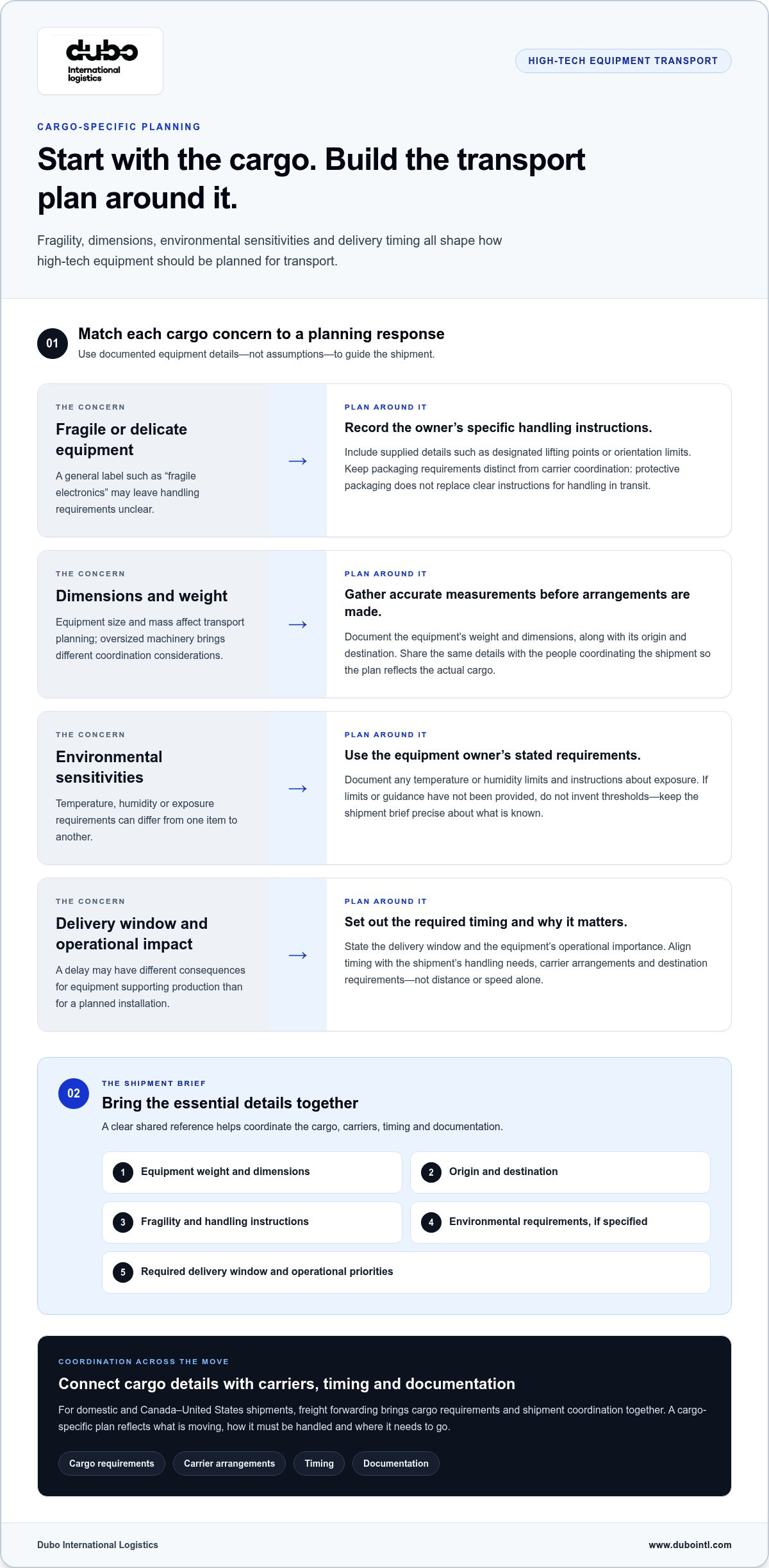
Start with accurate information from the equipment owner. Dimensions and weight help inform transport planning, while fragility and environmental sensitivities can affect how the cargo should be handled and moved. Record the owner’s instructions clearly so the people coordinating the shipment have a shared reference instead of having to rely on assumptions.
Equipment value and operational importance can also affect priorities. A machine needed to support a production schedule may have different delivery constraints from equipment being moved for a planned installation. The goal is not to treat every high-value item identically. It is to understand the consequences of damage, delay or a handling error, then reflect those priorities in the plan.
For example, a delicate instrument may call for close attention to the owner’s handling instructions, while oversized machinery can bring different transport and coordination considerations. A temperature-sensitive product has its own environmental requirements. These cargo types call for different planning inputs, so describing them all simply as “high-tech freight” is not enough.
What does a logistics partner coordinate?
Freight forwarding is the strategic coordination of domestic and cross-border cargo movement. For sensitive or specialized equipment, that coordination connects shipment details with carrier arrangements, timing and documentation. Clear information helps keep everyone involved aligned on what is moving, how it must be handled and where it needs to go.
Route context matters, too. Transport networks and traffic conditions can affect how a shipment moves through a corridor. Intelligent Transportation Systems describes technologies used in transport systems, including traffic management. This provides useful context, but the equipment’s own requirements must still guide the shipment plan.
Dubo coordinates freight forwarding and customized transportation around cargo and project requirements. For a broader look at planning specialized cargo movements, see the specialized freight buyer’s guide. Learn more at www.dubointl.com.
How Equipment Sensitivity, Handling, and Delivery Requirements Affect Transport
A reliable plan begins with information the shipper can document. For high-tech equipment transportation, the owner’s technical details and handling instructions help shape packaging decisions, transport arrangements and delivery coordination. A vague description such as “fragile electronics” leaves too much open to interpretation.
Cargo-specific handling requirements should inform both transport mode and carrier planning. The way equipment must be protected and handled can affect which transport arrangements fit the shipment and how its movements need to be coordinated.
How should delicate or high-value equipment be assessed?
Before planning begins, record the equipment’s dimensions and weight, describe its condition and fragility, and document any handling restrictions supplied by the owner. Include practical instructions that affect movement, such as designated lifting points or limits on orientation, when the shipper provides them. Clear documentation gives everyone involved a shared reference.
Separate packaging requirements from transportation coordination. The owner or packaging plan may specify customized crating or another protective approach. Packaging addresses how the item is protected; carrier coordination addresses how the shipment is arranged and handled in transit. One does not replace the other.
Avoid choosing packaging based on assumptions about the equipment category alone. Two electronic systems can differ in construction, fragility and handling limits. Let the shipper’s documented instructions guide decisions rather than relying on a generic specification. Protecting Sensitive Electronics in Shipment offers additional context on protecting electronic cargo. The requirements for a specific shipment should come from its equipment and packaging details.
When do temperature or condition requirements matter?
Environmental planning depends on the equipment owner’s stated requirements. Record any temperature or humidity limits, along with instructions about exposure or other conditions that could affect the cargo. If the owner has not supplied limits or handling guidance, do not invent thresholds. Keep the shipment brief precise about what has been specified and what needs coordination.
Condition monitoring may be relevant when the shipper identifies environmental conditions that need to be observed during transit. Its role and requirements should follow the shipment brief. Do not assume a particular device, monitoring service or reporting arrangement. This helps keep the transport plan aligned with the equipment’s actual requirements.
Timing is another distinct planning input. Record the requested delivery window and the operational consequences of missing it. If timing is a key part of the shipment brief, expedited transportation options may be relevant to the planning discussion. Dubo’s freight forwarding and specialized transportation coordination bring cargo instructions and shipment requirements into a project-specific plan. Explore logistics support at www.dubointl.com.
Comparing Transport Approaches for High-Tech Equipment
No single transport mode suits every equipment shipment. The right approach depends on the delivery requirement, cargo dimensions, handling needs, route and number of transitions involved. Compare options against the shipment details and destination requirements rather than assuming urgency alone determines the answer.
The overview below is a planning aid, not a guarantee of availability or performance. Suitability depends on the cargo and route.
| Approach | May merit consideration when | Planning considerations |
|---|---|---|
| Air | The shipment has an urgent delivery requirement and the cargo is suitable for air movement. | Assess the equipment’s dimensions, handling instructions, route and coordination needs alongside the requested delivery window. |
| Road | The route and equipment dimensions suit movement by road. | Consider cargo size, the handling needed during transit and delivery constraints at the destination. |
| Multimodal | A shipment may need more than one transport mode to address its route or delivery requirements. | Account for transitions between modes, including how handling instructions and shipment information remain aligned. |
These options are not ranked. A tight delivery window may bring air transport into consideration, while equipment dimensions or route needs may make road transport more relevant. A multimodal plan may suit a route involving distinct legs, but each transition adds coordination to consider. In every case, the shipper’s documented requirements and destination context should inform the decision.
When might air or road transport fit the shipment?
Consider air transport when urgency is a defining requirement and the cargo is suitable for that mode. Road transport may fit when the route and equipment dimensions align with road movement. Neither is an automatic match. Compare the equipment’s handling needs and delivery constraints against the route and shipment details before selecting an approach.
How can LTL freight shipping fit specialized equipment?
LTL freight shipping is an arrangement in which multiple shippers share trailer capacity. For specialized equipment, the key question is whether its protection and handling requirements can be coordinated within that arrangement. Dubo manages specialized transportation projects within an LTL framework, shaping coordination around the project rather than treating LTL as a one-size-fits-all solution.
Provide clear shipment and destination details before comparing modes. Dubo’s freight forwarding coordinates domestic and cross-border cargo movement, including carrier and shipment planning. For transport needs centred on urgency, expedited transportation options may be relevant to the discussion. Learn more at www.dubointl.com.
How to Prepare High-Tech Equipment for a Transportation Plan
Good preparation turns a complex move into a coordinated shipment. A clear brief helps the logistics partner assess transport requirements, align carrier arrangements and organize documentation before the equipment is in transit. For high-tech equipment transportation, details that seem minor at first can affect handling, delivery coordination and shipment visibility.
What shipment details should be assembled first?
Gather the information in sequence. Accurate details make it easier to plan around both the cargo and its destination.
- Describe the equipment. Provide a clear cargo description, dimensions and weight. Include the number of pieces or units where relevant, and identify any unusual shape or features that affect movement.
- Document handling requirements. Share the owner’s instructions, including fragility, handling restrictions and shipper-defined packaging or protection requirements. Where specific instructions are available, do not rely on a general “handle with care” note alone.
- Set out environmental needs. Include any temperature or humidity requirements supplied by the equipment owner, along with other relevant sensitivities.
- Define the route endpoints. Record the shipment origin and destination, plus delivery-site constraints that may affect access, unloading or the receiving schedule.
- State the delivery window. Identify the requested timing and any operational requirements tied to it. This gives the planning team a defined constraint to consider alongside cargo and route details.
Keep these details consistent across the shipment brief and supporting documents. If the equipment description, dimensions or handling instructions change, update the people coordinating the move so the plan reflects the latest information.
How should documentation and shipment visibility be planned?
Documentation and compliance requirements belong in the transport plan, not as a last-minute administrative step. For a domestic shipment, organize the information needed to describe and coordinate the cargo. For a cross-border move, identify the documentation and compliance considerations relevant to the shipment and its movement between Canada and the United States. Requirements can depend on shipment details, so avoid assumptions or reusing paperwork from a different move.
For cross-border planning context, see the Canada-US freight coordination guide. Dubo’s freight forwarding brings domestic and cross-border cargo movement, carrier coordination and shipment documentation into an organized plan.
Tracking systems can support shipment visibility by helping coordinate awareness of cargo movement. Set out expected updates and any service commitments in the agreed project plan rather than assuming a particular update frequency or reporting method. Clarifying this in advance helps align the shipper, logistics partner and receiving team. To plan around the cargo and delivery requirements, explore Dubo’s transportation services or visit www.dubointl.com.
How Dubo Coordinates High-Tech Equipment Transportation
Specialized equipment movements need more than a carrier assignment. They call for coordination that connects cargo requirements with transport arrangements, documentation and delivery context. Dubo supports high-tech equipment transportation through freight forwarding and logistics planning, coordinating shipments across Canada and the United States.
What Dubo brings to a specialized shipment
Dubo coordinates carrier arrangements and shipment documentation around each project’s requirements. Its customized transportation services address oversized machinery, delicate equipment and temperature-sensitive products, with planning shaped to the cargo rather than applied as a standard template.
Dubo uses tracking systems and a network of reliable carriers for specialized transportation. These support shipment visibility and carrier coordination, while the specific arrangements reflect the project’s requirements. Dubo is a member of the Canadian International Freight Forwarders Association (CIFFA).
Every shipment brings its own considerations. The aim is to align cargo requirements, carrier arrangements and documentation in a plan that reflects the movement at hand.
What to include when planning the next shipment
A clear shipment brief gives the planning process a practical starting point. Share the cargo type and dimensions, handling needs, route and timing priorities. Include destination constraints and any environmental requirements supplied by the equipment owner.
- Cargo: equipment type, dimensions and weight.
- Handling: documented instructions and protection requirements.
- Route: origin, destination and whether the shipment crosses a border.
- Timing: requested delivery window and operational priorities.
With these details, Dubo can tailor transportation coordination to the shipment’s needs and operational context. If any requirements change, share the updated information so the plan reflects the current brief.
Discuss your shipment requirements with Dubo, including cargo profile, route, handling needs and timing priorities. Discuss your transportation requirements with Dubo.
Set Your Next Equipment Move in Motion
Turn your equipment requirements into a shipment brief that supports clear decisions. Consider what the receiving operation needs, which handling instructions must travel with the cargo and what delivery constraints could affect the plan. Bringing these details together early gives the logistics conversation a practical starting point and helps keep the shipment aligned with operational priorities.
For high-tech equipment transportation, precision begins before the equipment moves. A well-defined plan connects cargo needs with the route, timing and coordination required for the shipment, whether it moves domestically or crosses the Canada-US border. Dubo International Logistics can help shape that plan around your shipment requirements.
Start with the cargo type, dimensions, handling needs, origin, destination and requested delivery window. Discuss your high-tech equipment shipment with Dubo International Logistics and take the next step with a plan shaped around your operation.
Frequently Asked Questions
What is high-tech equipment transportation?
High-tech equipment transportation means moving technology cargo under a plan shaped by the equipment’s needs rather than a preset transport mode. In a purchasing or project brief, use the term to flag that the shipment needs cargo-specific planning. Then identify the equipment and its operational role. This context helps distinguish a routine equipment move from one where disruption or mishandling could affect installation, testing or production activities.
How do I choose a transport method for high-tech equipment?
Set out the shipment’s non-negotiable requirements before weighing transport options. Separate essential conditions, such as a fixed receiving appointment, from preferences that could be adjusted. Then consider whether air, road or a combined approach can meet those conditions for the cargo and route. This order keeps the comparison focused on operational fit instead of treating a single factor, such as urgency, as the whole answer.
Can high-tech equipment move through LTL freight shipping?
It may be suitable if the cargo can be planned within a shared-capacity arrangement and its handling requirements can be addressed. Before selecting LTL, clarify whether the equipment has restrictions on loading, orientation or contact with other freight, if the owner has provided such instructions. Share those details with the logistics partner early. Dubo manages specialized transportation projects within an LTL framework, tailoring coordination to the cargo.
How should delicate technology equipment be protected during transportation?
Establish a record of the equipment’s condition before it is handed over for transportation. The shipper can document visible condition and identify components or surfaces that need particular care, using the owner’s instructions as a reference. Keep this record with the shipment file so it can be consulted during coordination and at receipt. Packaging decisions should follow the equipment’s documented requirements, not a generic assumption about electronics.
What information should I provide for a high-tech equipment shipment?
Along with cargo and route details, prepare the supporting information the receiving team needs to plan for arrival. Identify the receiving contact, any delivery appointment process and site instructions provided to the shipper. Keep the equipment description consistent across the shipment brief and documents, and note who can provide answers if details change. Maintaining a single record can reduce confusion as planning moves from initial coordination to dispatch.
Can high-tech equipment be transported across the Canada-US border?
Yes. Shipments can be planned between Canada and the United States. For a smoother handoff, align the cargo description and shipment information across the parties involved, and identify who is responsible for providing each document. Address missing or inconsistent details before the shipment moves. Dubo coordinates freight forwarding across Canada and the United States, with arrangements tailored to the cargo and route.
