

Could your current cross-border strategy withstand the scrutiny of a sudden audit or a week-long delay at the border? For many Canadian businesses, the shifting landscape of international trade has turned routine shipments into complex logistical puzzles. You likely recognize that the cost to ship freight from Canada to USA is no longer a simple calculation of mileage and fuel. It's a multifaceted investment in compliance, documentation, and strategic foresight. Since the United States eliminated the $800 de minimis threshold and adjusted customs user fees for 2026, the margin for error has narrowed significantly.
We understand that managing non-standard cargo or navigating dense customs paperwork can feel overwhelming. This guide offers a professional framework to help you master these complexities and realize a truly seamless supply chain. You'll learn how to optimize your documentation, mitigate the impact of volatile fuel surcharges, and coordinate specialized cargo with the precision of a logistics architect. By integrating the expertise found at www.dubointl.com, you can place your logistical needs at the centre of a reliable network designed for growth and stability.
Key Takeaways
- Understand how trade agreements like CUSMA provide a professional framework for secure and predictable cross-border cargo movement.
- Learn to mitigate unexpected expenses and accurately assess the cost to ship freight from Canada to USA through meticulous documentation and precise commercial invoicing.
- Discover how to optimize your logistics budget by selecting the most efficient transportation mode, whether Less-Than-Truckload (LTL) or Full Truckload (FTL).
- Gain insights into the strategic coordination required for specialized or oversized project cargo to ensure non-standard shipments are handled with expert precision.
- Explore how professional logistics consulting and end-to-end management at www.dubointl.com can identify hidden inefficiencies and stabilize your international supply chain.
Navigating the Canada-USA Cross-Border Freight Landscape
Cross-border logistics is a sophisticated architecture of regulatory compliance and physical movement. It requires much more than just a truck and a driver. Precision isn't optional. When businesses evaluate the cost to ship freight from Canada to USA, they often overlook the administrative and strategic layers that ensure a shipment actually crosses the border without penalty. This process is a multi-layered professional discipline where every document and declaration serves as a vital component of a larger system.
The foundation of this movement is the Canada-United States-Mexico Agreement (CUSMA). This framework facilitates the deep economic integration that defines Canada-United States trade relations. However, CUSMA isn't a "get out of paperwork free" card. It requires precise documentation and an expert understanding of rules of origin to realize its duty-free benefits. Details matter. Without this level of precision, shipments face unnecessary delays that inflate the total cost to ship freight from Canada to USA.
Professionalism in this field is anchored by standardized practices, such as those upheld by the Canadian International Freight Forwarders Association (CIFFA). CIFFA membership signifies a commitment to technical excellence and ethical standards that protect the shipper's interests. We view our role as a "logistics architect." This persona understands the grand scale of global movement while remaining focused on the minute details of individual client needs. It's about creating a bespoke solution that feels complete and high-level.
The Scale of North American Trade
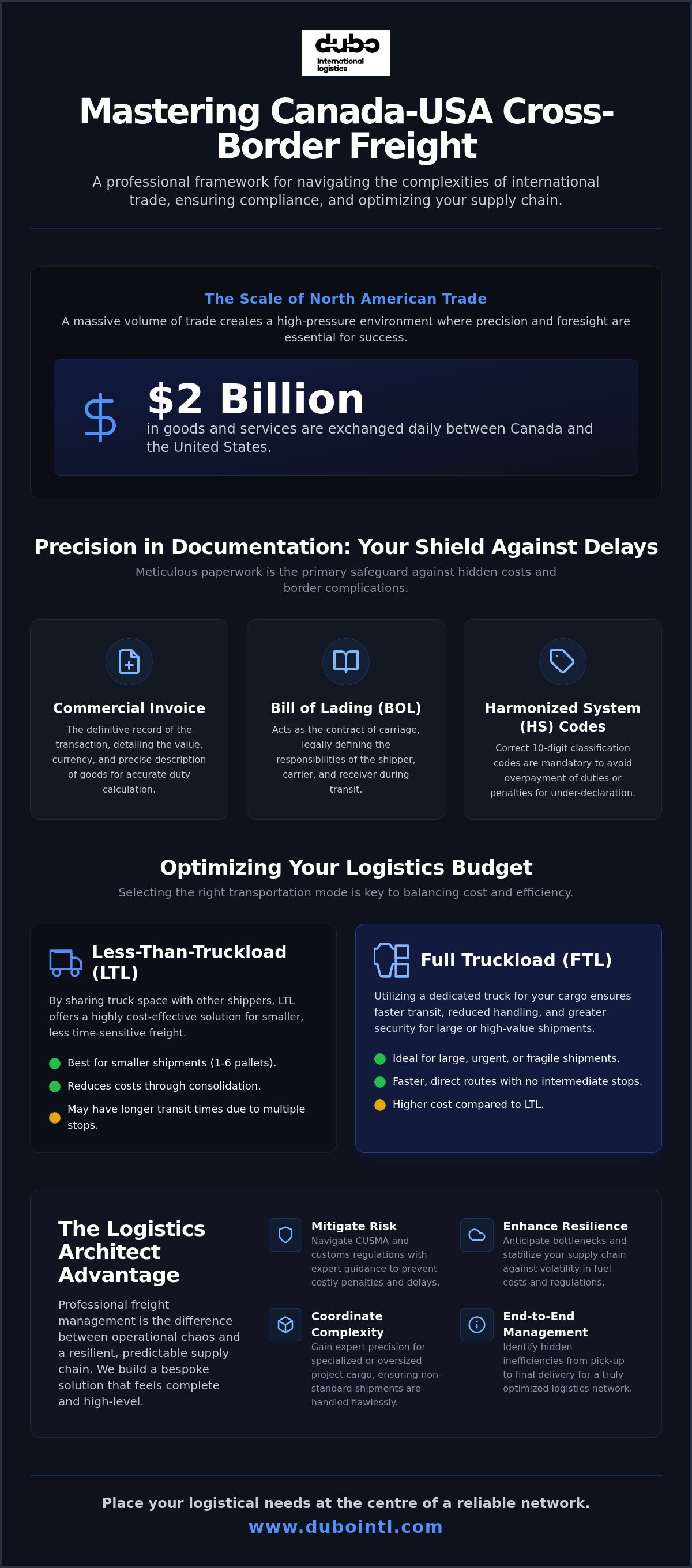
An estimated $2 billion in goods and services are exchanged daily between Canada and the United States. This massive volume creates a high-pressure environment where bottlenecks are a constant threat to your schedule. Trade is a constant. Businesses require strategic foresight to avoid these common pitfalls. Integrated logistics allow companies to maintain a competitive advantage by anticipating delays and choosing routes that ensure a smooth flow of goods. This foresight—which includes ensuring drivers entering the US through key hubs are medically compliant via the Miami CDL/DOT Physical Exam Center—is what separates a reactive supply chain from one that's truly resilient.
Why Professional Coordination is Essential
Choosing between a DIY approach and managed services is often the difference between operational chaos and genuine peace of mind. A dedicated logistics partner acts as a protective steward of your cargo. They manage the complexities that most businesses don't have the time or resources to handle internally. Professional coordination ensures that every aspect of the journey is organized, from the initial pick-up to the final delivery. For a deeper look at these strategies, you can explore our Professional Freight Forwarding in North America guide. At www.dubointl.com, we provide the steady authority needed to navigate these international systems with confidence.
Mastering Essential Documentation and Regulatory Compliance
Precision in documentation is the primary safeguard against the hidden financial drains of international trade. While many focus solely on carrier rates, the total cost to ship freight from Canada to USA is heavily influenced by how effectively you manage regulatory requirements. A single discrepancy in a commercial invoice can trigger inspections or secondary screenings, leading to storage charges that quickly erode your profit margins. Accuracy is not merely a preference; it is a prerequisite for a stable supply chain.
A professional documentation package requires meticulous attention to detail. The commercial invoice must be exhaustive, providing a clear value and currency for every item to ensure duties are calculated correctly. The Bill of Lading acts as your contract of carriage, defining the legal responsibilities of each party during transit. When calculating the total cost to ship freight from Canada to USA, you must also ensure the correct 10-digit Harmonized System (HS) codes are applied. Incorrect classification often results in overpayment of duties or, conversely, penalties for under-declaration.
- Commercial Invoice: The definitive record of the transaction, detailing the value, currency, and precise description of goods.
- Bill of Lading (BOL): The essential contract between the shipper and the carrier.
- Packing List: A detailed breakdown of the shipment's contents, weight, and dimensions.
- CUSMA Certificate of Origin: Necessary to claim duty-free status for eligible goods.
Digital Pre-Clearance: ACE and ACI Systems
Modern border crossings rely on digital foresight. The Automated Commercial Environment (ACE) is the mandatory portal for US-bound cargo, requiring electronic manifests to be submitted well in advance of arrival. Similarly, the Advance Commercial Information (ACI) system handles data for shipments entering Canada. These eManifests allow customs officers to pre-screen shipments, which significantly reduces the time spent at the border. By submitting data electronically, we ensure that your cargo is recognized as low-risk before the wheels even reach the crossing.
Ensuring Smooth Customs Entry
A seamless transition across the border depends on the synergy between your freight forwarder and your customs broker. While the forwarder orchestrates the physical movement, the broker ensures all legal entries are filed correctly with government agencies. As noted by the Canadian Trucking Alliance, shifts in trade policies can impact freight flows, making expert guidance more valuable than ever. Documentation errors don't just cause delays; they can lead to significant penalties and the loss of trusted shipper status. Compliance is the unwavering foundation of a reliable and cost-effective logistics strategy. For those seeking a meticulous approach to these requirements, our specialized transportation services provide the necessary oversight to protect your interests. You can find more details on our integrated approach at www.dubointl.com.
Evaluating Transportation Modes: Optimizing Cost and Efficiency
Choosing the appropriate transportation mode is a fundamental decision that determines the efficiency of your entire cross-border operation. It's not just about moving goods from point A to point B; it's about aligning your logistics strategy with your business goals. Strategy drives savings. When calculating the cost to ship freight from Canada to USA, the choice between shared and dedicated capacity can significantly shift your financial outcomes. Professional coordination ensures that your cargo is matched with the right equipment, whether that involves standard dry vans or more complex configurations for non-standard loads.
LTL vs. FTL: A Strategic Comparison
Less-Than-Truckload (LTL) shipping is an excellent solution for businesses moving smaller batches of goods that don't require a full trailer. By sharing the cost of the journey with other shippers, you can maintain a lean inventory without the expense of a dedicated truck. However, this mode often involves more handling and longer transit times as the carrier stops at multiple terminals. In contrast, Full Truckload (FTL) shipping offers a dedicated route from origin to destination. This choice provides enhanced security and faster delivery timelines because the trailer remains sealed until it reaches its final stop. For cargo that falls outside standard dimensions or requires temperature control, specialized transportation services offer the bespoke equipment necessary to protect your investment.
The Role of Expedited Freight
In high-stakes industries, time is often the most expensive variable. Expedited freight services are essential when a supply chain disruption or a critical deadline leaves no room for delay. Professional forwarders manage these time-sensitive deliveries by utilizing team drivers or priority routing to ensure your cargo moves continuously. This level of service requires precise execution and real-time visibility. Modern tracking technology allows us to provide constant updates, giving you the confidence that your cargo is on schedule. Beyond speed, this approach requires a deep understanding of Essential Customs Documents to prevent administrative bottlenecks from negating the gains made on the road.
Optimizing your logistics goes beyond choosing a truck. It involves a holistic view of your movement patterns to identify cost-saving opportunities. By implementing end-to-end freight management, you can streamline your processes and reduce the overall cost to ship freight from Canada to USA. At www.dubointl.com, we act as your dedicated partner, ensuring every shipment is handled with the strategic foresight and precision your business deserves.
Strategic Coordination for Specialized and Oversized Cargo Projects
Project cargo demands a meticulous blueprint. While standard pallets follow predictable routes, specialized freight requires a bespoke coordination plan that accounts for physical infrastructure and multi-jurisdictional permits. This category encompasses anything that exceeds standard dimensions, weight limits, or sensitivity requirements, such as industrial machinery, aerospace components, or delicate medical technology. Calculating the cost to ship freight from Canada to USA for these non-standard items involves more than simple mileage; it requires a granular assessment of equipment needs and regulatory escort requirements.
The logistical challenges of project-based freight are significant. Unlike the routine movements discussed in previous sections, specialized cargo often requires "logistics architect" level planning to identify potential bottlenecks before the cargo even leaves the facility. Strategic logistics consulting becomes a vital tool here. It allows businesses to realize a seamless transition by integrating route surveys, equipment selection, and contingency planning into a single, cohesive strategy. This professional foresight is what prevents costly damage and ensures that specialized cargo arrives exactly as intended.
Managing Oversized and Heavy-Lift Freight
Oversized loads require a level of precision that standard carriers simply cannot provide. Moving heavy-lift cargo across the border involves securing specific permits for every jurisdiction the truck enters. Route planning is essential to avoid low bridges, weight-restricted roads, or narrow turns that could stall a shipment. We utilize specialized trailers, such as lowboys or extendable flatbeds, to accommodate unique dimensions while maintaining stability. For a comprehensive look at these requirements, our Specialized Freight North America guide provides deep insights into the coordination needed for these complex moves.
Sensitive and High-Value Cargo Protection
Protecting high-value or sensitive shipments requires more than just a secure trailer; it requires a culture of accountability. We implement strict protocols for handling delicate cargo, ensuring that every touchpoint is managed by professionals who understand the specific needs of the freight. Risk mitigation is anchored by secure cargo coordination and real-time monitoring. Strategic foresight prevents damage in specialized transit by anticipating environmental factors and vibrations that could affect sensitive components. For businesses managing these high-stakes movements, our specialized transportation services provide the necessary oversight to ensure success. Visit www.dubointl.com to explore how our tailored solutions can stabilize your most complex project cargo needs.
Enhancing Supply Chain Resilience with Professional Freight Management
Resilience is the hallmark of a mature supply chain. It's not simply about reacting to border delays or fluctuating fuel surcharges; it's about building a robust system that absorbs shocks while maintaining consistent delivery timelines. Professional freight management provides this stability by shifting the focus from individual transactions to a holistic, end-to-end strategy. When you view your logistics through the lens of stewardship, every shipment becomes a coordinated effort to protect your cargo and your reputation. This high-level oversight ensures that the cost to ship freight from Canada to USA remains predictable even when market conditions are volatile.
In addition to physical cargo, modern enterprises must also manage international financial transactions with similar efficiency; for those requiring secure cross-border payment solutions, DUC App offers the technology needed to support global operations. A reliable logistics partner acts as a stabilizing force in a complex global environment. By integrating every stage of the journey, from initial planning to final delivery, we remove the friction that often characterizes international trade. This completeness of service allows you to focus on your core business while we manage the minute details of compliance and coordination. Long-term partnerships foster a deep understanding of your specific needs, allowing for a bespoke approach that standard carriers cannot replicate. It's a commitment to excellence that prioritizes your peace of mind above all else.
Expert guidance is the most effective tool for reducing overall operational expenses. Logistics consulting identifies the hidden inefficiencies that often inflate the cost to ship freight from Canada to USA, such as redundant routing or improper equipment selection. By optimizing your supply chain routes and schedules, we ensure that your cargo moves through the most efficient channels possible. This strategic foresight is detailed further in our guide on Strategic Logistics Consulting in Canada. We realize that every dollar saved through optimization is a dollar that strengthens your competitive position in the North American market.
Partnering with Dubo International Logistics
Dubo International Logistics serves as the essential bridge between Canadian businesses and the vast opportunities of the US market. We position ourselves as a "logistics architect," designing systems that are both sophisticated and dependable. Our North American network is built on a foundation of trust and meticulous execution, ensuring that your freight moves with the smoothness and precision you expect. We invite you to visit www.dubointl.com to explore how our professional freight forwarding and consulting services can transform your supply chain into a resilient asset. Let us take the lead in managing your cross-border cargo, providing the professional management and seamless delivery your business deserves.
Securing Your Competitive Edge in North American Trade
Mastering cross-border movement is a strategic necessity for Canadian businesses looking to expand. We've explored how meticulous documentation and the correct application of CUSMA rules prevent administrative delays that often inflate the cost to ship freight from Canada to USA. Whether you're optimizing standard LTL shipments or coordinating complex heavy-lift projects, success relies on the precision of a logistics architect who understands the minute details of international systems. Precision isn't just about avoiding errors; it's about realizing a supply chain that supports your growth.
Reliability is the foundation of a resilient supply chain. As a CIFFA Certified Member and specialized project cargo expert, we provide the steady authority needed to navigate the complexities of the 2026 trade landscape. Our strategic North American network ensures that your goods move with the completeness and excellence your business deserves. Experience seamless cross-border logistics with the experts at Dubo International Logistics. You can trust that your interests are in the hands of dedicated stewards committed to your long-term success and peace of mind.
Frequently Asked Questions
What documents are mandatory for shipping commercial cargo from Canada to the USA?
Mandatory documents for commercial cargo include the following items:
- Commercial Invoice detailing the value and currency
- Bill of Lading acting as the contract of carriage
- Detailed Packing List
- CUSMA Certificate of Origin for duty-free claims
Precision in these forms is vital because errors directly impact the cost to ship freight from Canada to USA through storage fees or penalties. Professional forwarders ensure these are organized before the truck reaches the crossing.
How long does it typically take for freight to clear the border?
Most pre-cleared freight clears the border in under an hour, provided the eManifest was filed correctly. However, total transit times for shipments from Canada to the USA typically range from 4 to 8 business days for standard parcel or LTL moves. Delays usually stem from documentation discrepancies or secondary inspections. Meticulous planning ensures your cargo moves through the crossing without the stress of unexpected wait times or administrative bottlenecks.
What is the difference between an eManifest and a paper manifest?
An eManifest is a digital transmission sent to customs authorities before the cargo arrives at the border. While paper manifests were once the standard, the Automated Commercial Environment (ACE) now mandates electronic filing for US-bound freight. This digital foresight allows officers to pre-screen shipments, which significantly reduces the risk of congestion. Transitioning to electronic systems is a core component of modern, professional freight management and helps ensure a stable supply chain.
Can I ship oversized or non-standard cargo across the border?
You can certainly ship oversized or non-standard cargo, but it requires specialized transportation services and meticulous route planning. These moves often necessitate specific permits for every jurisdiction the trailer enters and may require escort vehicles. Because non-standard loads don't fit into typical logistics patterns, we act as a logistics architect to coordinate the necessary equipment and ensure all regulatory requirements are met for a safe, compliant journey.
Do I need a customs broker if I use a freight forwarder?
Yes, a customs broker is necessary to handle the legal entry of goods, while a freight forwarder manages the physical movement and coordination. While they perform different roles, their synergy is what creates a smooth cross-border experience. A forwarder organizes the transit and documentation, but the broker ensures all duties are correctly filed. For comprehensive coordination that integrates these services, you can visit www.dubointl.com to explore our end-to-end management solutions.
What are the benefits of LTL shipping for small businesses?
Less-Than-Truckload (LTL) shipping allows small businesses to share the cost of a trailer with other shippers. This mode is highly cost-effective for smaller batches that don't require a full 53-foot trailer. It provides the flexibility to maintain lean inventory levels without the expense of dedicated capacity. By optimizing these shared routes, small businesses can reduce their overall cost to ship freight from Canada to USA while benefiting from professional handling.
How are HS codes used to determine duties on cross-border shipments?
Harmonized System (HS) codes are 10-digit numbers used globally to classify traded products. Customs authorities use these codes to determine the exact duty rates and taxes applicable to your shipment. Applying the correct code is a matter of precision; an incorrect classification can lead to overpayment or legal penalties. Expert logistics consulting helps you realize duty precision by ensuring every item is classified according to current international trade regulations and trade agreements.
What happens if my cargo is inspected at the border?
If your cargo is selected for inspection, it may undergo an X-ray scan or a full physical offload. Inspections are routine but can cause delays and result in additional handling fees. While you can't prevent random selections, maintaining perfect documentation reduces the likelihood of triggers caused by discrepancies. Professional management ensures that if an inspection occurs, all paperwork is in order to resolve the inquiry and get your freight moving again quickly.

