

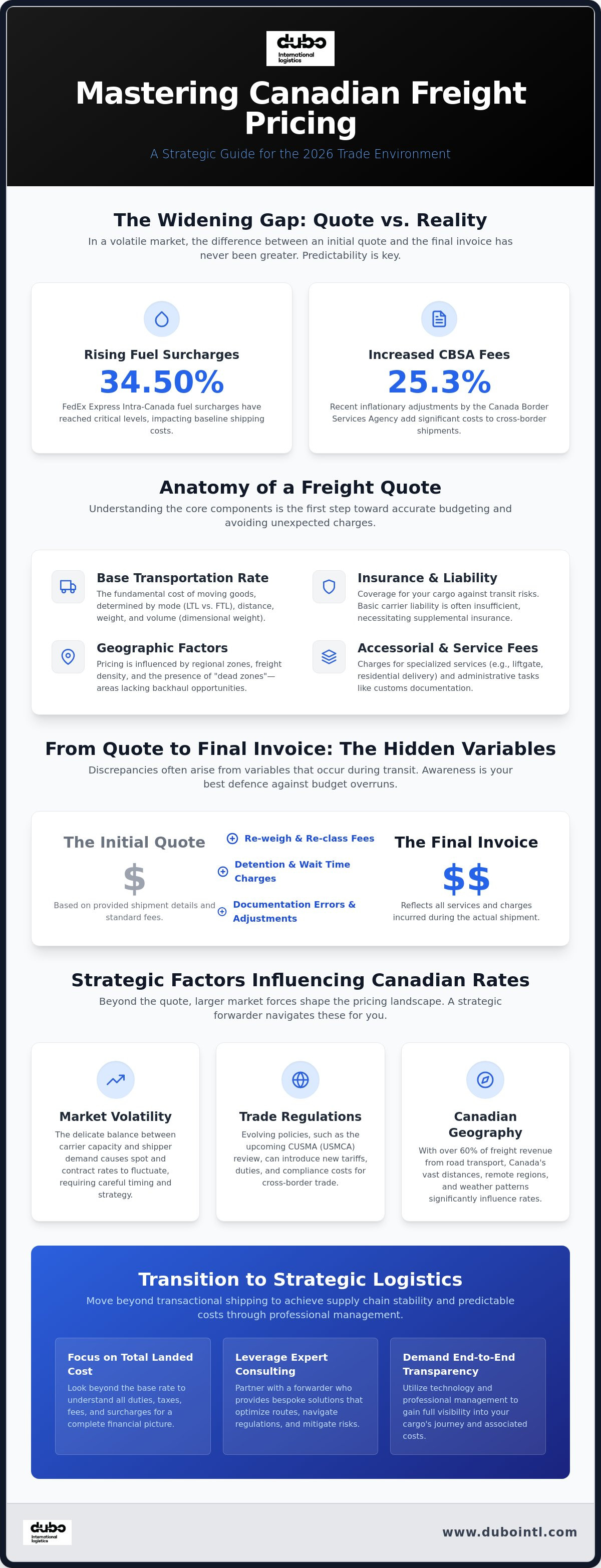
Why is it that a logistics quote often feels more like a suggestion than a commitment? In a market where fuel surcharges for FedEx Express Intra-Canada have reached 34.50 percent and CBSA fees have risen by 25.3 percent this year, the gap between expectations and reality has never been wider. You shouldn't have to guess the cost of moving your goods across the border. Mastering freight forwarding pricing Canada is no longer just about finding the lowest rate; it's about achieving the precision required for stable, predictable budgeting in a volatile 2026 trade environment.
At www.dubointl.com, we understand that confusion over accessorial fees and dimensional weight calculations can disrupt your entire supply chain strategy. This comprehensive reference guide provides the clarity you need to navigate these complexities with confidence. We'll examine the core components of Canadian freight costs, from fuel surcharges to the upcoming CUSMA review impacts, and provide a framework for evaluating forwarder value. By the end of this article, you'll have a strategic roadmap to optimize your logistics spend and ensure your shipping operations remain a stabilizing force for your business.
Key Takeaways
- Distinguish between base freight rates and total landed costs to ensure your logistics budgeting remains precise and predictable.
- Navigate the nuances of freight forwarding pricing Canada by mastering the calculation of fuel surcharges and specialized accessorial fees.
- Identify how seasonal capacity trends and evolving trade regulations like the USMCA review impact your cross-border shipping rates.
- Transition from transactional shipping to strategic supply chain optimization through bespoke logistics consulting and professional management.
- Learn more about achieving end-to-end transparency in your global trade movements by visiting www.dubointl.com.
Understanding Freight Forwarding Pricing in the Canadian Market
In the professional logistics environment, pricing represents the total compensation required for the meticulous coordination and movement of cargo across vast distances. It is a figure that encompasses far more than a simple line item for transportation. To effectively manage your bottom line, you must distinguish between a base freight rate and the total landed cost of goods, which includes duties, taxes, and terminal handling fees. At www.dubointl.com, we view pricing as the financial reflection of a secured supply chain. To understand the cost, one must first understand the function: What is a Freight Forwarder? in the context of a modern supply chain; they are the architects who integrate various modes of transport into a single, cohesive movement.
Canada’s unique geography necessitates a specialized approach to regional pricing zones. Unlike smaller, more densely populated nations, Canadian logistics must account for lower freight density in rural areas and the high operational costs associated with the northern territories. Because road freight accounts for over 60 percent of the revenue share in the Canadian market, these geographic nuances directly influence freight forwarding pricing Canada. A seasoned forwarder acts as a strategic architect, building routes that balance speed with cost-efficiency while accounting for the physical realities of the Canadian landscape.
The Difference Between a Quote and the Final Invoice
Discrepancies between an initial estimate and the final billing often stem from variables that arise during the physical movement of goods. Weight adjustments are a frequent culprit; if the actual weight or dimensions differ from the documentation, carriers will apply re-weigh fees. Wait times at loading docks or congested border crossings also generate detention charges that can inflate an invoice. Professional documentation is essential for mitigating these risks, particularly following the 25.3 percent increase in CBSA inflationary adjustments that took effect on April 1, 2026. Choosing "all-in" quotes provides a level of certainty, whereas itemized estimates offer transparency but require a deeper understanding of potential variables to avoid surprises.
Why Pricing Fluctuates in the 2026 Logistics Landscape
Global trade volatility continues to exert pressure on Canadian domestic shipping lanes. As carrier capacity shifts in response to international demand, the balance between spot market rates and long-term contract pricing becomes increasingly delicate. Shippers often find that spot rates provide temporary relief during periods of high capacity, yet they offer little protection when the market tightens. Market equilibrium represents the point where carrier capacity and shipper demand align to create price stability, a state that remains elusive in the current 2026 logistics cycle. By analyzing these shifts, businesses can better realize when to lock in rates and when to leverage the flexibility of the spot market.
Core Components of a Freight Forwarding Quote
A professional freight quote is a multifaceted document that reflects the meticulous requirements of your cargo's journey. At its foundation, transportation charges are dictated by the choice between Less-than-Truckload (LTL) and Full Truckload (FTL) services. LTL allows for cost-sharing among multiple shippers; on the other hand, FTL offers greater speed and dedicated security for larger volumes. Beyond simple transit, documentation and service fees account for the administrative labour required for professional freight management, where CIFFA membership serves as a recognized benchmark for pricing integrity. These figures are influenced by national Transportation and Supply Chain Indices, which track the shifting costs of equipment and personnel across the country.
Geography remains a primary driver of freight forwarding pricing Canada. Shippers often encounter higher rates when moving goods into "dead zones," which are regions where a lack of backhaul opportunities forces carriers to charge more to cover the cost of an empty return journey. This reality is particularly evident in northern communities or remote industrial sites. Additionally, insurance and liability coverage for high-value cargo are essential components that provide security against transit risks. While basic carrier liability exists, it's often insufficient for specialized project cargo, making supplemental insurance a prudent investment.
Weight and Volume: Dimensional Weight Explained
Carriers utilize a dimensional weight formula to ensure they're compensated for the physical space a shipment occupies, not just its mass. This calculation balances density and volume to prevent light, bulky items from consuming profitable trailer space at a loss. If you ship items like un-assembled furniture or large electronics, you'll likely pay based on volume rather than actual weight. Shippers can realize significant savings by optimizing their packaging to eliminate void space and reduce the overall footprint of their pallets.
Mode Selection and Its Financial Impact
Selecting the right mode is a financial decision as much as a tactical one. For long-haul routes across the Prairies, rail often provides superior cost-efficiency compared to road transport. However, when cargo exceeds standard dimensions or requires rapid delivery to a job site, specialized transportation services become necessary. You can find more detail on aligning your shipping methods with business goals in our guide to End-to-End Freight Management. If you're seeking to refine your current strategy, the team at Dubo International Logistics is available to provide the logistics consulting and strategic foresight your supply chain requires.
Beyond the Base Rate: Mandatory Surcharges and Fees
The base rate provides a useful starting point for budgeting, yet it rarely represents the final total on a professional invoice. To master freight forwarding pricing Canada, shippers must look beyond the initial quote to understand the mandatory surcharges that ensure cargo reaches its destination safely and legally. These fees aren't arbitrary additions; rather, they're essential recovery costs that carriers apply to manage external economic pressures and specialized handling requirements. At www.dubointl.com, we prioritize transparency by detailing these components early in the consulting process, ensuring you aren't surprised by the financial realities of 2026 trade.
Fuel Surcharges and 2026 Carbon Levies
Fuel surcharges (FSC) remain the most volatile component of any shipping quote. As of July 2026, major carriers like FedEx and Purolator have set fuel surcharges for intra-Canada services at 34.50 percent, while truckload (TL) surcharges for some providers have climbed as high as 75.8 percent. These figures are calculated based on weekly national averages and now integrate the compounding effects of carbon pricing and environmental regulations. Budgeting around these volatile energy costs requires a proactive approach, where logistics consulting helps you realize when to consolidate shipments to mitigate the impact of high-percentage surcharges.
Accessorial Charges for Specialized Cargo
Accessorial charges cover the specialized labour and equipment required for non-standard delivery scenarios. If your cargo requires a lift-gate for a residential delivery or "protect from freeze" services during the harsh Canadian winter, these specific costs will be added to the base rate. For businesses moving oversized project cargo, pricing often includes escort vehicles and specialized permits to ensure regulatory compliance. You can explore the complexities of these requirements in our Specialized Freight North America guide.
The cost of waiting also plays a significant role in final pricing. Demurrage and detention fees apply when cargo remains at a terminal or on a trailer beyond the allotted "free time," often due to documentation errors or facility congestion. When combined with the 25.3 percent increase in CBSA service fees implemented in April 2026, these administrative costs can quickly escalate. Strategic foresight and professional coordination are your best defences against these avoidable expenses, allowing you to maintain a predictable and efficient logistics budget.
Strategic Factors Influencing Cross-Border and Domestic Rates
The financial landscape of freight forwarding pricing Canada is shaped by a complex interplay of international trade agreements and domestic economic shifts. As we move through 2026, the formal review of the Canada-United States-Mexico Agreement (CUSMA) in July has introduced a fresh layer of strategic consideration for cross-border shippers. Currency exchange rates also play a pivotal role; because many international carrier contracts and fuel indices are denominated in USD, fluctuations in the Canadian dollar can alter your final quote without any change in physical service. Understanding these variables allows for a more sophisticated approach to logistics budgeting that anticipates rather than reacts to market shifts.
Seasonal capacity trends further complicate the pricing narrative. During the annual "Produce Season" and the year-end "Peak Season," available trailer space tightens as demand for temperature-controlled units and retail inventory surges. These periods often see significant price hikes on the spot market, which was already 46 percent higher in June 2026 compared to the previous year. For international movements, terminal handling charges at major ports and rail yards add another layer of cost that must be accounted for to maintain total landed cost accuracy. Professional oversight ensures these fees are audited and integrated into your broader financial plan.
Navigating Canada-USA Border Complexities
Documentation errors remain the primary driver of unexpected cross-border expenses. Incomplete paperwork leads to border delays, resulting in detention fees that can quickly erode your margins. Working with a partner who specializes in cross-border freight forwarding is essential for navigating the 25.3 percent increase in CBSA service fees that took effect this year. Utilizing pre-clearance programs and automated data exchange systems can indirectly reduce your transportation costs by ensuring a seamless transition through customs, effectively avoiding the wait-time surcharges that plague less-organized shipments. If you require a tailored analysis of your current cross-border spend, the experts at Dubo International Logistics can provide the strategic consulting necessary to streamline your operations.
Regional Infrastructure and Accessibility
Pricing variations between major Canadian hubs like Toronto, Montreal, or Vancouver and remote northern regions are stark. Shippers often encounter the "Beyond Point" surcharge, a premium applied to destinations situated outside the standard service areas of primary carriers. These costs reflect the lower freight density and higher operational risks associated with remote deliveries. The quality of regional infrastructure directly influences carrier equipment choices, as specialized trailers or heavy-duty suspension systems are often required for routes with challenging road conditions. By accounting for these geographic realities, you can ensure your logistics strategy remains grounded in the physical constraints of the Canadian landscape.
Optimizing Your Logistics Spend Through Professional Management
Achieving fiscal stability in the complex 2026 trade environment requires a fundamental shift from transactional shipping to strategic supply chain optimization. While many businesses focus solely on the immediate quote, the most successful organizations realize that freight forwarding pricing Canada is a variable that can be managed through precision and professional foresight. By moving beyond simple rate-shopping, you can transform your logistics department from a cost centre into a source of competitive advantage. This evolution begins with a commitment to long-term partnerships and a rejection of the "lowest price" fallacy, which often masks the hidden costs of delays and poor coordination.
Consolidated shipping remains one of the most effective strategies for regular importers and exporters seeking to lower their per-unit costs. By grouping smaller shipments into larger, more efficient loads, you can leverage volume discounts and reduce the frequency of mandatory base fees. This methodical approach to cargo movement requires a reliable partner who understands the nuances of the Canadian market and can coordinate multi-vendor pickups with surgical precision. Establishing a consistent relationship with a seasoned forwarder ensures that your cargo is prioritized during peak seasons, providing a level of security that spot-market transactions simply cannot match.
Leveraging Logistics Consulting for Efficiency
Professional management pays for itself by uncovering the systemic waste that standard shipping platforms often overlook. Through meticulous audits, a logistics consultant can identify redundant steps in your current cargo coordination process, such as inefficient routing or under-utilized container space. Our guide on logistics consulting in Canada details how these identified efficiencies provide a framework for long-term spend reduction. This shift from "lowest price" to "best value" ensures that every dollar spent contributes to a more resilient and reliable movement of goods, ultimately lowering your total landed cost.
Selecting a Partner for Long-Term Value
Choosing a logistics partner is a decision that impacts your business's reputation and financial health. In an industry where pricing can feel opaque, CIFFA membership serves as a critical indicator of a forwarder's commitment to professional standards and pricing integrity. A reliable partner provides more than just a truck or a container; they offer transparent reporting and proactive communication that allows you to predict your logistics spend with confidence. This level of stewardship ensures that your interests are protected even when global markets fluctuate. To realize a more efficient supply chain and master the complexities of the Canadian market, we invite you to visit www.dubointl.com and discover how our seasoned experts can architect a bespoke solution for your unique needs.
Securing Your Supply Chain for the Year Ahead
Mastering the complexities of freight forwarding pricing Canada is a continuous process that rewards precision and strategic foresight. You've seen how mandatory surcharges and evolving regulatory fees, such as the 2026 CBSA adjustments, can shift your bottom line if left unmanaged. By distinguishing between simple base rates and the total landed cost of goods, you can build a more resilient budgeting framework. Professional management isn't just about moving cargo; it's about architecting a supply chain that remains stable despite global volatility.
As a proud member of the Canadian International Freight Forwarders Association (CIFFA), we provide the pricing integrity and expertise required for even the most complex project cargo. Our team specializes in specialized transportation and strategic logistics consulting, ensuring your spend is optimized for long-term growth rather than short-term savings. We invite you to request a professional consultation for your freight forwarding pricing in Canada and realize the peace of mind that comes with expert stewardship. Your logistics operations can become a pillar of consistency in an ever-changing world.
Frequently Asked Questions
What is the most expensive part of freight forwarding in Canada?
Transportation costs, specifically the base line-haul rate and fluctuating fuel surcharges, represent the most significant portion of a typical quote. In a country as vast as Canada, the distance between major industrial hubs naturally increases fuel consumption and driver labour hours. These primary expenses are often compounded by specialized requirements for project cargo or oversized shipments that demand bespoke routing and escort services to ensure regulatory compliance.
How do I calculate dimensional weight for my Canadian shipment?
You calculate dimensional weight by multiplying the length, width, and height of your package and dividing the total by a carrier-specific divisor, which is typically 139 or 166. Canadian carriers use this "Dim Weight" to ensure they're compensated for the physical space a light but bulky item occupies in a trailer. If the resulting dimensional weight exceeds the actual physical weight, your freight forwarding pricing Canada will be based on that higher value.
Are fuel surcharges the same across all Canadian freight forwarders?
Fuel surcharges aren't uniform and fluctuate based on the specific carrier, the mode of transport, and the weekly national fuel price averages. While many providers follow similar indices, the percentage applied to LTL shipments often differs from that applied to full truckloads. Professional forwarders at www.dubointl.com audit these surcharges to ensure they align with current market benchmarks and reflect the actual economic conditions of the 2026 trade environment.
Can logistics consulting actually reduce my total freight spend?
Logistics consulting identifies systemic inefficiencies in your supply chain that standard transactional shipping often overlooks. By conducting a meticulous audit of your routing, packaging, and carrier selection, consultants can uncover redundant steps that inflate your overhead. This strategic oversight allows businesses to move from a "lowest price" model to a "best value" framework; this results in sustainable, long-term reductions in your total logistics spend.
What are accessorial fees and how can I avoid them?
Accessorial fees are charges for services that exceed standard dock-to-dock transportation, such as residential delivery, lift-gate requirements, or inside pickup. You can avoid many of these costs by providing precise shipment details and ensuring both the origin and destination are properly equipped for the cargo. Clear communication with your forwarder prevents the administrative discrepancies that lead to unexpected wait-time fees or re-delivery surcharges during the movement process.
How does the Canada-USA exchange rate affect my freight pricing?
The Canada-USA exchange rate directly influences your quote because many international carrier contracts and fuel indices are denominated in USD. When the Canadian dollar weakens, the cost of moving goods across the border or paying for international fuel surcharges increases proportionally. Understanding this relationship is essential for maintaining accurate landed cost projections and achieving predictable freight forwarding pricing Canada in an increasingly volatile global market.
Why do freight prices increase during the Canadian winter?
Prices often surge during the winter months due to increased operational risks and the requirement for specialized "protect from freeze" (PFF) services. Harsh weather conditions lead to slower transit times, higher fuel consumption for idling, and tighter equipment availability for heated trailers. These seasonal factors require proactive planning and strategic foresight to ensure that your cargo moves safely without incurring excessive emergency surcharges during the coldest months.
What is the difference between a spot rate and a contract rate?
A spot rate is a one-time price based on current market capacity, while a contract rate is a fixed price negotiated for a specific volume over a longer duration. Spot rates offer flexibility but are highly susceptible to market volatility and peak season hikes. Conversely, contract rates provide budget stability and guaranteed capacity; this makes them the preferred choice for businesses with consistent shipping patterns and high-volume requirements.

