

The lowest quoted rate can lead to higher freight spend when delays, accessorial charges or extra handling follow. Durable savings come from controlling shipment variability, not simply choosing the cheapest option. Effective freight cost reduction strategies start with understanding what each shipment requires and how it performs across its lane.
Freight spend can be difficult to compare across shipment types, especially when service requirements and extra charges differ. Cutting transport spend without considering cargo protection, delivery needs and compliance can create new operational risks. A measured approach helps teams distinguish avoidable spend from the requirements that protect continuity.
This guide explains how to identify common sources of avoidable freight spend, compare practical strategies against service and shipment requirements, and build a repeatable plan for measuring results. It covers shipment planning, consolidation, mode selection, packaging and carrier coordination, while showing why a low quote alone doesn’t tell the full story. Dubo International Logistics coordinates freight across Canada and North America, with logistics consulting and freight forwarding to help businesses assess their shipping patterns. Learn more at www.dubointl.com.
Key Takeaways
- Separate one-time billing corrections from recurring changes to shipment planning, handling and transportation.
- Review shipment records by lane and type to spot partial loads, inconsistent booking practices and avoidable handling.
- Compare freight cost reduction strategies by suitability, service trade-offs and how results can be measured.
- Set a baseline for shipment volume, service outcomes, invoice accuracy and recurring exceptions before testing changes.
- Use freight forwarding expertise to coordinate carrier choices and plan for cargo requirements that a lowest-rate-only decision may miss.
Freight cost reduction strategies start with understanding shipment spend
Reliable savings begin with a clear view of what shipments require and what they actually experience. Freight cost reduction strategies should improve shipment economics without weakening service requirements, cargo protection or operational continuity. Look beyond individual invoices to the planning, handling and transportation choices that shape repeat shipments.
Separate one-time billing corrections from recurring improvements. Correcting a duplicate charge or inaccurate invoice resolves a specific discrepancy, but doesn’t change how future freight moves. Recurring opportunities may come from shipment timing, packaging, handling instructions, mode selection or carrier coordination. The right approach depends on the lane, mode, cargo profile and delivery requirements. Freight transport can move by different modes, as outlined in Freight transport, but a mode is suitable only when it meets the shipment’s practical needs.
What belongs in a useful freight spend baseline?
A freight spend baseline is a grouped record of shipment activity, invoiced charges and service outcomes that helps teams identify patterns, prioritize changes and measure what happens after a change.
Group records by lane, mode, cargo type and service requirement. Review invoices alongside shipment documents, then flag recurring discrepancies and accessorial patterns for investigation. Compare the planned service with actual delivery and handling outcomes. For example, a shipment requiring repeated extra handling may need clearer instructions or a different plan, while an isolated invoice discrepancy calls for a billing review.
Use consistent categories and record exceptions with their causes. If teams group unlike shipments together, a change in cargo mix or delivery requirements can make comparisons misleading. A useful baseline should show which shipments are comparable and why exceptions occurred, not just provide a headline total.
Why the lowest quoted freight rate can mislead
A quote reflects only the information and requirements included in it. Compare the complete shipment need, including handling, cargo protection, delivery timing and service commitments, rather than judging options by the initial transportation rate alone. A low quote may not account for delays, damage exposure, extra handling or disruption to a production schedule or customer commitment.
Fragile equipment or oversized machinery, for example, may require tailored planning and handling. Choosing an option on rate alone could overlook requirements that affect cargo protection or continuity. Measure the full outcome against the baseline, including service and recurring exceptions. No single strategy guarantees savings or delivery performance; disciplined comparison helps teams make informed trade-offs. Dubo International Logistics supports businesses with freight forwarding and logistics consulting across Canada and North America. Learn more at www.dubointl.com.
How to reduce freight costs through planning and shipment coordination
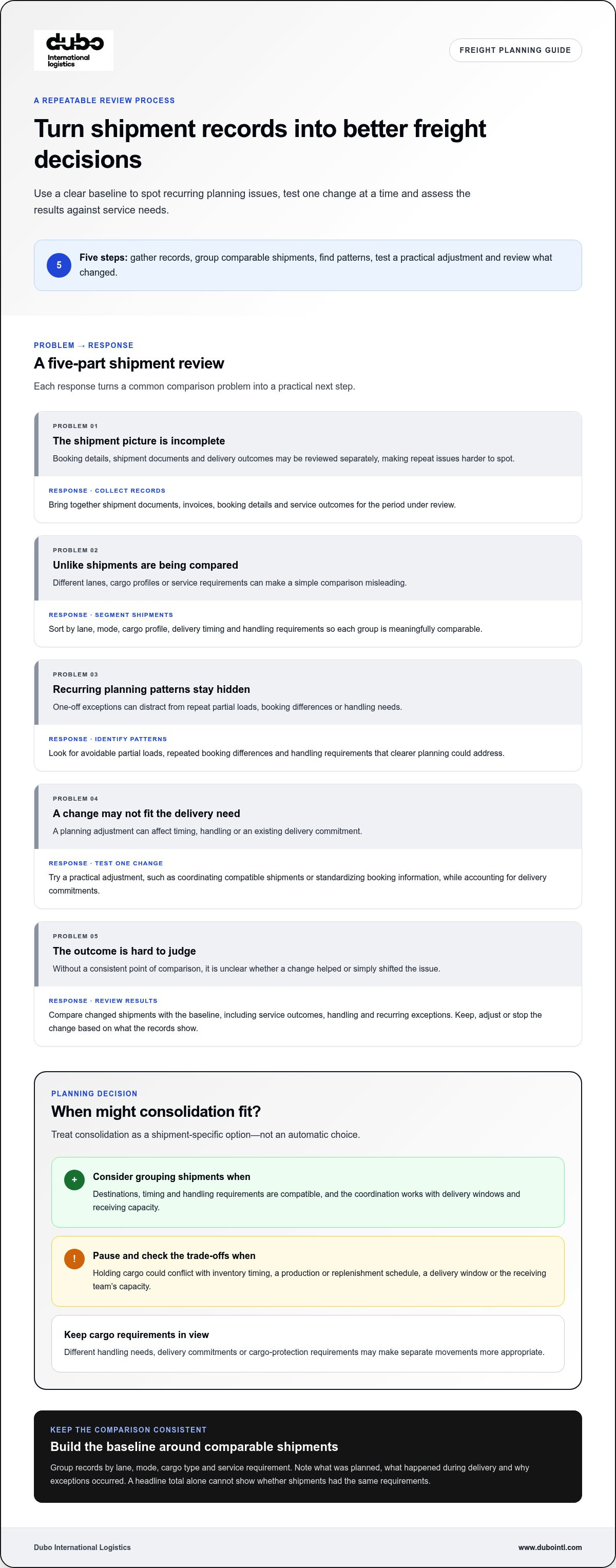
Turn shipment records into a repeatable review, then test one operational change at a time. This helps distinguish a recurring planning issue from an isolated exception and makes it easier to assess whether a change supports efficiency and service needs. For a broader view of how shipment activities connect, see this guide to end-to-end freight management.
- Collect records. Bring together shipment documents, invoices, booking details and service outcomes for the period under review.
- Segment shipments. Sort by lane, mode, cargo profile, delivery timing and handling requirements so unlike shipments aren’t compared as if they were identical.
- Identify patterns. Look for avoidable partial loads, repeated booking differences and handling requirements that clearer planning could address.
- Test a change. Select a practical adjustment, such as coordinating compatible shipments or standardizing booking information, while accounting for delivery commitments.
- Review results. Compare the changed shipments with the baseline, including service outcomes, handling and recurring exceptions. Keep, adjust or stop the change based on what the records show.
When consolidation and shipment scheduling may help
Consolidation may suit shipments with compatible destinations, timing and handling requirements. Combining shipments can reduce fragmented movement, but it also changes when cargo is ready to depart and when it reaches its destination. Compare the coordination benefit with inventory timing, delivery windows and the receiving team’s capacity. For businesses using Just-in-Time systems, holding a shipment to combine it with another may conflict with production or replenishment schedules.
Check cargo compatibility before grouping loads. Different handling needs, delivery commitments or cargo-protection requirements may make separate movements more appropriate. A sound plan weighs the full shipment requirement rather than treating consolidation as an automatic choice.
How documentation and invoice review prevent repeat issues
Reconcile shipment details and invoiced charges against the agreed service requirements and shipment documents. When a discrepancy appears, record its cause and track whether similar issues recur by lane, carrier or shipment profile. This turns invoice review into a planning tool: repeated exceptions may point to unclear booking details, mismatched service expectations or handling needs that should be addressed earlier. For related freight factors, see freight forwarding pricing factors.
Dubo coordinates freight forwarding and logistics consulting to help businesses examine shipment patterns. For information about expedited freight coordination, visit Dubo’s expedited freight services or learn more at www.dubointl.com.
Compare freight cost reduction strategies without trading away reliability
Compare each option against the shipment it is meant to improve. Shipment size, urgency, handling needs and delivery constraints determine whether a strategy is practical. LTL freight shipping can suit shipments that fit shared capacity and compatible handling, while dedicated capacity may better match freight with specific timing, protection or equipment requirements. Neither is universally preferable.
A lower freight rate is no saving if it creates avoidable disruption to delivery, cargo condition or operations. Use the comparison below to identify trade-offs and decide what to measure before changing a shipping plan.
| Strategy | Suitable conditions | Potential benefit | Operational trade-off | How to measure |
|---|---|---|---|---|
| Consolidation | Shipments share compatible destinations, timing and handling. | Fewer separate movements may improve shipment utilization. | Waiting to combine freight can conflict with delivery windows or inventory needs. | Compare shipment count, schedule adherence and handling exceptions. |
| Mode selection | Transit time, cargo profile and route support more than one suitable mode. | A mode aligned with the shipment may improve overall transport efficiency. | Transit, transfers and handling can vary by mode; no mode is best for every shipment. | Review transit outcomes, transfer points and cargo condition. |
| Routing | Alternative routes can meet service and cargo requirements. | A better-aligned route may reduce unnecessary movement or handling. | Route changes can affect transit time, handoffs and predictability. | Track actual transit, exceptions and delivery-window performance. |
| Packaging review | Packaging can be adjusted without compromising cargo protection. | Better-fit packaging may reduce avoidable space or handling demands. | Changes must preserve protection, especially for fragile or specialized cargo. | Compare shipment dimensions, damage reports and handling exceptions. |
| Invoice auditing | Shipment documents and agreed service details are available for comparison. | Review can identify discrepancies and recurring billing patterns. | Audit findings address recorded charges, but won’t correct planning issues on their own. | Track discrepancy types and recurrence by lane and shipment profile. |
Match the strategy to shipment requirements
Apply freight cost reduction strategies to a defined shipment profile, not as a blanket rule. Oversized machinery, fragile equipment or temperature-sensitive products may call for specialized transportation and tailored handling. Compare options using the same service requirements, including delivery timing and cargo protection, so an apparent rate advantage doesn’t obscure a material difference in what’s being provided.
Assess carrier and service trade-offs
A carrier vetting process should consider safety, insurance, compliance and capabilities alongside rate and transit requirements. Where applicable, service level agreements (SLAs) can clarify performance expectations, delivery windows or equipment availability. Measure results against those expectations and cargo suitability, not just the quote. Dubo coordinates freight and specialized transportation across Canada and North America. Explore expedited freight coordination or visit www.dubointl.com.
Create a freight cost reduction plan your team can measure
A plan works when the team can see what changed, what stayed reliable and whether the result holds across comparable shipments. Start with a baseline that records shipment counts, service outcomes, invoice accuracy and recurring exceptions. Then rank potential changes by feasibility, cargo risk, customer commitments and expected operational impact. A change that looks simple on paper may need more planning if it affects sensitive cargo or a firm delivery window.
Choose measures that reveal total shipment performance
Track a balanced set of measures: on-time performance, damage or exception trends, invoice accuracy and shipment variability. Compare like-for-like lanes and cargo profiles so changes in shipment mix don’t distort the results. Keep measures tied to customer commitments and internal service requirements, not just transport activity. For example, assess an option that changes delivery timing against the relevant delivery window as well as its effect on handling and exceptions.
Use a controlled pilot. Select one suitable lane or shipment profile, document the current process, make one defined change and review the same measures afterward. Record exceptions and operational feedback alongside the results. If service outcomes weaken or new issues appear, revise the approach before extending it to other shipments.
Coordinate changes across teams and carriers
Assign clear ownership for booking, documentation, approvals and exception follow-up. Share updated handling and timing requirements with the relevant shipping partners before the revised process begins. Without clear responsibilities, teams may follow different instructions, making results difficult to interpret and repeat.
Review the pilot with the people who manage shipments and receive them. Confirm that the documented process matches how freight moved in practice, then decide whether to continue, adjust or stop the change. Revisit the plan when shipment patterns, cargo requirements or customer commitments shift. Broader planning considerations are covered in this guide to supply chain optimization consulting.
Freight cost reduction strategies are more dependable when measurement and coordination work together. Dubo’s logistics consulting helps businesses review shipment patterns and coordinate freight planning. Discuss freight planning with Dubo or visit www.dubointl.com.
Use freight forwarding expertise to sustain cost improvements
A cost review only becomes useful when its findings inform shipment planning and execution. Freight forwarding connects planning, carrier coordination and shipment documentation, helping teams align requirements across a movement instead of treating each booking as a separate decision. For shipments involving multiple carriers, cross-border movement or complex cargo, coordinated planning can clarify responsibilities, handling instructions and timing expectations.
This coordination matters when cargo requirements affect the choice of transport. Oversized machinery, fragile equipment and temperature-sensitive products may need tailored planning, so the lowest quoted rate alone may not reflect the shipment’s service and protection needs. For time-sensitive shipments, Dubo Expedited transport can be considered as part of a plan shaped around the required timing and cargo profile.
For additional service context, read about freight forwarding in North America. The goal is not to assume coordination will produce a particular result, but to give the team a clearer view of how shipment requirements, carrier arrangements and documentation fit together.
When external freight coordination can support the plan
Coordination can be especially useful when a shipment involves more than one carrier, a cross-border journey or cargo with specific handling requirements. A logistics partner can organize the movement around the shipment profile and clarify responsibilities and requirements for the parties involved. This gives the business a structured basis for assessing options while keeping operational needs in view.
Turn a cost review into a practical next step
Before discussing options, identify the lanes under review, recurring exceptions and service constraints that cannot be compromised. Include relevant shipment profiles and handling requirements so recommendations reflect the operation rather than a generic target. Dubo International Logistics provides freight forwarding, logistics consulting and specialized transportation, coordinating freight across Canada and North America.
For a focused discussion, bring your shipment patterns and improvement priorities to Dubo. Explore Dubo’s freight coordination, or visit www.dubointl.com to discuss freight planning.
Make your next freight review a measured step forward
Freight cost reduction strategies work best when they address recurring shipment patterns, not just isolated invoice errors. A clear baseline helps your team compare like-for-like shipments, identify where planning or coordination may improve, and track service outcomes alongside freight spend.
Choose changes that fit the cargo, delivery commitments and handling requirements. Test adjustments on suitable shipments, review the results consistently and refine the plan as business needs change. The aim is not simply to select a lower rate, but to improve shipping efficiency while protecting reliability and continuity.
Dubo is a member of the Canadian International Freight Forwarders Association (CIFFA) and provides freight forwarding, logistics consulting and specialized transportation across North America. As a logistics partner, Dubo can help your team assess shipment patterns and define practical improvement priorities without treating every shipment the same.
Start with the lanes, recurring exceptions and service requirements you want to review. Discuss your freight planning priorities with Dubo at www.dubointl.com. A structured review can help your team make informed decisions and move forward with greater confidence.
Frequently Asked Questions
How can a business reduce freight costs without affecting delivery reliability?
Start by comparing similar shipments and identifying recurring inefficiencies before changing the shipping plan. Review delivery performance, handling exceptions and invoice accuracy alongside shipment spend. Then pilot one practical change on a suitable lane and monitor whether service remains aligned with customer commitments. If the change introduces delays, added handling or other issues, adjust the plan before applying it more broadly.
What are the most effective freight cost reduction strategies?
The most effective freight cost reduction strategies depend on the shipment profile and service requirements. Businesses can review consolidation opportunities, transportation modes, routing, packaging and invoice accuracy. For example, consolidation may suit compatible shipments, while a packaging review may help address avoidable handling or space requirements. Compare each option against cargo protection, delivery timing and operational impact, then measure results using consistent shipment and service records.
Can shipment consolidation reduce freight costs?
Shipment consolidation can improve the use of transport capacity when shipments have compatible destinations, timing and handling needs. It may not suit freight with different delivery windows or cargo requirements. Businesses using Just-in-Time systems should also consider whether waiting to combine shipments could affect production or replenishment schedules. Compare the planned movement with actual delivery timing and service outcomes before making consolidation a regular practice.
How does freight invoice auditing help control shipping spend?
Invoice auditing helps identify discrepancies by comparing billed charges with shipment documents and agreed service requirements. Review repeated charge differences or charges that don’t align with the shipment record, then track patterns by lane, carrier and shipment profile. An audit can help correct individual billing issues, but recurring operational problems may need separate changes to booking practices, documentation or shipment planning.
Is the lowest freight rate always the most cost-effective option?
No. A quote may not reflect every handling requirement, cargo-protection need or service commitment. Assess the full shipment requirement, including delivery timing, potential transfers, damage exposure and the effect of disruption on operations. For example, fragile equipment may need handling suited to its cargo profile. Compare options against the same requirements and review service outcomes, rather than judging suitability by the quoted transportation rate alone.
How should a company measure freight cost reduction?
Set a baseline using shipment counts, invoice accuracy, delivery outcomes and recurring exceptions. Compare like-for-like lanes and cargo profiles to avoid confusing a change in shipment mix with a process improvement. Track on-time performance, damage or exception trends and shipment variability alongside spend. Pilot one change, review the same measures afterward and revise the approach if service or cargo requirements aren’t being met.
When should a business work with a freight forwarder to reduce costs?
A freight forwarder can help coordinate planning when shipments involve multiple carriers, cross-border movement or complex cargo requirements. Freight forwarding connects shipment planning, carrier coordination and documentation, supporting a clearer view of responsibilities and service needs. Dubo International Logistics is a member of the Canadian International Freight Forwarders Association (CIFFA) and coordinates freight across North America. Learn more at www.dubointl.com.
